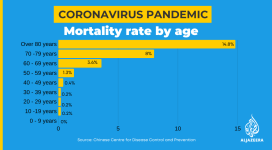
It remains to be seen whether hiding away the most at risk and allow the UK's supposedly fitter/healthier members of the herd to take it on the muzzle will turn out well, but given the lack of alternatives and likelihood that approx 75% of the population are going to catch it at some stage regardless, I can see the logic behind the science.

Try to picture this: when there are no isolation measures every corona patient infects 2 tot 3 other persons (depending on family structures, greeting habits and large gatherings like for instance soccer games):
1 - 3 - 9 - 27 - 81 - 243 - 729 - 2187 - 6561 - 19683 - etc
When people stay inside and this spread can be reduced to half say 1.5 the same array looks like.
1 - 1.5 - 2,25 - 3,375 - 5,0625 - 7,59375 - 11 - 17 - 26 - 38 - etc
That is a whole lot of people less. This lower number will not flood the intensive care bed capacity (like has happened in China and Italy).
When 50% of the people have had the corona virus, 50 percent of the people are immune, so the restrictions can be loosened, because a corona patient can no longer infect 3 persons anymore, because half of them are immune.
The logic of the strongest people biting the bullet is economy. The restrictive measures just have to much impact. With restrictions in place it could take a year before 50 percent of the population has become immune (because they survived corona).
Expect restrictive measures to become more granular in the future e.g. only people below 40 are allowed to move freely or gather in groups larger than 100 people. This gives them the opportunity to become infected without draining IC capacity because a lower percentage of them will have serious effects of corona (maybe only 10 percent get pneumonia like problems and only 1 percent of them will need IC).