
New Update GNOME 50 released, this is what’s new

lokamoka820

Level 43
Thread author
Verified
Top Poster
Well-known
Mar 1, 2024
3,243
3
10,655
4,169
Banana Republic
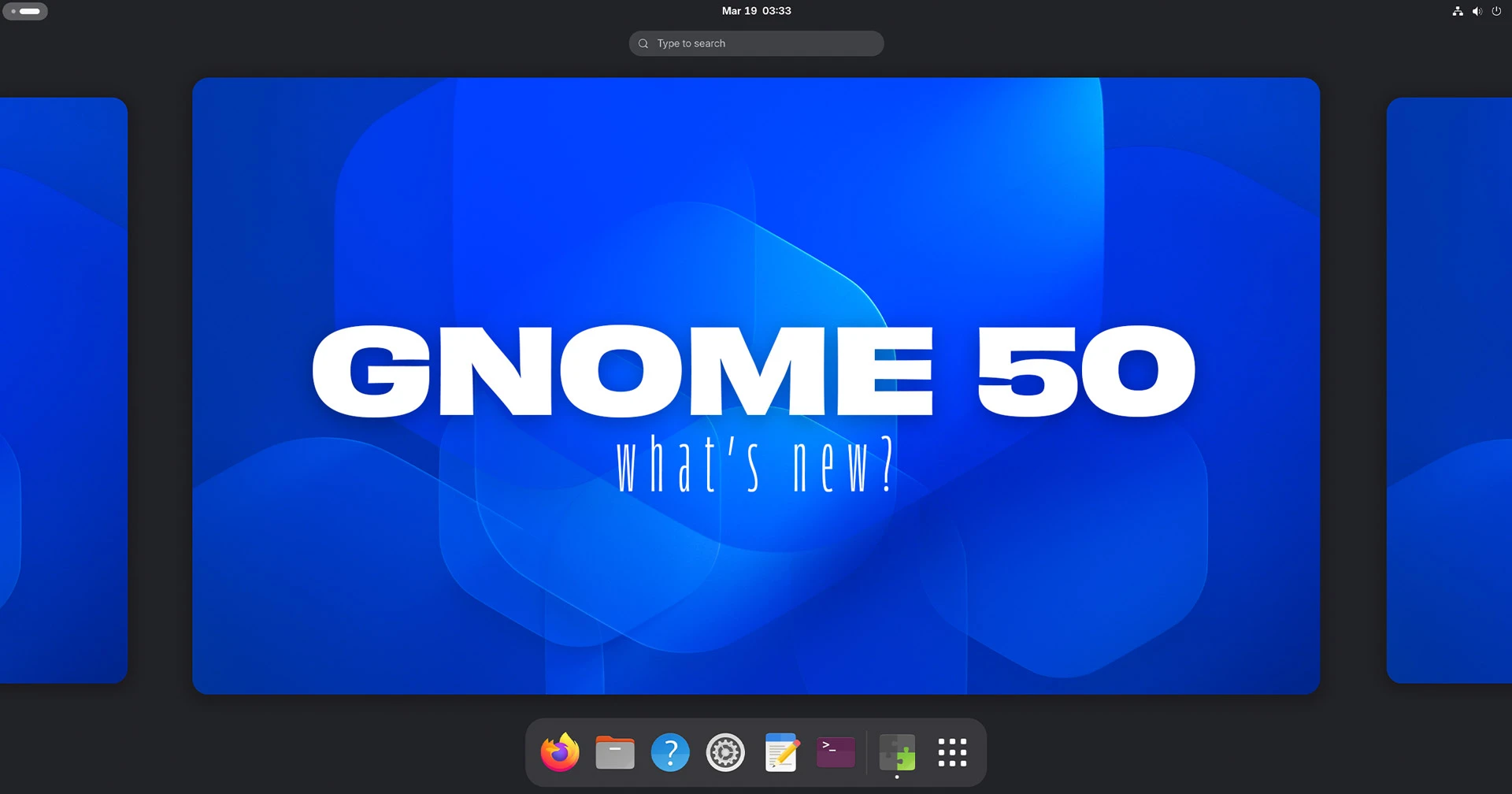
GNOME 50 is out, bringing a new set of features to the open-source desktop environment that Ubuntu uses.

The latest release, codenamed “Tokyo”, enables Variable Refresh Rate and fractional scaling by default, expands parental controls, and plumbs in support for hardware accelerated remote desktop sessions.

GNOME’s core apps also pick up improvements, with new ink and text tools in Document Viewer, faster thumbnail generation in Files, and the ability to see event attendees for public events in Calendar.
A glance:
  • VRR and fractional scaling on by default
  • Power Profile indicator
  • PDF form filling in Document Viewer
  • File manager tweaks
  • Parental controls
  • New reduced motion setting
  • Remote Desktop GPU acceleration
  • Other changes:
    • Sound > Volume Levels separates apps based on input and output
    • Date and Time provides a first-day-of-week setting
    • Wi-Fi shows a status page if there are no saved Wi-Fi networks
    • Apps asks for confirmation when removing file/link association
 
A glance:
  • VRR and fractional scaling on by default
  • Power Profile indicator
  • PDF form filling in Document Viewer
  • File manager tweaks
  • Parental controls
  • New reduced motion setting
  • Remote Desktop GPU acceleration
  • Other changes:
    • Sound > Volume Levels separates apps based on input and output
    • Date and Time provides a first-day-of-week setting
    • Wi-Fi shows a status page if there are no saved Wi-Fi networks
    • Apps asks for confirmation when removing file/link association
GNOME 50 looks like a solid quality-of-life release rather than a dramatic redesign.

The most notable change for many Linux desktop users is probably that VRR and fractional scaling are enabled by default. That should improve the out-of-box experience on compatible hardware, especially for:
  • high-refresh-rate displays
  • mixed-DPI multi-monitor setups
  • laptops with HiDPI panels

That said, default enablement does not guarantee perfect behavior on every system. In practice, results can still depend on:
  • the GPU vendor and driver stack
  • whether the session is Wayland-based
  • the monitor’s own VRR support
  • distribution-specific patches and packaging

A few changes stand out as especially useful:
  • Power Profile indicator should make performance mode changes more visible and easier to understand
  • Document Viewer improvements, especially PDF form filling, are practical additions many users will notice immediately
  • Remote Desktop GPU acceleration could be important for enterprise, support, and virtual workstation use cases if implemented well by the distro and graphics stack
  • Reduced motion is a good accessibility improvement, not just a cosmetic one
  • Parental controls expansion is relevant for shared-family systems and schools

About Ubuntu specifically

Since Ubuntu ships GNOME with some integration and customization, the exact experience may vary depending on:
  • which Ubuntu release picks up GNOME 50
  • whether Canonical backports any features
  • the graphics drivers in use
  • X11 vs Wayland session behavior

So while the feature list is promising, it is best to wait for the final Ubuntu packaging and user reports before assuming every feature will behave identically across distributions.

Bottom line

From the feature summary, GNOME 50 appears to be a meaningful refinement release with useful desktop, accessibility, and remote-work improvements. The default activation of VRR and fractional scaling is probably the headline change, but the smaller usability updates may matter more day to day.