

The MalwareTips app
Your community, one tap away.
Open MalwareTips from your Home Screen or desktop. Follow discussions, find answers and pick up where you left off.
- Home Screen access
- Optional push alerts
- Your community
You're ready to explore.Explore what's new
Installation instructions
iPhone & iPad
- Open MalwareTips in Safari and tap Share. You may need to open the Page Menu first.
- Choose Add to Home Screen. If it is not listed, use Edit Actions to add it.
- Keep Open as Web App enabled if shown, then tap Add.
Android
- Open MalwareTips in Chrome or another browser that supports app installation.
- Open the browser menu and look for Install app, Install and create shortcut, or Add to Home screen.
- Choose Install and confirm. Wording varies by browser.
Desktop
- Chrome: use the install icon in the address bar, or the menu under Cast, save and share.
- Edge: open the menu, then More tools, Apps and Install this site as an app.
- Safari on Mac: choose Share or File, then Add to Dock. Firefox on Windows: look for the web apps button in the address bar.
If you cannot find an install option, update your browser or use its bookmark option to keep MalwareTips close.
Keep up with your conversations
After installation, open the app and sign in. Enable push notifications in Preferences if you want alerts. On iPhone and iPad, push requires a Home Screen web app and iOS or iPadOS 16.4 or later.
Sign in to manage notificationsInstallation is optional. Your notification settings stay under your control.
You are using an out of date browser. It may not display this or other websites correctly.
You should upgrade or use an alternative browser.
You should upgrade or use an alternative browser.
Serious Discussion Google Chrome Stable Channel Updates
-
 Thread starter
Gandalf_The_Grey
Thread starter
Gandalf_The_Grey
- Start date
- 505 Replies
- 147,939 Views

Google has released a critical security update for the Chrome Stable channel, addressing two high-severity vulnerabilities that expose users to potential arbitrary code execution (ACE) and denial-of-service (DoS) attacks.
The update pushes the browser version to 144.0.7559.132/.133 for Windows and macOS, and 144.0.7559.132 for Linux.

Chrome Vulnerabilities Let Attackers Execute Arbitrary Code and Crash System
Google has released a critical security update for the Chrome Stable channel, addressing two high-severity vulnerabilities that expose users to potential arbitrary code execution (ACE) and denial-of-service (DoS) attacks.cybersecuritynews.com

Gandalf_The_Grey
Level 86
Verified
Honorary Member
Top Poster
Content Creator
Well-known
Forum Veteran
Google Chrome 144.0.7559.132/.133 Stable Channel Update for Desktop

 chromereleases.googleblog.com
The Stable channel has been updated to 144.0.7559.132/.133 for Windows/Mac and 144.0.7559.132 for Linux, which will roll out over the coming days/weeks.
This update includes 2 security fixes. Below, we highlight fixes that were contributed by external researchers.
[N/A][478942410] High CVE-2026-1861: Heap buffer overflow in libvpx. Reported by Google on 2026-01-26
[TBD][479726070] High CVE-2026-1862: Type Confusion in V8. Reported by Chaoyuan Peng (@ret2happy) on 2026-01-29
Stable Channel Update for Desktop
The Stable channel has been updated to 144.0.7559.132/.133 for Windows/Mac and 144.0.7559.132 for Linux, which will roll out over the comi...

Google Chrome 145.0.7632.45/46 Stable Channel Update for Desktop
chromereleases.googleblog.com
The Chrome team is delighted to announce the promotion of Chrome 145 to the stable channel for Windows, Mac and Linux. This will roll out over the coming days/weeks.
Chrome 145.0.7632.45 (Linux) 145.0.7632.45/46 Windows/Mac contains a number of fixes and improvements -- a list of changes is available in the log. Watch out for upcoming Chrome and Chromium blog posts about new features and big efforts delivered in 145.
Stable Channel Update for Desktop
The Chrome team is delighted to announce the promotion of Chrome 145 to the stable channel for Windows, Mac and Linux. This will roll out ov...
Gandalf_The_Grey
Level 86
Verified
Honorary Member
Top Poster
Content Creator
Well-known
Forum Veteran
Google Chrome 145.0.7632.75/76 Stable Channel Update for Desktop
chromereleases.googleblog.com
The Stable channel has been updated to 145.0.7632.75/76 for Windows/Mac and 144.0.7559.75 for Linux, which will roll out over the coming days/weeks.
This update includes 1 security fix.
[TBD][483569511] High CVE-2026-2441: Use after free in CSS. Reported by Shaheen Fazim on 2026-02-11
Google is aware that an exploit for CVE-2026-2441 exists in the wild.
Stable Channel Update for Desktop
The Stable channel has been updated to 145.0.7632.75/76 for Windows/Mac and 145.0.7632.75 for Linux, which will roll out over the coming d...
Google Chrome 145.0.7632.75/76 Stable Channel Update for Desktop
Stable Channel Update for Desktop
The Stable channel has been updated to 145.0.7632.75/76 for Windows/Mac and 145.0.7632.75 for Linux, which will roll out over the coming d...
The high-severity vulnerability, tracked as CVE-2026-2441 (CVSS score: 8.8), has been described as a use-after-free bug in CSS. Security researcher Shaheen Fazim has been credited with discovering and reporting the shortcoming on February 11, 2026.
"Use after free in CSS in Google Chrome prior to 145.0.7632.75 allowed a remote attacker to execute arbitrary code inside a sandbox via a crafted HTML page," according to a description of the flaw in the NIST's National Vulnerability Database (NVD).

New Chrome Zero-Day (CVE-2026-2441) Under Active Attack — Patch Released
Google fixes actively exploited Chrome zero-day CVE-2026-2441, a high-severity CSS use-after-free flaw enabling sandboxed remote code execution.thehackernews.com

Google has released emergency updates to fix a high-severity Chrome vulnerability exploited in zero-day attacks, marking the first such security flaw patched since the start of the year.
"Google is aware that an exploit for CVE-2026-2441 exists in the wild," Google said in a security advisory issued on Friday.
According to the Chromium commit history, this use-after-free vulnerability (reported by security researcher Shaheen Fazim) is due to an iterator invalidation bug in CSSFontFeatureValuesMap, Chrome's implementation of CSS font feature values. Successful exploitation can allow attackers to trigger browser crashes, rendering issues, data corruption, or other undefined behavior.
The commit message also notes that the CVE-2026-2441 patch addresses "the immediate problem" but indicates there's "remaining work" tracked in bug 483936078, suggesting this might be a temporary fix or that related issues still need to be addressed.
The patch was tagged as "cherry-picked" (or backported) across multiple commits, indicating that it was important enough to include in a stable release rather than waiting for the next major version (likely because the vulnerability is being exploited in the wild).
Although Google found evidence of attackers exploiting this zero-day flaw in the wild, it did not share additional details regarding these incidents.
"Access to bug details and links may be kept restricted until a majority of users are updated with a fix. We will also retain restrictions if the bug exists in a third party library that other projects similarly depend on, but haven't yet fixed," it noted.
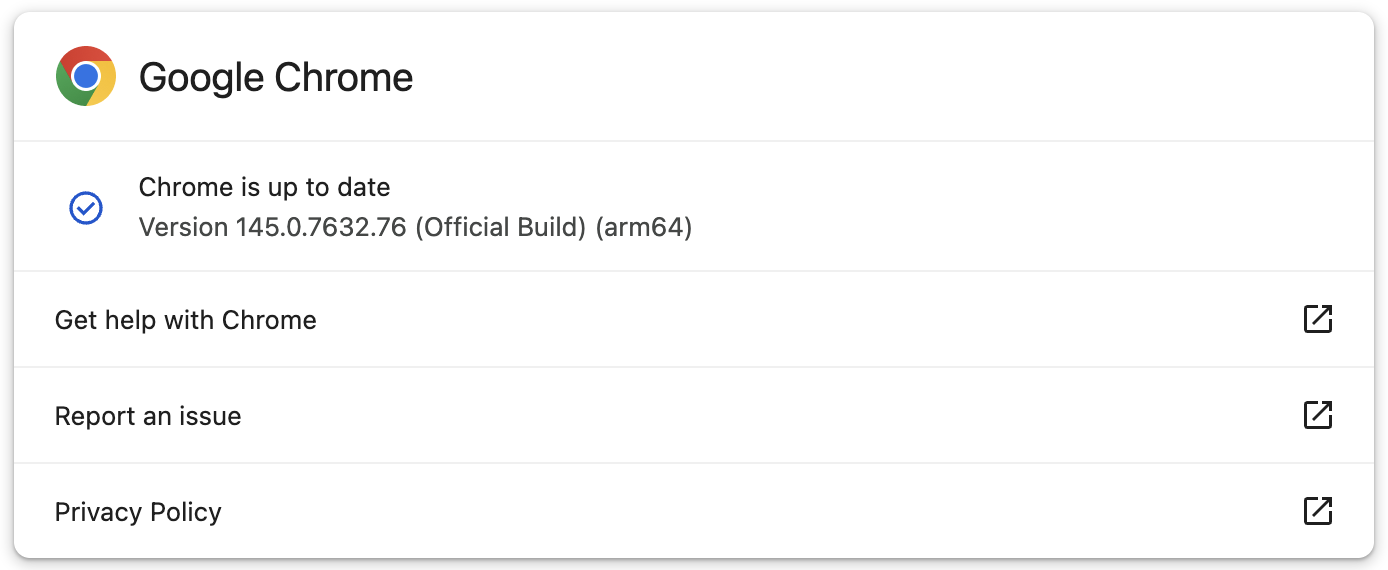
Google has now fixed this vulnerability for users in the Stable Desktop channel, with new versions rolling
out to Windows, macOS (145.0.7632.75/76), and Linux users (144.0.7559.75) worldwide over the coming days or weeks.
If you don't want to update manually, you can also let Chrome check for updates automatically and install them after the next launch.
While this is the first actively exploited Chrome security vulnerability patched since the start of 2026, last year Google addressed a total of eight zero-days abused in the wild, many of them reported by the company's Threat Analysis Group (TAG), widely known for tracking and identifying zero-days exploited in spyware attacks targeting high-risk individuals.
I noticed that Chromium browsers are receiving updates every few days this week.

Yes, Patch My PC seems to have been busier than normal, with Chrome updates.I noticed that Chromium browsers are receiving updates every few days this week.
Another Chrome "pulse" update 145.0.7632.110
Gandalf_The_Grey
Level 86
Verified
Honorary Member
Top Poster
Content Creator
Well-known
Forum Veteran
Google Chrome 145.0.7632.109/110 Stable Channel Update for DesktopAnother Chrome "pulse" update 145.0.7632.110
The Stable channel has been updated to 145.0.7632.109/110 for Windows/Mac and 144.0.7559.109 for Linux, which will roll out over the coming days/weeks.
This update includes 3 security fixes.
[TBD][477033835] High CVE-2026-2648: Heap buffer overflow in PDFium. Reported by soiax on 2026-01-19
[TBD][481074858] High CVE-2026-2649: Integer overflow in V8. Reported by JunYoung Park(@candymate) of KAIST Hacking Lab on 2026-02-03
[N/A][476461867] Medium CVE-2026-2650: Heap buffer overflow in Media. Reported by Google on 2026-01-18
Stable Channel Update for Desktop
The Stable channel has been updated to 145.0.7632.109/110 for Windows/Mac and 144.0.7559.109 for Linux, which will roll out over the comin...
Gandalf_The_Grey
Level 86
Verified
Honorary Member
Top Poster
Content Creator
Well-known
Forum Veteran
Google Chrome 145.0.7632.116/117 Stable Channel Update for Desktop
chromereleases.googleblog.com
The Stable channel has been updated to 145.0.7632.116/117 for Windows/Mac and 144.0.7559.116 for Linux, which will roll out over the coming days/weeks.
This update includes 3 security fixes.
TBD][482862710] High CVE-2026-3061: Out of bounds read in Media. Reported by Luke Francis on 2026-02-09
[TBD][483751167] High CVE-2026-3062: Out of bounds read and write in Tint. Reported by cinzinga on 2026-02-11
[TBD][485287859] High CVE-2026-3063: Inappropriate implementation in DevTools. Reported by M. Fauzan Wijaya (Gh05t666nero) on 2026-02-17
Stable Channel Update for Desktop
The Stable channel has been updated to 145.0.7632.116/117 for Windows/Mac and 144.0.7559.116 for Linux, which will roll out over the com...
Gandalf_The_Grey
Level 86
Verified
Honorary Member
Top Poster
Content Creator
Well-known
Forum Veteran
Google Chrome 145.0.7632.159/160 Stable Channel Update for Desktop
chromereleases.googleblog.com
The Stable channel has been updated to 145.0.7632.159/160 for Windows/Mac and 145.0.7632.159 for Linux, which will roll out over the coming days/weeks.
A full list of changes in this build is available in the Log
Stable Channel Update for Desktop
The Stable channel has been updated to 145.0.7632.159/160 for Windows/Mac and 145.0.7632.159 for Linux, which will roll out over the com...
Google has released a critical security update for Chrome, pushing the Stable channel to version 145.0.7632.159/160 for Windows and Mac, and 145.0.7632.159 for Linux. The update addresses 10 security vulnerabilities, including three rated Critical.
Three of the ten patched flaws carry a Critical severity rating. The most notable is CVE-2026-3536, an integer overflow in Chrome’s ANGLE graphics layer, reported by researcher cinzinga on February 18, 2026, which earned a $33,000 bounty.
A second critical flaw, CVE-2026-3537, involves an object lifecycle issue in PowerVR, reported by Zhihua Yao of KunLun Lab on January 8, earning $32,000. The third critical bug, CVE-2026-3538, is an integer overflow in the Skia graphics engine, reported by Symeon Paraschoudis on February 17.
The remaining seven vulnerabilities are rated High severity and span a range of Chrome subsystems, from V8 and WebAssembly to CSS and Navigation.
The breadth of affected components, spanning graphics rendering (ANGLE, Skia, PowerVR), JavaScript execution (V8), multimedia (WebAudio, WebCodecs), and web standards (CSS, WebAssembly), reflects the wide attack surface modern browsers expose, according to the Google advisory.

Google Releases Emergency Chrome Update to Fix 10 Security Vulnerabilities
Google has released a critical security update for Chrome, pushing the Stable channel to version 145.0.7632.159/160 for Windows and Mac, and 145.0.7632.159 for Linux. The update addresses 10 security vulnerabilities, including three rated Critical, and is rolling out to users over the coming...
Google Chrome 146.0.7680.71/72 Stable Channel Update for Desktop
chromereleases.googleblog.com
Stable Channel Update for Desktop
The Chrome team is delighted to announce the promotion of Chrome 146 to the stable channel for Windows, Mac and Linux. This will roll out ov...
Google Chrome 146.0.7680.75/76 Stable Channel Update for Desktop
chromereleases.googleblog.com
The Stable channel has been updated to 146.0.7680.75/76 for Windows/Mac and 146.0.7680.75 for Linux, which will roll out over the coming days/weeks. A full list of changes in this build is available in the Log
This update includes 2 security fixes. Please see the Chrome Security Page for more information.
Stable Channel Update for Desktop
The Stable channel has been updated to 146.0.7680.75/76 for Windows/Mac and 146.0.7680.75 for Linux, which will roll out over the coming d...
Google Chrome 146.0.7680.80 Stable Channel Update for Desktop
chromereleases.googleblog.com
The Stable channel has been updated to 146.0.7680.80 for Windows/Mac and 146.0.7680.80 for Linux, which will roll out over the coming days/weeks. A full list of changes in this build is available in the Log
This update includes 1 security fix. Please see the Chrome Security Page for more information.
- [N/A][491421267] High CVE-2026-3909: Out of bounds write in Skia. Reported by Google Threat Analysis Group on 2026-03-10
Stable Channel Update for Desktop
The Stable channel has been updated to 146.0.7680.80 for Windows/Mac and 146.0.7680.80 for Linux, which will roll out over the coming days...
Google Chrome 146.0.7680.153/154 Stable Channel Update for Desktop
chromereleases.googleblog.com
The Stable channel has been updated to 146.0.7680.153/154 for Windows/Mac and 146.0.7680.153 for Linux, which will roll out over the coming days/weeks. A full list of changes in this build is available in the Log
Stable Channel Update for Desktop
The Stable channel has been updated to 146.0.7680.153/154 for Windows/Mac and 146.0.7680.153 for Linux, which will roll out over the comin...
Gandalf_The_Grey
Level 86
Verified
Honorary Member
Top Poster
Content Creator
Well-known
Forum Veteran
The Security Fixes and Rewards part was added later, with 26 security fixes!Google Chrome 146.0.7680.153/154 Stable Channel Update for Desktop
Stable Channel Update for Desktop
The Stable channel has been updated to 146.0.7680.153/154 for Windows/Mac and 146.0.7680.153 for Linux, which will roll out over the comin...
This update includes 26 security fixes.
[TBD][475877320] Critical CVE-2026-4439: Out of bounds memory access in WebGL. Reported by Goodluck on 2026-01-15
[TBD][485935305] Critical CVE-2026-4440: Out of bounds read and write in WebGL. Reported by c6eed09fc8b174b0f3eebedcceb1e792 on 2026-02-20
[TBD][489381399] Critical CVE-2026-4441: Use after free in Base. Reported by Google on 2026-03-03
[TBD][484751092] High CVE-2026-4442: Heap buffer overflow in CSS. Reported by Syn4pse on 2026-02-16
[TBD][485292589] High CVE-2026-4443: Heap buffer overflow in WebAudio. Reported by c6eed09fc8b174b0f3eebedcceb1e792 on 2026-02-18
[TBD][486349161] High CVE-2026-4444: Stack buffer overflow in WebRTC. Reported by c6eed09fc8b174b0f3eebedcceb1e792 on 2026-02-21
[TBD][486421953] High CVE-2026-4445: Use after free in WebRTC. Reported by c6eed09fc8b174b0f3eebedcceb1e792 on 2026-02-22
[TBD][486421954] High CVE-2026-4446: Use after free in WebRTC. Reported by c6eed09fc8b174b0f3eebedcceb1e792 on 2026-02-22
[TBD][486657483] High CVE-2026-4447: Inappropriate implementation in V8. Reported by Erge on 2026-02-23
[TBD][486972661] High CVE-2026-4448: Heap buffer overflow in ANGLE. Reported by M. Fauzan Wijaya (Gh05t666nero) on 2026-02-23
[TBD][487117772] High CVE-2026-4449: Use after free in Blink. Reported by Syn4pse on 2026-02-24
[TBD][487746373] High CVE-2026-4450: Out of bounds write in V8. Reported by qymag1c on 2026-02-26
[TBD][487768779] High CVE-2026-4451: Insufficient validation of untrusted input in Navigation. Reported by c6eed09fc8b174b0f3eebedcceb1e792 on 2026-02-26
[TBD][487977696] High CVE-2026-4452: Integer overflow in ANGLE. Reported by cinzinga on 2026-02-26
[TBD][488400770] High CVE-2026-4453: Integer overflow in Dawn. Reported by sweetchip on 2026-02-27
[TBD][488585488] High CVE-2026-4454: Use after free in Network. Reported by heapracer (@heapracer) on 2026-03-01
[TBD][488585504] High CVE-2026-4455: Heap buffer overflow in PDFium. Reported by c6eed09fc8b174b0f3eebedcceb1e792 on 2026-03-01
[TBD][488617440] High CVE-2026-4456: Use after free in Digital Credentials API. Reported by sean wong on 2026-02-28
[TBD][488803413] High CVE-2026-4457: Type Confusion in V8. Reported by Zhenpeng (Leo) Lin at depthfirst on 2026-03-01
[TBD][489619753] High CVE-2026-4458: Use after free in Extensions. Reported by Shaheen Fazim on 2026-03-04
[TBD][490246422] High CVE-2026-4459: Out of bounds read and write in WebAudio. Reported by Jihyeon Jeong (Compsec Lab, Seoul National University / Research Intern) on 2026-03-06
[TBD][490254124] High CVE-2026-4460: Out of bounds read in Skia. Reported by c6eed09fc8b174b0f3eebedcceb1e792 on 2026-03-06
[TBD][490558172] High CVE-2026-4461: Inappropriate implementation in V8. Reported by Google on 2026-03-07
[TBD][491080830] High CVE-2026-4462: Out of bounds read in Blink. Reported by heapracer (@heapracer) on 2026-03-09
[TBD][491358681] High CVE-2026-4463: Heap buffer overflow in WebRTC. Reported by c6eed09fc8b174b0f3eebedcceb1e792 on 2026-03-10
[TBD][487208468] Medium CVE-2026-4464: Integer overflow in ANGLE. Reported by heesun on 2026-02-24
Stable Channel Update for Desktop
Monday, March 23, 2026
The Stable channel has been updated to 146.0.7680.164/165 for Windows/Mac and 146.0.7680.164 for Linux, which will roll out over the coming days/weeks. A full list of changes in this build is available in the Log
Recently browsing
Members who viewed this thread in the last 5 minutes
You may also like...
-
F
- News Archive
- ForgottenSeer 116559
- · 8
-

-

-

-
