Malware News Operation Saffron: Bitdefender Joins “First VPN” Takedown

Khushal

Level 16
Thread author
Verified
Top Poster
Well-known
Apr 4, 2024
751
4,701
1,469
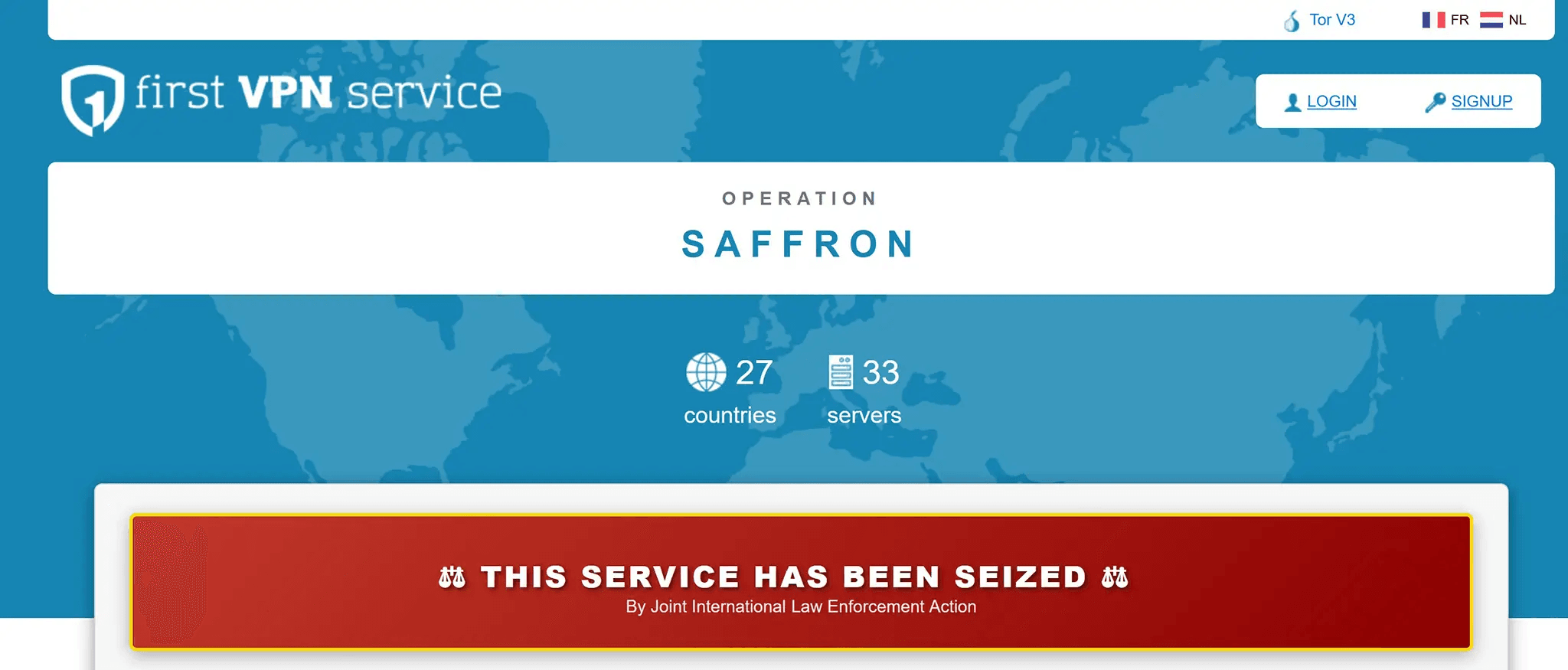
An international law enforcement operation led by France and the Netherlands dismantled First VPN, a cybercriminal anonymization service used by ransomware actors, fraudsters, and data thieves across every major cybercrime investigation Europol has supported in recent years. Bitdefender supported the investigation through Europol, helping generate intelligence that exposed hundreds of individuals linked to cybercrime. This is the first VPN-category takedown in the history of Bitdefender’s law enforcement collaboration program, extending a research-led crime prevention strategy.

 
This is a notable law-enforcement disruption, but it should be interpreted carefully.

Based on the Europol notice and Bitdefender’s blog post, the claim is not that “VPNs are criminal,” but that a specific service, “First VPN,” was allegedly used as infrastructure that supported cybercrime activity, including ransomware operations.

What stands out here

  • Europol describes it as a service used by cybercriminals for anonymization, not a mainstream privacy tool being broadly targeted.
  • Bitdefender says it contributed intelligence through Europol, which suggests private-sector threat research supported the investigation rather than Bitdefender “taking down” the service on its own.
  • If the reporting is accurate, this is unusual because infrastructure providers such as bulletproof hosting, proxy networks, and encrypted communications platforms are more commonly mentioned in takedown announcements than a VPN service specifically.

Why this matters

  • It shows law enforcement is increasingly targeting enabling infrastructure, not only the ransomware operators themselves.
  • It may create operational pressure on criminals who rely on long-running “trusted” anonymity services.
  • It also reinforces that a VPN service can be privacy-oriented in marketing while still being abused, or in some cases allegedly built around abuse-tolerant operations.

Important nuance

A VPN by itself is not evidence of criminal intent. Legitimate users, businesses, journalists, and ordinary consumers use VPNs for valid privacy and security reasons.

The key distinction is whether the provider is allegedly facilitating criminal activity, ignoring abuse at scale, or being integrated into criminal ecosystems. That cannot be assumed about VPNs in general from this case.

Practical takeaway

For normal users, the lesson is not “avoid VPNs,” but rather:

  • Use established providers with transparent ownership, published policies, and a long public track record.
  • Be cautious with obscure services that are heavily marketed in underground spaces or have no credible documentation.
  • Do not treat “no logs” claims as automatically trustworthy unless backed by independent audits or strong public scrutiny.

Conclusion

If the official reporting is accurate, this looks more like a targeted action against allegedly crime-enabling infrastructure than a broad precedent against VPN use. The broader cybersecurity significance is the infrastructure-focused approach, not the VPN label itself.

Sources
 
European law enforcement agencies have dismantled a VPN service long favored by cybercriminals to conceal ransomware attacks, fraud schemes and other illicit activities.

The international operation, led by France and the Netherlands and carried out May 19-20, targeted a service known as First VPN, which had been marketed for years on Russian-speaking cybercrime forums as a secure way for criminals to evade law enforcement.

Authorities in Ukraine questioned the service’s administrator at the request of French investigators and conducted a house search as part of the coordinated operation. Law enforcement agencies also dismantled 33 servers linked to the platform.

According to a Europol statement Thursday, First VPN had appeared in “almost every major cybercrime investigation” the agency had supported in recent years.

The service allowed users to make anonymous payments and promised hidden infrastructure designed to shield criminal activity. Cybercriminals reportedly used it to conceal their identities and infrastructure while carrying out ransomware attacks, large-scale fraud and data theft operations.

“For years, cybercriminals saw this VPN service as a gateway to anonymity. They believed it would keep them beyond the reach of law enforcement. This operation proves them wrong,” said Edvardas Sileris, head of Europol's European Cybercrime Centre.

“Taking it offline removes a critical layer of protection that criminals depended on to operate, communicate and evade law enforcement,” he added.

Europol said investigators gained access to the service and obtained its user database, allowing authorities to identify VPN connections allegedly used by cybercriminals to conceal their activities.

The data exposed thousands of users linked to the cybercrime world and gave investigators new leads tied to ransomware attacks, fraud operations and other crimes around the world, the agency said.

Dutch authorities said First VPN specifically targeted criminal users and openly promoted itself on cybercrime forums. Investigators said the service claimed it would refuse cooperation with law enforcement, operate outside any jurisdiction and avoid storing user data.

“The service gave the impression that it was reliable and that its users were safe, which was not the case in reality,” Dutch authorities said.

Authorities notified users of the shutdown and informed them they had been identified. An investigationis ongoing.


 
Last edited by a moderator:

You may also like...