
AV-Comparatives Real-World Protection Test February-May 2025

Disclaimer
  1. This test shows how an antivirus behaves with certain threats, in a specific environment and under certain conditions.
    We encourage you to compare these results with others and take informed decisions on what security products to use.
    Before buying an antivirus you should consider factors such as price, ease of use, compatibility, and support. Installing a free trial version allows an antivirus to be tested in everyday use before purchase.

Gandalf_The_Grey

Level 85
Thread author
Verified
Honorary Member
Top Poster
Content Creator
Well-known
Forum Veteran
Apr 24, 2016
7,806
6
82,950
8,389
55
The Netherlands
Continuing its dedication to assessing home-user security software, AV-Comparatives, a prominent antivirus testing lab, proudly presents the results of its Real-World Protection Test conducted from February to May 2025.This thorough evaluation covered 19 leading anti-malware programs, scrutinizing their effectiveness in shielding users from internet threats.

The Real-World Protection Test is an integral part of our ongoing Consumer Main-Test Series, designed to replicate real-life scenarios that users face daily. The test meticulously checked whether each threat could alter the test system, reflecting the practical impact of these security solutions. Additionally, to gauge user-friendliness and reduce false alarms, every product was subjected to a false-positives test. Products with high false alarm rates had their award levels adjusted accordingly.

In this years Real-World Protection Test 19 home-user security programs where assessed this are: Avast Free Antivirus, AVG AntiVirus Free, Avira Free Antivirus, Bitdefender Total Security, ESET HOME Security Essential, F-Secure Internet Security, G DATA Total Security, K7 Total Security, Kaspersky Premium, Malwarebytes Premium, McAfee Total Protection, Microsoft Defender Antivirus, Norton Antivirus Plus, Panda Free Antivirus, Quick Heal Total Security, Total Defense Essential Anti-Virus, TotalAV Antivirus Pro, Trend Micro Internet Security, and VIPRE Advanced Security

Eleven of these products achieved the highest award level, “ADVANCED+,” in the Real-World Protection Test. These top-tier security solutions, listed alphabetically, are Avira, Bitdefender, ESET, G DATA, Kaspersky, McAfee, Microsoft, Norton, Total Defense, TotalAV, and VIPRE. These programs all displayed excellent protection capabilites against various internet-borne threats.
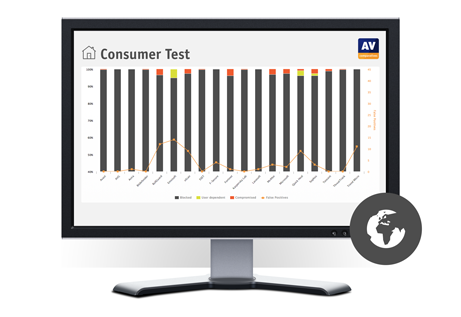
Announcement:
Full Report:
PDF Download:
Consumer Test Charts:
 
Thanks for sharing the results of the Real-World Protection Test conducted by AV-Comparatives. It's great to see that 11 out of 19 home-user security programs achieved the highest award level, "ADVANCED+". This information is crucial for users when choosing the most effective antivirus software.
 
we can disagree on that whether Trendmicro is unusable -- TM has not been giving me false+ and I like its operation on my computer, but it's good to know if it does throw a flag it might be a false+...
Every AV can give FP; Kaspersky, which has the second rank of FP in this test, gave me one with lots of headache and rollback yesterday while installing Ulaa browser.
However, when the rate of FP is too high, it will interfere with usability.
I admire the figures of MD in this particular test; its detection is equal to ESET, with very low FP.
 
A low number of false positives could also mean that the solution failed to scan large(r) file, which installers frequently could be, or it trusts digital signatures blindly (which Trend Micro and F-Secure were doing before and it didn’t work too well for them).
 
A low number of false positives could also mean that the solution failed to scan large(r) file, which installers frequently could be, or it trusts digital signatures blindly (which Trend Micro and F-Secure were doing before and it didn’t work too well for them).
This is the case when you get low FP rate with low detection rate, but with high detection rate, it is a sign of effeciency.
Sometimes, high FP rate causes more trouble than low detection rate.
I prefer AV with marginally lower detection rate, if it has as much as possible FP rate.
 
It is clearly mentioned in this test that it also includes pages/websites, and cases where the whole website is blocked due to one malicious page are considered false positives.
Not all fps are detections on files.

Whilst there is nothing wrong, everyone has their own philosophy, I don’t really agree with AVC that chasing down individual pages and playing whack-a-mole is the right way to go.

Microsoft Defender in this relation also has an extreme edge as it doesn’t block websites at all. If another browser different from Edge is used, malicious websites are not blocked by Microsoft at all, as by default this is off. The entire testing methodology is somewhat flawed, as it is heavily centred around false positives but not all products have the same features set, hence one of the products naturally leans towards a higher score.

Whilst we all know that the perfect result is 100% blocked with 0 false positives, we also know that this is unachievable. It’s easy to test, document and set expectations but it’s not so easy when you’re actually trying to solve a problem.
 
AV-Lab latest shows MD is scoring higher than ESET.
Need a big bag of salt.

After including all tests from the last year (Consumer category) from AVLab, AV-Test, and AV-Comparatives, the MD score is similar to the ESET score.
Two AVs with equal protection rates can often get different scores in one particular test. No need to worry. :)
 
Last edited:
The 6 in AV-Test is the grade, not the detailed results, AV-Test shows the products that passed the tests with 5 to 6, for a detailed result you need to find the product test page, for example:
AV-Test beside the ambiguous"6", does not report the false positive rate, as the case with AVC, which is a signficant defect.
FP rate is as important as the detection rate; I can easily get 100% detection rate by flagging all the files, regardless of its nature.