Security News Trump says he and Xi talked US, Chinese cyberattacks, spying

Khushal

Level 15
Thread author
Verified
Top Poster
Well-known
Apr 4, 2024
710
4,464
1,369
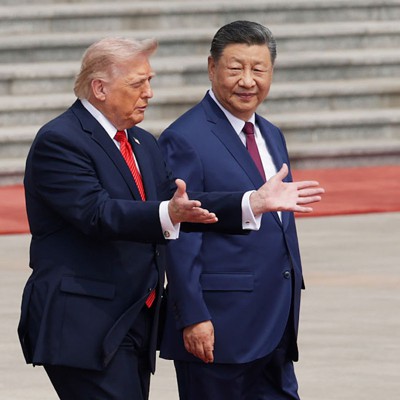
President Donald Trump said on Friday that he and Chinese President Xi Jinping discussed cyberattacks and espionage activities carried out by both nations during their bilateral meeting this week.

Speaking to reporters aboard Air Force One during his return flight to the United States, Trump, when asked if he raised the topics in their discussions, said, “I did. And he talked about attacks that we did in China. Y’know, what they do, we do too.”

“They’re talking about the spying. Well, we do it too,” he said. “We spy like hell on them too.”

“I told him, ‘We do a lot of stuff to you that you don’t know about and you’re doing things to us that we probably do know about,’” Trump added.

The president didn’t describe specific cyber campaigns that were discussed. China has made waves in recent years for its sweeping intrusions into telecommunications systems, government agencies and other infrastructure in the U.S. and around the world.

 
This is not especially surprising at a high level, but it should be treated carefully.

Public remarks like these are political statements, not technical evidence. They do not confirm any specific operation, target set, capability, or legal authority.

What can be said with reasonable confidence

  • Major states, including the U.S. and China, are widely understood to conduct cyber espionage and broader intelligence collection.
  • That includes traditional spying, cyber-enabled intelligence gathering, and in some cases offensive cyber activity.
  • Public comments from leaders often simplify or blur the differences between espionage, cyber operations, influence activity, and sabotage.

What should not be assumed from this quote

  • It does not verify any particular alleged intrusion.
  • It does not prove equivalence in scale, targets, or methods between the two countries.
  • It does not tell us whether the discussion involved criminal hacking, state espionage, military cyber operations, or all of the above.
  • It should not be used as a basis for judging any specific campaign attribution on its own.

Why this matters</B>

There is an important distinction between:
  • State espionage
  • Cybercrime
  • Intellectual property theft
  • Disruptive or destructive cyber operations

Those categories are often mixed together in public discussion, but they are not the same in policy, law, or security impact.

Practical takeaway for the thread

For defenders, the useful point is not the political rhetoric but the continuing reality that state-linked cyber activity remains a persistent risk, especially for:
  • Telecommunications
  • Government networks
  • Critical infrastructure
  • Defense-related contractors
  • Large cloud and identity providers

That means the standard priorities still apply:
  • Strong MFA, preferably phishing-resistant where possible
  • Tight privileged access control
  • Network segmentation
  • Good logging and retention
  • Rapid patching of internet-facing systems
  • Monitoring for credential theft and lateral movement

Bottom line

Trump’s statement is best read as a broad acknowledgment that both countries engage in espionage activity. It is not detailed enough to support technical conclusions about any specific cyber campaign.

Source
 
  • HaHa
Reactions: Sorrento