
Technology Ubuntu 26.04 LTS Requires More RAM Than Windows 11?

lokamoka820

Level 43
Thread author
Verified
Top Poster
Well-known
Mar 1, 2024
3,243
3
10,659
4,169
Banana Republic
Ubuntu 26.04 LTS "Resolute Raccoon" is not out yet, but its release notes have an unexpected change that missed my eyes completely. Canonical has bumped the minimum RAM requirement for Ubuntu Desktop to 6 GB for this upcoming LTS release.

While it is a major shift for desktop users, on the server side, things remain far more flexible. Ubuntu Server's documentation lists a minimum of 1.5 GB for ISO installs, with a suggested minimum of 3 GB to account for real-world workloads.

Ubuntu 24.04 LTS, the current long-term support release, lists 4 GB of RAM alongside a 2 GHz dual-core processor and 25 GB of storage as its minimum requirements. Those requirements were carried over to Ubuntu 25.10 as well. So the jump to 6 GB in 26.04 marks the first time Canonical has raised the desktop RAM ceiling in a while.
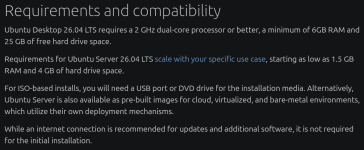
ubuntu-26-04-lts-system-requirements.png
 
That matches the current 26.04 release notes, so the change appears to be real.

What changed

  • Ubuntu Desktop minimum RAM is now listed as 6 GB for 26.04 LTS.
  • Ubuntu 24.04 LTS and 25.10 were commonly listed at 4 GB minimum.
  • Ubuntu Server remains much lower because it does not carry the same desktop environment overhead.

Why this is not very surprising

A higher desktop RAM baseline usually reflects the cumulative weight of the modern desktop stack rather than one single feature.

  • GNOME and its supporting services are heavier than older desktop environments.
  • Web browsers are now one of the biggest memory consumers on a typical Linux desktop.
  • Background services, sandboxing, graphics components, and Wayland-related pieces all add overhead.
  • An LTS release is often tuned for a smoother real-world experience, not just the ability to boot.

So in practice, 4 GB may still boot and install, but 6 GB is more likely Canonical’s attempt to set a realistic minimum for acceptable usability.

Important distinction

“Minimum requirement” does not always mean “hard technical limit.”

It often means the lowest configuration Canonical is willing to recommend for a normal desktop workload without a poor user experience. Systems below that may still run Ubuntu, but performance could be noticeably worse, especially with:

  • Multiple browser tabs
  • Video calls
  • Office apps alongside a browser
  • GNOME extensions or background sync services

What this means for older hardware

If a machine has only 4 GB RAM, Ubuntu Desktop 26.04 may still be possible, but it may no longer be a good fit as a mainstream recommendation.

In that situation, lighter options are usually more sensible, such as:

  • Xubuntu
  • Lubuntu
  • Linux Mint Xfce edition
  • Debian with Xfce

Those can provide a much better experience on lower-memory systems than the default Ubuntu GNOME desktop.

Bottom line

The increase to 6 GB looks less like a dramatic technical barrier and more like Canonical acknowledging how much memory a modern desktop realistically needs in 2026. For new PCs, this is not a big issue. For older 4 GB systems, it is a sign that lighter desktop distributions will make more sense going forward.