McAfee Labs researchers discovered a large-scale malware campaign in January 2026 where attackers used AI to help write parts of their malicious code — a technique being called "vibe-coded malware."
What is vibe coding? The term was coined in February 2025 by OpenAI researchers. It describes an approach where the AI does the heavy lifting: instead of manually writing code, users describe their intent through text prompts and LLMs respond with fully functional code. Cybercriminals have now turned this against us.
Scale of the Attack
In January 2026, McAfee Labs observed 443 malicious ZIP files impersonating a wide range of software — AI image generators, voice changers, stock-market tools, game mods, game hacks, GPU drivers, ransomware decryptors, VPNs, and even other stealers and backdoors.
Across these 440+ ZIP files, researchers found 48 unique malicious WinUpdateHelper.dll variants responsible for the infections, distributed through legitimate platforms like Discord, SourceForge, FOSSHub, and MediaFire.
The campaign specifically targeted users in the US, UK, India, Brazil, France, Canada, and Australia.
How the Attack Works (The Kill Chain)
Step 1 — The Lure: Victims search for tools online and instead download trojanized ZIP files. The executable inside appears legitimate, while a hidden malicious DLL called WinUpdateHelper.dll does the actual damage.
Step 2 — Misdirection: When run, the malware tells users they're missing dependencies and redirects them to a file-hosting site. While the victim is distracted downloading unrelated third-party software, the DLL has already connected to the attacker's command-and-control (C2) server.
Step 3 — The Payload: The C2 server delivers a PowerShell script that runs entirely in memory — a fileless execution technique designed to evade signature-based detection. The script then downloads cryptocurrency mining software and begins mining using both the CPU and GPU.
The AI Fingerprint
This is the most jaw-dropping part. Within the PowerShell scripts, researchers found structured, explanatory-style comments that strongly indicate large language models were used during development — including a comment reading "# I am forever sorry" and similar guilt-laden notes like "# sorry lol" scattered across multiple scripts.
One comment even reads "Downloads cvtres.exe from your GitHub URL" — where "your GitHub URL" is a placeholder left over from AI-assisted code generation, pointing to the threat actor's own repository hosting the malware.
Following the Money
The campaign mined multiple cryptocurrencies including Ravencoin, Zephyr, Monero, Bitcoin Gold, Ergo, and Clore. Attackers used a clever strategy: mine Ravencoin (easier on victim hardware) and auto-convert rewards to Bitcoin before payout, since Bitcoin offers higher liquidity.
Because Bitcoin's blockchain is fully traceable, McAfee researchers were able to identify 7 wallets actively receiving mined cryptocurrency. As of the report, those wallets held approximately $4,536 USD, with total funds received across the campaign amounting to roughly $11,497 USD.
Anti-Analysis Tricks
The C2 server uses a domain name that rotates every 58 days, generated dynamically using the UNIX timestamp. The server also actively checks the User-Agent of incoming requests and only delivers the payload when the request comes from PowerShell — blocking researcher tools like Curl.
Additionally, the download URLs embedded in the PowerShell scripts are unique to each victim and expire after just 60 seconds, returning a 404 error to anyone trying to analyze them after the fact.
The Bigger Takeaway
The availability of LLMs capable of generating code instantly, combined with widespread accessibility of technical knowledge, has created a low-effort, high-reward environment — making malware deployment increasingly accessible to people with little technical background.
The barrier to becoming a cybercriminal is now as low as knowing how to type a prompt.
A few parts of that summary should be treated carefully.
The McAfee blog post may be useful as a vendor research write-up, but some of the claims in the quoted text go beyond what should be stated as fact unless they are directly supported in the report itself.
What can be said with confidence
Using AI or code assistants to help generate malicious code is plausible and has been discussed by multiple security vendors and researchers.
Comments, placeholders, and odd explanatory text inside scripts can be indicators of AI-assisted development.
A DLL sideloading or trojanized ZIP delivery chain combined with PowerShell-based payload retrieval is a common malware distribution pattern.
Cryptomining payloads, short-lived URLs, and anti-analysis checks such as filtering by User-Agent are also established techniques.
What should be stated more cautiously
“AI-written malware” is usually too strong unless the researchers can prove the code was generated by an LLM. In practice, they can usually only say there are signs consistent with AI-assisted development.
The phrase “the barrier to becoming a cybercriminal is now as low as knowing how to type a prompt” is more of an opinion or warning than a verifiable technical conclusion.
Wallet attribution should also be treated cautiously. Seeing funds in wallets linked by the researchers is not the same as proving total criminal profit with certainty.
If the report says the samples were distributed through platforms like Discord, SourceForge, FOSSHub, or MediaFire, that still does not mean those platforms were knowingly involved. Usually it just means they were abused for hosting or delivery.
About the VirusTotal sample link
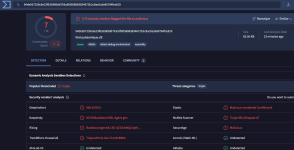
I cannot determine from the VT link alone whether that specific DLL is definitively the same campaign component without reviewing the technical indicators in the McAfee report and matching hashes, behavior, network indicators, or code overlap.
A VT detection page can show that many engines flag a file, but it does not by itself prove:
full campaign attribution
AI-assisted origin
exact role in the kill chain
whether all public descriptions around it are accurate
Best takeaway for the thread
A balanced conclusion would be:
The campaign itself sounds credible if it is documented by McAfee with hashes, infrastructure, and behavioral analysis.
The “AI fingerprint” angle should be framed as evidence suggestive of AI assistance, not definitive proof that the malware was fully written by AI.
The more important security point is not the marketing phrase, but that commodity malware campaigns can now be assembled faster, with scalable lures, disposable infrastructure, and low-skill code generation assistance.
Practical implication
For defenders, the meaningful lesson is still the same:
Do not trust software downloads from random links, even if they are hosted on legitimate file-sharing services.
Check hashes, signatures, publisher reputation, and the official vendor source.
Be cautious with ZIP packages that bundle an EXE with extra DLL files.
Watch for PowerShell spawning unexpected network activity or miner-related behavior.
Conclusion
The campaign is worth discussing, but the strongest accurate wording is that the report appears to describe malware with indicators of AI-assisted development, not proven “AI-written malware” in an absolute sense.
Confirmed facts
Indicate a widespread malware campaign distributing Trojanized ZIP files that deploy a malicious DLL, identified as WinUpdateHelper.dll, which subsequently executes fileless PowerShell scripts to install cryptocurrency miners.
Assessment
This is fully "AI-written" malware is a theory based on script comments (e.g., "# I am forever sorry") and should be treated as evidence of AI-assisted development rather than definitive proof of autonomous AI generation.
Technical Analysis & Remediations
MITRE ATT&CK Mapping
T1204.002
(User Execution: Malicious File)
T1059.001
(Command and Scripting Interpreter: PowerShell)
T1569.002
(System Services: Service Execution)
T1562.001
(Impair Defenses: Disable or Modify Tools)
T1496
(Resource Hijacking)
CVE Profile
N/A [CISA KEV Status: Inactive].
This attack relies on social engineering and user execution rather than software vulnerability exploitation.
Constraint
The structure of the final payload resembles the XMRIG miner family based on the specified C2 pools (solo-zeph.2miners.com:4444, solo-rvn.2miners.com:7070) and target coins (Ravencoin, Zephyr, Monero).
Command
Initiate incident response protocols for potential cryptomining and infostealer infections across endpoints that have downloaded third-party mods or tools.
DETECT (DE) – Monitoring & Analysis
Command
Query SIEM/EDR for the hash 94de957259c8e23f635989dd793cdfd058883834672b2c8ac0a3e80784fce819 and executions of WinUpdateHelper.dll.
Command
Alert on PowerShell processes making network connections to .xyz domains dynamically generated via UNIX timestamps.
Command
Detect registry modifications adding C:\ProgramData to Windows Defender exclusion paths.
RESPOND (RS) – Mitigation & Containment
Command
Isolate endpoints exhibiting sustained high CPU/GPU utilization coupled with unauthorized PowerShell activity.
Command
Purge unauthorized services named "Microsoft Console Host" associated with this campaign.
RECOVER (RC) – Restoration & Trust
Command
Revert unauthorized Windows Defender path exclusions.
Command
Validate endpoint cleanliness via secondary EDR sweeps before rejoining the network.
IDENTIFY & PROTECT (ID/PR) – The Feedback Loop
Command
Block identified C2 domains (1770000000[.]xyz, 1765000000[.]xyz) and mining pool URLs at the firewall/DNS level.
Command
Restrict user execution of binaries downloaded from non-standard repositories (e.g., Discord, MediaFire) via AppLocker or WDAC.
Remediation - THE HOME USER TRACK (Safety Focus)
Priority 1: Safety
Command
Disconnect from the internet immediately to sever the C2 connection and halt cryptocurrency mining or data exfiltration.
Command
Do not log into banking/email until verified clean.
Priority 2: Identity
Command
Reset passwords/MFA using a known clean device (e.g., phone on 5G), especially for cryptocurrency wallets and critical accounts, as secondary payloads like SalatStealer may be present.
Priority 3: Persistence
Command
Check Windows Security (Defender) settings and remove C:\ProgramData from the "Exclusions" list.
Command
Check Services (services.msc) for a rogue entry masquerading as "Microsoft Console Host" and inspect Scheduled Tasks.
Command
Run a full system scan with a reputable antivirus solution to locate and quarantine WinUpdateHelper.dll and related dropped binaries.
Hardening & References
Baseline
CIS Benchmarks for Windows 10/11 (Restrict PowerShell execution policies; enforce Application Control).
Note
End users should exercise extreme caution when downloading game mods, cheats, or "cracked" software from platforms like Discord or FOSSHub, as these are primary delivery vectors for this campaign.