Technology Windows Drops Under 60% in Global Desktop OS Share for the First Time in Years

That the main challenge which Linux try to solve. once get the developer support " which i see is increasing " it will be the number 1 OS but this comes gradually. increasing the Linux market share will push the software developer to consider it as an important OS with target audience to develop productivity software for "Also in the time being there is a good alternative with very similar GUI i am trying such as LibreOffice ...etc
Linux has a fundamental issue which is fragmantation. Do you know how many distros out there? How many DEs? Tremendous, but fragmented efforts. This is what is holding Linux back.
 
Linux has a fundamental issue which is fragmantation. Do you know how many distros out there? How many DEs? Tremendous, but fragmented efforts. This is what is holding Linux back.
No, I disagree. This is one of the powerful features that make it flexible . You know if it is combined in one company, maybe it will be converted to closed source later, and be like Microsoft when it has a large market share
 
No, I disagree. This is one of the powerful features that make it flexible . You know if it is combined in one company, maybe it will be converted to closed source later, and be like Microsoft when it has a large market share
I did not say I want it under the control of one company. But at the same time the existence of endless distros is not a good thing either.
 
I have heard those who are in Europe can remove Edge
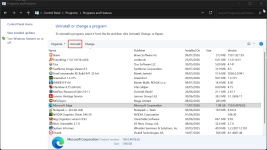
I have the option to uninstall Microsoft Edge because I changed my device's region setting to Ireland.

2026-07-13 17_21_33-Programs and Features.png
 
I have the option to uninstall Microsoft Edge because I changed my device's region setting to Ireland.

View attachment 298788
AS in LTSC, but actually it is trick; after uninstall, all files are there in C drive and all entries are there in Registry.
You have to manually remove.

And uninstalling Edge Webview caused unexpected issues with Windows security for me.
 
No, I disagree. This is one of the powerful features that make it flexible . You know if it is combined in one company, maybe it will be converted to closed source later, and be like Microsoft when it has a large market share

It really is a minefield for a new user looking at Linux, also the Linux community themselves 'argue' which distro is 'better' & as on here threads regarding Linux show users changing disros frequently, most people do not want that they want a PC to just work, (that's if they want the perceived bother of a PC) that's all, they are philistines but that's really how it is, there are many things in life like that, photography & music reproduction are similar - We live in a quick fix society, sad but to me its a fact - Most on here are different but we are unusual :oops:
 
It really is a minefield for a new user looking at Linux, also the Linux community themselves 'argue' which distro is 'better' & as on here threads regarding Linux show users changing disros frequently, most people do not want that they want a PC to just work, (that's if they want the perceived bother of a PC) that's all, they are philistines but that's really how it is, there are many things in life like that, photography & music reproduction are similar - We live in a quick fix society, sad but to me its a fact - Most on here are different but we are unusual :oops:
i agree but this not problem i think it give the user more flexibility for what to choose depend on needs and features.for example i selected Ubuno as it has good support community and good LTS stable release beside good support for productivity tools and day to day operation. Another one my choose Linux mint to feel more close to the windows GUI...etc. it is all about personal preferences
 
Thanks for sharing this, but honestly it is not about how to remove things, but rather about the consequences
This tool give you some recommendation about the feature uninstallation if it is recommended or not and you have the final answer.so the final decision is for the user to take if there is a risk, it is categorized by recommended / Limited / No options >> if it is limited and it is mandatory for you , then you can consider switching to another OS which satisfy your need or consider Linux distro

1784032899294.png
 
Last edited:
According to StatCounter.com analytics, after many years of remaining unscathed, the data is now are less reliable.
This is because PC users are using browsers and ad blockers that prevent the analytical tracking carried out on over 1 million websites that we all visit.
Essentially, these are trackers that are blocked by filter lists or by browsers that block trackers natively, such as Firefox.

FAQ | Statcounter Global Stats

So without this “tracker filtering,” the OS share is likely much higher.;)
 
This tool give you some recommendation about the feature uninstallation if it is recommended or not and you have the final answer.so the final decision is for the user to take if there is a risk, it is categorized by recommended / Limited / No options >> if it is limited and it is mandatory for you , then you can consider switching to another OS which satisfy your need or consider Linux distro

View attachment 298804
Yes indeed I am considering moving to Fedora on one of my devices, but I am doing some research on battery life as I am using the Thinkpad in the campus and I need it to serve me at least 4 hours of uninterrupted use on battery power.
 
I have done some distro hopping in my search for a secure OS but that was a few years ago. But no matter how much I distro hop, I keep one 'home' distro and do all my security tooling on that. The more effort I put into the security tooling, the less inclined I would be from moving away. I used to be based off Ubuntu, now I favor Fedora. It's daily updates are keeping me safer I think, And I like it's SELinux confinement. And I also appreciate installing apps from a distro's verified repositaries, and it's store. You rarely have to go outside the walled garden to get installers. Big distro's like Ubuntu and Fedora's repositaries have all the open source software you'll need.
 
Last edited:
I heard that with MS PowerToys you can select Euro something and that allows removal of Edge.
Just a correction: it’s Wintoys, not MS PowerToys. 😉
 
I have done some distro hopping in my search for a secure OS but that was a few years ago. But no matter how much I distro hop, I keep one 'home' distro and do all my security tooling on that. The more effort I put into the security tooling, the less inclined I would be from moving away. I used to be based off Ubuntu, now I favor Fedora. It's daily updates are keeping me safer I think, And I like it's SELinux confinement. And I also appreciate installing apps from a distro's verified repositaries, and it's store. You rarely have to go outside the walled garden to get installers. Big distro's like Ubuntu and Fedora's repositaries have all the software you'll need.
it is good choice but as i said it depend on personal preference as you explained . Also anyone can test all the feature without instillation using bootable live CD or virtual machine so isnot issue nowadays . For me i balanced between security , support and stability so i have choose Ubuntu 26.4 LTS with 5 years of support that is good ans stable . i care more anout security updates more than new features for My very old laptop XD. Actually Linux brought it to live without Microsoft bloatware with these AI resources eating features and lot of fix to make new feature updates compatible and face these blue screens Lol
 
No, Windows did not fall below 60% market share or lose 20 points to Linux
I downloaded the data from StatCounter, and we found that an operating system labeled “Unknown” suddenly accounted for 21.45% of the desktop market. This category could include any device where the browser’s user agent is modified, unavailable, or cannot be correctly identified by StatCounter.

That means a portion of those “Unknown” devices could very well be Windows PCs. The more likely explanation is that StatCounter misclassified a large number of devices rather than Windows suddenly falling below 60% or contributing to Linux’s growth.

It’s not the first time StatCounter has reported wild numbers. In 2025, a number of outlets and influencers reported that Windows 7 was gaining market share to prove a point that Windows 11 is a terrible operating system.
 
it is good choice but as i said it depend on personal preference as you explained . Also anyone can test all the feature without instillation using bootable live CD or virtual machine so isnot issue nowadays . For me i balanced between security , support and stability so i have choose Ubuntu 26.4 LTS with 5 years of support that is good ans stable . i care more anout security updates more than new features for My very old laptop XD. Actually Linux brought it to live without Microsoft bloatware with these AI resources eating features and lot of fix to make new feature updates compatible and face these blue screens Lol
The only downside to Ubunto, in my opinion, is snap