

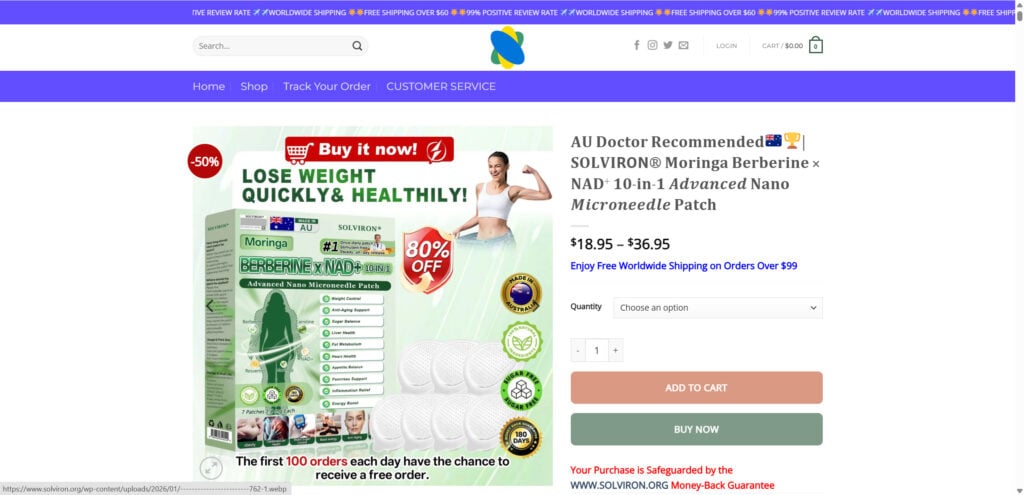
Solviron is marketed as a nano microneedle weight-loss patch that claims to support fat loss, appetite control, blood sugar balance, liver health, gut health, skin firmness, energy, mood, and overall metabolic wellness.
The offer follows a familiar viral wellness-product pattern: dramatic health claims, AI-style social media ads, generic China-product signals, large result promises, multi-unit pressure, and refund terms that may make returns difficult once the product is opened, used, or shipped.
What Is Solviron?
Solviron is sold through Solviron.org as a nano microneedle patch. The product page uses stylized text, but the URL and branding point to Solviron.
The product is advertised as a patch that is applied to clean, dry skin for around 8 hours per day. The page says each box contains 7 patches and recommends daily use, often while sleeping.
The advertised claims include:
- weight management
- appetite regulation
- reduced cravings
- lipid metabolism support
- blood sugar balance
- liver support
- gut health support
- cardiovascular support
- skin tightening
- skin elasticity
- mood and energy support
- brain protection
- reduced fatigue
- menopause symptom support
- joint pain support
- visible results in 7 days
- 6–8 kg fat loss in one week
- 98% absorption rate
- 180-day money-back guarantee
Those are extremely broad claims for a low-cost adhesive patch. A product that claims to affect fat loss, blood sugar, liver health, gut health, cardiovascular health, brain fog, joint pain, skin firmness, and menopause symptoms should be backed by strong clinical evidence on the exact finished product.
The Solviron page does not provide that level of proof.
The Main Problem: Solviron Claims Too Much
Solviron is not marketed as a simple wellness patch. It is marketed almost like a complete metabolic treatment system.
The page claims the product can support weight loss, improve blood sugar, help liver function, improve gut issues, reduce inflammation, support brain function, improve mood, tighten skin, help joints, and address obesity-related complications.
That is a major red flag.
Real health problems such as obesity, type 2 diabetes, fatty liver disease, hypertension, high cholesterol, sleep apnea, arthritis, and menopause symptoms are complex. They cannot be solved by a generic patch applied to the skin overnight.
A patch may create a sensation on the skin. It may contain common wellness ingredients. It may give some users a placebo effect or a feeling of routine. But it should not be treated as a medical or weight-loss breakthrough.
Why Solviron Raises Red Flags
1. The weight-loss claims are unrealistic
The page claims some users lost 6–8 kg of stubborn fat in one week and describes “precision fat elimination” that targets visceral and abdominal fat.
That is not realistic for a consumer patch.
A patch cannot selectively melt belly fat. It cannot target visceral fat. It cannot safely produce large, rapid fat loss without diet, exercise, medical treatment, or major calorie restriction.
Claims about rapid fat loss, no rebound, no extreme dieting, and effortless results are classic warning signs in weight-loss advertising.
2. “ 6–8 kg of stubborn fat in one week and describes “precision fat elimination” that targets visceral and abdominal fat.
That is not realistic for a consumer patch.
A patch cannot selectively melt belly fat. It cannot target visceral fat. It cannot safely produce large, rapid fat loss without diet, exercise, medical treatment, or major calorie restriction.
Claims about rapid fat loss, no reboundNo injection” marketing borrows from GLP-1 hype
The page compares the patch to injectable and oral weight-loss products and says it offers a needle-free, natural approach without gastrointestinal burden.
This is a common trick in current weight-loss funnels. Sellers try to borrow attention from legitimate medical treatments like GLP-1 drugs while selling an unrelated supplement patch.
A microneedle patch with ingredients like berberine, moringa, NAD+, curcumin, chromium, and plant extracts is not the same as prescription weight-loss medication.
3. The product claims to help too many conditions
Solviron’s page links the product to:
- obesity
- type 2 diabetes
- fatty liver
- high blood pressure
- cholesterol
- cardiovascular disease
- arthritis
- joint pain
- brain fog
- anxiety
- insomnia
- menopause symptoms
- vaginal odor or itching
- gut inflammation
- constipation
- indigestion
- acid reflux
That is far too broad.
When one product claims to support nearly every major health problem at once, it usually means the marketing is built to catch as many buyers as possible.
A real clinical product would make narrower, better-supported claims.
4. The “clinical studies” claims are vague
Solviron uses strong clinical language throughout the page. It claims endocrinology experts tested the formula, says clinical trials involved more than 5,000 participants, and claims FDA regulatory review recognized its safety and effectiveness.
Those are serious statements.
A buyer should expect:
- study titles
- author names
- publication links
- trial registration
- placebo control
- dosage details
- participant data
- adverse event reports
- manufacturer details
- regulatory documentation
- actual FDA clearance or approval records
The visible product page does not provide that level of evidence.
Without verifiable documentation, the “clinically validated” and “FDA review” language should be treated as marketing, not proof.
5. The FDA-style claim is suspicious
The page says the product has undergone rigorous FDA regulatory review and that its safety, effectiveness, and compliance were formally recognized.
That is a major red flag for a weight-loss patch sold through a general ecommerce site.
If a product is claiming FDA-recognized safety and effectiveness for weight loss or metabolic health, the seller should provide clear regulatory details. Otherwise, buyers may wrongly believe the product has been approved like a medical device or drug.
For wellness products and supplements, FDA-related wording is often used to create false confidence.
6. The testimonials are extreme
The page includes testimonials claiming dramatic results, including losing 55 kg, 65 kg, or 85 kg, improved blood pressure, improved fatty liver, better blood sugar, restored energy, improved sleep, and major lifestyle changes.
These stories are not normal product reviews. They read like sales-page scripts.
They also make medical-adjacent claims that should not be accepted without evidence. Weight loss of that magnitude normally involves major lifestyle changes, medical care, surgery, prescription medication, or long-term supervised treatment.
A patch should not be credited with extreme body transformations based only on seller-controlled testimonials.
7. The review section says there are no reviews
The product page contains many dramatic testimonials and claims “99% positive review rate,” but the WooCommerce review tab says there are no reviews yet.
That mismatch matters.
A product page cannot simultaneously rely on huge testimonial claims while its own product-review section shows zero customer reviews. This suggests the testimonial content may be manually placed sales copy rather than verified buyer feedback.
8. The product looks like a cheap China-made microneedle patch category
Solviron’s formula and format closely match many generic nano microneedle slimming patches sold by China-based suppliers.
Similar products are widely available as:
- nano microneedle slimming patches
- berberine patches
- moringa patches
- body shaping patches
- weight-control patches
- metabolism patches
- fat-burning patches
- transdermal slimming stickers
- microneedle body contouring patches
These products can often be purchased cheaply, customized, and resold under different brand names.
That does not prove the exact Solviron patch comes from one specific supplier, but it supports the private-label/dropshipping concern. A seller can source a cheap patch, create a dramatic story, add AI-style ads, and sell it as a premium weight-loss breakthrough.
9. Orders ship from China and the US
Solviron’s delivery policy says orders are shipped from China and the US.
That is consistent with a dropshipping or mixed-fulfillment model. China shipping alone is not automatically a scam, but it becomes concerning when combined with exaggerated health claims, generic product similarities, and restrictive return conditions.
10. Buyers cannot cancel after ordering
Solviron’s delivery policy says buyers are not allowed to cancel purchases after the orders are placed.
That is a major buyer risk.
Many social media shoppers order quickly after seeing an ad. If they later notice the claims are exaggerated, ordered the wrong quantity, or realize the product ships from overseas, the cancellation window may already be closed.
11. Returns are very restrictive
The product page promotes a 180-day money-back guarantee. But the delivery policy says return requests must be made within 14 days of receiving the order, accepted returns must be sent back within 7 days, and products must be in perfect condition, unused, unwashed, and in original packaging.
That creates a serious contradiction.
You cannot know whether a weight-loss patch works without opening and using it. But once opened or used, the policy may give the seller a reason to deny the return.
12. Refunds are limited to narrow reasons
Solviron’s customer service page says refunds are issued if goods are damaged, if the order does not arrive within 45 business days, or if the wrong items were sent.
That is much narrower than a broad satisfaction guarantee.
If the product arrives but does not help with fat loss, cravings, blood sugar, or energy, the buyer may struggle to get a refund.
13. Buyer pays return shipping
Solviron’s policy says the buyer is responsible for return shipping, and original shipping charges are not refunded.
For a low-cost product shipped from overseas, that can make returns impractical. Even if a refund is technically allowed, the time, cost, tracking requirement, and approval process can make it effectively impossible.
14. Multiple-unit risk is built into the product page
Solviron offers quantity options such as 1PC, 2PCS, and 3PCS. The page also says most customers order 6 boxes or more for best results.
That is a classic bundle-pressure tactic.
Buyers may end up receiving more boxes than intended because of:
- quantity dropdowns
- bundle pressure
- “best results” recommendations
- upsells
- post-purchase offers
- confusing mobile checkout
- duplicate order clicks
- high-pressure social ads
If the product does not work, extra boxes become extra loss.
15. Subscription or recurring-billing risk should be checked
I did not see a clear subscription option on the static Solviron product page I reviewed. However, the user flagged subscription risk, and this type of social media wellness funnel often uses checkout add-ons, recurring shipment offers, or post-purchase upsells.
Before paying, buyers should check carefully for:
- Subscribe and Save
- auto-refill
- recurring billing
- monthly shipment
- VIP membership
- future deliveries
- continuity plan
- post-purchase one-click offers
- shipping protection add-ons
- warranty add-ons
If the checkout does not clearly say one-time purchase, do not proceed.
How the Solviron Funnel Appears to Work
Step 1: The ad targets weight-loss frustration
The promotion likely reaches people who are tired of diets, cravings, belly fat, low energy, blood sugar swings, and weight regain.
The pitch is designed to sound easy: apply a patch, sleep, and let the product work.
Step 2: Science-style language creates trust
The page uses terms like nano microneedle, transdermal delivery, berberine, NAD+, AMPK, insulin sensitivity, visceral fat, gut microbiome, and metabolic regulation.
This language makes the product sound advanced. But scientific terms do not prove that the exact patch works.
Step 3: AI-style ads and testimonials create authority
Fake AI social media ads can make a generic product look like a medical breakthrough. A fake doctor, pharmacist, endocrinology team, or customer story can make the product feel legitimate.
Solviron’s page includes dramatic professional-style testimonials and expert-team claims that should be treated cautiously unless independently verified.
Step 4: The page expands the benefits
The product is not only framed as a weight-loss patch. It is also linked to liver support, blood sugar, gut health, mood, brain fog, skin firmness, menopause, and joint pain.
This makes the product appeal to more buyers and more health concerns.
Step 5: Multi-box pressure increases the order value
The page says most customers order multiple boxes for best results and offers quantity options. That encourages buyers to spend more before testing one box.
Step 6: Return friction appears later
If the buyer is disappointed, the 180-day guarantee may collide with a policy requiring unused, unopened, perfect-condition products and narrow refund reasons.
That is where the “risk-free” offer may become difficult in practice.
Main Red Flags
- Claims rapid fat loss, including 6–8 kg in one week.
- Claims to target visceral and abdominal fat.
- Claims appetite control, blood sugar support, liver support, gut health, skin tightening, brain protection, cardiovascular support, and joint relief.
- Claims visible results in 7 days.
- Claims FDA regulatory review recognized safety and effectiveness.
- Claims clinical trials with more than 5,000 participants without clear public study details.
- Uses dramatic testimonials with extreme weight-loss numbers.
- Product-review tab says there are no reviews yet.
- Similar nano microneedle slimming patches are widely available from China suppliers.
- Orders ship from China and the US.
- Buyers are not allowed to cancel after ordering.
- Product page says 180-day guarantee, but policy says 14-day return requests.
- Returns must be unused, perfect, and in original packaging.
- Refunds are mainly limited to damaged, missing, wrong, or non-delivered orders.
- Buyer pays return shipping.
- Multi-box ordering is encouraged.
- Subscription and checkout upsell risks should be checked carefully.
Is Solviron a Scam?
Solviron may ship a real patch, so this may not be a simple “pay and receive nothing” scam.
The concern is the marketing and refund structure.
A fair conclusion is this: Solviron appears to be a high-risk dropshipping-style weight-loss patch offer because it combines exaggerated health claims, generic China-product signals, AI-style social media marketing, extreme testimonials, multi-unit pressure, China shipping, and return terms that may make refunds difficult or impossible after the product is opened or used.
The patch may exist. The issue is whether it can do what the ads and product page suggest.
Buyers should not treat Solviron as a proven solution for obesity, diabetes, fatty liver, blood pressure, menopause, joint pain, or rapid fat loss.
What Solviron May Actually Do
Solviron may provide:
- a daily routine reminder
- a skin sensation
- placebo effect
- temporary feeling of wellness
- mild irritation or tingling
- adhesive-based skin contact
- the impression of using a “high-tech” product
Solviron is unlikely to reliably:
- burn stored fat
- target belly fat
- reduce visceral fat
- cause 6–8 kg fat loss in a week
- balance blood sugar
- improve fatty liver
- reverse obesity-related disease
- tighten loose skin after major weight loss
- reduce joint pain
- treat menopause symptoms
- replace GLP-1 drugs
- replace medical weight-loss care
If a patch could reliably do all of that, it would be a major regulated medical product, not a low-cost online offer sold through social media ads.
Safety Concerns Buyers Should Consider
Microneedle-style patches can irritate the skin. Even shallow patches may create tiny contact points or deliver ingredients through the skin.
Possible risks include:
- redness
- itching
- burning
- rash
- swelling
- peeling
- pain
- allergic reaction
- adhesive sensitivity
- infection risk if used on broken skin
- pigment changes
- scarring
Do not use Solviron on:
- broken skin
- irritated skin
- open wounds
- rashes
- eczema
- psoriasis
- sunburn
- infected skin
- moles
- suspicious skin lesions
- areas recently shaved or waxed
Be cautious if you have:
- diabetes
- poor circulation
- immune suppression
- sensitive skin
- pregnancy or breastfeeding
- medication use
- skin disease
- allergies to adhesives or botanicals
Do not use any weight-loss patch as a substitute for medical care.
What To Do Before Buying
1. Treat it as unproven
Do not buy Solviron expecting real fat loss. Treat it as an unproven wellness patch.
2. Avoid multiple boxes
Do not buy 2, 3, 6, or more boxes before testing one. Extra boxes increase the loss if the product disappoints or irritates your skin.
3. Check for subscriptions
Before paying, inspect every line of the checkout for recurring billing, auto-refill, memberships, or monthly shipment terms.
4. Screenshot everything
Save screenshots of:
- product claims
- guarantee language
- FDA-style claims
- clinical-trial claims
- quantity selected
- final price
- shipping policy
- refund policy
- checkout page
- subscription checkbox status
- order confirmation
5. Compare similar products
Search for:
- nano microneedle weight loss patch
- berberine microneedle patch
- moringa berberine patch
- slimming microneedle patch
- transdermal weight loss patch
- body shaping patch
- Solviron patch alternative
- Alibaba slimming patch
If similar items appear cheaply elsewhere, do not pay premium pricing.
6. Use a protected payment method
Use a credit card or PayPal when possible. Avoid payment methods that make disputes difficult.
What To Do If You Already Ordered
1. Check your confirmation email
Confirm:
- number of boxes ordered
- total amount charged
- shipping fee
- selected quantity
- merchant name
- whether any subscription appears
- delivery estimate
- support contact
2. Cancel immediately if possible
Solviron’s policy says buyers are not allowed to cancel after ordering, but you should still email support immediately if the order is wrong.
Use direct wording:
“I am requesting immediate cancellation of this order and a refund to my original payment method. Do not ship additional units or enroll me in any recurring plan.”
3. Save all evidence
Save:
- ad screenshots
- product page screenshots
- guarantee claims
- checkout screenshots
- order confirmation
- payment statement
- support emails
- tracking page
- package photos
- product label photos
4. Do not open every box
If you received multiple boxes, keep extras sealed. Opened or used products may be denied under the written return terms.
5. Watch for recurring charges
Monitor your card for duplicate or recurring charges. If you see any repeat charge, contact the seller and your bank immediately.
6. Request a refund quickly
Use clear wording:
“The product does not match the advertised claims. I am requesting a refund under the money-back guarantee shown on the product page.”
7. Dispute if necessary
Contact your bank, credit card issuer, or PayPal if:
- you were charged for more items than ordered
- the product never arrives
- the seller refuses the advertised guarantee
- the product is not as advertised
- the return policy contradicts the product page
- the seller does not respond
- a recurring charge appears
- the product causes irritation or injury
Use clear dispute wording such as:
- “item not as described”
- “misleading weight-loss claims”
- “merchant refuses advertised refund”
- “refund policy contradicts sales page”
- “unauthorized quantity charged”
- “unauthorized recurring charge”
- “product advertised with unsupported medical claims”
FAQ
What is Solviron?
Solviron is a nano microneedle patch marketed for weight management, appetite control, blood sugar balance, liver support, gut health, energy, and skin firmness.
Is Solviron a scam?
Solviron may ship a real patch, but the offer has major red flags: exaggerated health claims, generic China-product similarities, AI-style social media ads, multi-unit pressure, China shipping, and restrictive refund terms.
Does Solviron really help with weight loss?
There is no clear proof on the product page that this exact patch causes meaningful fat loss. Claims about losing 6–8 kg in one week should be treated skeptically.
Is Solviron made in China?
Solviron’s policy says orders are shipped from China and the US. Similar nano microneedle slimming patches are widely sold by China-based suppliers.
Can Solviron balance blood sugar?
Do not rely on Solviron for blood sugar control. Anyone with diabetes or prediabetes should speak with a healthcare professional before using weight-loss or blood-sugar supplements.
Can Solviron replace injections or medication?
No. Solviron should not be treated as a replacement for prescription medication, GLP-1 drugs, diabetes treatment, or medical weight-loss care.
Are returns easy?
No. The product page promotes a 180-day guarantee, but the policy says returns must be requested within 14 days, accepted returns must be sent within 7 days, and items must be unused and in original packaging.
Can buyers receive multiple boxes?
Yes, this is a risk because the product page offers quantity options and says most customers order multiple boxes for best results.
Is there a subscription risk?
The product page I reviewed did not clearly show a subscription option, but buyers should still inspect checkout carefully for recurring billing, auto-refill, memberships, or post-purchase upsells.
Should I buy Solviron?
Be cautious. Do not buy bundles, do not rely on the weight-loss claims, screenshot the checkout, and use a protected payment method if you still decide to order.
The Bottom Line
Solviron is marketed as a nano microneedle patch that can support weight loss, appetite control, blood sugar balance, liver health, gut health, skin tightening, mood, energy, and more. The product may ship, but the claims are broad, aggressive, and difficult to verify.
The biggest warning signs are the extreme weight-loss promises, vague clinical and FDA-style claims, dramatic testimonials, generic China-product similarities, China shipping, no-cancellation language, multi-box pressure, and a return policy that may block refunds after the product is opened or used.
Solviron should be treated as an unproven wellness patch, not a real fat-loss or metabolic-health treatment. Buyers should avoid multi-box orders, check carefully for recurring billing, document the checkout, and dispute the charge if the advertised guarantee is not honored.
10 SEO Titles
- Solviron Nano Microneedle Patch Review: Scam or Legit?
- Solviron Scam Warning: Weight Loss Patch Claims Exposed
- Solviron Patch Review: Cheap China Product or Real Weight Loss Solution?
- Is Solviron Legit or Another Dropshipping Weight Loss Patch Scam?
- Solviron Exposed: AI Ads, Fat Loss Claims, and Refund Problems
- Solviron Nano Patch Scam? Read This Before Buying
- Solviron Weight Loss Patch Review: Claims vs Reality
- Solviron Refund Warning: 180-Day Guarantee vs Restrictive Returns
- Solviron Microneedlyer Risks
- Solviron Review: Generic Slimming Patch Sold With Big Health Claims








