

WellaCooler is being promoted as a portable AC that can cool rooms quickly, reduce humidity, and help people avoid expensive air conditioning.
The sales page looks polished. The claims sound convincing. The product appears simple, modern, and easy to use.
But when you look closer, WellaCooler raises serious red flags.
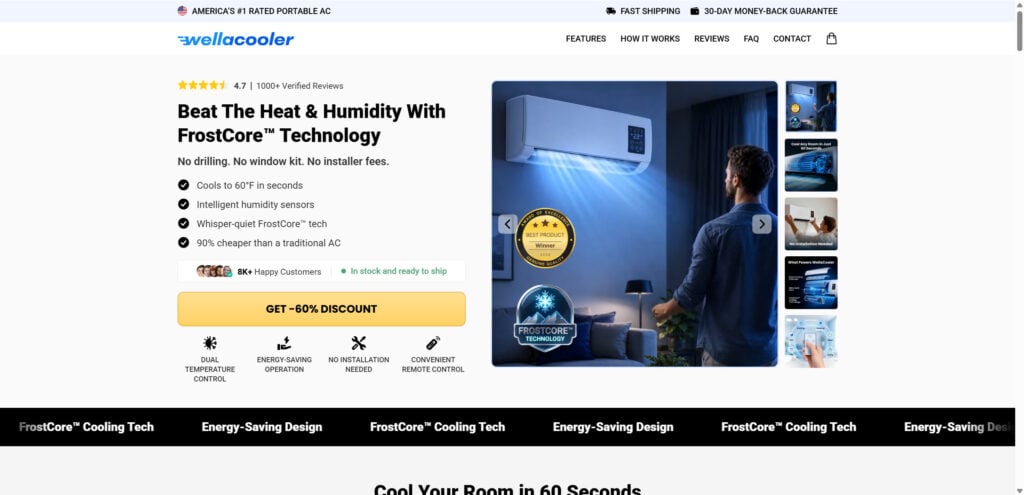
Overview
WellaCooler is advertised as “America’s #1 rated portable AC.” The website promotes it as a plug-in cooling device with “FrostCore” technology, fast shipping, a 30-day money-back guarantee, and a 4.7 rating with more than 1,000 verified reviews. It also claims the device cools to 60°F in seconds, uses intelligent humidity sensors, runs quietly, and costs 90% less than traditional air conditioning.
That sounds impressive.
But the first major issue is simple: WellaCooler does not appear to be a real air conditioner in the way most shoppers understand that term.
A real air conditioner removes heat from indoor air and transfers that heat outside. The U.S. Department of Energy explains that air conditioners use an evaporator coil to absorb heat indoors, a condenser coil to release heat outside, and a compressor to circulate refrigerant between the two.
That is why real portable air conditioners usually need an exhaust hose, a window kit, or another way to vent heat outdoors.
WellaCooler, however, promotes “no drilling,” “no window kit,” and “no installer fees.” Its FAQ says there is no hose, no drilling, no installer, no water tank, and no messy setup.
This is the central problem.
If a device does not use a proper refrigeration system and does not move heat outside, it should not be expected to cool a room like a real AC.
At best, it may work as a small personal fan or fan-heater. It may blow air near your desk, bed, or chair. It may make you feel slightly more comfortable if it is pointed directly at you.
But that is not the same as cooling an entire room.
The product shown in the ads also looks very similar to generic wall-mounted fan and heater units sold on Chinese wholesale platforms. In the screenshot you provided, similar products are listed for around $5.79 to $13.80 per unit, depending on supplier and quantity.
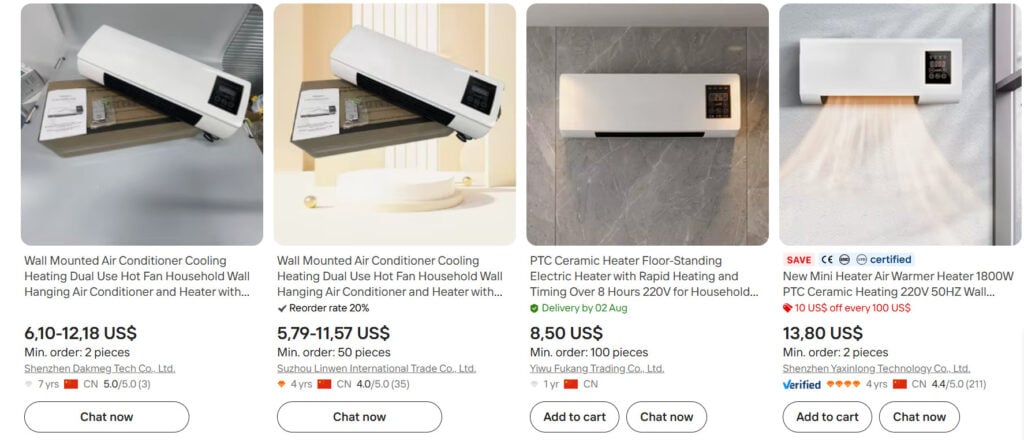
T
hat does not automatically prove WellaCooler is a scam. But it strongly suggests that this may be a cheap generic device sold under a new brand name with much heavier marketing.
This is a common pattern.
A low-cost product is sourced from China. A new brand name is created. A professional website is built. The product is promoted with big claims, large discounts, reviews, fake-looking trust signals, and social media ads.
The product itself may be basic.
The marketing makes it look advanced.
WellaCooler’s website claims it can cool a room in 60 seconds and says one unit is suitable for rooms up to 550 sq ft. It also says the device provides cooling and heating, has 6 climate control modes, remote control, touchscreen controls, intelligent humidity sensors, and whisper-quiet operation.
Those claims deserve skepticism.
A small plastic wall-mounted gadget cannot be judged by marketing words like “FrostCore” or “heat-exchange technology.” The real question is whether it has the components of a real AC and a way to remove heat from the room.
From the product style and the “no hose” setup, buyers should not expect true air-conditioning performance.
Another concern is the review section.
The WellaCooler page displays a 4.7 rating, 1,768 reviews, and says 97% of reviewers would recommend the product. It shows many highly positive reviews claiming the device cooled rooms, cut power bills, helped with sweaty nights, and worked well in rentals.
But these reviews appear directly on the sales page.
That matters.
Reviews controlled by the seller are not the same as independent reviews from a trusted retailer or third-party platform. A sales page can choose which reviews to show, how to format them, and whether negative reviews appear at all.
The terms also say testimonials and reviews are used for informational and marketing purposes and should not be treated as guarantees of performance.
That is an important detail.
The page uses reviews to build confidence, but the legal terms reduce responsibility for relying on those reviews.
There is also a notable AI and image disclaimer.
WellaCooler’s terms say product images and videos may be digitally enhanced, edited, stylized, staged, computer-generated, or created using artificial intelligence. The same section says the actual product may vary in appearance, size, color, packaging, scale, or details.
That does not mean every image is fake. But it confirms that buyers should not treat the marketing visuals as exact proof of what they will receive.
This is especially important with viral cooling gadgets. Ads often show dramatic airflow, icy effects, perfect rooms, and happy customers. Those visuals can make a small fan look much more powerful than it really is.
The refund policy also deserves attention.
The website promotes a 30-day refund guarantee. But the return page says returns must be approved in advance, require an RMA, and must be sent only to the address provided by customer support. It also says customers are responsible for return shipping costs and original shipping costs are non-refundable.
That can create a real problem for buyers.
If the item is cheap, bulky, or shipped from overseas, returning it may cost enough that many people give up. If the return address is not provided quickly, or if the seller rejects the return because the product was used, the refund may become difficult.
The terms also say orders may be processed, fulfilled, and shipped from facilities in different countries, and some products may be shipped from outside the buyer’s country, including international fulfillment centers.
That is another warning sign for shoppers expecting a local, simple return process.
The page may look like a normal American product website, but the fulfillment and return process may be more complicated.
WellaCooler’s legal terms identify the brand as operated by UAB Rara Digital, with a registered address in Vilnius, Lithuania. The same terms say some products may be manufactured, stored, or shipped from locations outside the customer’s country.
Again, this does not automatically make the product fraudulent.
But it does mean buyers should be careful before assuming they are buying from a simple U.S.-based appliance brand with easy domestic returns.
The biggest risk is not only receiving a weak product.
The bigger risk is buying because of exaggerated claims, then discovering that the product cannot cool a room, returns are difficult, and the final charge may be higher than expected because of bundles, upsells, or multiple units.
That is why WellaCooler should be treated as a high-risk viral gadget offer, not a proven replacement for a real air conditioner.
How The Operation Works
1. A Cheap Generic Product Is Rebranded
The first step is usually the product itself.
A small fan, heater, or fan-heater device is sourced from a low-cost supplier. These products are often already available on Chinese wholesale websites under generic names.
They may be described as:
- Wall-mounted air conditioner fan
- Cooling and heating fan
- PTC ceramic heater
- Mini air cooler
- Household hot fan
- Portable cooling heater
The wording can be misleading even at the wholesale level. Suppliers may use “air conditioner” loosely because it helps the product sell.
Then a reseller creates a new brand.
In this case, that brand is WellaCooler.
The product may not be new. The story around it is new.
That is why the same or very similar product can appear under many different names online.
2. A Premium-Sounding Technology Name Is Invented
The next step is naming the technology.
WellaCooler uses the term “FrostCore” throughout its page. It sounds advanced, scientific, and proprietary.
The website says WellaCooler uses FrostCore heat-exchange technology to pull warm air through dual cooling coils and push cold air back into the room. It also says the device can hold temperatures from 75°F down to 60°F.
This wording is designed to make the product sound like a serious cooling system.
But shoppers should ask a simple question.
Where does the heat go?
A real AC removes heat from the room and releases it outside. If WellaCooler has no hose, no outside unit, no drain, and no window kit, then the cooling claim becomes difficult to accept as true room cooling.
A fan can move air.
A heater can add heat.
But a small no-hose gadget cannot magically remove heat from a room.
3. The Website Uses Big Claims Early
The sales page quickly presents bold benefits.
It says WellaCooler is portable, energy-saving, quiet, easy to install, and able to cool rooms quickly. It also compares the product against regular AC units and claims advantages such as no drilling, simple installation, low energy use, and the ability to cool any room in minutes.
This is effective marketing.
Most people do not read technical details first. They scan the page and notice:
- Big discount
- Fast cooling
- No installation
- Low bills
- Many reviews
- Money-back guarantee
- Easy checkout
That creates confidence.
But confidence is not proof.
A strong sales page can make a basic gadget look like a breakthrough appliance.
4. Social Media Ads Create Urgency
Products like WellaCooler often spread through social media ads.
These ads usually appear when the weather is hot. They target people who want fast relief from heat but do not want to buy a large AC unit.
The ad may show someone sweating in a room. Then the product appears. Within seconds, the room looks cool, fresh, and comfortable.
Sometimes these ads use AI-generated visuals, stock footage, edited product demos, or exaggerated airflow effects.
WellaCooler’s own terms allow for product images and videos to be digitally enhanced, staged, computer-generated, or created using AI.
That is a major reason to be careful.
A product demo in an ad may not show real-world performance. It may be designed to create a feeling, not prove a result.
The feeling is simple: “This little device will save me from the heat.”
That feeling drives the sale.
5. Fake-Looking Reviews Reduce Doubt
After the ad brings the shopper to the website, the reviews do the next job.
WellaCooler shows many positive reviews from supposed customers. Some say it cooled a lounge in minutes. Others mention lower power bills, better sleep, and whole-room comfort.
These reviews are persuasive because they answer the buyer’s doubts.
The buyer wonders: “Can this really cool a room?”
The page responds: “Yes, look at all these happy customers.”
But there is no clear independent review platform proving the reviews are real verified purchases. The page also allows users to submit reviews that appear only after approval.
That means the seller controls what appears.
This does not prove every review is fake. But it means the review section should be treated as marketing, not independent evidence.
6. Media-Style Claims Add Authority
The website also uses authority-style language.
One section says WellaCooler was rated as the best AC for room climate control in 2026. Another section includes a quote attributed to a licensed HVAC technician recommending the device.
This is another trust-building technique.
When people see expert-style claims, they are more likely to believe the product has been tested.
But buyers should look for proof.
Was the product tested by a known laboratory?
Is there a real HVAC review with full details?
Is there a verified performance test showing how many degrees it lowered room temperature, in what room size, at what humidity, and for how long?
If the answer is no, the claim should be treated carefully.
7. The Checkout May Push Bundles or Extra Units
Many viral gadget funnels are designed to increase the order total.
The shopper may click to buy one unit, then see bundle discounts, special offers, or extra protection plans. Some sites use post-purchase upsells after payment details are entered.
That can lead to confusion.
A buyer may think they ordered one WellaCooler but later see a charge for several units. This is why you should always review the final checkout page carefully before paying.
Check:
- Quantity
- Final total
- Currency
- Shipping cost
- Taxes
- Warranty add-ons
- Extra accessories
- Subscription terms
- Merchant name on the charge
WellaCooler’s terms include a section about subscriptions and recurring billing, saying that where subscriptions are offered, the customer authorizes recurring charges until canceled.
That does not prove WellaCooler automatically enrolls every buyer into a subscription.
But it does mean buyers should check the checkout page carefully and make sure no recurring option, protection plan, or repeat billing is selected.
8. Shipping May Not Be as Local as the Website Feels
The page uses American-style marketing and calls the product “America’s #1 rated portable AC.” (WellaCooler)
But the legal terms identify the operating company as UAB Rara Digital in Lithuania, and say orders may be fulfilled from locations different from the registered office or the customer’s country. They also mention that some products may be shipped from the People’s Republic of China.
That matters.
If a buyer expects quick domestic shipping and easy returns, international fulfillment can create delays, customs issues, and refund complications.
The terms also say import duties, customs charges, VAT, sales tax, and other government fees may be the buyer’s responsibility unless clearly stated otherwise at checkout.
This is important fine print.
A product page may feel simple. The purchase process may not be.
9. The Product Arrives and the Reality Becomes Clear
This is usually where buyers become disappointed.
The product may arrive in basic packaging. It may feel lightweight. It may look like a cheap generic fan or heater. The airflow may be weak. The cooling effect may be limited to the area directly in front of the device.
If the room is hot, it may not make a meaningful difference.
That is because a small fan cannot do what a real air conditioner does.
It may move air.
It may create a breeze.
It may feel slightly better if you sit close to it.
But it should not be expected to cool a 550 sq ft room like the website suggests. (WellaCooler)
This is the key point shoppers need to understand before buying.
A personal fan and a room air conditioner are not the same product.
10. Returns Can Become Frustrating
If the buyer asks for a refund, the process may not be as easy as the sales page made it sound.
WellaCooler’s return policy says customers must contact support within 30 days, wait for review, receive an RMA, use the exact return address provided, include the RMA form, and email the tracking number after shipping. Returns without approval or tracking may be refused.
The policy also says customers are responsible for return shipping costs and original shipping costs are non-refundable.
That can make refunds difficult in practice.
If the return address is far away, tracked shipping may cost too much. If the item has been used, the seller may reject the return. If the buyer misses the deadline or sends the package to the wrong address, the refund may be denied.
So the “30-day money-back guarantee” may not feel risk-free.
11. The Product Can Reappear Under Another Name
When complaints build up around one brand, the same type of product may appear under a new name.
This is common with viral cooling gadgets.
The same generic fan or heater can be sold as:
- WellaCooler
- Cool Cove AC
- Arctic-style coolers
- Mini portable AC units
- Desktop air coolers
- Smart room climate devices
- Plug-in cooling systems
The name changes.
The sales formula stays the same.
This makes research harder because each new brand name starts with a clean search history.
That is why image searching is useful. If the same product appears on wholesale websites for $5 to $15, while the branded page sells it as a premium cooling device, that is a serious red flag.
What To Do If You Have Fallen Victim
- Save all evidence immediately
Take screenshots of everything.
Save:
- Product page
- Cooling claims
- Price and discount
- Refund policy
- Checkout page
- Order confirmation
- Tracking number
- Customer service emails
- Bank or card charge
- Photos of the product received
- Photos of packaging and manual
This evidence matters if you need a refund, chargeback, or complaint.
- Check exactly what you were charged
Look at your bank or credit card statement.
Check whether the charge matches what you expected.
Watch for:
- Extra units
- Duplicate charges
- Add-on warranties
- Unexpected shipping fees
- Foreign transaction fees
- Subscription charges
- A different merchant name
If you ordered one unit and were charged for more, document it right away.
- Contact WellaCooler support in writing
Send a clear email.
Include your order number, the problem, and the resolution you want.
For example:
“I ordered WellaCooler because it was advertised as a portable AC. The product does not cool my room as advertised. I am requesting a full refund. Please provide the RMA and return address.”
Keep the message simple.
Ask for:
- RMA approval
- Return address
- Refund amount
- Return deadline
- Who pays return shipping
- Confirmation that no additional charges will occur
Do not rely only on chat or phone calls. Written records are better.
- Do not send the product back without approval
WellaCooler’s return policy says returns must be approved first and sent only to the return address provided with the RMA. Returns without approval or sent to the wrong address may not be processed. =
So do not ship it randomly.
Wait for written return instructions.
If they delay or refuse to provide an address, save that as evidence.
- Be careful with partial refund offers
Some sellers offer a small partial refund and tell you to keep the product.
Think before accepting.
If you paid a high price for a cheap fan that does not work as advertised, a small refund may not be fair.
Once you accept a partial refund, it may be harder to dispute the full amount later.
- Contact your credit card company
If the seller refuses to refund you, delays too long, or charged you incorrectly, contact your card issuer.
The FTC says that if you never got your order, rejected it, or were charged incorrectly and the company will not reverse the charge, you can dispute it. Credit card billing errors generally must be disputed in writing within 60 days of the first statement showing the error. (Consumer Advice)
Act quickly.
Do not wait until the return window or chargeback period expires.
- Report unordered or extra items
If you receive products you did not order, or if the seller sends extra items and demands payment, the FTC says companies cannot send unordered merchandise and demand payment. (Consumer Advice)
However, if the seller claims you selected a bundle during checkout, the situation may be more complicated.
That is why screenshots of the checkout page are important.
- Monitor your account for future charges
Watch your card for at least several weeks.
If you see another charge from the same merchant, contact your bank immediately.
Ask them to block future charges from that merchant.
If needed, request a new card number.
- Report the ad
Report the ad on the platform where you saw it.
You can report misleading ads on:
- TikTok
- YouTube
- Other ad networks
Include screenshots if possible.
- Leave a factual review
If you can post on an independent review platform, explain what happened clearly.
Mention:
- What the ad claimed
- What you ordered
- What arrived
- Whether it cooled the room
- Whether you were charged correctly
- How support handled your refund request
Keep it factual.
Facts help other buyers more than angry statements.
The Bottom Line
WellaCooler looks like another version of the same viral “portable AC” product being sold under different names.
The product appears similar to cheap generic wall-mounted fan and heater units available from Chinese suppliers. The website presents it as a powerful portable AC, but the no-hose, no-window-kit design is a major warning sign.
A real air conditioner removes heat from a room and releases it outside. A small fan cannot do that.
WellaCooler may blow air. It may work as a small personal fan or heater. But buyers should not expect it to cool a full room like a real AC.
The biggest red flags are the exaggerated cooling claims, fake-looking reviews, AI and edited image disclaimers, difficult return conditions, possible international fulfillment, and the risk of paying far more for a generic product than it is worth.
If you need real cooling, buy a properly rated air conditioner from a trusted retailer.
If you only need airflow near your desk or bed, a normal fan from a known brand is likely cheaper, safer, and more honest.








