

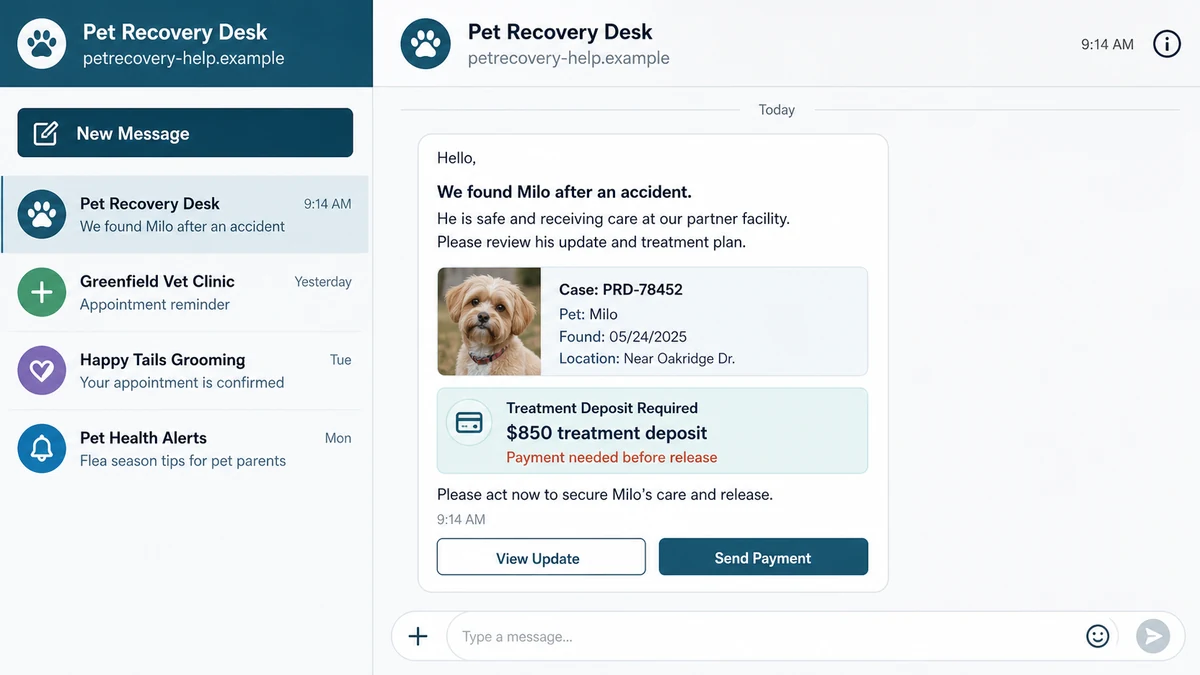
A message says someone found your missing pet. The sender knows the animal’s name, color, neighborhood, and the phone number from the flyer. Then a photo or short video appears to prove the story.
Relief lasts only a moment. The animal supposedly needs emergency treatment, and payment must arrive before a clinic will continue care or release it.
The AI pet emergency scam is built for that emotional collision. It gives the owner something familiar to recognize, then replaces verification with a clock.
Overview
Public pet information becomes a private-looking message
Missing-pet flyers and social posts often contain the animal’s name, photographs, breed, neighborhood, medical needs, and an owner’s contact number. That information is meant to help honest neighbors, but it also gives a scammer a ready-made script.
The message may come from someone claiming to be a finder, animal-control officer, police employee, veterinarian, shelter volunteer, or rescue coordinator. The sender can repeat details from the public post, making the approach feel personal and credible.
The FTC warned in June 2026 that criminals may use stolen, manipulated, or AI-generated pet images and videos to support false emergency stories. A convincing image is no longer reliable proof of who has the animal.
A fake emergency turns love into payment pressure
The pet is said to have been struck by a car, found dehydrated, picked up near traffic, or admitted for urgent treatment. The owner is told that a deposit must be paid before surgery, medication, transport, or release.
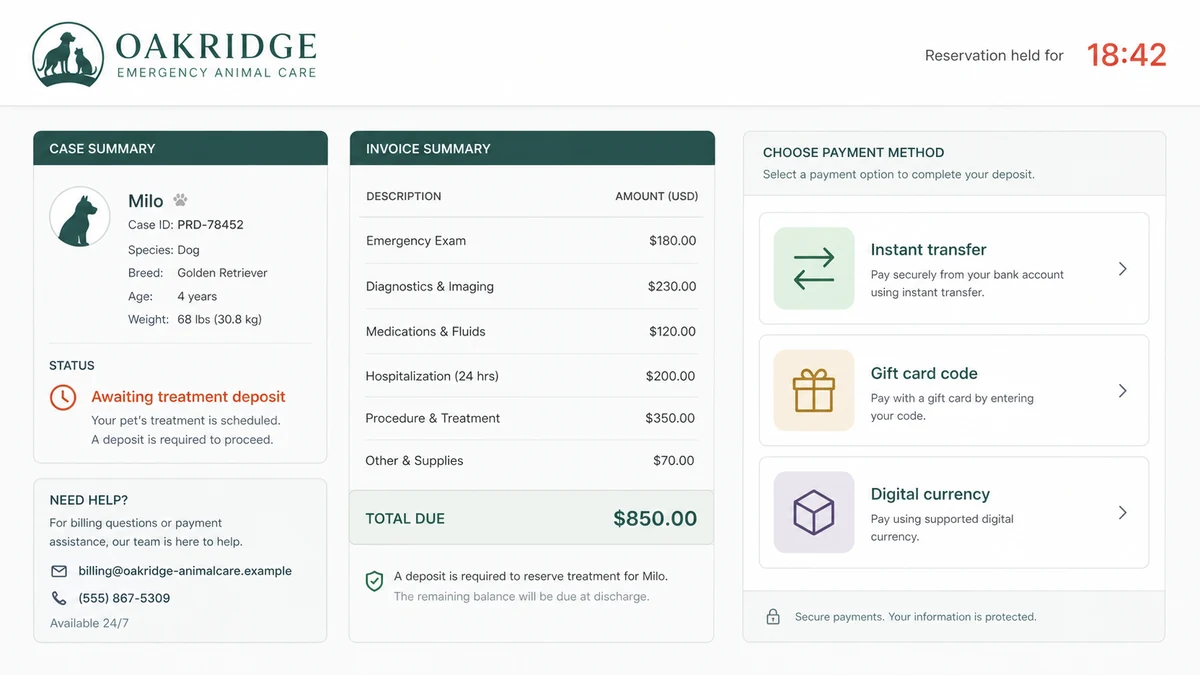
The requested method is often difficult to reverse: a payment app, gift card, cryptocurrency, wire transfer, or instant bank transfer. The sender may refuse a normal card payment or a direct payment to the clinic.
The cruelty is deliberate. An owner who would normally question a stranger may act immediately when delay is framed as suffering.
The picture can be true, altered, or generated
A scammer does not always need advanced AI. A photograph can be copied from the owner’s post, cropped, darkened, or placed inside a fake clinic portal. Another animal with similar markings may be used.
Generative tools can create a new image, add bandages, change a background, or produce a short emotional clip. Poor quality is not required. The stronger test is whether the sender can prove live possession without controlling every part of the verification.
Warning signs include:
- The sender repeats only details already posted publicly.
- A clinic name is supplied, but the owner cannot call it independently.
- Payment is required before a live conversation or pickup location.
- The sender refuses to describe a private identifying feature.
- A photo is treated as proof while a live video is avoided.
- The payment recipient does not match the clinic or shelter.
- Gift cards, crypto, wire, or an unrelated payment account are required.
- New medical, transport, or release fees appear after the first payment.
Why This Scam Can Feel More Real Than an Ordinary Impostor Call
A missing pet creates an open line to strangers. Owners expect calls from unknown numbers and may answer questions they would normally treat as suspicious.
The public post also supplies emotional context. A sentence such as “Milo needs medication” can be reused as a threat: pay now because the pet’s condition is getting worse.
Scammers may contact an owner soon after the post appears, before shelters, neighbors, and animal-control offices have completed their checks. The speed makes the message feel connected to the disappearance.
Caller ID and display names are weak evidence. A sender can label a payment account with a clinic-sounding name, copy an animal hospital’s logo, or use a phone number from the same area code.
A familiar pet photo creates the strongest shortcut. Owners see their animal and stop asking who produced the image, when it was captured, or whether it proves current possession.
The safest response is not to debate the image. Move the conversation to a verification step the sender did not design.
How the AI Pet Emergency Scam Works
Step 1: The scammer finds a missing-pet post
Local social groups, lost-pet databases, public flyers, and neighborhood pages provide recent targets. The scammer records the pet’s name, appearance, last location, owner contact, and any reward.
Comments may reveal where the owner has already searched and which shelters have been called. That makes it easier to invent a location or organization that sounds plausible.
Step 2: A trusted role is chosen
The criminal claims to be connected with a clinic, shelter, animal-control office, police department, rescue group, or helpful neighbor. A copied logo and professional vocabulary add authority.
Some versions avoid naming an organization at first. The caller says a friend or partner facility has the pet, then introduces a billing contact when money is discussed.
Step 3: An image or video supplies emotional proof
The owner receives a photograph, video, intake card, medical summary, or portal link. The material may use a copied image of the real pet, another animal, or AI-generated content.
Visual details distract from missing operational facts. A genuine clinic should have an independently verifiable address, phone number, licensed staff, and a patient record that can be confirmed through its official front desk.
Step 4: The animal is placed in immediate danger
The story introduces an injury, required scan, surgery, medication, boarding deadline, or transport problem. The owner is warned that treatment cannot continue without a deposit.
The scammer may say privacy rules prevent a video call or that staff are too busy to answer. Those explanations keep the owner inside the scammer’s communication channel.
Step 5: A cash-like payment is demanded
Gift cards, cryptocurrency, instant transfers, wires, and payment apps are favored because the sender can receive money quickly and disappear. The recipient may be an individual rather than the named clinic.
A legitimate animal hospital may require payment, but it should not object when the owner calls a verified number, confirms the patient, and pays through its established process.
Step 6: The first payment creates another emergency
After the deposit, the supposed injury becomes more serious. Additional medication, specialist care, transport, boarding, or release paperwork creates a second charge.
If the owner questions the demand, the scammer uses guilt. The victim may be told that refusing payment is delaying care or abandoning the pet.
Step 7: The contact disappears or changes identity
Once payments stop, the phone number, account, page, or portal may vanish. Another person may then claim to be a supervisor, investigator, or refund agent.
That follow-up is not proof of a larger organization. It may be the same group attempting to collect a final fee or more identity information.
How to Prove Someone Really Has Your Pet
Ask for a live video call and choose a simple action during the call, such as showing the pet beside a handwritten current date or panning continuously from the animal to the room. A prerecorded clip cannot respond.
Do not disclose every private identifying feature. Ask the finder to describe something not visible in public photographs, such as a marking under the collar, a chipped tooth, a scar, or a behavior known to the family.
If a clinic is named, end the call and find the clinic through a trusted directory or map search. Call the published front-desk number. Ask whether the pet is present, who admitted it, and how payment is normally handled.
Contact local shelters, animal control, microchip registry, veterinarians, and police directly. A genuine finder should not object to an official or trusted third party helping confirm possession.
Use reverse image search on every photo. Results may show that the image came from the owner’s own post, an unrelated rescue, an old news story, or another animal’s fundraiser.
Look closely at video continuity, but do not rely on visual defects. AI content can be clean, and a real copied video can show no artifacts at all.
MalwareTips has a separate guide to online puppy scams, where stolen animal photos are used to sell pets that do not exist. The payment pressure differs, but the verification rule is the same: an image is not custody.
If a reward was offered, arrange exchange through police, animal control, or a public shelter. Do not send the reward before the pet is safely recovered.
How AI Changes the Evidence Without Changing the Safety Rule
AI can make a false pet image faster and more personalized, but it does not create custody. The sender still has to prove where the animal is and allow independent confirmation.
Look for inconsistency across the whole story, not only strange pixels. The case number, clinic, veterinarian, time, location, payment recipient, and treatment description should form one verifiable record.
A generated image may contain distorted fur, unreadable tags, mismatched markings, or impossible medical equipment. Those flaws can help, but their absence does not make the image authentic.
A real photograph can be weaponized more easily than a generated one. The owner may have uploaded several angles, giving the scammer enough material to create a convincing update without altering anything.
Video is not automatically stronger. A clip may be old, stolen, edited, or generated. Ask for a live response to an unpredictable request while keeping the request safe for the animal.
Voice can also be fabricated. A caller may imitate professional clinic language or use synthetic audio. The voice should never override a call to the provider’s independently verified front desk.
Metadata can sometimes reveal when or how a file was created, but messaging apps often remove it. Missing metadata is not proof of fraud, and plausible metadata is not proof of custody.
Owners should avoid sending more private photos to “help with identification” until the caller proves possession. New images can improve the scammer’s material and expose home details.
If the sender asks for a code sent to your phone, stop. The code may reset a social, email, microchip, or payment account rather than confirm pet ownership.
A microchip number is sensitive but not magical proof. Contact the registry yourself and update the missing status. Do not surrender account access or transfer registration through a link sent by a stranger.
The practical standard remains simple: independent institution, independently sourced contact, live possession, private identifier, and payment only through a verified provider after the pet is confirmed.
When those checks cannot be completed, continue the search through shelters, neighbors, veterinarians, and animal control. Do not let a convincing file pull attention away from reliable recovery channels.
Ask one trusted person to review the message before money moves. Someone who is less emotionally involved may notice that the clinic domain, payment recipient, and claimed location do not agree.
If the caller becomes angry when verification begins, end the contact. A genuine finder may be impatient, but protecting the animal does not require hiding the facility, refusing police involvement, or demanding gift cards.
Continue updating the original missing-pet post with safe, verified information. Warn others about the scam account without publishing private payment or identity data that could interfere with a report.
Keep the legitimate search active until the animal is physically recovered. A false sighting can waste crucial time by persuading the family that the pet is already safe somewhere else.
Company, Address, and Fulfillment Checks
The clinic name must match a real legal provider
Search the exact clinic or shelter name and compare its official website, professional license records, map listing, and business registration. Criminals often borrow the identity of a genuine provider that has no connection to the message.
Call the verified provider and describe the message. Do not blame the real clinic until it confirms whether the case, employee, and payment request belong to it.
The address must be a place that can receive the animal
A veterinary clinic, municipal shelter, and rescue foster have different operations. Confirm the physical location and whether the pet can be seen or collected there.
A mailbox, virtual office, unrelated residence, or copied address does not establish custody. If the sender refuses to provide a location until payment, stop.
Support must answer through an independent channel
Use a phone number found outside the message. Ask the front desk to confirm the case number, pet name, intake time, veterinarian, and invoice.
A generic “billing department” reachable only by chat, text, or reply email is not enough. The employee requesting money should be traceable inside the organization’s normal system.
The care and payment chain must be traceable
The named provider should explain what care was given, who authorized it, and why the invoice goes to the listed recipient. The payment account should belong to the clinic or a disclosed processor.
Gift card codes and personal crypto wallets are not normal evidence of veterinary care. A professional-looking portal cannot replace a patient record confirmed by the real facility.
What to Do if You Have Fallen Victim to This Scam
- Stop communicating long enough to verify the pet. Call shelters, animal control, police, the microchip registry, and any named clinic through independently sourced numbers.
- Contact the payment provider immediately. Tell the bank, wire service, payment app, gift card issuer, or crypto exchange that the transfer followed an impersonation and pet-emergency scam. Ask about recall, reversal, or freezing the recipient.
- Do not pay a second invoice. Surgery, transport, boarding, release, and refund fees may extend the same false story.
- Preserve every detail. Save messages, caller numbers, payment accounts, usernames, URLs, images, videos, portal pages, invoices, and transaction references. Keep original files because metadata may help an investigation.
- Notify the impersonated organization. A real clinic, shelter, rescue, or police department can warn others and confirm that its name was misused.
- Report the fraud. File with the FTC at ReportFraud.ftc.gov, local police, the FBI’s IC3 when appropriate, the social platform, and the payment service.
- Secure exposed accounts. If you entered a password into a portal, change it from the real service, enable multi-factor authentication, and remove unknown sessions, forwarding rules, and recovery methods.
- Protect identity information. If the sender collected a driver’s license, address, insurance details, or financial records, use IdentityTheft.gov to build a recovery plan and consider credit freezes.
- Scan devices that opened files. Run a full Malwarebytes scan if you downloaded an attachment, installed an app, or opened an unusual file. The scan can identify malware that may have arrived with the fake medical update.
- Block malicious follow-up pages. AdGuard can reduce exposure to known scam domains, malicious ads, and trackers. It cannot authenticate a veterinarian or locate the pet, so independent calls remain essential.
- Warn people helping with the search. Ask friends and group moderators not to disclose private markings, verification answers, or new locations publicly.
- Reject paid recovery promises. No stranger can guarantee a refund or pet recovery for an advance fee. Work with the payment provider and legitimate authorities.
Frequently Asked Questions
Can scammers make a convincing video of my pet?
They may copy a real clip, alter an image, use a similar animal, or generate new media. Verify live possession and private identifying details instead of judging image quality.
What if the caller knows my pet’s name and neighborhood?
Those details may come from a public flyer or social post. Ask for information that was never published and confirm through a shelter, clinic, or police.
Do real veterinarians ask for deposits?
Some clinics require payment, but the owner should be able to call the real facility, confirm the patient and treatment, and use its established payment process.
Should I pay the reward before seeing the pet?
No. Arrange a safe handover, preferably through a shelter, animal-control office, or police. A reward should not be released before recovery is confirmed.
Can reverse image search prove a photo is fake?
It can expose a copied image, but no result does not prove authenticity. New, cropped, private, or AI-generated images may not appear in search.
What should I keep private in a missing-pet post?
Keep one or two identifying details unpublished. Limit unnecessary personal information and tell helpers to send sightings privately rather than revealing verification answers in comments.
The Bottom Line
The AI pet emergency scam turns a real search into a manufactured medical crisis. A familiar face, name, or video is designed to make the payment request feel like rescue.
Pause before paying. Move the claim to an independently verified clinic, shelter, animal-control office, or live proof process. Someone who truly has your pet should help establish custody, not use the animal’s safety to block verification.

Join the discussion
0 commentsShare your experience or ask a question about this article.
Discussion
Start the conversation
Have a question or something useful to share? Add the first comment.