

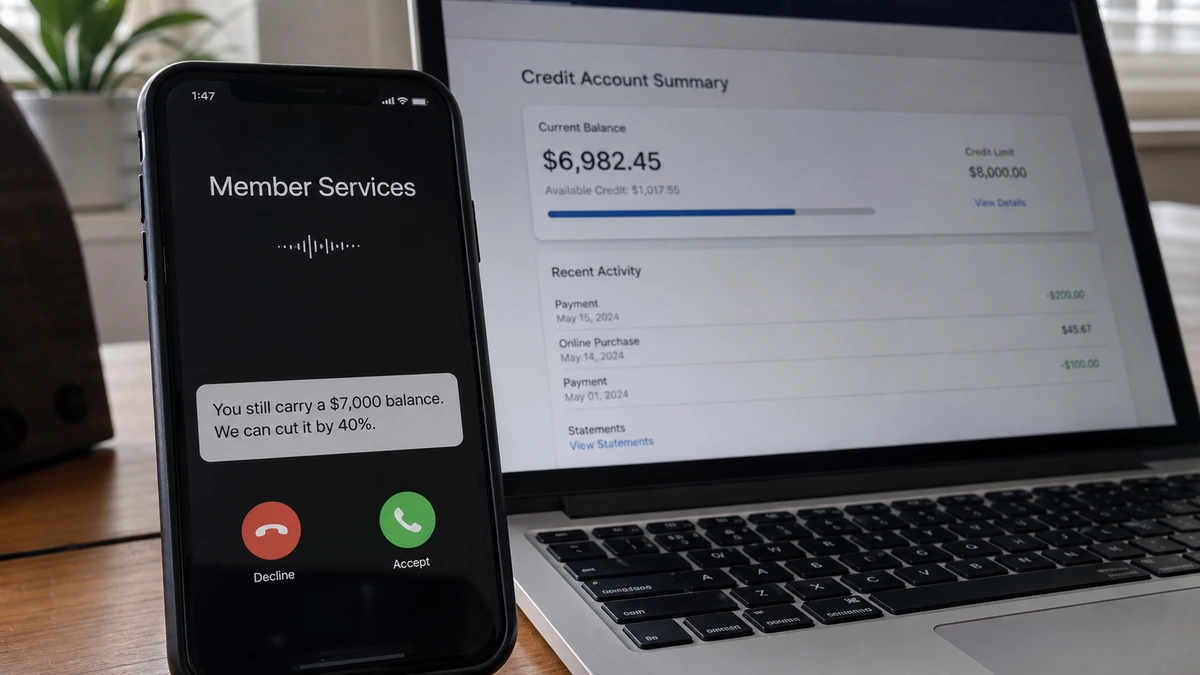
The AI Debt Relief Call did not begin with a vague guess. The caller used the recipient’s name and stated the real balance on a credit card: about $7,000.
That accuracy made “member services” sound connected to an account the caller could see. The next questions quietly tested how much more financial information the recipient would reveal.
Overview
The exact balance was the trust shortcut
A recent consumer report describes an unexpected call from someone claiming to represent “member services.” The caller knew the recipient’s name and said the person was making payments while still carrying a $7,000 credit card balance.
The figure was accurate. The recipient therefore treated the call as if it might be connected to a card issuer, account benefit, or authorized financial service.
The caller never clearly identified the card, issuer, legal company, or source of the information. “Member services” sounded familiar but did not say whose member or which service.
The conversation became a debt qualification interview
After establishing credibility, the caller asked for the recipient’s total credit card debt. He suggested a program might reduce the balance by about 40% and asked whether the cards had collateral.
Those questions did not verify an existing account. They collected new information about the recipient’s finances and vulnerability to a settlement pitch.
The call then shifted awkwardly. The speaker placed the recipient on hold, returned with an unnatural transition, appeared to speak to another person, and the call ended. The recipient wondered whether an AI-generated or automated voice had been involved.
Accuracy does not prove authorization
The exact balance is alarming, but it does not establish how the caller obtained it. Possible sources include a marketing lead, data broker, breached record, exposed account data, a prior application, or another unauthorized source. The report does not identify which explanation applies.
The FTC now specifically warns that unexpected credit-card relief callers may know a real balance, partial Social Security number, or ZIP code. That information is used to create trust, not to prove the caller represents the card issuer.
Warning signs in the AI debt relief call included:
- The call was unexpected and came from an unrecognized number.
- “Member services” did not identify a legal company or card issuer.
- The caller knew one accurate figure but asked the recipient for the remaining debt total.
- A reduction of about 40% was mentioned before a documented review.
- The caller asked about collateral on credit cards.
- No written terms, fees, risks, or creditor details were provided.
- The transfer and hold sequence sounded unnatural.
- The call ended before the supposed program was clearly identified.
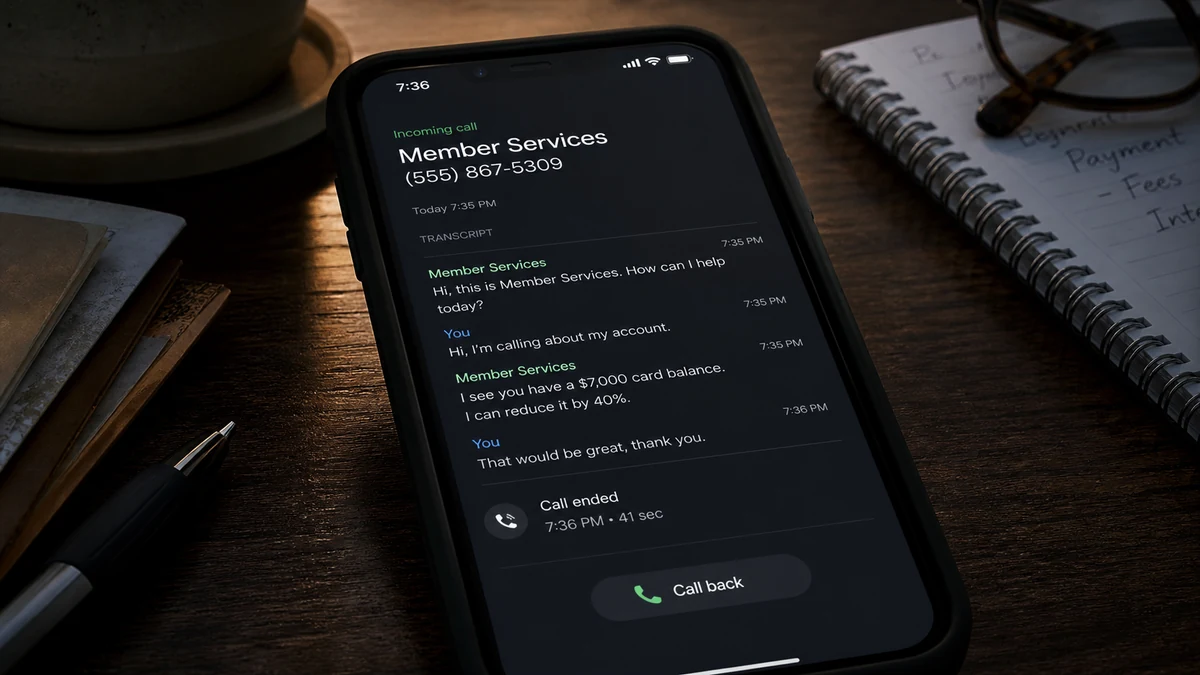
Why the Exact $7,000 Balance Does Not Authenticate the Caller
People use private facts as identity checks. A caller who knows a balance appears to be reading a bank screen, so the recipient may stop asking who initiated the contact.
But a balance is data, not authority. Information can move through credit marketing, loan inquiries, lead forms, service providers, compromised accounts, and criminal data markets. A person possessing it is not automatically entitled to discuss the account or sell a remedy.
The FTC’s April 2026 alert, Say no thanks to unexpected offers to lower your credit card interest rate, describes this exact credibility tactic. It says scammers may know real account details and advises cardholders to call the number on the back of the card instead.
The recipient in the public report supplied a total debt estimate and answered a collateral question. That disclosure does not automatically give the caller access to the bank account. It does, however, make the lead more detailed and valuable for future targeting.
A follow-up caller can now refer to the amount, the lack of collateral, and the person’s interest in relief. The second call may sound even more informed than the first.
This is similar to the Hardship Relief Program call, which uses vague authority and a large financial promise to start a qualification conversation.
How the AI Debt Relief Call Scam Works
Step 1: A financially relevant lead is selected
The operation starts with a phone number and enough information to make a debt pitch plausible. Some lists may contain a name, approximate balance range, credit interest, or history of responding to loan offers.
The caller does not need a complete credit file. One accurate detail can make the target volunteer everything else.
Step 2: A generic department name borrows authority
“Member services,” “account services,” and “card services” sound like departments consumers have heard before. The names avoid a direct false statement about one identifiable bank while encouraging the recipient to supply that connection mentally.
If challenged, the caller may give a new company name, claim to work with several issuers, or say the file was referred by a partner.
Step 3: The caller states a real balance
The $7,000 figure changes the call from random marketing into what feels like unfinished account business. The recipient begins verifying the caller instead of requiring the caller to verify himself.
Caller ID adds no reliable proof. Numbers and displayed business names can be spoofed or rotated.
Step 4: New financial information is collected
Questions about total debt, income, payment status, collateral, available credit, hardship, and employment build a more complete profile. The questions can be presented as a no-obligation eligibility check.
Even without a Social Security number, those answers help a sales desk decide which product to pitch and how much pressure the recipient may tolerate.
Step 5: A dramatic reduction is offered
A promise to cut debt by about 40% is emotionally powerful because it gives the recipient an immediate picture of relief. It is not the same as an agreement from the creditor.
Debt settlement can involve fees, missed payments, collection activity, tax consequences, and credit damage. No honest provider can know the result before reviewing the debts and contacting creditors.
Step 6: Automation or an AI voice scales the pitch
An AI-generated voice can make a robocall sound conversational and respond to simple answers. A human agent may also use prompts, voice assistance, or a scripted transfer. The awkward exchange in this report raises the question, but does not prove which technology was used.
The FCC has stated that AI-generated voices fall within the TCPA’s treatment of artificial or prerecorded voices. Legal requirements still depend on the call, consent, and circumstances, but “AI” does not make an unsolicited sales call trustworthy.
Step 7: The lead becomes a fee, contract, or second sale
The next agent may request a Social Security number, bank information, card details, electronic signature, or payment. Another route is to sell the qualified lead to a debt-settlement, credit-repair, or loan marketer.
In a direct scam, the victim pays before any debt is resolved. In a deceptive service, the victim may sign a costly program whose risks were hidden during the friendly first call.
Was the Voice Really AI?
The public report describes an unnatural hold sequence and a moment when the caller seemed to speak to another person using a prearranged phrase. That can happen with an AI voice, a recorded script, a call-center soundboard, poor audio, or a human agent following a rigid transfer process.
No recording or technical analysis was provided, so the safest conclusion is that AI was possible, not established. The fraud risk does not depend on settling that question.
A polished human voice can lie, and a synthetic voice can repeat accurate data. The correct test is whether the organization can be independently identified and whether the offer is documented through a channel you initiate.
Do not challenge a suspicious caller to prove they are human. That prolongs the call and may reveal more about how you respond. End it and contact the card issuer directly.
If the same voice calls again, save the voicemail and call log. Do not rely on voice recognition, because recordings and synthetic speech can be reused.
The focus should remain on authorization. A legitimate issuer representative can be reached through the number on the card, inside the authenticated banking app, or through the issuer’s official website.
How Legitimate Debt Help Differs
A real card issuer may offer hardship assistance, a temporary lower rate, a payment plan, or other account-specific options. Start that conversation yourself using a trusted number.
Nonprofit credit counseling can help evaluate a budget and possible debt-management plan. The counselor should explain fees, creditor participation, payment handling, and the effect on accounts before enrollment.
Debt settlement is different from debt management. A settlement company may ask consumers to stop paying creditors while money accumulates for negotiations. Interest, late fees, calls, lawsuits, and credit damage can continue.
The Consumer Financial Protection Bureau warns that creditors do not have to settle and that debt-settlement programs can leave consumers deeper in debt.
Under the federal Telemarketing Sales Rule, companies selling covered debt-relief services by phone cannot collect a fee before they settle or otherwise resolve at least one debt and the consumer makes a payment under that result. An upfront fee is therefore a decisive warning.
Compare any offer in writing. Confirm the legal company, physical address, state registration where applicable, fee schedule, cancellation rights, refund policy, and exactly what happens to creditor payments.
The older Credit National Assist debt-relief scam shows how an unsolicited call can progress from qualification questions to sensitive information and advance fees.
What Information May Now Be at Risk
In the reported call, the recipient disclosed a total debt amount and answered that the cards had no collateral. Those facts are sensitive, but they are not the same as giving a card number, online-banking password, one-time code, or Social Security number.
The immediate account-takeover risk is therefore lower than it would be after sharing credentials. The recipient should still expect targeted follow-up calls, texts, and emails.
Monitor credit reports and card activity. If the caller already knew a precise balance, the cardholder should ask the issuer whether there are unusual logins, profile changes, third-party access, or marketing inquiries.
Do not assume the bank experienced a breach. The source could sit elsewhere in a long data chain. Ask the issuer what it can verify and preserve the call details.
If a Social Security number, date of birth, or account credentials were also disclosed, place stronger identity protections immediately. A credit freeze can block many new-credit applications.
Be prepared for recovery impersonators. A second caller may claim the first was fraudulent and offer to secure the account. End that call too and return to the official issuer channel.
Questions to Ask the Card Issuer
Tell the issuer that the caller knew the approximate balance before you disclosed it. Ask whether the bank placed the call, used the displayed number, or shared the account with an authorized marketing partner.
Ask whether anyone recently accessed the online account, changed contact details, requested statements, added an authorized user, initiated a balance transfer, or triggered a credit inquiry. Record the representative’s answer and case number.
Confirm what information a legitimate issuer representative would already know and what information the bank would never request on an unsolicited call. That prepares the cardholder for a second contact using the same script.
Ask the issuer to place a verbal password or enhanced alert on the account if available. Do not choose a word the caller could guess from social media or data-broker records.
Review communication preferences and revoke marketing consent where possible. This will not stop criminal calls, but it reduces the number of legitimate sales contacts that a scammer can imitate.
If the issuer confirms it did not call, report the number and the exact balance disclosure to its fraud team. The pattern may help connect other complaints even when no unauthorized charge has occurred yet.
Do not call back the incoming number to test the explanation. A callback reaches the same unverified operation and can confirm that the number belongs to a responsive person with debt.
Keep the issuer’s written response with the call notes. If similar contacts continue, a documented pattern is more useful than trying to remember which caller used which company name.
Company, Address, and Fulfillment Checks
“Member services” is not a company
The phrase did not identify a bank, debt-relief provider, legal entity, or licensed professional. It described a department without naming the organization that supposedly operated it.
A real provider should give a legal name that can be checked before collecting financial details.
No verifiable business address was supplied
The report contains no physical office, official website, written contract, or regulatory disclosure connected to the caller.
An incoming phone number is not a business address and may not belong to the person displayed by caller ID.
The exact balance did not establish account authority
The caller did not identify the card issuer or prove access through a secure issuer message. Knowing the balance was persuasive information, not authentication.
The cardholder should verify the account only through the number printed on the card or the authenticated app.
No debt reduction was fulfilled
No creditor agreement, written analysis, fee disclosure, or settlement result was provided. The 40% figure was a sales claim made before documented review.
A real reduction exists only when the creditor and terms can be independently confirmed.
What to Do if You Have Fallen Victim to This Scam
- End contact. Block the number and do not continue a qualification call with another agent.
- Call the issuer directly. Use the number on the back of the card and explain exactly what the caller knew and what you disclosed.
- Review recent activity. Check charges, cash advances, profile changes, authorized users, contact details, and connected devices.
- Change compromised credentials. If you shared a login or reused password, change it from a clean device and revoke other sessions.
- Protect your identity. If a Social Security number or substantial identity data was disclosed, visit IdentityTheft.gov and consider freezing all three credit files.
- Save evidence. Keep the incoming number, time, voicemail, transcript, company names, and notes about every question.
- Report the call. File reports with the FTC, FCC, state attorney general, and card issuer as appropriate.
- Do not pay an upfront debt-relief fee. Stop any payment and ask the bank whether it can be reversed.
- Speak with creditors yourself. Ask about hardship options before signing a third-party settlement contract.
- Run a Malwarebytes scan. This is important if the caller sent a link, app, document, or remote-access tool that you opened.
- Use AdGuard after cleanup. It can reduce exposure to malicious follow-up links, although it cannot identify every fraudulent caller.
- Ignore refund agents. Government agencies will not charge a fee to recover money from the call.
Frequently Asked Questions
How could the caller know my exact credit card balance?
The report does not identify the source. Marketing records, lead forms, exposed data, an account compromise, or another broker could be involved. Ask the issuer what it can verify.
Did giving my total debt let the caller access my bank?
Not by itself. It creates a more detailed target profile, but account access normally requires credentials, card data, identity checks, or one-time codes.
Can a legitimate company reduce credit card debt by 40%?
A creditor may agree to a settlement in some circumstances, but no cold caller can guarantee that result before review. Settlement also carries fees and serious risks.
Was the caller definitely an AI voice?
No. The behavior raised suspicion, but a scripted human, soundboard, automated system, or AI voice could produce it. The unverified offer is the central issue.
Should I replace the card?
Ask the issuer. Replacement is urgent if the full card number, security code, login, or one-time passcode was exposed, or if unauthorized activity appears.
Where can I find real debt help?
Start with the card issuer and the CFPB’s official guidance. A reputable nonprofit credit counselor can also explain options without promising instant forgiveness.
The Bottom Line
The AI debt relief call did not earn trust by identifying a real company. It earned trust by stating a real $7,000 balance, then used that moment to collect more information and introduce a 40% reduction promise.
Accurate data can be stolen, purchased, or passed through a lead chain. End the call, contact the issuer through a number you already trust, and judge debt help by written terms and verified results, not by how much a stranger already knows.








