

The Fake $255 Shipping Fee appeared only after a buyer had sent $500 for a used drum set and expected ordinary UPS Ground delivery.
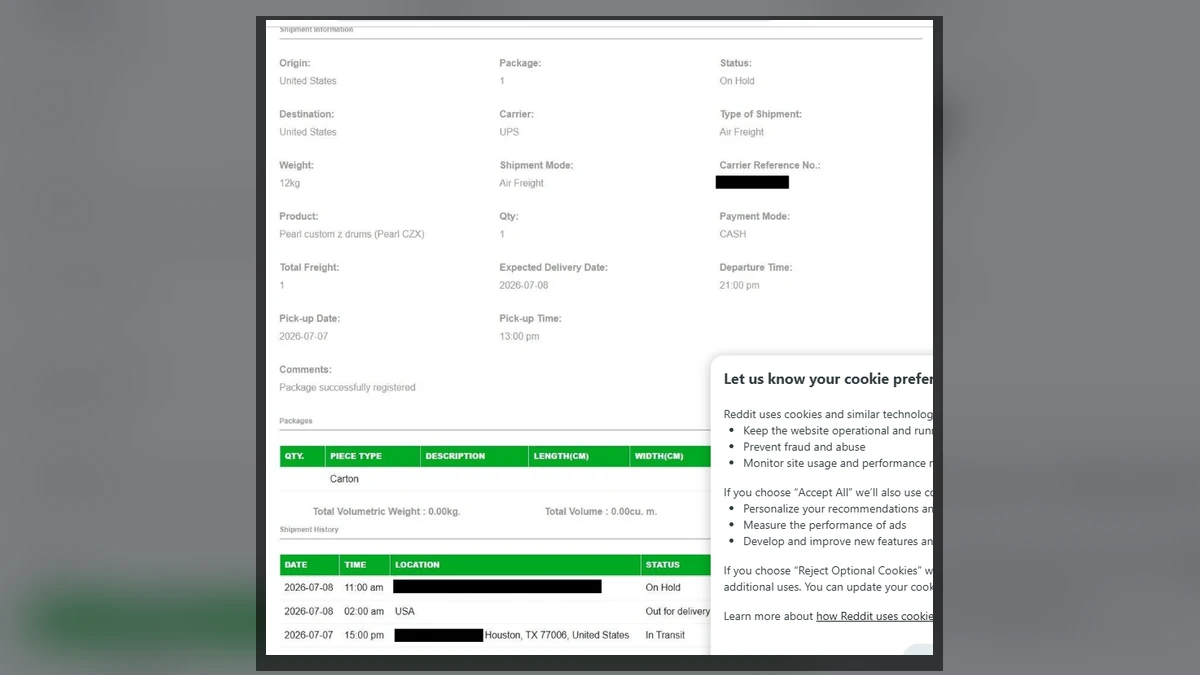
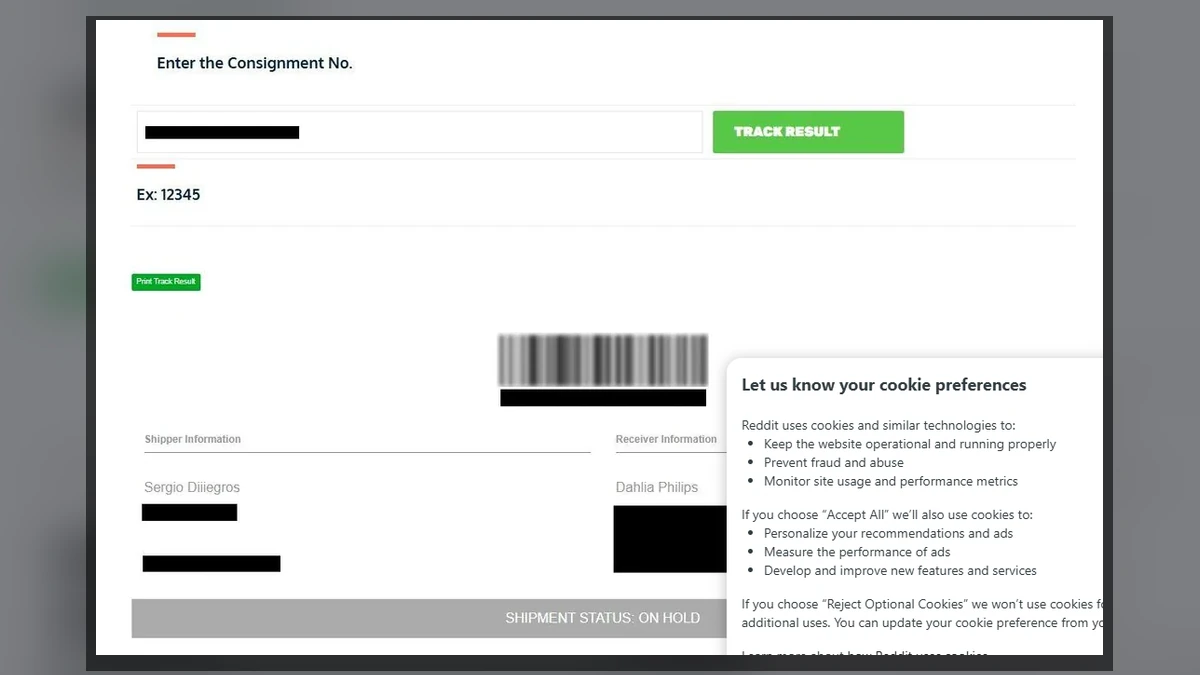
The seller then supplied a different tracking site, an on-hold shipment, and one more payment that was described as fully refundable.
Overview
The $500 purchase moved outside the agreed shipping plan
A buyer reported agreeing to purchase a drum set from a person in Houston for $500. Shipping was included, and both sides had discussed using the cheapest UPS Ground option.
The buyer sent the money through Zelle. Instead of a UPS tracking number, the seller later supplied a link to globalexpresslogistik.com and a tracking code beginning with letters associated with that site.
That switch is central. A seller who promised one carrier did not provide proof from that carrier. The buyer was moved into a tracking system controlled by an unfamiliar party connected to the seller’s story.
The tracker created an on-hold package and a refundable fee
The page displayed details resembling the real transaction, including a drum description and a route from Houston. The shipment was then marked on hold.
An email said the parcel was “VIP Cargo” and required $255 in refundable insurance. The additional charge had not been agreed when the $500 price and included shipping were discussed.
A refund promise makes the fee sound temporary, but it does not make the recipient accountable. If the same operation controls the seller, tracker, and payment instructions, it can invent both the hold and the refund.
The website contains serious internal credibility problems
At the time of review, Global Express Logistik displayed a Los Angeles address, a phone number, and broad claims about hundreds of offices across dozens of countries.
The live text also contained unrelated business names such as “Ascent Courier” and “One Time Shipping.” Its cargo-insurance section described retiring outdated IT assets rather than insuring freight. Those mismatches suggest a site assembled from recycled logistics copy.
Warning signs in the Fake $255 Shipping Fee story included:
- The buyer paid an unknown seller through Zelle before independently confirming shipment.
- The seller promised UPS Ground but supplied a different tracking website.
- The unfamiliar tracker already knew details from the private sale.
- The shipment became “VIP Cargo” without the buyer requesting that service.
- A $255 insurance payment appeared only after the original $500 was sent.
- The extra payment was labeled refundable without an accountable insurer or policy.
- The site mixed multiple courier names and unrelated service descriptions.
- The seller, tracker, and fee demand could not be verified as independent parties.
Why a Detailed Tracking Page Can Still Be Fake
A tracking page feels objective because it appears to sit between buyer and seller. It shows dates, locations, status changes, a barcode, and a reference number that seem generated by a logistics network.
But the seller already knows the item, price, origin, and destination. Anyone controlling a simple website form can enter those details into a database and produce a convincing result.
The page does not need to track a physical box. It needs only to move through statuses that justify the next request: registered, in transit, on hold, insurance required, customs fee due, or delivery scheduled.
Redacted information can increase credibility. A victim sees a familiar first name or city while black bars imply the site is protecting sensitive data.
Real tracking should be verified through the carrier’s own domain, reached independently. If a seller says UPS was used, the number should work at ups.com or through UPS support. A page that merely lists “UPS” as a carrier is not UPS verification.
The FTC’s warning about fake shipping notifications recommends contacting the shipper through a known website or phone number rather than using the message’s link.
How the Fake $255 Shipping Fee Scam Works
Step 1: A desirable item is offered at a workable price
The seller lists a drum set, pet, electronics, vehicle part, furniture, or another item difficult to collect in person. The price is attractive but not so low that it immediately looks impossible.
Conversation focuses on the item and shipping details. Photographs, serial numbers, or a plausible location can be copied from another listing.
Step 2: The buyer sends a payment with limited protection
The seller requests Zelle, Cash App, cryptocurrency, wire transfer, or another method intended for trusted contacts. The transaction is described as faster than marketplace checkout.
Zelle’s own security guidance says to send money only to people you know and trust. It also explains that an authorized payment generally does not carry purchase protection when an item never arrives or differs from its description.
MalwareTips’ guide to Facebook Marketplace buyer and seller scams explains why leaving protected checkout gives an unknown counterparty more control over payment and communication.
Step 3: A custom tracking number is supplied
After payment, the seller sends a professional-looking email from an unfamiliar courier. The tracker displays the correct product and route because those details were entered by the same operation.
The presence of a number does not show that a carrier scanned a parcel. Independent validation matters more than formatting.
Step 4: The package moves until it is placed on hold
The tracker may show pickup, departure, transit, and arrival events. Then a problem appears close enough to delivery that abandoning the purchase feels wasteful.
The problem can be insurance, customs, a crate, a permit, temperature control, inspection, storage, or refundable protection. It is designed around the item.
Step 5: A second payment is called refundable
The buyer is told that $255 must be sent to release the “VIP Cargo.” The fee may be described as a deposit returned in cash at the door.
No clear policy explains who holds the funds, what triggers the refund, or how to claim it. The refund exists only as a promise from the party demanding payment.
Step 6: New holds follow each successful fee
If the buyer pays, the tracker can create another obstacle. Customs, city permits, anti-money-laundering verification, warehouse rent, or an upgraded insurance certificate may be required.
The original $500 and each new payment make the next fee feel like the last chance to save the deal. This sunk-cost pressure is deliberate.
Step 7: The seller and courier disappear
When the buyer refuses, the seller may blame the courier or accuse the buyer of abandoning the parcel. The courier may threaten disposal, legal action, or daily storage charges.
Eventually the accounts block the buyer, the site changes domains, or the tracking page stops updating. Recovery scammers may then offer to trace the payment for another fee.
The UPS Detail Needs a Careful Correction
The public report suggested that UPS no longer handles freight. That statement should not be used as the deciding fact.
UPS offers ground services that can price certain shipments by freight characteristics, and its portfolio has changed over time. A large drum set is not automatically proof that a UPS reference is impossible.
The stronger contradiction is specific to the transaction. The buyer and seller agreed to UPS Ground, yet the seller produced a Global Express Logistik page rather than a trackable UPS number.
That page labeled fields in inconsistent ways, including UPS as carrier while also presenting itself as the tracking authority. The buyer did not independently select or contract with this courier.
When checking any shipment, avoid broad assumptions about what a carrier can transport. Call the carrier through its published site and ask whether the exact tracking number, service, and fee are genuine.
A real carrier can explain who created the label, whether the parcel received a physical scan, and which party is responsible for insurance. A custom page controlled by an unknown seller cannot provide independent confirmation.
What the Live Site Revealed
Global Express Logistik claimed to operate more than 631 distribution centers or offices across 350 cities in 47 countries and regions. Claims at that scale should leave a substantial independent footprint.
Yet the site text repeatedly drifted into other identities. One road-transport passage referenced “Ascent Courier.” Sea-freight and special-services passages referred to “One Time Shipping.”
The cargo-insurance description said it provided a scalable solution for customers retiring outdated IT assets. That text belongs to asset disposal, not shipment insurance.
The about page claimed operations since 2004, bonded drivers, a global fleet, and 24/7 offices. A recent-looking domain, generic template language, and no clear corporate registration supporting those claims create a serious verification gap.
Copy errors alone do not prove that every delivery is fictional. Combined with the seller’s broken UPS promise and the surprise refundable fee, they make sending another payment indefensible.
ICANN’s registration lookup can help compare a domain’s public creation record with claims of decades in business. Privacy-protected registration is common, but dates and registrar data can still expose contradictions.
Why “Refundable Insurance” Is Such an Effective Demand
Insurance sounds responsible. Buyers know valuable goods can be lost or damaged, so a protection charge appears more legitimate than a random request for extra shipping.
The word “refundable” removes the apparent cost. The buyer is encouraged to think of the $255 as a temporary hold that will return when the drum set arrives.
Real insurance does not become real because a courier promises a refund. There should be an identifiable insurer, policy wording, coverage period, beneficiary, premium, exclusions, and claims process.
A refundable deposit should also explain who safeguards the funds. Money sent directly to a person, payment-app account, or crypto wallet is not escrow merely because the email uses that word.
The timing is another clue. Insurance was introduced after the buyer and seller agreed that $500 included shipping. A material new term appeared only after the buyer had lost bargaining power.
The “VIP Cargo” label supplies artificial status. It suggests the shipment has been upgraded into a category with special rules, even though the buyer requested the cheapest ground service.
Pressure may include a deadline, daily storage charge, or threat that the package will be confiscated. Those consequences are generated inside the same unverified tracking system.
The older MalwareTips report on the “additional shipping fees” email scam shows how a delivery problem can be used to collect payment details. This drum-set case adds a fake seller and custom tracking record before the fee.
Ask for the insurer’s legal name and call it through a number found independently. Request the policy before paying. A genuine company can explain coverage without requiring secrecy or an immediate person-to-person transfer.
Do not be reassured if the courier offers to refund the fee in cash at delivery. That promise postpones verification until after the irreversible payment has been sent.
The simplest calculation is also the most useful: a seller who included shipping should resolve an unexpected carrier charge with the carrier. The buyer should not finance a contract they never made.
If the courier claims local law requires the deposit, ask for the statute and the responsible public agency. Contact that agency through a government website, not through a number inside the payment email.
Save the fee invoice as a file or screenshot before the tracker changes. Compare the payment recipient with the company named on the document. A mismatch between a supposed insurer and a personal recipient is another reason to stop.
Legitimate insurance can have real conditions, but they should be disclosed before shipment and documented by accountable parties. Surprise, urgency, and a refund promise are not documentation.
How to Buy a Shipped Marketplace Item More Safely
Keep payment inside a marketplace with buyer protection whenever possible. A seller who insists on leaving the platform is asking you to give up the dispute route designed for that transaction.
Use a credit card or protected checkout rather than a person-to-person transfer. The FTC’s guide to buying through online marketplaces recommends safer payment methods and checking the platform’s refund process.
Reverse-search listing images and exact phrases from the description. Ask for a new photograph showing the item beside a handwritten date and a specific requested detail.
For expensive or bulky goods, verify the seller through a live video walk-through, serial numbers, and a written bill of sale. None of these checks is perfect, but together they make copied listings harder to sustain.
Choose the carrier yourself or buy the label through the marketplace. Confirm the tracking number on the carrier’s official site and look for an acceptance scan, not merely “label created.”
Never pay a surprise insurance, crate, customs, or permit fee to a contact supplied only by the seller. Stop and verify with the real carrier before the sunk cost grows.
Company, Address, and Fulfillment Checks
The Global Express Logistik company identity was not verified
The site presented a brand, phone number, email, and sweeping operational claims. The review did not find an independently established corporate chain matching the scale described.
Its internal references to Ascent Courier and One Time Shipping weaken confidence that the content was written for one accountable logistics company.
The Los Angeles address did not prove control of an office
The site listed 645 W 9th St #110, Los Angeles, CA 90015. A written address does not show that the website operator leases, staffs, or receives freight there.
Do not visit or confront people at a listed location. Verify occupancy through property records, business filings, and the building’s published management contact.
The insurance description did not identify an insurer or policy
A legitimate refundable insurance demand should identify the insurer, policy number, coverage, insured party, premium, refund basis, and payment recipient.
The site’s public cargo-insurance copy instead discussed outdated IT assets. That mismatch does not support a $255 cargo deposit.
No independent carrier scan confirmed fulfillment
The tracking page displayed transaction details, but the buyer did not receive a UPS tracking number that could be verified through UPS.
A status generated on the seller-linked site does not establish that a drum set was collected, weighed, scanned, or placed on a delivery vehicle.
What to Do if You Have Fallen Victim to This Scam
- Do not send the $255 or any later fee. A new payment will not make the original transfer safer.
- Contact your bank and Zelle immediately. Report the seller, recipient details, amount, date, and fraudulent sale. Ask whether the receiving institution can be alerted.
- Preserve the full transaction. Save the listing, seller profile, chats, Zelle confirmation, emails, tracking pages, headers, phone numbers, and payment instructions.
- Report the seller to the marketplace. Include evidence that the promised carrier changed after payment.
- Report the domain and payment recipient. File with the FTC and IC3, and provide the report numbers to the bank.
- Do not threaten the delivery address. Names and addresses shown on a tracker may belong to unrelated people or other victims.
- Change exposed credentials. If you created an account on the tracking site or reused a password, change it everywhere and secure your email.
- Scan suspicious downloads. If the courier asked you to install a tracking app or open a file, run a full scan with Malwarebytes.
- Block malicious follow-up links. AdGuard can reduce exposure to known phishing pages and malicious ads, but it cannot reverse an authorized Zelle payment.
- Ignore recovery guarantees. Work only with your bank, Zelle, the marketplace, and law enforcement.
Time matters, but honesty matters too. Tell the bank that you authorized the transfer because the seller misrepresented a sale. Do not describe it as an account takeover if that is not what happened.
Frequently Asked Questions
Is the $255 insurance really refundable?
There is no independently verified insurer, policy, or escrow supporting the promise. Treat the refund claim as part of the fee demand.
Does a working tracking number prove shipment?
No. A site operator can create a database entry from details supplied by the seller. Verify the number through the carrier named in the original agreement.
Was it impossible for UPS to ship the drum set?
No. Carrier capabilities are not the decisive issue. The problem is that the seller promised UPS Ground but supplied an unrelated tracker and surprise fee.
Can Zelle reverse the $500 payment?
Recovery is not guaranteed for an authorized payment. Report it immediately anyway so the bank can review the recipient and any available recall options.
Should I pay because I already spent $500?
No. The original loss does not make the new fee safer. Sunk-cost pressure is how one payment becomes several.
What if the seller says the courier is independent?
Independence must be verified outside the seller’s contacts. A domain, tracking page, and email supplied by the same person do not establish it.
The Bottom Line
The Fake $255 Shipping Fee depended on a convincing handoff. The seller received $500, a custom tracker created a believable drum shipment, and “VIP Cargo” supplied the reason for another payment.
The buyer did not need to solve every claim about freight. The carrier changed, the new fee was never agreed, and no independent scan or insurer supported it. Stop at that point, preserve the evidence, and report the payment rather than funding the next invented hold.








