

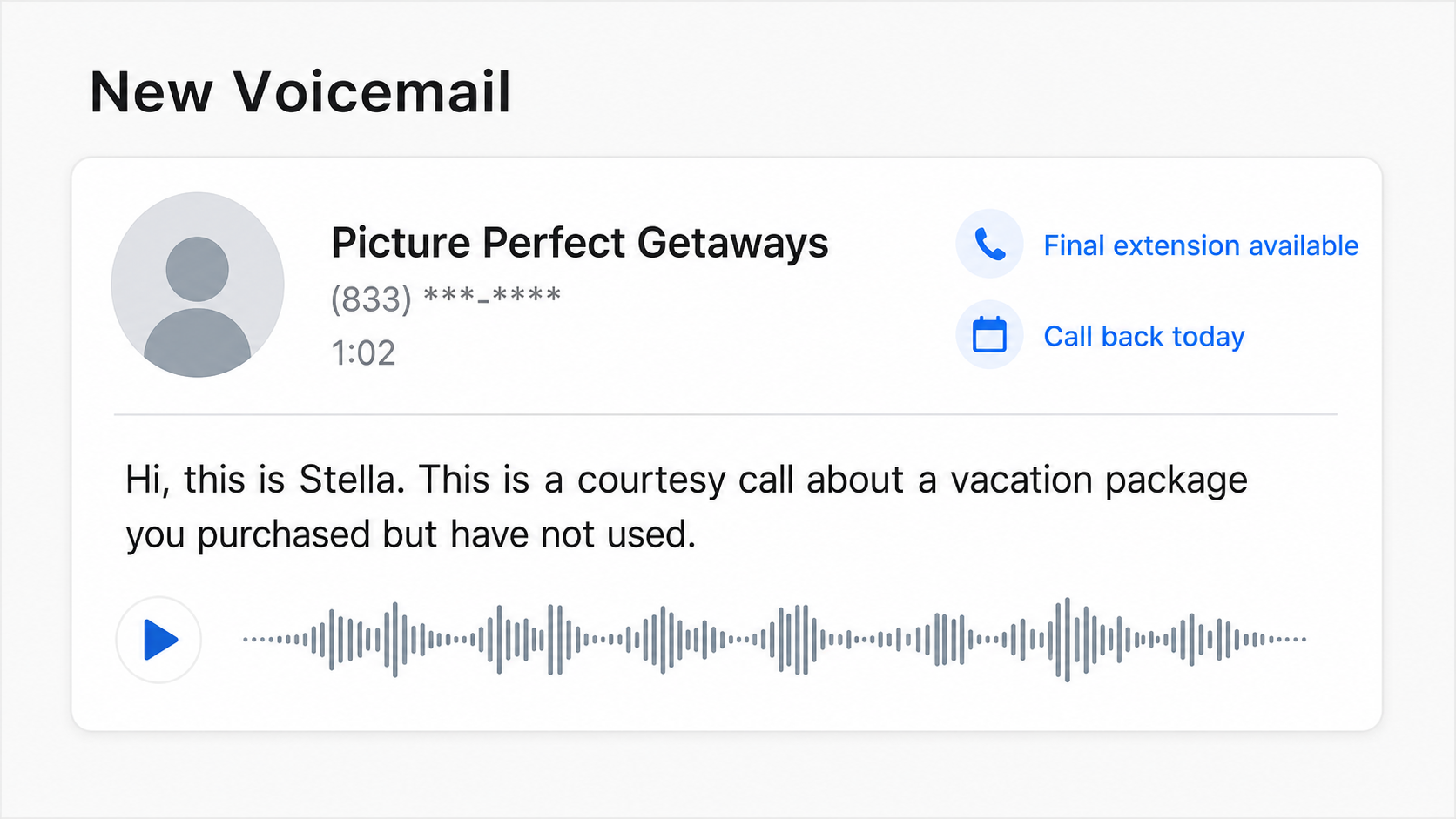
The voicemail sounds oddly familiar. A woman named Stella says a vacation package you once bought is still waiting, but its final extension is about to expire.
Even people who cannot remember the purchase may wonder whether it came from an old trip, promotion, timeshare visit, or forgotten booking.
Overview
The call claims you already own a vacation package
The Picture Perfect Getaways scam call does not begin like an ordinary sale. The recorded voice insists the recipient previously purchased a travel package.
The message says repeated attempts were made to reach the customer. It claims travel partners granted one final extension before the package expires.
That framing changes the emotional question. Instead of asking whether to buy, the listener worries about losing something already paid for.
The callback opens the real sales or fraud conversation
The voicemail provides a number and urges immediate contact. Calling back confirms the number reaches a person willing to engage with the travel story.
The operator may request a name, email, address, card details, or an activation fee. Another version can lead into a vacation club or timeshare presentation.
The exact endgame can vary between call centers. The unsolicited message is designed to create a warm lead from a cold robocall.
- The caller speaks as if a prior purchase is already established.
- No booking number, travel date, destination, or original seller is provided.
- “Final extension” creates pressure without offering verifiable records.
- The callback number may differ from the caller ID.
- The recipient is encouraged to supply information the caller should already possess.
Treat the message as a scam unless independently verified
A legitimate travel company should identify the original transaction, package terms, amount paid, booking reference, legal seller, and official account where the record appears.
Do not verify the story by calling the number in the voicemail. Find the original company through old statements or independently located contact information.
If no matching purchase exists, there is nothing to reactivate. The caller’s urgency does not create a real asset or reservation.
The safest response is to delete the message, block the number, and avoid confirming personal or payment information.
What the Picture Perfect Getaways Voicemail Says
A recent reported message begins with “Hi, this is Stella calling from Picture Perfect Getaways.” The speaker quickly adds that it is not a sales call.
That denial matters because the remaining script behaves exactly like lead generation. It asks the listener to return a call about travel.
The recording says a vacation package was previously purchased but never used. It claims several earlier contacts failed and a final extension was arranged.
No useful transaction details appear. The message does not state when the package was bought, how much it cost, or which card paid.
It also omits the destination, hotel, airline, confirmation number, seller, and expiration terms. Those are the facts a real account notice would normally include.
Instead, the script supplies a story broad enough to fit millions of people. Many adults have entered travel drawings, attended resort presentations, or booked discounted trips.
The listener fills the empty spaces with personal memory. That psychological participation makes the vague claim feel more specific than it actually is.
Why “This Is Not a Sales Call” Is a Warning
Scam and lead-generation calls often disarm suspicion before presenting the pitch. Saying “courtesy call” makes the contact sound administrative rather than commercial.
The caller also uses the language of ownership. “Your package” is more persuasive than “a vacation offer” because it suggests sunk money and existing rights.
“Final extension” then creates a deadline without naming an actual date. The listener feels urgent pressure while remaining unable to verify the event.
Repeated-contact language adds legitimacy. If a company supposedly called several times, the current message can feel like the end of an established process.
In reality, the recipient may be one entry in a large dialing list. Robocall software can deliver the same recording to thousands of numbers cheaply.
Responding tells the operation that the number is active and the owner listens to travel messages. That information has value even before payment occurs.
How the Picture Perfect Getaways Scam Call Works
Step 1: A robocaller reaches a large list
The campaign begins with automated calls or voicemails sent across many area codes. The operation does not need to know who bought a vacation.
It only needs a small share of recipients to have enough travel history that the claim feels plausible.
Spoofed caller ID can make the call appear local. A different callback number can route responses to a central sales or fraud team.
Step 2: The script invents a forgotten asset
The caller says a vacation package already belongs to the recipient. No evidence is offered because vagueness lets the listener supply the missing history.
Someone who visited a resort booth may remember a drawing. Another person may think of a cruise certificate or a discounted hotel package.
The scam exploits uncertain memory rather than creating a completely unfamiliar story.
Step 3: A final deadline forces the callback
The package supposedly survived several extensions, but this one is the last. Acting today appears safer than risking the loss of previous money.
No written deadline or contract is provided. The time pressure exists only inside the caller’s script.
A genuine company can send an itemized notice and allow verification. A scammer benefits when the victim stays on the telephone.
Step 4: The operator gathers personal details
After the callback, an agent may ask for a name, email, date of birth, address, or spouse’s information to “locate” the package.
Those questions reverse the burden. The caller claimed to possess the account, yet the consumer supplies the data needed to build one.
Even without payment, the collected details can enrich marketing lists, support identity fraud, or make future calls more convincing.
Step 5: A fee appears to reactivate the benefit
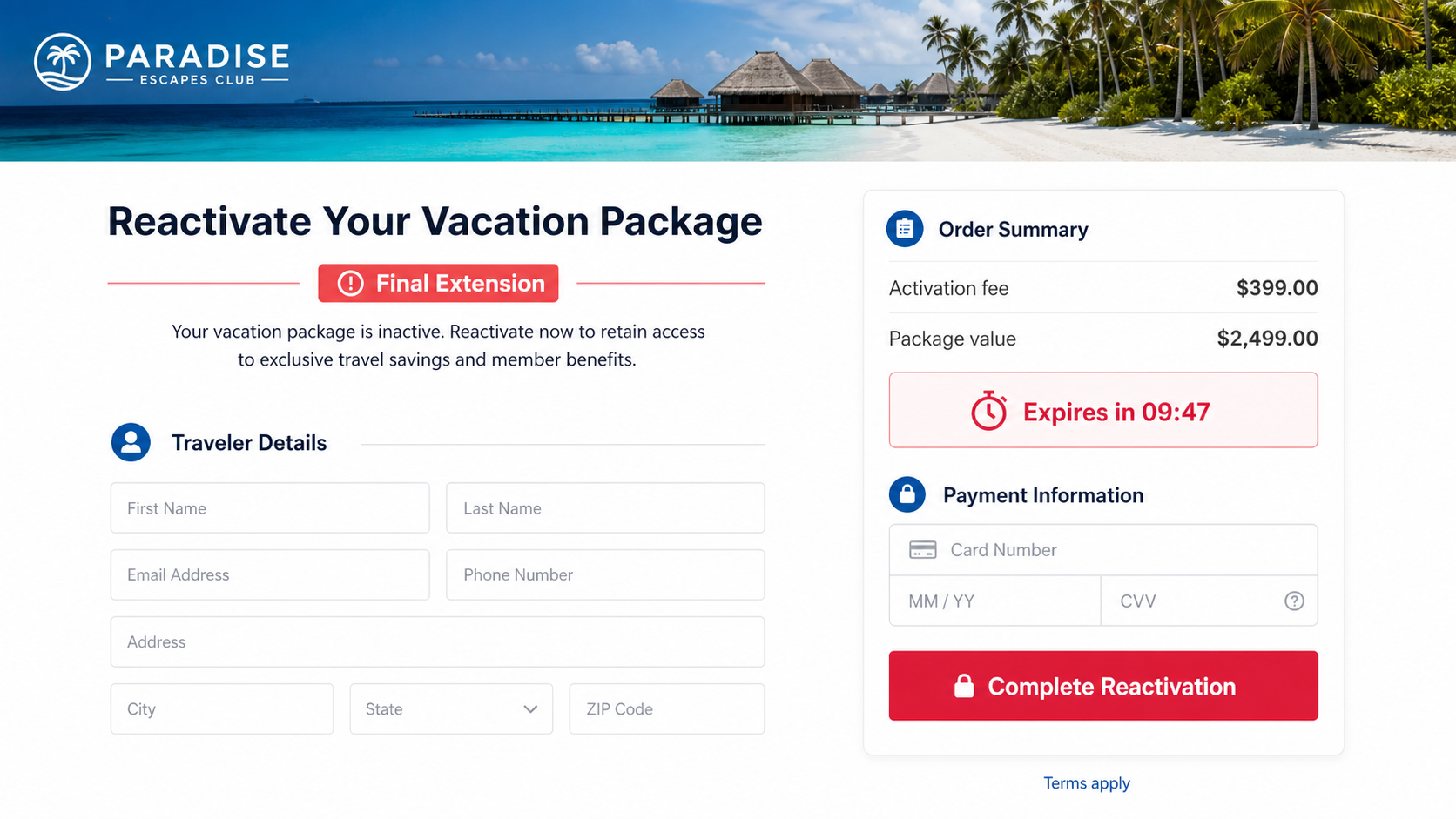
The operator may say taxes, processing, resort charges, or a reactivation fee must be paid before the package becomes usable.
The amount may seem small compared with the stated package value. A $399 fee can sound reasonable beside an alleged $2,499 vacation.
That comparison is meaningless when the package value was invented or the travel comes with restrictions that make redemption impractical.
Step 6: The victim is pushed into a club or presentation
Some operations deliver something, but not the vacation imagined. The result may be a discount club, reservation certificate, or mandatory timeshare presentation.
Dates, destinations, fees, age limits, income requirements, deposits, and blackout periods may make the advertised benefit difficult to use.
Other campaigns simply take card information and provide nothing. The original robocall alone cannot prove which endgame follows.
Step 7: Follow-up charges or calls continue
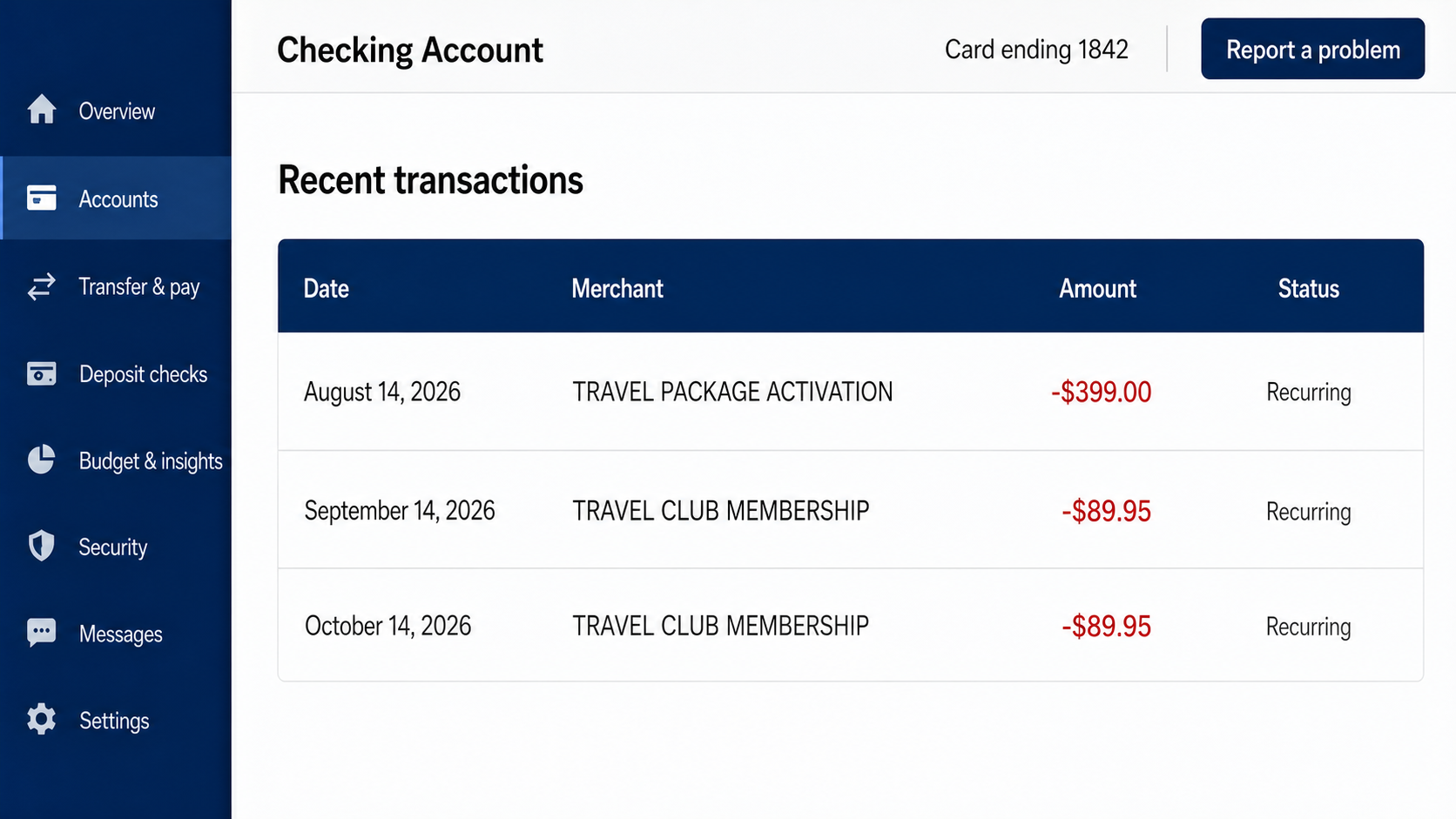
A card payment can be followed by membership fees, booking charges, upgrades, or recurring travel-club billing.
The victim’s number may also move to a responsive-lead list. New callers can offer refunds, recovery services, cruises, insurance, or additional packages.
The story changes, but the useful asset remains the same: a person who answered, trusted the script, and paid.
What Could Happen After You Call Back
The operator may sound prepared without knowing anything
Call-center scripts contain answers for predictable doubts. An agent may place the caller on hold, then return claiming to have located an old account.
The delay creates theater. Information supplied moments earlier can be repeated as if it came from a customer database.
Ask for the original order number before providing details. If the agent cannot supply it, the ownership claim has no foundation.
The package may carry expensive restrictions
A “free” or prepaid vacation can require resort fees, taxes, deposits, transportation, meal plans, presentations, or specific travel dates.
Availability may disappear when the customer requests popular periods. Upgrades then become the only practical way to use the offer.
Request every condition in writing before paying. Do not accept a verbal summary or a link controlled by the caller as sufficient proof.
The payment may authorize more than one transaction
A form can bundle the reactivation fee with club membership or recurring benefits. The recurring term may appear near the final button.
Telephone consent can also be recorded selectively. The agent may repeat only the parts that sound like authorization.
Never read a full card number to an unsolicited caller. Do not provide a one-time bank code or approve a wallet notification.
Company and Checkout Checks
Verify the original seller before discussing anything
Search old card statements, receipts, and email for the exact package. A real purchase should leave a transaction trail independent of the voicemail.
Match the merchant name, date, amount, destination, and confirmation number. Do not search only for “Picture Perfect,” because generic names can produce unrelated businesses.
Contact the original seller through a number found on its verified website or your old receipt, not the callback number.
Demand a written contract with complete terms
Ask for the legal company name, physical address, booking reference, package value, expiration clause, cancellation terms, and every required fee.
Read the document away from the call. Search distinctive sentences to see whether the same certificate appears in complaint reports.
Avoid links that demand immediate card entry. A legitimate contract can be reviewed without a countdown.
Check the address, phone, and payment descriptor
Map the listed address and compare it with corporate records. A mailbox, registered-agent address, residence, or unrelated office deserves clarification.
Search each phone number separately. Caller ID, callback, customer service, billing, and cancellation numbers should connect to the same accountable company.
Ask exactly what name will appear on the card statement. If the agent avoids the question, end the call.
Assume a fulfillment center proves very little
Travel certificates and welcome packets may be mailed from third-party fulfillment services. That warehouse does not necessarily operate or guarantee the vacation.
A polished envelope proves only that something was printed and shipped. It does not prove hotels will honor the promised dates or rates.
The responsible company must remain identifiable after fulfillment. Returns, cancellations, refunds, and disputes need a real legal counterparty.
Warning Signs in an “Unused Vacation Package” Call
- The message says “not a sales call” before promoting travel.
- The caller claims a purchase but provides no transaction details.
- You are told several contact attempts already failed.
- A final extension creates immediate pressure.
- The callback number differs from caller ID.
- The agent asks you to provide information already supposedly on file.
- A fee appears before written package details.
- The offer requires a presentation, club membership, or upgrade.
- Payment must be made by card, transfer, wallet, or gift card immediately.
- The company refuses independent verification or written cancellation terms.
Not every travel promotion is fraudulent. The burden remains on the caller to prove the specific package exists and belongs to you.
Silence that burden by refusing to supply clues. Ask the agent to state the original transaction details first.
If those details never arrive, end the call. You do not lose a legitimate vacation by verifying it through an independent channel.
What to Do if You Have Fallen Victim to This Scam
- End the conversation. Do not send another fee, provide another code, or accept a recovery offer from the same caller.
- Write down the timeline. Preserve the voicemail, caller ID, callback number, agent name, promised package, payment amount, and websites.
- Contact the card issuer immediately. Explain that an unsolicited caller misrepresented a prior travel purchase and ask about disputing the charge.
- Block repeat billing. Request a merchant-specific payment block and monitor the account for differently named travel charges.
- Cancel in writing. Send a clear revocation to every known company address and demand confirmation that no membership remains active.
- Protect exposed identity details. Change reused passwords, enable multifactor authentication, and consider a credit freeze if sensitive data was shared.
- Notify your mobile carrier. Report the spam call, block the number, and enable available call-filtering protections.
- Scan any affected device. If you installed an app or opened a suspicious download, use Malwarebytes and remove unknown software.
- Reduce malicious advertising. AdGuard can block many scam pages and ads, although it cannot stop ordinary telephone robocalls.
- Report the campaign. File details with the FTC, your state attorney general, and the Federal Communications Commission.
- Warn relatives calmly. Share the script and explain that the caller invents ownership to make the offer feel familiar.
Frequently Asked Questions
Is Picture Perfect Getaways a real company?
A generic business name alone proves nothing. Verify the legal seller and original transaction independently before trusting the caller.
Why does the message say it is not a sales call?
The phrase lowers resistance. The callback can still lead to a fee, club membership, timeshare pitch, or collection of personal information.
What if I really bought a vacation package?
Find the original receipt and contact that seller using independently verified details. Do not rely on the voicemail number.
Can calling back cause harm?
Calling confirms your number is active. Further harm occurs if you reveal information, authorize payment, install software, or follow deceptive links.
Can the caller charge me without my card?
The caller normally needs existing billing access or new authorization. Never confirm stored digits, approve codes, or accept unexplained wallet prompts.
How do I stop future calls?
Block and report each number, use carrier filtering, avoid pressing opt-out keys on suspicious robocalls, and never engage with the script.
The Bottom Line
The Picture Perfect Getaways voicemail succeeds by turning a cold call into a supposed account problem. It wants memory and urgency to replace proof.
A real package has receipts, dates, terms, and an identifiable seller. A vague recording has only a callback number and a deadline.
Do not pay to preserve a vacation you cannot verify. End the call, inspect your own records, and contact any genuine travel company independently.








