

The voicemail knows your name. It may know an old address, the name of a relative, or the last four digits of an identifier. The caller says legal papers are waiting and that today is your final chance to respond.
The fake process server call scam turns those scraps of real information into a deadline that feels official. It is designed to make calling back seem safer than ignoring the message.
What happens during that callback is the part the recording leaves out.
Overview
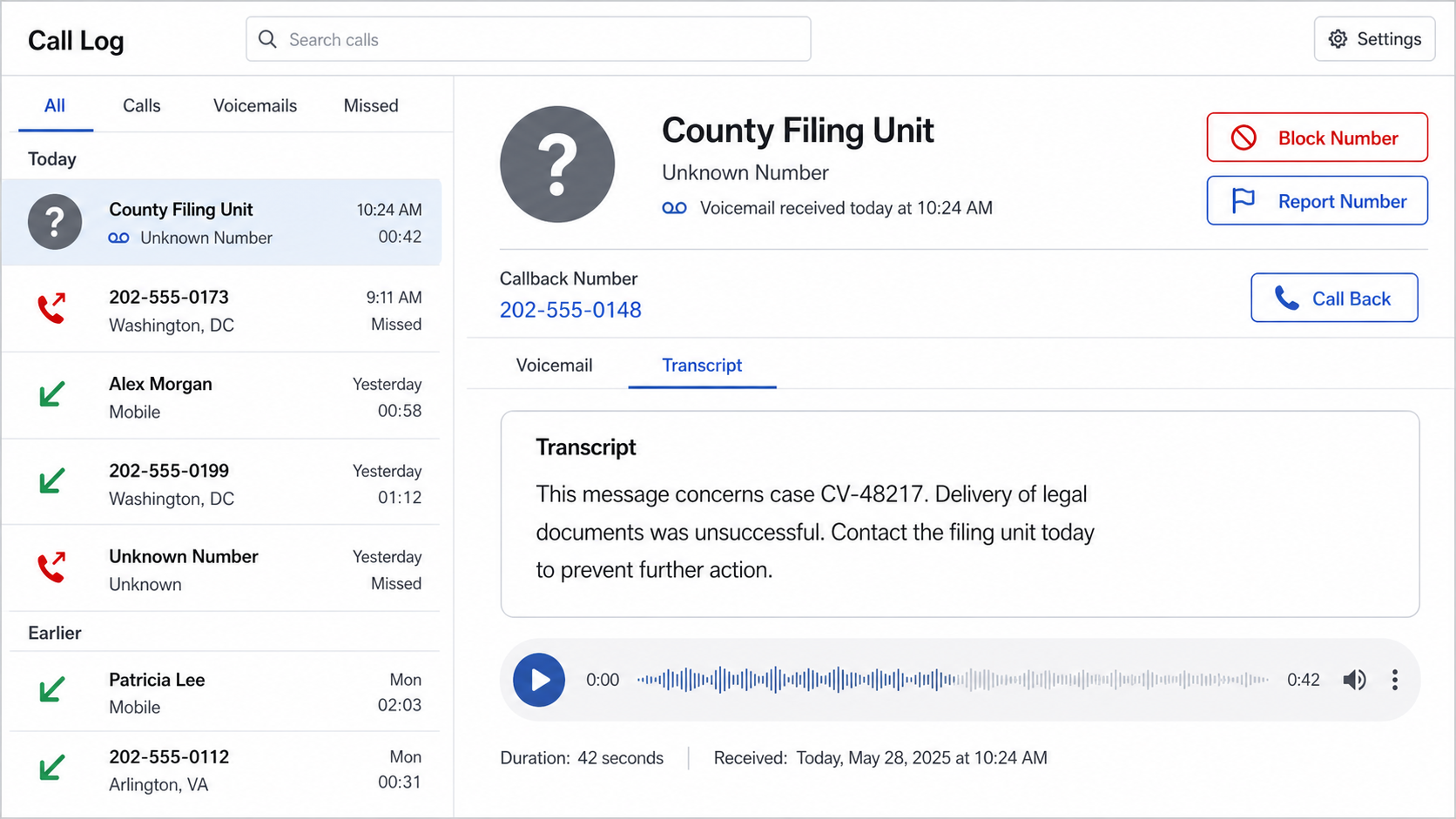
The caller claims legal documents could not be delivered
The fake process server call scam begins with a voicemail from a “filing unit,” “civil processing division,” “document courier,” or “county case services” office. The speaker says someone attempted to serve papers at your home or workplace and failed.
A case number and callback deadline add a layer of bureaucracy. The message may threaten wage garnishment, a court judgment, arrest, or an embarrassing visit to your employer if you do not contact the listed number immediately.
Some versions call a relative instead of the alleged target. Naming the family member creates alarm and practically guarantees that the message will be passed along. The criminal reaches one person by frightening another.
The callback leads to a fake debt or settlement demand
When you call, a second person claims to represent a law office, mediation company, creditor, or legal department. They say the case can still be stopped if you pay an old loan, medical balance, bank overdraft, payday debt, or contract claim before papers are served.
The amount may sound plausible because the operator has purchased or stolen personal data. Old addresses, partial Social Security numbers, past lenders, and relatives can be found in breached databases and data-broker records. Knowing those details does not prove a debt or a lawsuit exists.
The Federal Trade Commission warns that fake debt collectors may have real information about you, pressure you to pay immediately, and threaten arrest or other consequences. A legitimate collector still has to provide required information and respect federal law.
The process-server story is used to bypass verification
A real process server’s job is to deliver legal documents, not negotiate a payment that makes them disappear. A real court case can be checked with the court. A real debt collector can send a validation notice. The scammer tries to keep you away from both checks.
The operator may say the file is “pre-litigation,” sealed, not yet public, or available only through a private portal. Each explanation answers the same inconvenient question: why can nobody outside the call confirm this urgent case?
Warning signs include:
- A vague office claims legal service failed but will not name the court.
- The caller threatens arrest over an ordinary consumer debt.
- A relative receives the message even though the caller supposedly has your file.
- The only callback number comes from the threatening voicemail.
- You must pay today to prevent papers from being served.
- The caller refuses to mail a debt validation notice.
- The case number cannot be found through the court’s official channel.
- The payment must use gift cards, cryptocurrency, wire, payment app, or prepaid card.
- The caller says questioning the claim counts as refusal to cooperate.
- A private portal displays personal data but no verifiable court record.
How the Fake Process Server Call Scam Works
Step 1: The criminal assembles a believable personal file
Data breaches and commercial people-search records can reveal names, phone numbers, addresses, relatives, dates of birth, and past financial relationships. The criminal does not need a complete identity. Two correct details can make the rest of the script sound credible.
An old address is especially useful. If the alleged service attempt happened there, any lack of real paperwork can be blamed on your move rather than on the nonexistence of the case.
Step 2: A courier leaves a controlled voicemail
The first voice usually avoids discussing the supposed debt. They claim to handle documents and provide a case number plus another office’s phone number. That separation makes the call sound like one neutral worker passing along a legal requirement.
The caller may announce a future service window or mention your employer. These details create fear of public embarrassment. They also push you to contact the “claimant” before verifying anything.
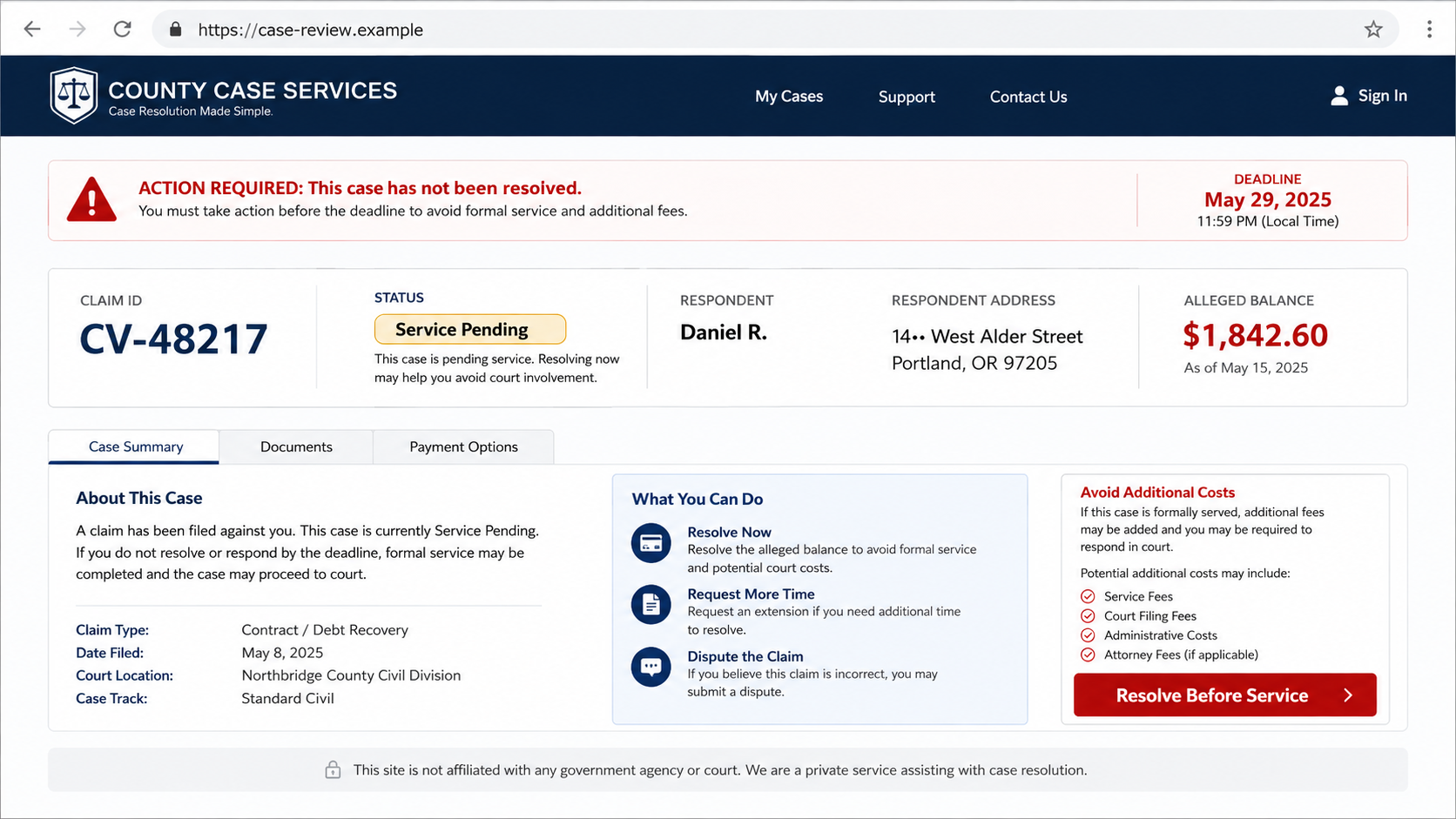
Step 3: The callback number reaches a fake legal desk
A polished greeting, hold music, extensions, and transfers can make a small operation sound like a law firm. The agent retrieves the case using the number from the voicemail, even though every record on the system was created by the same scammers.
The agent may read a scripted allegation and then ask you to confirm your birth date, Social Security number, or current address. Information presented as verification may actually fill gaps in the criminal’s file.
Step 4: The operator introduces the settlement window
The debt is described as old enough to be forgotten but serious enough to justify court action. The caller says the original balance has grown through interest, legal fees, and filing costs, then offers a smaller amount if you resolve it today.
This manufactured discount reframes payment as a smart escape. You are not given time to request records, compare dates, or determine whether the debt belongs to someone with a similar name.
Step 5: Threats make independent contact feel dangerous
If you ask to call the court or creditor, the agent says doing so will close the settlement window. They may claim that hanging up triggers service, a judgment, or arrest. The threat keeps the criminal’s phone line at the center of reality.
The FTC’s debt-collection guidance says collectors must provide validation information and cannot lie about the amount owed or threaten arrest. Pressure to skip written validation is not legal urgency; it is a fraud signal.
Step 6: Payment is routed through a difficult channel
The agent may accept a card through a private portal, but many demand a wire, gift card, cryptocurrency, payment app, or bank transfer. The recipient may not match the named creditor or law office.
A convincing receipt does not fix that mismatch. Anyone can generate a settlement letter or payment confirmation. The important question is whether the creditor, collector, and account can be independently verified before money moves.
Step 7: One payment reveals a responsive target
After payment, the victim may receive another call about filing fees, a second account, or a balance the first settlement did not cover. The original “courier” may call again and claim the service cancellation has not processed.
The information collected during the callback can support identity theft or future impersonation scams. The supposed resolution may be the beginning, not the end, of the contact.
How Real Service and Debt Collection Differ
Legal procedures vary by state and by type of case, so a voicemail alone cannot prove that no legal matter exists. The safe response is not to ignore every document. It is to verify the court, collector, and debt through channels the caller does not control.
A real process server generally attempts to deliver documents according to local rules. They do not decide whether a lawsuit proceeds, collect a private settlement, or promise to erase a filing in exchange for a card payment.
A legitimate debt collector should identify the creditor and provide validation information, including the amount and your rights to dispute. They cannot truthfully claim you will be arrested simply for not paying a consumer debt.
A real lawsuit leaves a trail with an actual court. Search the official state or county court system using contact details found independently. If online records are limited, call the clerk’s published number and ask how to check the case number and parties.
Do not use a “court lookup” link supplied in the voicemail. A fake portal can be populated with the same personal data and case number from the call. It confirms only that the scammers built two matching pieces of the same story.
What Information the Caller May Already Have
People often assume a scammer could not know a former address or relative’s name. In reality, that information may be old, widely brokered, or exposed in a breach. A credit application, marketing database, public filing, or compromised account can connect many of the details.
Listen for what the caller asks you to supply. They may state the last four digits of an identifier, then ask for the rest. They may name a street but ask for the apartment number. They may mention an old employer and wait for you to correct it with the current one.
Do not turn partial knowledge into a complete profile. Ask the collector to send the legally required notice to the address already on file. You do not need to confirm sensitive data during an unexpected threat call.
If the caller knows a real debt, contact the original creditor through its published number. The debt might have been sold, but the creditor may be able to identify the current collector or confirm that the caller has no relationship to the account.
Even when a debt is genuine, the person demanding payment can still be an impostor. Verification is about who is calling and where the money goes, not only whether you once had an account.
Company, Address, and Fulfillment Checks
Verify the court through an official directory
Ask for the court’s full name, case number, filing date, and parties. Find the court’s website or clerk number yourself. A caller who refuses to name the jurisdiction has not given you a checkable claim.
Demand written debt validation
Do not settle from a voicemail. Ask the collector for its legal business name, mailing address, creditor, account details, and written validation notice. Review your rights before responding.
Check licenses and business records
Some states require debt collectors to be licensed. Search the appropriate regulator and business registry, then contact the listed company through the number on that record. A matching company name can still be impersonated.
Match the recipient to the verified entity
Before any payment, confirm that the recipient belongs to the validated collector or creditor. A personal payment-app account, unrelated merchant, crypto wallet, or gift card cannot become legitimate because a caller calls it a legal escrow account.
What to Do if You Have Fallen Victim to This Scam
- Stop communicating through the supplied number. Do not call back to argue, correct details, or negotiate another payment.
- Contact the payment provider immediately. Tell the bank, card issuer, wire service, payment app, or crypto exchange that the transaction resulted from impersonation and threats. Ask what can be frozen or recalled.
- Verify whether any real case exists. Use the official court clerk and the original creditor’s published contact details. Do not rely on the private portal or callback number.
- Request debt validation in writing. If a legitimate collector is involved, use your rights to obtain the creditor, amount, account information, and dispute instructions.
- Preserve evidence. Save voicemails, caller IDs, case numbers, names, portal URLs, payment instructions, receipts, emails, and the exact threats made.
- Protect exposed identity data. If you supplied a Social Security number, birth date, or identity document, place appropriate fraud alerts or credit freezes and monitor reports.
- Change exposed passwords. If you created a portal login or reused a password, change it everywhere it was used and secure the connected email account.
- Scan downloaded files. If the portal provided a document viewer, extension, or attachment, disconnect the device from sensitive accounts and run a full Malwarebytes scan.
- Block known malicious pages. AdGuard can help prevent many phishing and malicious-ad destinations after cleanup. It cannot determine whether an unexpected legal caller is genuine.
- Report the fraud. File with the FTC at ReportFraud.ftc.gov, your state attorney general, the relevant debt-collection regulator, and local police when money or identity data was stolen.
- Warn relatives. Tell family members not to provide your current number, address, employer, or other details to anyone claiming to carry documents.
- Ignore recovery callers. A person offering to retrieve the payment for a fee may be using information shared by the original operation.
Frequently Asked Questions
Will a real process server call before serving papers?
Practices vary, and some legitimate servers may call to arrange delivery. The warning sign is a demand to pay a debt through the caller to stop service. Verify any case through the court.
Can I be arrested for an unpaid consumer debt?
Ordinary unpaid consumer debt is generally a civil matter, and a collector cannot lawfully threaten arrest just to force payment. Separate issues such as ignoring a real court order require legal advice.
Does a correct Social Security fragment prove the call is real?
No. Personal information circulates through breaches and data brokers. Treat partial identifiers as evidence that your data was obtained, not that the claimed case exists.
Why is the case absent from the court website?
Some records take time to appear or are not fully searchable online. Call the clerk through an official number. Do not accept a caller’s private portal as a substitute.
Should I ignore actual papers after receiving a scam call?
No. A fake call does not make genuine documents harmless. Verify the court and deadlines independently and seek qualified legal advice if you receive real service.
Can I pay first and dispute the debt later?
Payment to a scammer can be difficult to recover and may expose more information. Verify the debt, collector, recipient, and your dispute rights before paying.
The Bottom Line
The fake process server call scam uses real personal details to sell an invented deadline. A case number, legal vocabulary, and a private portal are easy to manufacture; an independently verifiable court filing is not.
End the call, contact the court and creditor through official channels, and demand written validation. If the only way to prevent “service” is paying the voice that threatened you, do not send the money.

Join the discussion
0 commentsShare your experience or ask a question about this article.
Discussion
Start the conversation
Have a question or something useful to share? Add the first comment.