

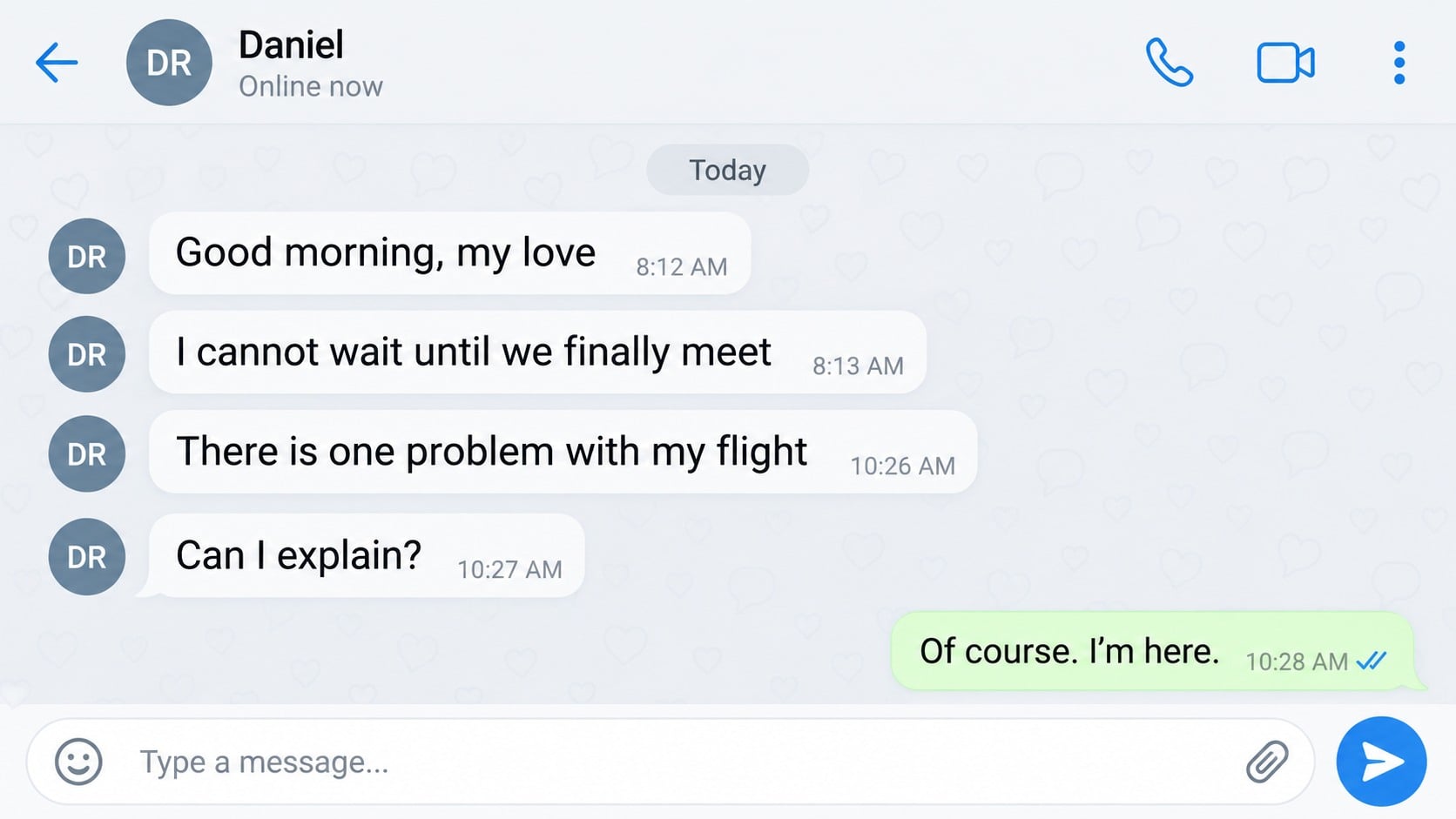
The relationship may begin with an ordinary friend request or dating-app match. Within days, the stranger is unusually attentive, remembers every detail, and talks about a future together with a confidence that feels flattering rather than suspicious.
Then something goes wrong overseas. The emotion is real for the person receiving the messages, but the emergency, identity, and promised meeting may all belong to a carefully managed fraud.
Overview
The label describes a method, not an entire country
A Nigerian romance scam is a form of confidence fraud in which a criminal builds an online relationship and then converts trust into money, account access, personal information, or help moving funds. Some operations are connected to Nigeria, while similar schemes are run from many countries.
The term should never be used to treat a Nigerian identity, accent, or location as proof of fraud. The evidence is the behavior: a stolen or unverifiable identity, avoidance of real-world contact, escalating emergencies, and requests that place the target’s money or accounts at risk.
The person in the profile may be entirely innocent. Scammers steal photographs and biographical details from military members, engineers, doctors, business owners, aid workers, and ordinary social-media users.
The relationship is the delivery system
The scam is rarely a single message. The criminal may communicate every morning and night, send affectionate voice notes, discuss marriage, and offer emotional support for weeks or months. That investment makes the later request feel personal.
Common stories include:
- An oil worker, engineer, contractor, or service member stranded overseas.
- A widow or widower raising a child alone.
- A valuable shipment held by customs.
- A hospital bill, visa fee, legal problem, or cancelled flight.
- A profitable cryptocurrency opportunity available through a private platform.
- A request to receive money, open an account, buy gift cards, or forward a package.
The details change, but each story creates a reason the person cannot meet and a reason the target must provide money or financial access.
The losses can extend beyond the first payment
The FBI explains that romance scammers use fake identities to gain affection and trust before asking for money. A target may also be recruited as a money mule, meaning stolen funds pass through the target’s bank account or packages are forwarded on behalf of the criminal.
That can expose the victim to frozen accounts, debt, tax complications, and law-enforcement questions. Intimate images may be used for extortion, while identity documents can support new accounts or further impersonation.
The shame surrounding romance fraud helps criminals. Victims may hide losses from family or continue paying because admitting the deception feels like losing both the money and the relationship.
Why the Story Can Feel So Convincing
Skilled scammers do not begin with money. They mirror interests, offer frequent reassurance, and learn when the target feels lonely, worried, or hopeful. Public posts can reveal birthdays, bereavements, travel plans, and family tensions that make the conversation feel uncannily personal.
The profile often contains enough truth to survive a casual check. A real person’s photographs may match a genuine career and social history, but the scammer controls a separate account. A copied passport or employee badge adds detail without proving who is typing.
Video is no longer a perfect test. A scammer may avoid it, play a prerecorded clip, blame a weak connection, or use manipulated media. A brief video that never supports a natural two-way conversation should not outweigh months of financial pressure.
The Move From Affection to Obligation
The first financial request is often modest and framed as temporary. The person claims a card stopped working, a phone bill is due, or a child needs medicine. The target is promised repayment as soon as a contract clears or a frozen account is released.
Paying once changes the relationship. The scammer now knows which story worked, how the victim pays, and how much resistance to expect. New emergencies can grow larger because each payment is presented as the final obstacle before meeting.
When questions arise, the criminal may alternate affection with guilt, anger, silence, or threats. That emotional whiplash is a control tactic, not evidence of a genuine crisis.
How the Nigerian Romance Scam Works
Step 1: A stolen identity opens the conversation
The criminal creates a dating or social-media profile using attractive photographs and a believable personal story. The account may be new, or it may be an older compromised account with real history.
The first message is friendly and low pressure. If the recipient responds, the scammer studies the profile and adjusts the persona to match the target’s values and circumstances.
Step 2: The conversation moves away from the platform
The new contact quickly suggests email, WhatsApp, Telegram, or another private channel. They may claim the dating app is expensive, unreliable, or unsafe.
Moving the conversation reduces moderation and makes it harder for the original platform to detect or preserve the scheme. It also gives the scammer direct access even if the fake profile is removed.
Step 3: Intense affection creates a private world
Messages become frequent and emotionally rich. The scammer discusses marriage, shared faith, family, retirement, or a home together before the pair has met.
They may encourage secrecy or describe friends as jealous. Isolating the target makes it less likely that an outside person will notice contradictions.
Step 4: Distance explains why a meeting never happens
The persona is posted overseas for military service, construction, shipping, medicine, or business. Meetings are planned, then cancelled because of a work emergency, travel problem, hospitalization, or official restriction.
Each cancellation produces sympathy and keeps the future promise alive. The relationship always feels close to becoming real, but the final meeting remains just beyond the next payment.
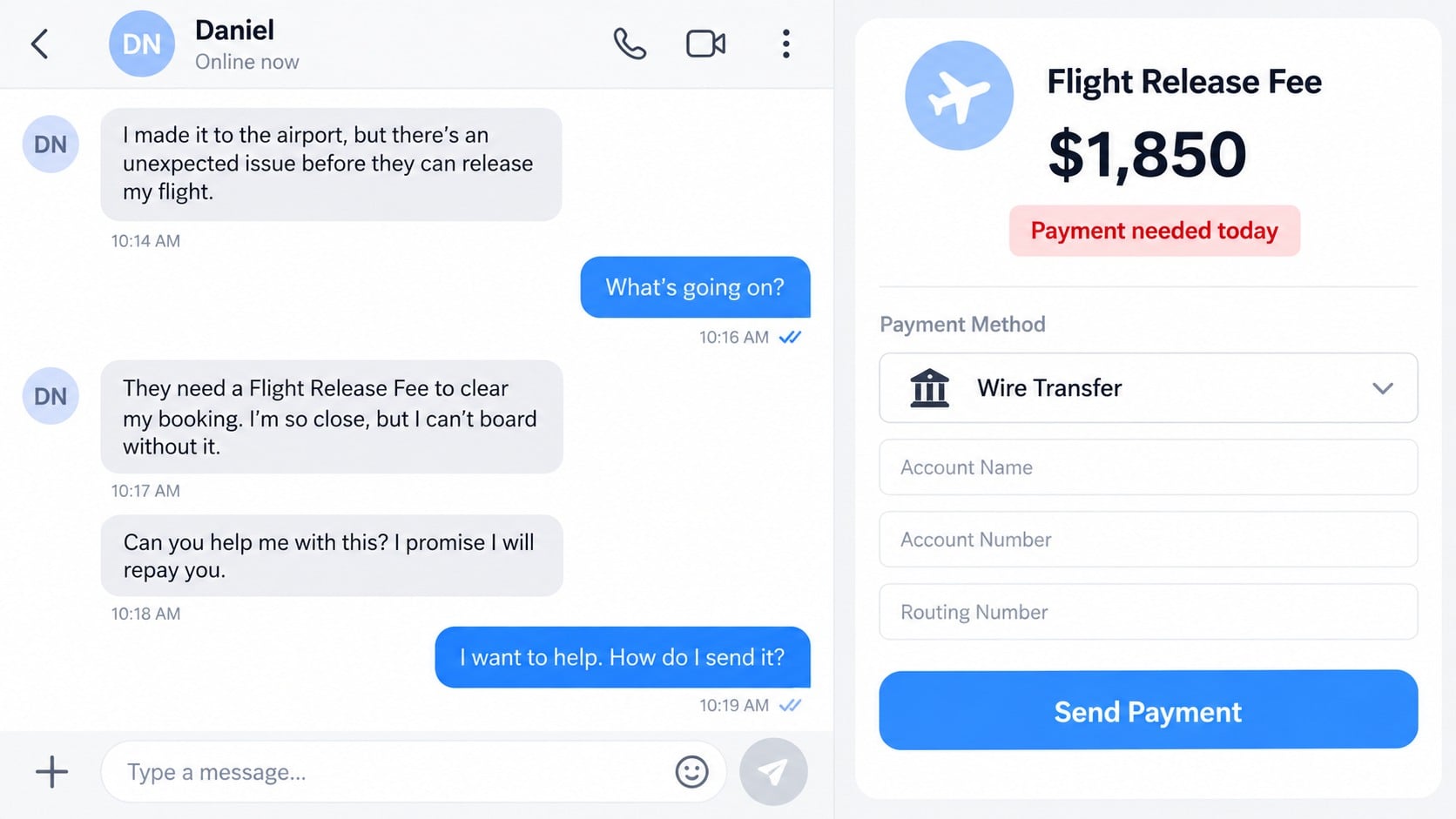
Step 5: An urgent problem introduces money
The scammer needs airfare, customs charges, medical care, legal fees, equipment, or help accessing funds. Payment is requested by wire transfer, gift card, cryptocurrency, money-transfer service, or a bank account belonging to another person.
Documents, invoices, and messages from a supposed doctor, diplomat, lawyer, or shipping agent may support the story. Those additional characters can be controlled by the same group.
Step 6: The victim is pressured into repeated payments or financial tasks
A new fee appears after every payment. If the victim cannot send more, the scammer may ask them to borrow, sell assets, accept a check, receive a transfer, open a cryptocurrency account, or forward money to someone else.
That last stage can turn a fraud victim into an unwitting money mule. The safest response is to stop all transactions and speak honestly with the bank and law enforcement.
Company, Address, and Fulfillment Checks
The profile name is not verified identity
Compare the person’s name, photographs, employment, email, and social accounts. Reverse-image search the photos and search distinctive sentences from their biography or messages.
A stolen photo may appear under several names. A passport image is also not enough because documents can be stolen or edited.
The overseas address may support the script
Scammers use foreign projects, military bases, oil rigs, hospitals, and hotels because distance makes verification difficult. Search the location independently and contact the organization through its official website.
Do not call a number supplied in the story. A supposed manager or embassy official may simply be another participant in the fraud.
Support characters can be part of the same operation
A lawyer, customs officer, doctor, child, sibling, or courier may contact the victim to confirm the emergency. Multiple voices and documents can create the illusion of an external event.
Verification must leave that closed circle. Use official directories and independently sourced numbers, and do not reveal what answer the scammer wants you to hear.
Every payment path should be traceable
Look at the recipient name, country, bank, wallet, gift-card demand, and explanation. Payments routed through unrelated people or frequently changing accounts are serious warnings.
Never allow a romantic contact to use your account to receive or forward money. Even if you keep none of it, the funds may come from another victim or compromised account.
Warning Signs That Matter Most
- The person declares love or a shared future unusually quickly.
- They want to leave the dating platform almost immediately.
- Their job or location makes every in-person meeting impossible.
- Video conversations are avoided, brief, silent, or repeatedly interrupted.
- An emergency introduces requests for money, cards, cryptocurrency, or account access.
- Names on payment accounts do not match the profile.
- Friends and relatives are described as enemies of the relationship.
- The person asks you to receive funds, forward packages, or open accounts.
No single occupation, nationality, or accent proves a scam. The decisive pattern is an unverifiable relationship that repeatedly requires money or financial secrecy.
Why Intelligent People Keep Paying
Romance fraud does not depend on a victim being careless. It exploits attachment, hope, grief, and the normal desire to help someone important. By the first payment, the target may have spent months building what feels like a committed relationship.
Each new fee is connected to money already sent and a future already imagined. Stopping can feel as though it guarantees the loss, while one more payment appears to preserve a chance of repayment and a meeting.
Scammers reinforce that pressure with affection, guilt, silence, and invented deadlines. They may return after an argument with apologies or a new emergency, keeping the victim focused on the relationship rather than the pattern.
An outside perspective helps because a trusted person can examine the facts without being inside that emotional cycle. Asking for help is not an admission of foolishness. It is a practical response to deliberate psychological manipulation.
What to Do if You Have Fallen Victim to This Scam
- Stop contact and payments. Do not announce an investigation or send one final fee. Block the accounts after preserving evidence, because continued conversation gives the scammer more opportunities to manipulate you.
- Contact every payment provider immediately. Tell banks, card issuers, money-transfer services, gift-card companies, and cryptocurrency exchanges that the transaction involved fraud. Ask about recalls, freezes, chargebacks, and recipient-account preservation.
- Be completely honest with your bank. Explain if you received or forwarded money for the person. Early disclosure can help separate victimization from intentional participation and may protect other victims.
- Secure your accounts. Change passwords, enable multi-factor authentication, revoke unfamiliar sessions, and replace recovery details. Protect email first because it can reset many other accounts.
- Protect identity documents and credit. If you shared a passport, driver’s license, Social Security number, or banking records, follow the recovery plan at IdentityTheft.gov and consider fraud alerts or a credit freeze.
- Scan devices and remove unknown software. Use Malwarebytes for a full scan if you opened files, installed an application, or allowed remote access. Remove suspicious browser extensions and update the operating system.
- Block malicious pages and ads. AdGuard can reduce exposure to known scam domains, malicious ads, and tracking links used in repeat targeting. Keep verifying new contacts because tools cannot judge a relationship for you.
- Report the profile and fraud. Notify the dating or social platform, report to IC3.gov when appropriate, and file with the FTC or your national fraud authority. Include recipient accounts, wallet addresses, phone numbers, and message history.
- Tell someone you trust. A family member, friend, counselor, or victim-support service can help you review decisions without judgment. Emotional recovery matters alongside financial recovery.
- Reject recovery agents who contact you. Criminals often return as hackers, investigators, lawyers, or government officials who promise to retrieve the money for an upfront fee. Do not pay them or provide more documents.
Frequently Asked Questions
Does a Nigerian accent prove someone is a romance scammer?
No. Nationality and accent are not evidence of fraud. Judge the identity, consistency, meeting history, financial requests, and independently verified facts.
Can a romance scam continue for years?
Yes. Some criminals maintain long relationships because repeated smaller payments and emotional control can be more profitable than a quick request.
What if the person video-called me?
A natural, repeated video conversation is useful but not conclusive. Recorded clips, accomplices, filters, and manipulated media can support a false identity.
Why did the scammer send me money first?
The funds may come from another victim, a stolen account, or a fake check. Forwarding them can create a loss and involve your account in fraud.
Can cryptocurrency sent to a romance scammer be recovered?
Recovery is difficult and never guaranteed. Contact the exchange immediately, preserve wallet details, and report the transaction. Avoid anyone promising guaranteed recovery for a fee.
Should I confront the person with my evidence?
No. Save the evidence, stop financial activity, and report safely. Confrontation usually produces new excuses, threats, or pressure rather than repayment.
The Bottom Line
A Nigerian romance scam is defined by deception and financial manipulation, not by the nationality of every person involved. The criminal creates intimacy, keeps the relationship at a distance, and turns an invented emergency into an obligation to pay.
Never send money, receive funds, or share sensitive documents with an online romantic partner you have not independently verified and met safely. If payments have begun, stopping now is not a betrayal. It is the first step toward protecting your finances, identity, and emotional well-being.








