

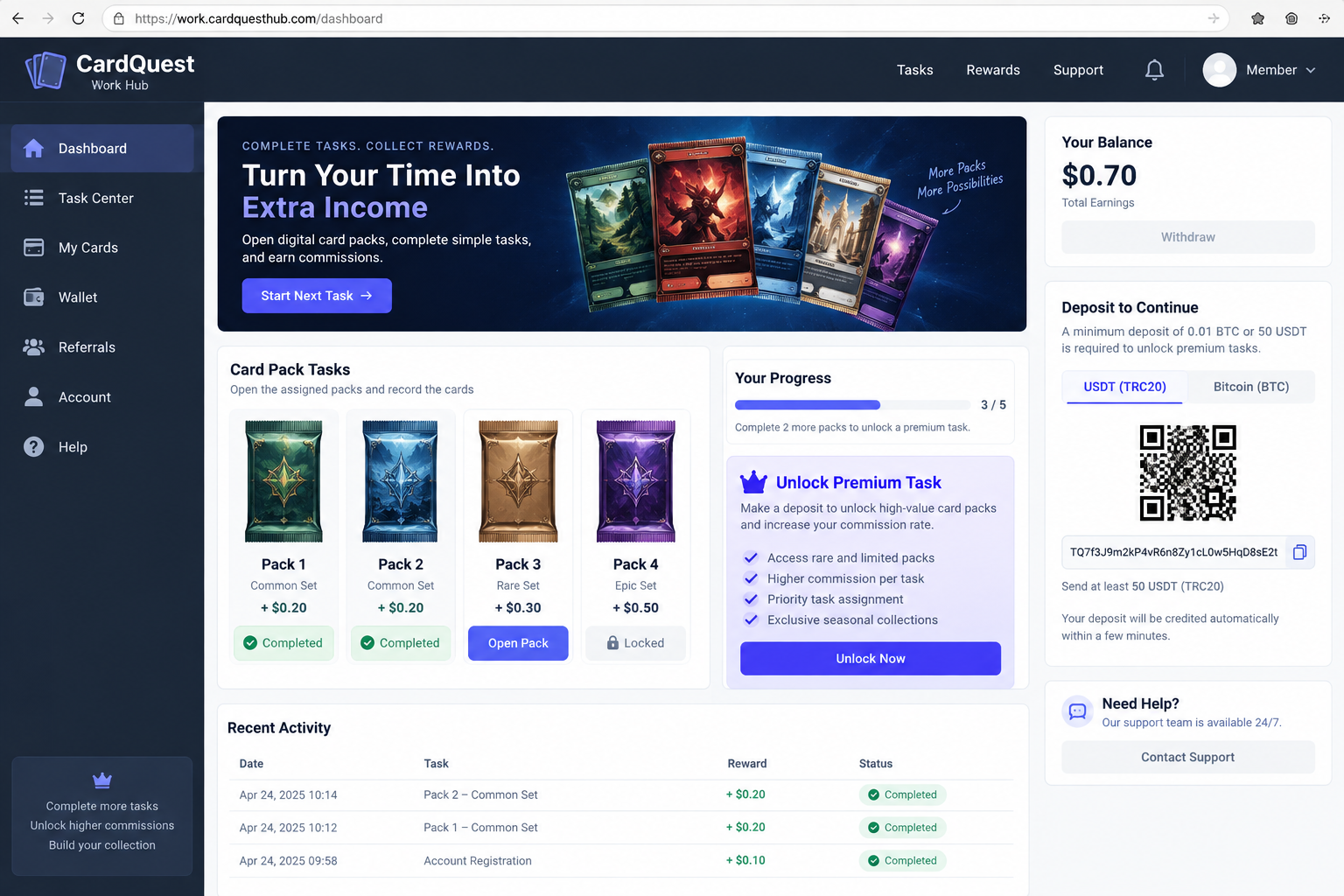
A trading card task scam does not begin with an obvious investment pitch. It arrives as a remote job where opening digital card packs or selecting collectibles supposedly earns a small commission.
The first tasks appear harmless, and the dashboard may even release a tiny payment. The trap becomes visible only after the worker is told to deposit real cryptocurrency to continue.
Overview
The collectible theme is a new wrapper around a task scam
A trading card task scam uses familiar collectible-card imagery to disguise an advance-fee job scheme. The victim is offered simple online work involving digital packs, card choices, ratings, or order optimization.
The platform displays commissions after every click. Those numbers are not wages held by an employer; they are figures controlled entirely by the scammer.
To unlock better packs or complete a set, the worker must send cryptocurrency. A legitimate job pays the worker and does not require deposits to earn or withdraw wages.
Small early payouts make the later deposits feel safer
Some victims receive a modest first payment. That deliberate loss buys credibility and teaches the target that the system appears to pay.
The next task costs more, but the dashboard shows a larger commission. Group-chat participants may celebrate withdrawals and encourage the new worker to increase the deposit.
Those participants can be accomplices, automated accounts, or fabricated profiles. Screenshots of profits cannot prove that an independent user withdrew money.
Police documented a recent resurgence and real losses
On September 14, 2026, the Singapore Police Force warned about job scams involving Pokémon and other trading-card tasks. Since August 25, police received at least 12 reports with losses totaling at least SGD 71,000.
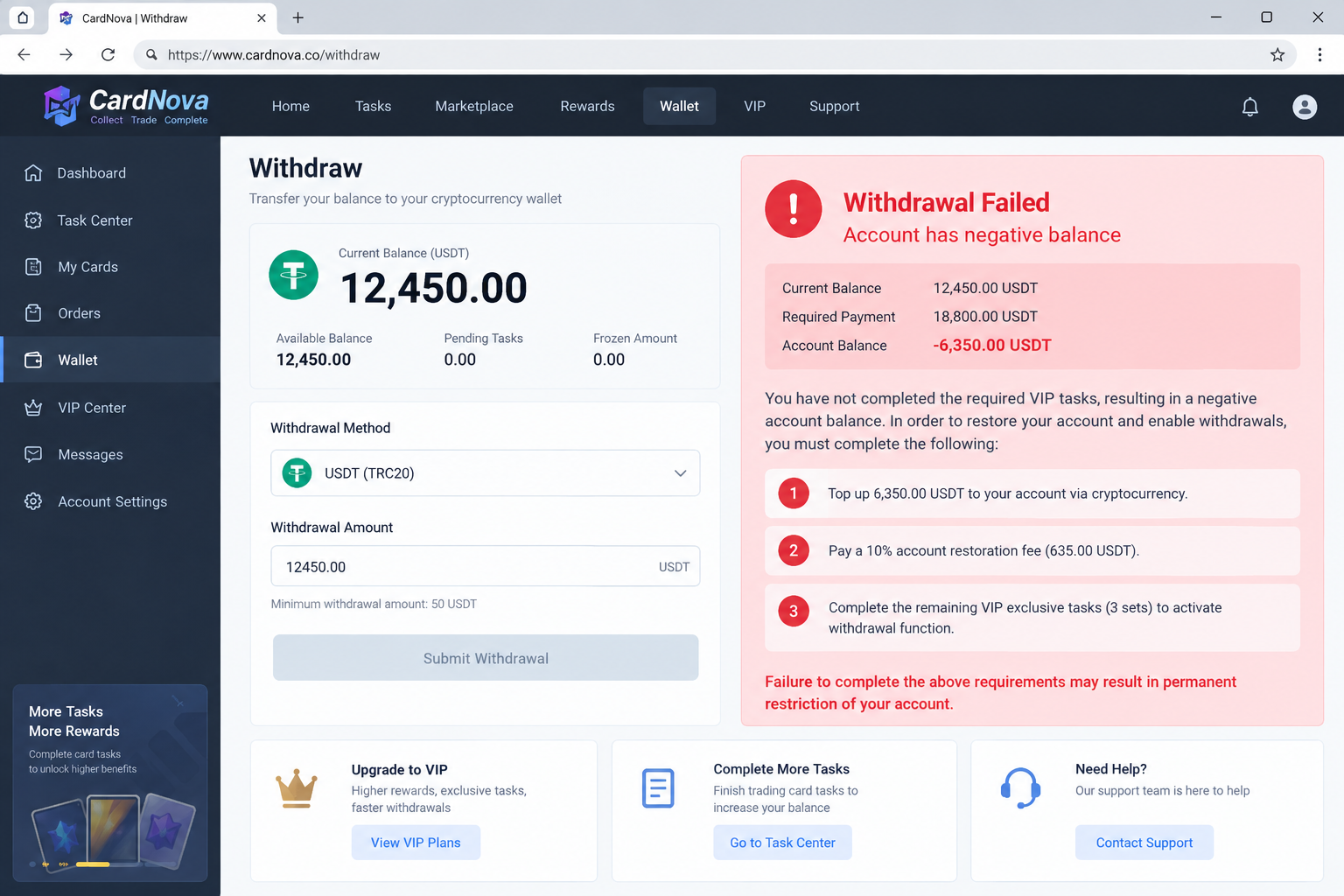
The advisory says victims were directed to fraudulent websites to open digital packs or select cards for commissions. They had to send cryptocurrency deposits, then faced demands to clear negative balances, restore accounts, finish tasks, or unlock withdrawals.
Warning signs include:
- an unsolicited remote job offered by text, call, or messaging app;
- high earnings for repetitive clicks with no real business output;
- a platform that requires cryptocurrency before tasks can continue;
- a coach who tells the worker exactly which wallet and network to use;
- small initial payouts followed by much larger required deposits;
- group members posting constant profit screenshots;
- a negative balance that appears only when withdrawal is requested;
- fees, taxes, or VIP upgrades that must be paid before wages are released.
Why Digital Card Packs Make an Effective Hook
Trading cards combine rarity, surprise, and visible price differences. A task dashboard can use those mechanics to make each click feel like productive work rather than a financial transaction.
The interface may show common, rare, and premium packs with different commission rates. Progress bars and limited sets encourage the worker to finish one more round.
Randomized task values provide an excuse for sudden costs. The operator says the victim was lucky to receive a rare bundle, even though that bundle creates a deposit the victim cannot comfortably afford.
The collectible brand may be real or merely imitated. Logos, card art, and character references do not prove that the platform has permission from the franchise owner.
The job title can sound ordinary: product optimizer, card reviewer, order matcher, merchant assistant, data rater, or promotion specialist. None explains why the employee must finance the platform.
Cryptocurrency completes the design. Transfers are fast, cross-border, and difficult to reverse, while the victim sees only an address supplied by the recruiter.
How the Trading Card Task Scam Works
Step 1: A recruiter offers easy remote income
The victim receives an unsolicited message claiming that a platform needs part-time workers. Experience is unnecessary, hours are flexible, and commissions can be earned from a phone.
The recruiter may impersonate a staffing company, gaming business, marketplace, or well-known card franchise.
Step 2: The conversation moves to a private messaging app
A coach explains the work in short, friendly messages. Moving away from a job platform reduces moderation and gives the scammer direct control over the target.
The coach supplies a registration link, referral code, and sometimes a group chat filled with apparent workers.
Step 3: Simple tasks create a visible commission
The website instructs the victim to open packs, select cards, confirm orders, or click through a set. Each action increases an on-screen balance.
No independent accounting exists behind the balance. The operator can add or remove any amount.
Step 4: A small deposit unlocks better work
The platform says higher-value tasks require a temporary account balance. The worker sends cryptocurrency and completes another round.
A small withdrawal may succeed, convincing the victim that deposits are returned with commission.
Step 5: A rare pack or combo creates a large deficit
The system assigns an unexpectedly expensive task and calls it a valuable opportunity. The account becomes negative until the worker deposits the difference.
Abandoning the round supposedly forfeits everything already earned, so the victim sends more to protect the earlier money.
Step 6: Withdrawal triggers new conditions
After the task set is complete, the platform demands a tax, verification charge, VIP upgrade, account restoration fee, or another task sequence.
The displayed profit grows while real money continues moving in only one direction.
Step 7: The platform freezes the account and disappears
Support stops responding or accuses the victim of violating procedure. The recruiter may offer one final payment route to rescue the balance.
Domains, wallet addresses, and group names can then be replaced, allowing the same operation to recruit a new audience.
The Dashboard Balance Is Not Evidence of Money
A number on a private website is only a database entry. It does not prove that funds exist in a regulated account, escrow, or wallet controlled by the worker.
The operator can credit an impossible commission instantly because no real revenue funds it. The number’s purpose is to persuade the victim to protect a profit that cannot be withdrawn.
Withdrawal tests should not require additional payment. If support says money must be sent before money can be received, stop.
A blockchain transaction proves that the victim sent cryptocurrency to an address. It does not prove the recipient credited a genuine employment account or owes wages.
Tax explanations are another common fiction. Legitimate tax obligations are not paid by transferring crypto to a recruiter’s wallet before a private platform releases wages.
Terms such as negative balance, combination order, premium task, recharge, restoration, and account optimization are interchangeable pressure tools. They create internal rules that always require another deposit.
How to Check a Remote Job Before Joining
Find the employer’s official careers page independently. Search the exact role and contact human resources through the verified company domain.
Check whether the recruiter actually works for the named business. A profile, photograph, and company logo can be copied or attached to a compromised account.
Ask what product or service the task creates and who pays the employer for it. Repetitive clicks with no meaningful output cannot sustainably fund large commissions.
Request a written contract that identifies the legal employer, wage, tax treatment, work location, and payment schedule. A messaging username is not an employment entity.
Search the platform domain, registration date, legal pages, address, and complaints. A recently created site with no independent corporate history deserves extreme caution.
Reject any job that requires a deposit, cryptocurrency purchase, gift card, equipment fee paid to the recruiter, or payment to unlock wages.
Do not treat a small payout as final proof. Task scams often budget for early withdrawals because they lead to larger later deposits.
Group Chats Are Part of the Sales Funnel
A busy chat creates social proof. Members congratulate one another, post withdrawal screenshots, and describe the coach as patient and trustworthy.
The group may contain a few real recruits surrounded by accounts controlled by the fraud network. Their agreement makes doubts feel unreasonable.
When a victim mentions a negative balance, others say the same thing happened to them and that paying solved it. This rehearsed reassurance pushes the victim toward another transfer.
Profit screenshots are easy to edit, and a private platform can generate any transaction record it wants. Ask for evidence outside the scammer’s ecosystem.
Leaving the group is not abandoning legitimate coworkers. It removes a pressure channel designed to keep the payment cycle moving.
Why Another Deposit Cannot Fix the Account
The platform’s rules are created by the same operator requesting the money. There is no independent payroll department, regulator, or escrow system enforcing the displayed balance.
When the victim pays a deficit, the operator can invent a larger task, compliance review, or network charge. Success is always moved one step beyond the latest transfer.
The growing balance is designed to make stopping feel like losing wages. In reality, the only confirmed funds are the cryptocurrency already sent out of the victim’s control.
Support may provide screenshots showing that a payment is pending. A private dashboard can display any status without a corresponding bank or blockchain transfer to the victim.
Borrowing to finish the sequence deepens the loss and can expose friends or relatives to the same recruiter. Do not recruit another person to rescue the fictional balance.
The safest financial decision is to stop immediately, even when the last transfer was recent. Each additional payment gives the criminal more money and confirms that pressure still works.
Company, Address, and Fulfillment Checks
The employer must exist outside the task website
Confirm the legal company through registries, its official domain, and independently listed contact details. A copied brand name does not establish employment.
Ask the real company whether it offers card-pack tasks and whether the recruiter is authorized.
The address must connect to real operations
Check whether the stated address is an office, mailbox, residential property, or unrelated business. Search for other websites using the same address.
A vague global headquarters claim cannot replace a verifiable employer location.
The payment path must run from employer to worker
Legitimate wages do not require the worker to fund a wallet controlled by the employer. Deposits, recharges, and withdrawal fees reverse the employment relationship.
Crypto sent to a personal address is not payroll.
The promised commission must be independently withdrawable
Fulfillment means receiving usable wages without sending more money. An on-screen balance, internal receipt, or support promise does not satisfy that test.
If every withdrawal attempt creates another fee, the balance is bait.
What to Do if You Have Fallen Victim to This Scam
- Stop sending cryptocurrency. Do not pay the negative balance, tax, VIP upgrade, restoration charge, or final withdrawal fee.
- Preserve blockchain evidence. Save wallet addresses, transaction hashes, network names, amounts, timestamps, exchange receipts, and screenshots of every deposit request.
- Contact the exchange immediately. Report the destination as fraud and ask it to preserve records or freeze funds if the address belongs to its service.
- Save the recruitment trail. Export chats, recruiter profiles, telephone numbers, group members, job ads, referral codes, domains, and dashboard pages before accounts disappear.
- Secure exposed accounts. Change reused passwords, enable multifactor authentication, review email recovery details, and remove unknown sessions or wallet connections.
- Revoke wallet permissions. If you connected a wallet or signed a transaction, use the wallet’s official tools to inspect and revoke suspicious approvals. Move remaining assets with trusted help if a seed phrase was exposed.
- Scan the device. If the recruiter required an app, browser extension, or file, remove it and run a full Malwarebytes scan. Rebuild the device if credential-stealing malware is suspected.
- Block deceptive infrastructure. AdGuard can help filter known malicious domains and advertisements, but it cannot reverse crypto transfers or make the task balance real.
- Report the campaign. Notify the messaging app, social platform, domain registrar, local police, and national fraud authority. US victims can also report at IC3.gov.
- Expect recovery scammers. Ignore anyone who promises blockchain recovery for an upfront fee or asks for a seed phrase, remote access, or another crypto transfer.
Frequently Asked Questions
Is opening digital card packs a real remote job?
A legitimate employer could create gaming or testing roles, but it would pay employees and would not require cryptocurrency deposits to unlock tasks.
Why did the platform pay me at first?
Small payouts are used to build trust and encourage much larger deposits. They do not validate the later payment demands.
Can I withdraw by paying the negative balance?
Usually another condition appears. Do not send more money to release a balance controlled by the scammer.
Are the other workers in the group chat real?
Some may be victims, but others can be accomplices, automated accounts, or fabricated profiles. Their screenshots are not independent proof.
Can cryptocurrency be recovered?
Recovery is difficult, but rapid reporting to the sending exchange and law enforcement can help trace funds. Never pay a stranger who guarantees recovery.
Does the use of a famous card brand prove partnership?
No. Scammers can copy names, artwork, and logos. Verify any partnership through the brand owner’s official site.
The Bottom Line
A trading card task scam turns digital packs and tiny commissions into a ladder of cryptocurrency deposits that the victim can never withdraw.
A job pays you. The moment a recruiter says you must fund the work, clear a negative balance, or pay to receive wages, leave the platform and preserve the evidence.








