

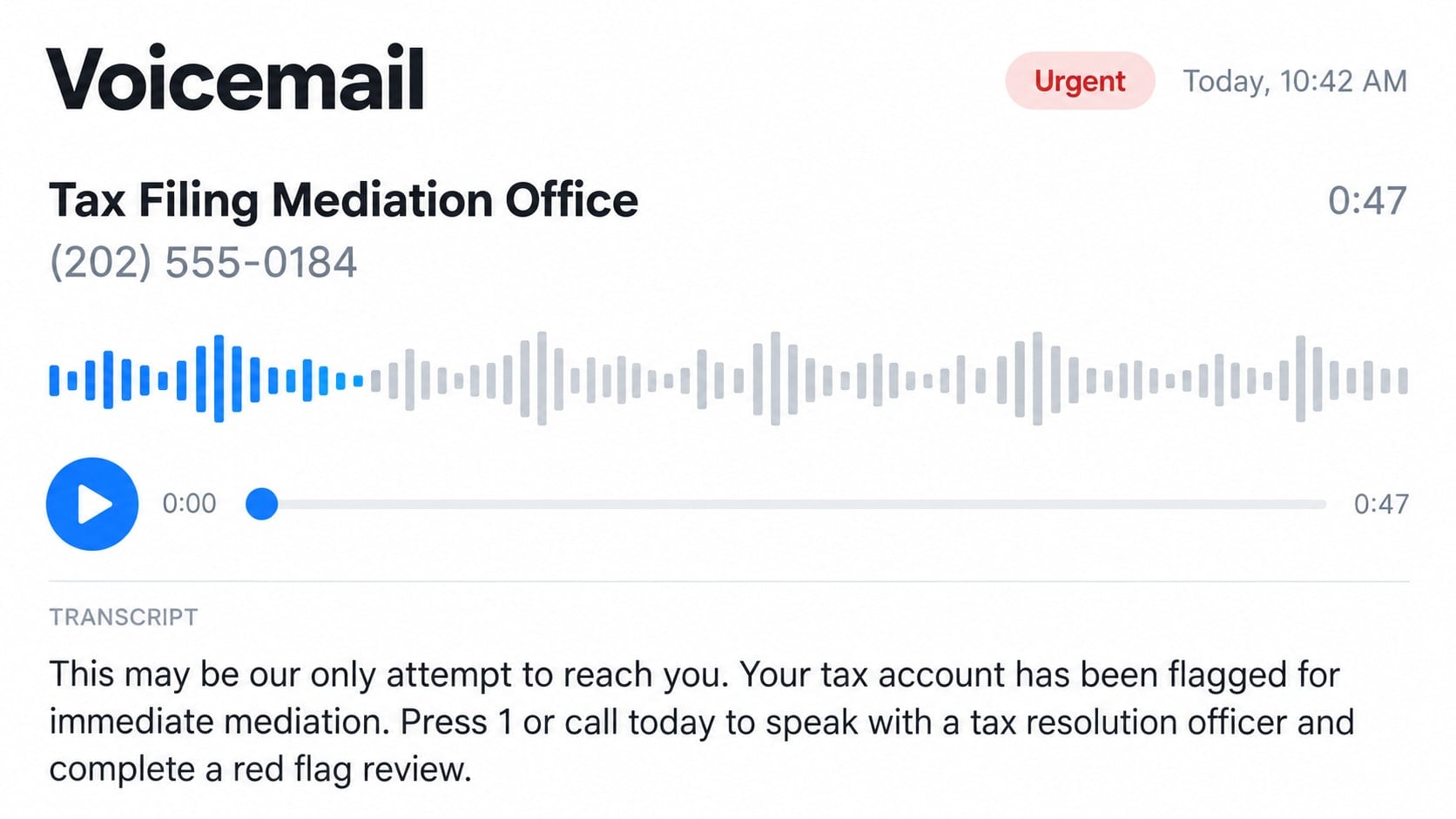
A voicemail saying this is the caller’s “only attempt” to address a tax problem can make an ordinary day feel dangerous. The message sounds formal, mentions a red flag, and offers a specialist who can supposedly stop the situation from getting worse.
There is no government Tax Filing Mediation Office waiting to clear the case. The official-sounding name is part of a call campaign built to collect personal information, sell worthless tax relief, or take an illegal advance fee.
Overview
The caller invents an official-sounding tax agency
Reported messages use names such as Tax Filing Mediation Office, Tax Mediation and Resolution Agency, or Tax Resolution Oversight Department. These labels are designed to sound close enough to a government unit that recipients return the call.
The Federal Trade Commission has warned about this exact pattern. The caller says the taxpayer needs mediation, a red flag review, or access to an IRS liability reduction program, but those named departments and programs are not real.
The call mixes fear with an offer of immediate relief
The voicemail may claim that unpaid taxes, penalties, or a compliance flag require attention. It then switches from threat to reassurance by promising a resolution officer who can reduce the balance or protect wages and property.
That emotional swing keeps the target engaged. The same person who introduced the danger now appears to offer the only easy escape from it.
The real objective is money or identity information
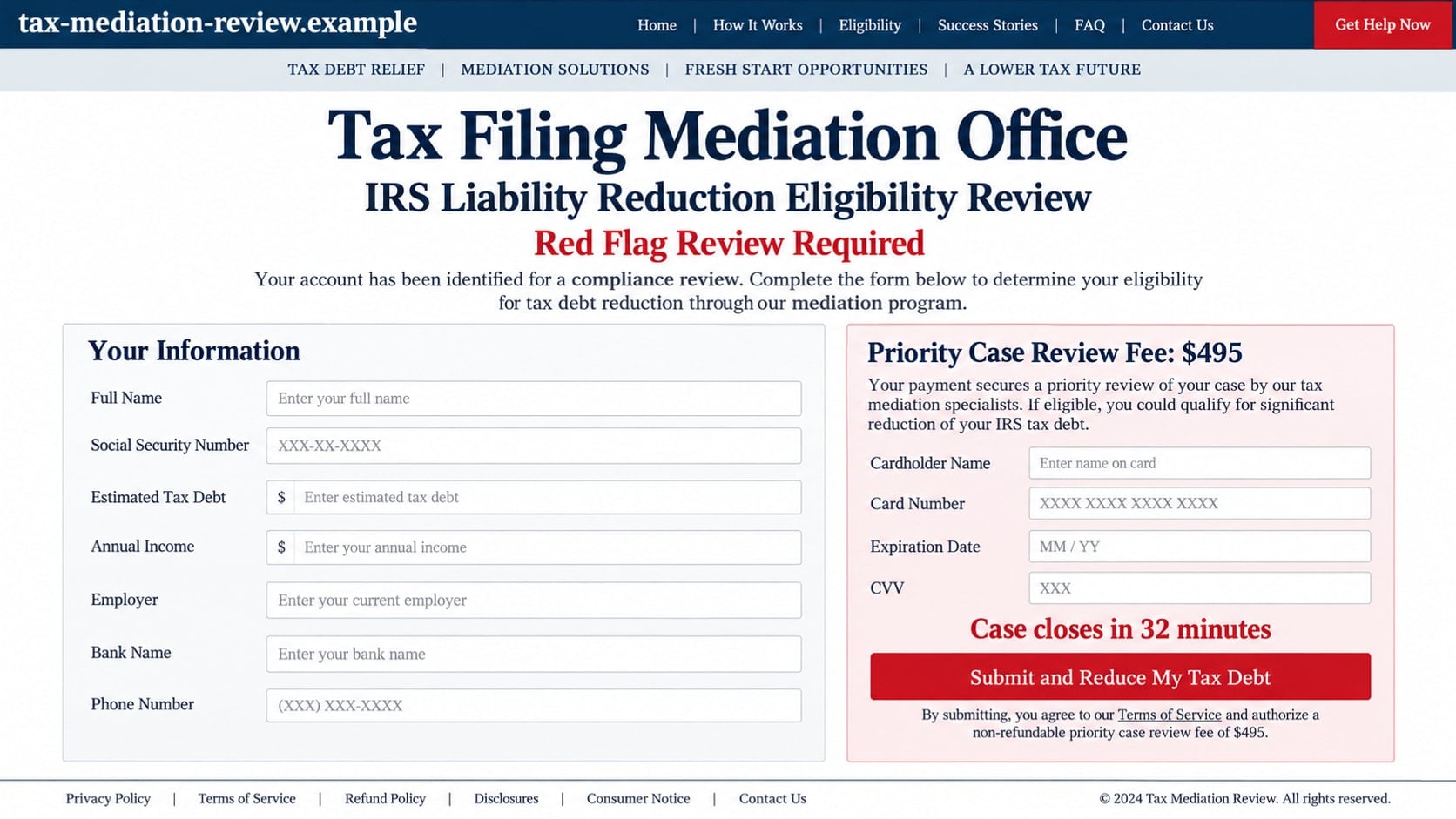
The operator may request a Social Security number, date of birth, income, employer, bank details, and tax balance to complete an eligibility review. Another version charges an upfront case fee for relief that never arrives.
The scheme can lead to:
- Identity theft using personal and tax information.
- Unauthorized card or bank withdrawals.
- Large advance fees for services never provided.
- False tax filings or access to an IRS Online Account.
- Follow-up calls demanding payment for new penalties.
- More scams from groups that buy or share victim lists.
What the Tax Filing Mediation Office Call Sounds Like
The message usually begins without naming the taxpayer or providing a real notice number. A recording says the account has been flagged and this may be the final attempt to reach the recipient before the case moves forward.
It may offer to connect the listener with a tax resolution officer or ask for a callback. Phrases such as mediation review, compliance department, liability reduction, and red flag check create the impression of a formal administrative process.
The caller may know a name, address, or part of a tax history from public records, marketing databases, or an earlier breach. Correct personal information does not prove access to an IRS account.
Some calls begin as a lead-generation scheme rather than a direct government impersonation. The operator claims to screen taxpayers for a private relief company. If the caller lies about a government affiliation, eligibility, results, or fees, the service is still deceptive.
The FTC says unexpected calls using names such as Tax Mediation and Resolution Agency and offering a red flag check should be treated as scams. The safest response is to hang up and check the tax account through IRS.gov.
How the Tax Filing Mediation Office Scam Works
Step 1: A robocall or voicemail creates a tax emergency
The campaign reaches thousands of numbers with the same recording. It mentions a time-sensitive tax issue without enough detail for the claim to be verified from the message itself.
The words only attempt, final notice, or pending action are chosen to make silence feel risky. Returning the call becomes a way to relieve uncertainty.
Step 2: A supposed intake agent confirms the story
The person answering uses a case script and may ask for a reference from the voicemail. They describe themselves as an intake specialist who must complete basic verification before transferring the call.
Questions begin with ordinary contact details, then move toward a Social Security number, filing status, employer, income, and estimated debt. The gradual progression makes the final requests feel like part of one routine form.
Step 3: A fake review finds an urgent problem
The agent may place the caller on hold, then return with the result of a supposed red flag or credit review. Unsurprisingly, the review finds a risk of liens, garnishment, penalties, or collection.
No meaningful government database check occurred. The alarming result is the sales script that moves every target toward a paid solution.
Step 4: A resolution officer promises dramatic savings
The call is transferred to someone with a senior title. They claim access to an IRS liability reduction program or guarantee that the balance can be settled for a small portion of what is owed.
Real tax relief options have eligibility rules. The IRS does offer payment plans, offers in compromise, penalty relief, and temporary collection delays, but no caller can guarantee approval from a brief unsolicited conversation.
Step 5: An advance fee or bank authorization is required
The operator asks for hundreds or thousands in enrollment, investigation, legal, or priority review fees. They may take card data, request an electronic bank withdrawal, or send a portal that collects payment and identity information together.
The pressure returns if the target hesitates. The supposed protection, discount, or case reservation expires that day, so the victim is told to pay before reading a contract or checking the company.
Step 6: The promised relief fails to materialize
Some victims receive generic forms they could have completed directly with the IRS. Others discover they never qualified for the promoted option, while the company stops answering or continues charging fees.
A direct scammer may simply disappear after collecting the first payment. The victim still owes any legitimate tax balance and now must address exposed identity and banking information too.
Identity, Contact, and Payment Checks
Verify the tax issue through IRS.gov
Sign in to the IRS Online Account by typing IRS.gov yourself. Review balances, notices, payment history, and available options there. Do not use a link or telephone number supplied by the caller.
The IRS says its first contact is generally by mail. It does not leave prerecorded urgent threats demanding immediate payment or prevent taxpayers from questioning or appealing an amount.
Check the company and the exact claims
Ask for the legal business name, physical address, written contract, full fee schedule, and the credentials of anyone claiming to represent you. Search those details independently before providing tax records.
A private tax professional can offer legitimate help, but that does not make every advertised result possible. Reject guarantees about settlement, timelines, penalty removal, or acceptance into an IRS program.
Compare relief options directly with the IRS
The official IRS tax debt page describes payment plans, offers in compromise, collection delay, and penalty relief. It also provides tools to explore options without beginning through an unsolicited caller.
If you do not agree with a balance, use the contact information on a verified notice or an IRS.gov page. A fake mediation office should not be allowed to interpret your account.
Reject rushed or unusual payment methods
The IRS does not demand gift cards, cryptocurrency, or prepaid cards. A private company asking for a large fee before providing a contract and eligibility analysis also deserves scrutiny.
Do not give a caller direct access to a bank account or authorize repeated withdrawals during the first conversation. Take time to review cancellation, refund, and service terms.
Warning Signs in the Fake Tax Relief Call
- The voicemail calls itself the Tax Filing Mediation Office.
- This is described as the only or final attempt to reach you.
- The caller invents a red flag check or IRS liability reduction program.
- No verified IRS notice or account record supports the claimed problem.
- The agent requests a full Social Security number immediately.
- A dramatic reduction is guaranteed before reviewing documents.
- An advance fee must be paid before the offer expires.
- The caller discourages direct contact with the IRS.
- Payment must be made by gift card, crypto, wire, or bank debit.
- The company will not provide its contract and credentials in writing.
- The caller threatens arrest, deportation, or immediate asset seizure.
A local area code does not prove the office is nearby. Caller ID can be spoofed, and internet calling services let operators select numbers that appear familiar to the recipient.
What Legitimate Tax Debt Help Looks Like
Start with the IRS rather than a sales call. The agency can explain payment options, account records, and verified notices. Some taxpayers can resolve the matter themselves without paying a private firm.
If professional representation would help, choose the person yourself. Verify whether the provider is an enrolled agent, certified public accountant, or attorney and confirm the credential with the appropriate licensing source.
A responsible professional asks for records before predicting an outcome. They explain that an offer in compromise is based on ability to pay, income, expenses, and asset equity, not a secret program unlocked by a telephone agent.
Fees and responsibilities should be written clearly. The agreement should say what work will be performed, what is not included, who communicates with the IRS, and how cancellation or refunds work.
Be careful even when an advertisement does not pretend to be the IRS. The IRS warns about offer in compromise mills that charge large fees and aggressively enroll people who are unlikely to qualify.
Ask how the provider will communicate progress and which IRS forms it plans to file. Vague answers about an internal government channel or a private approval list are reasons to choose someone else.
What to Do if You Have Fallen Victim to This Scam
- End contact and stop further payments. Do not send another fee to protect the case, release a settlement, or cancel the service. Block the numbers but preserve the voicemail, call log, emails, portal address, contract, and receipts.
- Contact the bank or card issuer. Report the transaction as connected to a suspected tax relief scam. Ask whether a charge can be disputed, a transfer recalled, recurring debits blocked, or the card replaced.
- Secure the IRS Online Account. Reach it through IRS.gov, review the profile and records, change exposed credentials, and enable available multi-factor protections. Look for an unfamiliar return, transcript request, or change.
- Respond to tax identity theft. If a Social Security number or tax document was exposed, follow the IRS guidance for tax-related identity theft. Use IdentityTheft.gov for a broader recovery plan and consider credit freezes.
- Change reused passwords. If the portal collected an account password, replace it everywhere it was reused. Secure email first, review forwarding rules and recovery methods, and sign out unfamiliar sessions.
- Remove remote-access or downloaded software. Uninstall anything the caller asked you to add. Run a full Malwarebytes scan to check for remote tools, information stealers, malicious browser extensions, and unwanted settings.
- Block known malicious infrastructure. AdGuard can reduce exposure to known phishing sites and harmful advertisements. It cannot confirm whether a tax relief company is honest, so business and credential checks remain necessary.
- Report the call. The IRS reporting page explains where to send suspicious tax calls and messages. Also report the scam at ReportFraud.ftc.gov and include every number and payment destination.
- Get real tax help. Check the balance through the IRS and speak with a verified tax professional if needed. A scam payment does not resolve a genuine tax obligation.
- Expect a recovery approach. Ignore anyone who promises to recover the fee for another advance payment. Victim details may be shared with callers posing as regulators, lawyers, or refund agents.
Frequently Asked Questions
Is the Tax Filing Mediation Office a real government agency?
No. The name has been used in official-sounding tax relief calls. Verify any real tax issue by visiting IRS.gov or using contact information from a notice confirmed in your IRS account.
Does the IRS call about unpaid taxes?
The IRS may call in limited circumstances, but it generally begins contact by mail. It does not make prerecorded urgent threats, demand payment now, or block your right to question the balance.
Is an IRS liability reduction program real?
Not under the vague name used by these callers. The IRS offers specific options such as payment plans, offers in compromise, penalty relief, and collection delays, each with rules.
Can a company guarantee an offer in compromise?
No. Eligibility depends on financial facts and IRS review. A guarantee made before examining records is a sales warning, not reliable tax advice.
What is a red flag tax review?
In this scam, it is a scripted phrase used to create alarm. Do not provide identity information so an unsolicited caller can perform a supposed check.
Where should I report a tax mediation call?
Keep the number and voicemail, then follow the IRS reporting guidance for suspicious tax debt relief calls. Reports can also be filed with the FTC and the FCC.
The Bottom Line
The Tax Filing Mediation Office scam uses a false agency name, an invented red flag review, and promises of easy relief to turn tax anxiety into a payment or identity theft opportunity.
Hang up, open IRS.gov independently, and verify the account before speaking with any relief provider. Legitimate tax options do not disappear because you took time to check who called.








