

The new match never runs out of things to say. Replies arrive quickly, every question gets a warm answer, and the conversation always seems one message away from becoming a real meeting.
There is one catch. Each message costs credits, and the person who is so eager to chat always has a reason to avoid a free video call.
By the time the pattern becomes clear, the conversation history may represent hundreds or thousands in purchases that cannot be taken back.
Overview
Police are seeing increased losses on fraudulent dating sites
Surrey Police and Sussex Police say they have seen a recent increase in reports from people who lost money, sometimes significant amounts, through fraudulent online dating websites. Many of the sites are hosted overseas.
The concern is not an ordinary subscription or a disappointing date. The warning describes sites built around credits or virtual tokens needed to send and receive messages.
The profiles may be bots or paid operators
Victims later discover that the highly responsive profiles may not be genuine. Police say some platforms appear to contain fake profiles, automated accounts, or operators whose purpose is to encourage more credit purchases.
The conversation is optimized for continuation, not for a relationship. A meeting, video call, or independent identity check remains close enough to keep hope alive but never actually happens.
The real product is the conversation itself
On a normal dating service, a successful match may leave the platform. On a fraudulent credit site, that outcome ends the spending. The system therefore has a financial reason to keep the chat inside its paid channel.
- An advertisement or message promises unusually eager local matches.
- Registration is free or cheap.
- Credits are required to send messages, photos, or gifts.
- Profiles reply quickly and encourage longer conversations.
- Meetings and video calls are repeatedly postponed.
- Small packages become frequent, expensive purchases.
- Used credits are declared non-refundable.
The warning does not mean every paid dating service is fraudulent. The scam is the deliberate use of fake identities, bots, or operators to manufacture engagement and drive spending without a genuine prospect of meeting.
How the Pay-Per-Message Dating Scam Works
Step 1: An advertisement promises active local singles
The funnel may begin with a social-media ad, pop-up, search result, unsolicited email, or message from a profile on another platform. Attractive images and location language make the site feel active nearby.
The advertisement rarely leads with the long-term cost. It promotes free registration, free matches, or a small starter balance that lets the first conversation begin.
Step 2: A new account receives immediate attention
Soon after signup, several profiles may like, message, or favorite the new user. The speed creates the impression that the service has solved the hardest part of online dating.
Generic profile questions can be answered from information supplied during registration. Automated messages can also be scheduled to arrive when the user is most likely to return.
Step 3: Free credits end at the emotional high point
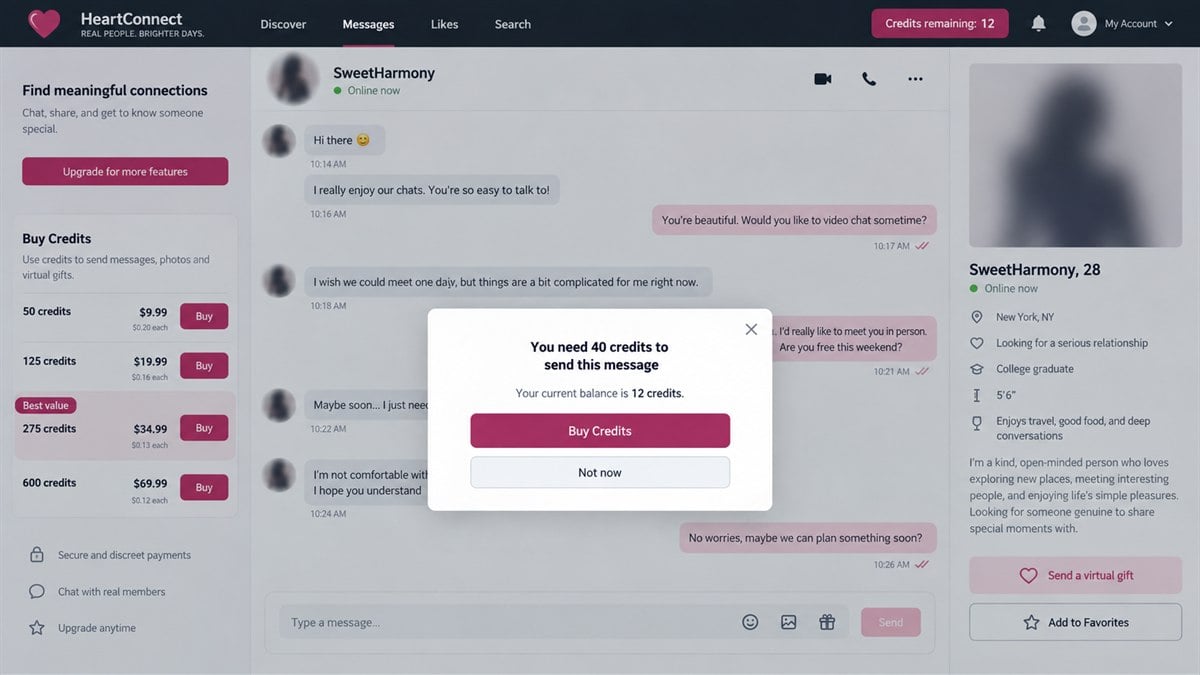
The starter balance runs out just as the conversation becomes personal, flirtatious, or close to arranging a meeting. The message box remains visible, but sending the next reply opens a credit-purchase window.
This interruption is deliberate. The user is no longer evaluating an abstract price list; the purchase appears to be the cost of not abandoning a promising person mid-conversation.
Step 4: The profile keeps the chat open-ended
Replies are warm but noncommittal. The profile asks questions, refers to earlier details, and suggests that a meeting would be wonderful after work, travel, family, or safety concerns are resolved.
When a specific date is proposed, a new complication appears. The profile may refuse telephone and video contact, claiming privacy, a broken camera, poor connection, or a preference to stay safe on the site.
Step 5: Credit packages disguise the real price
Users buy 40, 80, 120, or more tokens instead of paying directly per message. That extra calculation makes it harder to see that a short chat may cost several pounds.
Larger packages are labeled best value. Virtual gifts, photos, voice messages, and premium replies can consume more credits than ordinary text.
Step 6: Several profiles create several reasons to stay
If one conversation slows, another profile may appear. The user interprets the attention as proof that the site is popular and that leaving would waste multiple opportunities.
Bots or operators can maintain many conversations without intending to meet anyone. The platform earns when the user sends another message, not when a relationship succeeds.
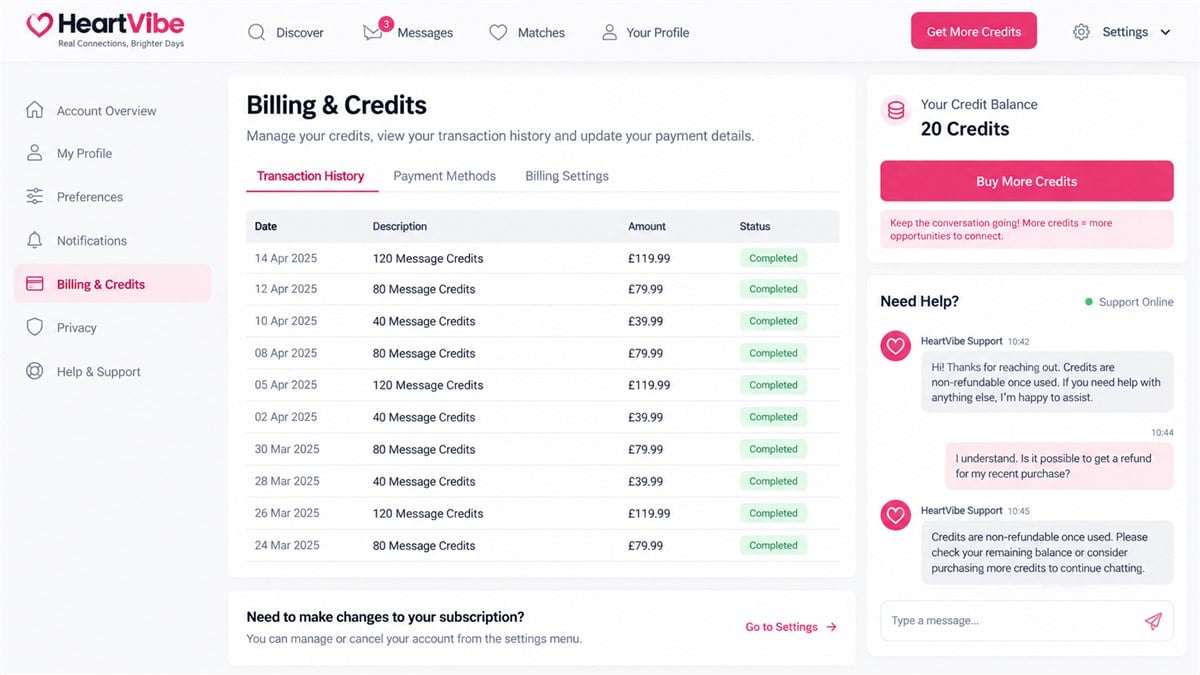
Step 7: Refund requests meet a terms-and-conditions wall
Support points to language stating that digital credits are consumed immediately and cannot be refunded. The company may argue that it sold a messaging service exactly as described.
That response avoids the central allegation: whether the profiles and conversations were represented honestly. A receipt for credits does not prove the apparent dater was real or independent.
What the Police Warning Actually Confirms
The September 2026 fraud newsletter states that Surrey Police and Sussex Police have seen an increase in reports involving fraudulent online dating websites that charge for messages.
Victims report being encouraged to spend increasing amounts while talking to profiles that appear attractive, engaging, and highly responsive. In many cases, those victims later question whether the profiles were genuine.
Police specifically mention sites that appear to contain large numbers of fake profiles, automated bots, or operators whose purpose is to keep users purchasing credits. They also describe conversations designed to prolong engagement while avoiding meetings, video calls, and other verification.
This evidence distinguishes the subject from a single unhappy customer complaining that a date did not work out. Authorities are warning about a recurring commercial fraud pattern reported by multiple victims.
The pattern can appear under many disposable site names. An article focused on one domain would miss how easily the same profiles, checkout, and scripts can move to another address.
Company, Address, and Fulfillment Checks
The operator must identify a real legal company
Look for the legal entity in the terms, privacy policy, checkout, and card statement. Compare the names rather than assuming a dating brand and a billing descriptor belong to the same business.
A generic company name, unexplained offshore entity, or rotating merchant descriptor makes disputes and accountability harder. Save every version shown before purchasing.
The business address must support traceability
Check whether the address belongs to the named company, a formation agent, mailbox, residence, unrelated business, or virtual office. An address alone does not prove fraud, but contradictions matter.
Overseas hosting is not automatically suspicious. The issue is whether the operator can be identified and reached when billing, privacy, or profile-authenticity questions arise.
Support must answer the profile question
Ask whether profiles can be operated by employees, contractors, moderators, entertainers, or automated systems. Search the terms for words such as virtual, moderated, fictional, entertainment, staff, controller, or operator.
A support reply that discusses only credit delivery and ignores who creates the messages leaves the most important issue unresolved.
The identity must be verifiable away from paid chat
Suggest a brief free video call at a reasonable time. Ask for a simple, non-sensitive verification that a bot or recycled profile cannot easily supply.
Do not pay for identity documents or “safety” checks sent by the profile. MalwareTips has separately documented dating verification subscription scams that turn the request into another checkout.
The Economics Explain the Endless Conversation
A credit platform can make each purchase feel small while the running total becomes large. Ten packages spread across a month do not feel like one major decision, even when the statement shows hundreds in spending.
Variable pricing also obscures comparison. One message may cost a few credits, a photograph more, and a virtual gift much more. “Best value” measures tokens per pound, not the likelihood that the profile represents a genuine person seeking a meeting.
The sunk-cost effect becomes powerful. After spending money and sharing personal stories, admitting that the conversation may be manufactured feels like losing both the relationship and the investment.
Operators can exploit that reluctance without making a direct promise. A profile says “maybe soon,” asks another question, and lets the user imagine that the next exchange will finally produce a call or date.
Healthy dating communication can be cautious and slow. The difference is not one postponed meeting. It is the repeated combination of paid messages, escalating purchases, unverifiable identity, and a conversation that never progresses outside the revenue channel.
Warning Signs of a Fraudulent Credit Dating Site
- Multiple polished profiles contact a new account immediately.
- Free credits expire just as a conversation becomes engaging.
- The cost per message is hidden behind token calculations.
- The same writing style appears across different profiles.
- Replies arrive at implausible hours or immediately after every purchase.
- Specific plans become vague when a date approaches.
- Every telephone or video-call request produces a new excuse.
- The profile refuses any safe verification outside paid chat.
- Terms mention fictional, moderated, entertainment, or staff-controlled profiles.
- Support will discuss credits but not profile authenticity.
- The billing company differs from the dating brand without explanation.
- Refunds are rejected solely because digital credits were consumed.
A real dater may be cautious, busy, or unwilling to meet. Do not accuse an individual from one delay. Evaluate the complete pattern and stop purchasing when the only progress happens inside the paid interface.
How to Test the Conversation Without Buying More
Let the credit balance reach zero and do not replenish it. A genuine person interested in continuing may agree to a safe free channel after enough trust has formed, while a revenue-driven profile will keep steering back to purchases.
Ask one clear question that requires a direct answer, such as a specific public meeting time or short video call. Notice whether the reply answers it or changes the subject with another emotionally engaging question.
Reverse-search profile images and look for the same photographs under different names. Remember that no match in search does not prove authenticity, especially when AI-generated or private images are used.
Read the terms before another purchase. Disclosures about moderated or entertainment profiles may be placed far from the chat screen. Save a copy because terms can change after complaints begin.
What to Do if You Have Fallen Victim to This Scam
- Stop purchasing credits. Do not buy one last package to confront the profile or extract a confession. More messages increase the loss and rarely create useful proof.
- Save the record. Capture the profile, chat, credit prices, purchase history, advertisements, promises, terms, company details, support replies, and card statement descriptor.
- Cancel stored billing. Remove the card when possible, turn off any recurring plan, and send a written cancellation that identifies the account and date.
- Contact the card issuer. Explain the alleged misrepresentation, not just that the date was disappointing. Ask about charge disputes, card replacement, merchant blocking, and recurring-payment controls.
- Request a written refund. State which purchases are disputed and why you believe the profiles, bots, or operators were not represented honestly. Keep the response.
- Protect personal information. Change reused passwords and secure email and social accounts. Treat identity documents, intimate images, workplace details, and financial information as exposed when shared.
- Report the site. File with local police or the national fraud-reporting service, the advertising platform, payment processor, hosting provider where appropriate, and consumer-protection authorities.
- Scan suspicious downloads. If the site or profile persuaded you to install an app, extension, or file, remove it and run a complete Malwarebytes scan.
- Reduce repeat targeting. AdGuard can block some scam ads and known malicious domains, but it cannot determine whether a dating profile is operated honestly.
- Reject recovery offers. Anyone promising a guaranteed refund for an advance fee may be exploiting the same victim list.
- Talk to someone you trust. Emotional manipulation grows in secrecy. A friend can review the conversation and spending pattern without the hope built inside the chat.
Frequently Asked Questions
Are all dating sites that sell credits scams?
No. The warning concerns fraudulent sites using fake profiles, bots, or operators to prolong paid conversations. Pricing alone does not prove fraud.
How can I tell whether a profile is an operator?
No single test is perfect. Repeatedly avoiding safe video or real meetings, generic replies, and constant pressure to remain in paid chat form a stronger pattern.
What do terms such as moderated or entertainment profile mean?
They may disclose that some interactions are not ordinary member-to-member dating. Read the exact definition and decide whether advertising and profiles made that limitation clear.
Can I charge back used credits?
The result depends on evidence, card rules, timing, and jurisdiction. Contact the issuer quickly and explain any alleged fake-profile or billing misrepresentation.
Should I pay for a verification link sent by the match?
No. That can lead to a second scam involving card theft or hidden subscriptions. Use the platform’s own safety tools and free independent verification.
What if the profile finally agrees to meet after I complain?
Do not buy more credits solely on that promise. Set a safe, specific plan outside paid chat and stop if another excuse or fee appears.
The Bottom Line
The pay-per-message dating scam does not need to ask for an emergency transfer. It turns attention, hope, and conversation into a meter that keeps running.
Police reports confirm that victims are losing significant amounts on sites where profiles may be fake, automated, or operated to drive credit sales. Stop judging the relationship by the warmth of the replies and start judging the service by whether identity and intentions can be verified away from the checkout.








