

MerryGlow offers the kind of Christmas display that instantly attracts attention: one set of lights, animated characters, phone controls, and almost no setup.
The product idea is plausible and visually impressive. Determining whether this particular offer deserves trust requires looking beyond the glowing tree.

Overview
The store sells one familiar technology through extraordinary imagery
MerryGlow advertises vertical strands of individually addressable LEDs that create Santa, snowflakes, bows, candy canes, and other animated patterns across a tree.
Programmable LED matrices and app-controlled decorative lights genuinely exist, so the basic product concept is neither impossible nor automatically fraudulent.
The uncertainty concerns whether the exact kit can reproduce the dramatic scenes, sizing, brightness, reliability, app experience, and durability shown online.
MerryGlow’s hero creative looks cinematic and highly polished, with a perfectly formed Santa image covering a towering tree in a dark luxury room.
The website later admits that its social-media content uses AI-generated material that has no correlation to its products.
The domain was days old while claiming more than a thousand reviews
Official registry data shows MerryGlows.com was registered on September 14, 2026, thirteen days before this investigation.
The homepage displayed a 4.7 rating based on 1,412 reviews and labeled those comments as verified buyer reviews for the light kit.
A new store can acquire sales quickly through advertising, but such a large review history needs independent evidence, dates, and a transparent collection method.
We could not verify that the review total represents completed purchases through this exact domain rather than imported, licensed, generated, or reused content.
Testimonials controlled by the seller should never substitute for an established third-party record tied to the same merchant.
Urgency and policy inconsistencies weaken the offer
A scrolling banner advertised 44% off and an early-bird sale ending tonight, while the main purchase card showed 50% off with a countdown.
The $89.95 offer appeared beside a crossed-out $179.99 reference price, yet the domain’s short life leaves little public price history to examine.
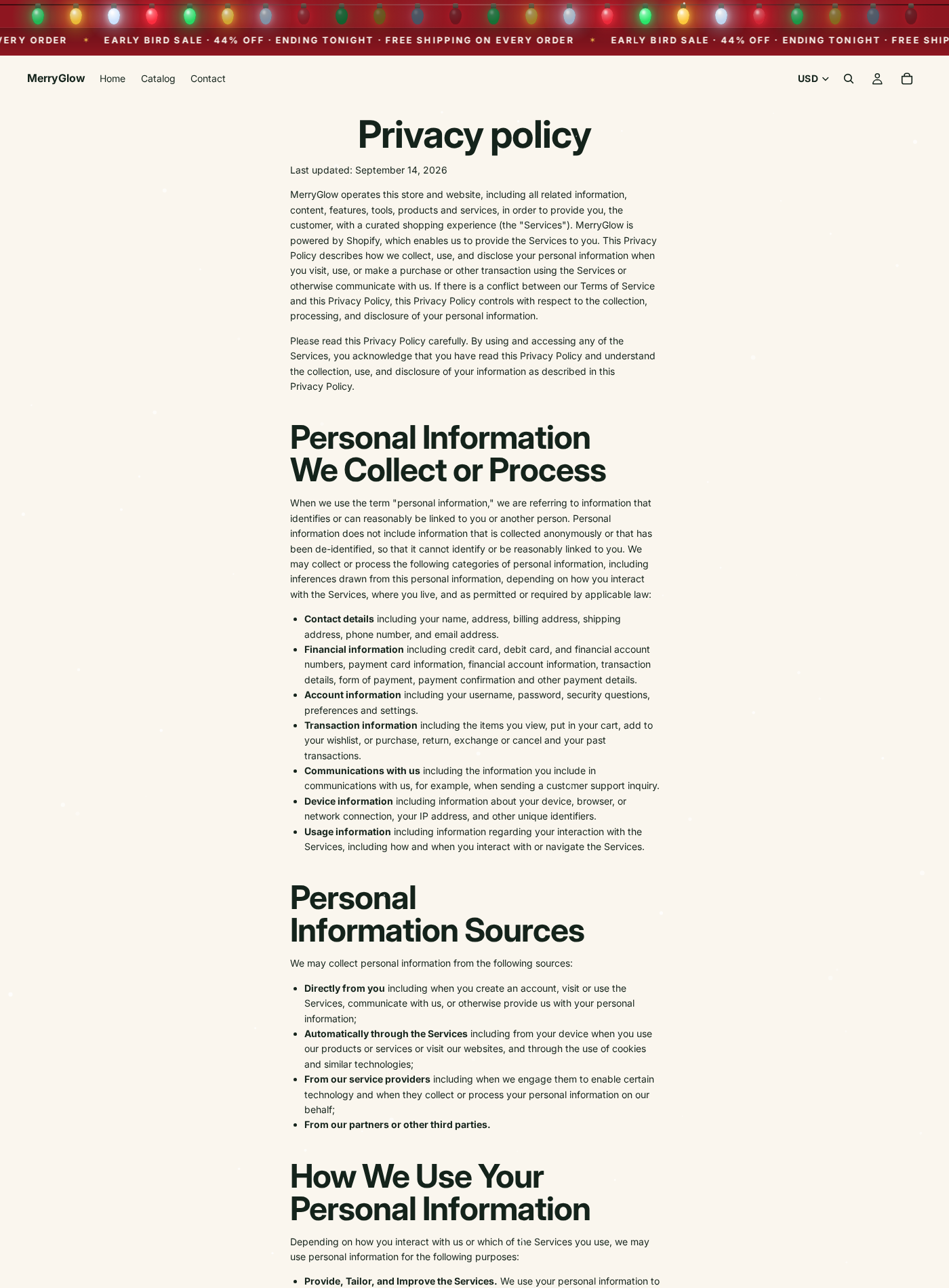
More seriously, the privacy policy and terms direct questions to contact@merryjammies.com and list a MerryJammies telephone number and Arizona address.
That unrelated contact trail creates uncertainty about which company controls customer data, processes orders, handles returns, and accepts legal responsibility.
A one-product seasonal store should resolve those identity questions before asking buyers for payment and personal information.
- MerryGlows.com was registered on September 14, 2026.
- The store claimed 1,412 verified buyer reviews within thirteen days of registration.
- Its homepage displayed both 44% and 50% discount messages.
- The site expressly says social-media promotions contain AI-generated content unrelated to the products.
- Privacy and terms pages contain contact details for MerryJammies rather than MerryGlow.
- The animated-light concept is real, but the exact advertised performance remains unverified.
How the MerryGlow AI-Driven Sales Funnel Works
Step 1: An impossible-looking Christmas scene stops the scroll
The funnel begins with an animated tree displaying crisp holiday characters across hundreds of perfectly positioned light points.
A viewer imagines recreating the scene at home without wrapping ordinary strings, programming controllers, or arranging a complex pixel matrix.
Social platforms reward spectacular transformations, so the most cinematic clips can spread more effectively than accurate demonstrations of everyday results.
MerryGlow acknowledges that its social-media content uses AI-generated material unrelated to the actual products, an unusually important disclosure.
Buyers should preserve the creative and separate its visual promise from the specifications stated on the final product page.
Step 2: A seasonal deadline makes research feel costly
The page repeats that the early-bird offer ends tonight, surrounds visitors with a countdown, and describes the price as the year’s lowest.
Holiday products already have a natural deadline because customers want them delivered, tested, and installed before celebrations begin.
Artificial countdown pressure compounds that calendar anxiety and encourages immediate ordering from a brand the shopper encountered minutes earlier.
The simultaneous 44% and 50% messages also make the promotion difficult to interpret as one stable, audited discount.
Revisit the page later and compare archived prices before accepting any “tonight only” claim at face value.
Step 3: The landing page supplies instant social proof
MerryGlow displays 1,412 reviews, a 4.7 score, named customers, and confident stories about fast setup, children’s reactions, and brightness control.
These comments address exactly the doubts a hesitant buyer would have, making the page feel supported by a sizable community.
No visible review dates, order references, independent platform link, or detailed moderation explanation established how that total was collected.
The reviews may originate from another seller or product, but the website does not clarify whether any migration occurred.
A legitimate imported review history should disclose its source and avoid implying that every review came through a thirteen-day-old domain.
Step 4: Product plausibility bridges the gap between the ad and checkout
Addressable LEDs can form images when mounted at known positions and controlled by software, giving the sales presentation a credible technical foundation.
Actual results depend on pixel count, tree shape, viewing angle, spacing, controller quality, app stability, power delivery, and careful installation.
A scene that looks perfect from one camera position may appear distorted from the side or on a tree with different dimensions.
The product page should provide controller model, pixel quantity, strand layout, voltage, certification, app identity, supported phones, and replacement options.
Broad phrases such as “fits any tree” cannot replace measurements and installation limitations for the exact kit being sold.
Step 5: Checkout hides the unresolved operator relationship
The store runs on Shopify and presents standard payment controls, which can make the transaction look familiar and technically secure.
Shopify provides ecommerce infrastructure. It does not independently endorse every merchant, product claim, review count, or refund decision.
The buyer may submit card, address, email, and telephone information before noticing that legal policies point to MerryJammies contact details.
That mismatch matters because a privacy controller and contractual seller should be identifiable before personal information is transferred.
Record the final merchant descriptor, company name, product quantity, add-ons, delivery promise, and all checkout disclosures before authorizing payment.
Step 6: Seasonal timing can weaken practical refund options
If delivery takes one or two weeks, a defective or disappointing kit may arrive close to the date it was meant to be used.
Customers may keep experimenting with the app, repositioning strands, or waiting for support instead of beginning a return promptly.
A replacement can arrive after Christmas, leaving a buyer with little seasonal value even when merchandise eventually appears.
Return postage for a bulky light kit may reduce the economic value of a refund if the seller does not provide a prepaid label.
Read cancellation, defect, return, and warranty rules before ordering, and test the complete system immediately after delivery.
What Our MerryGlow Investigation Found
The AI-ad disclosure changes how every promotional image should be read
MerryGlow states that social media is used to promote the site and contains AI-generated content with no correlation to its products.
That sentence means viewers cannot safely treat the advertising scene as a demonstration of the item they will receive.
An AI image can illustrate a concept while exaggerating light density, character sharpness, room scale, color, and installation simplicity.
The seller should distinguish simulations from real product footage and provide unedited demonstrations using the shipped kit and named app.
Without those demonstrations, customers risk purchasing an aspiration whose visual performance was never physically recorded.
The review volume is not independently supported by the store’s age
A count of 1,412 buyer reviews appearing within thirteen days would imply an extraordinary sales and feedback rate for a new domain.
That outcome is possible only with substantial prior sales, a transferred operation, imported reviews, or a rapid advertising launch.
The page does not explain which of those circumstances applies, nor does it link the review history to a verifiable external source.
Names and polished quotations are not enough because modern storefront themes can populate testimonials without authenticated transactions.
Buyers should give greater weight to dated, independent reviews containing real setup photographs and specific support outcomes.
MerryJammies details appear where MerryGlow details should be
The privacy page lists contact@merryjammies.com, a +1 480 telephone number, and 17834 W Thistle Landing Drive in Goodyear, Arizona.
The terms page also directs legal questions to the MerryJammies address rather than a dedicated MerryGlow company identity.
This could reflect copied policy text, shared ownership, a rebrand, or an operator using several storefronts under one infrastructure.
None of those explanations should be left for customers to infer after entering personal and payment information.
The site needs a consistent legal entity and a plain explanation of any relationship between the two names.
The evidence justifies a strong buyer warning without declaring the technology fake
We are not claiming that programmable Christmas lights are imaginary or that MerryGlow never sends a physical kit.
Our concern is the unverified gap between AI-driven promotion, a days-old domain, instant review volume, urgency, and inconsistent legal details.
Even a delivered product would not validate the promotional imagery, claimed review source, original price, or operator transparency.
Because seasonal alternatives exist from established lighting brands and retailers, buyers have little reason to accept this concentration of uncertainty.
MerryGlow should demonstrate real performance and correct its policies before consumers rely on its guarantees.
How to Evaluate Animated Christmas Lights Safely
Demand a continuous real-world demonstration
Ask for one unedited video showing the sealed kit, controller, app download, pairing, installation, every advertised design, and viewing angles around the tree.
The demonstration should identify the exact product variant, pixel count, dimensions, power supply, and phone operating system used.
Watch for cuts that replace an ordinary light string with a denser installation or computer-generated result.
A seller admitting unrelated AI media should provide unusually strong physical evidence to restore confidence.
Check electrical and app safety separately
Verify voltage, current, plug type, indoor rating, conformity marks, manufacturer, importer, cable specifications, and controller temperature limits.
Find the named companion app in official stores and read permissions, developer identity, privacy terms, updates, and independent reviews.
Avoid sideloading an application from a QR code or unknown file host merely because the included leaflet instructs you to do so.
Disconnect any controller that overheats, flickers abnormally, smells burned, exposes conductors, or loses insulation near connectors.
Measure the return timeline against the holiday calendar
Calculate processing, transit, testing, support, authorization, return shipping, inspection, and bank-posting time before ordering for a fixed date.
Ask whether an item arriving after Christmas qualifies for cancellation or return when delivery missed the advertised window.
Request the physical return country and warranty procedure, including who pays postage for a faulty electrical product.
Use a credit card and avoid optional protection charges whose terms are not clearly explained.
Company, Address, and Fulfillment Checks
MerryGlow does not present a consistent legal seller
The storefront uses MerryGlow throughout its branding, but the legal pages do not clearly identify a registered MerryGlow company accepting the order.
Instead, contact instructions lead to MerryJammies, a separate name that customers were not asked to research before entering the sales funnel.
A shared operator can run multiple brands legitimately, yet the relationship and legal entity should be disclosed explicitly.
Buyers need the company name and registration on the receipt, terms, privacy policy, warranty, card statement, and return authorization.
Until those documents agree, responsibility for data and refunds remains needlessly ambiguous.
The Arizona address belongs to the policy trail, not a confirmed return route
MerryGlow’s privacy disclosure references 17834 W Thistle Landing Drive, Goodyear, Arizona through the MerryJammies contact details.
We have not established that this address stores MerryGlow inventory, employs customer-service staff, or accepts consumer returns.
A residential, registered, virtual, or administrative address can be lawful while serving none of those operational functions.
Do not send lights there unless the seller provides written authorization tied to the exact order.
Ask whether the physical return goes to Arizona, another United States facility, or an overseas supplier before purchasing.
The telephone and email point to another brand
The policy lists a +1 480 number and contact@merryjammies.com, while the visible MerryGlow contact page primarily provides a submission form.
That setup can leave customers wondering whether the other brand will recognize their order, warranty, or merchant descriptor.
Test the contact details before checkout and ask the responder to identify the legal company behind both names.
Preserve complete email headers and screen captures because domain-linked support can disappear with a short-lived seasonal store.
Do not provide payment credentials or authentication codes when attempting to verify the relationship.
The manufacturing and fulfillment chain is undisclosed
MerryGlow says kits ship from stock and provides regional transit estimates, but it does not clearly identify the manufacturer or stock locations.
The product may be a generic addressable-light kit sold by numerous merchants under changing brand names and promotional creatives.
Generic manufacturing is not inherently defective, although safety, app support, firmware, spare controllers, and replacement strands require accountable suppliers.
Check packaging for a traceable manufacturer, model, batch, electrical specifications, importer, and responsible person for the destination market.
Stop using the kit when those details are missing or the hardware behaves unsafely.
What to Do if You Have Fallen Victim to This Scam
- Archive the AI-driven promotion. Save the advertisement, video, product page, review count, timer, discount messages, specifications, policies, checkout, receipt, and any page admitting unrelated AI content.
- Identify the contractual seller. Ask in writing whether MerryGlow, MerryJammies, or another registered entity processed the order and controls customer data, warranties, and refunds.
- Cancel promptly when uncertain. Send the order number, exact amount, items, and cancellation request through the form and every published email before dispatch.
- Film the complete setup. Record sealed packaging, labels, controller, power supply, strand count, app installation, pairing, displayed designs, failures, overheating, and differences from the advertisement.
- Disconnect unsafe equipment. Stop using any component that sparks, overheats, smells burned, exposes wiring, loses insulation, or requires an untrusted application outside official stores.
- Request a fault-specific remedy. Demand prepaid return instructions or replacement when goods are defective, materially misrepresented, incomplete, unsafe, or incompatible with the promised app.
- Do not accept endless troubleshooting. Give support a reasonable written deadline and preserve the card issuer’s dispute period while attempts to pair or replace equipment continue.
- Dispute with precise evidence. Explain whether the issue is non-delivery, materially different goods, unauthorized quantity, defective electronics, or a refund not processed after authorized return.
- Protect the ordering device. Run Malwarebytes after suspicious app downloads or redirects, and use AdGuard to limit AI-generated shopping ads and malicious imitation pages.
How to Recognize Similar AI Holiday-Product Campaigns
The demonstration looks more perfect than the specifications allow
A huge, sharply defined animated image requires enough pixels, controlled geometry, correct viewing distance, and software calibrated to the installation.
When the page never states pixel count or physical layout, a cinematic result deserves skepticism rather than admiration alone.
Ask for raw footage using the retail kit on ordinary trees of several shapes and sizes.
Avoid sellers whose only evidence consists of edited reels, simulations, influencer narration, or AI-generated rooms.
A seasonal brand accumulates instant heritage
New domains sometimes display thousands of reviews, years of customer satisfaction, and large sales counters immediately after launch.
Those claims may reflect imported product reviews, prior operations, or fabricated social proof, and the distinction matters.
Look for dated external posts, verified-order systems, archived pages, customer setup videos, and transparent review migration notes.
Never infer an established company from a testimonial carousel controlled by the seller.
Legal pages reveal an older or unrelated operation
Copied privacy and terms templates often retain another store’s email, address, product category, governing law, or company name.
These leftovers expose weak quality control and uncertainty about who actually formed the contract.
Read policy footers before checkout and search every unexpected name independently.
A trustworthy merchant corrects mismatches before accepting orders, not only after customers complain.
Frequently Asked Questions
Is MerryGlow definitely a scam?
We cannot prove that MerryGlow never ships lights, and the underlying addressable-LED technology is genuine.
The days-old domain, unrelated AI ads, unsupported review volume, urgency, and policy mismatches make this particular offer high risk.
Are MerryGlow social-media videos real?
The website itself says its social media contains AI-generated content with no correlation to its products.
Treat promotional scenes as conceptual advertising unless the seller provides unedited demonstrations using the exact retail kit.
How old is MerryGlows.com?
Official registry records show September 14, 2026 as the domain creation date.
Our review occurred thirteen days later, leaving almost no independent history for delivery, app reliability, returns, or warranty service.
Why does MerryJammies appear in the policies?
The privacy and terms pages list a MerryJammies email and related Arizona contact details.
The website does not clearly explain whether MerryJammies owns MerryGlow, provides fulfillment, or was left behind in copied policy text.
Can these lights really show animated characters?
Properly arranged individually addressable LEDs can display recognizable patterns and motion.
Real-world sharpness depends on pixel density, tree geometry, viewing angle, controller software, power, and installation accuracy.
What should buyers choose instead?
Select a named lighting manufacturer or established retailer providing model-specific demonstrations, electrical certification, app support, independent reviews, spare parts, and clear domestic returns.
Use a credit card and test the complete kit immediately.
The Bottom Line
MerryGlow markets a real category of smart lighting through imagery it admits can be AI-generated and unrelated to the physical product.
A thirteen-day-old domain, instant review history, conflicting discounts, and MerryJammies policy details leave too many unanswered questions. Buy proven hardware from a transparent seller instead.








