

A caller says a specialist team can trade binary options for you and send a predictable return each month. The pitch sounds less like gambling than a managed account.
That distinction is exactly what makes the offer worth examining. A professional voice, formal documents, and an online balance can hide more than they reveal.
Overview
The investment story was built around certainty
Binary options involve a wager on whether an asset’s price will meet a condition by a set time. Outcomes are uncertain by design.
Yet a UK fraud network sold managed binary-options accounts as a route to guaranteed monthly returns, according to the City of London Police.
The operation used the names Choice Option and Blue Crest Capital Options. Brokers cold-called people and said experienced traders would handle the investments.
The names are historically important, but the warning is larger than either brand. Any stranger promising fixed results from speculative trading deserves immediate scrutiny.
A familiar-looking account concealed an unfamiliar money path
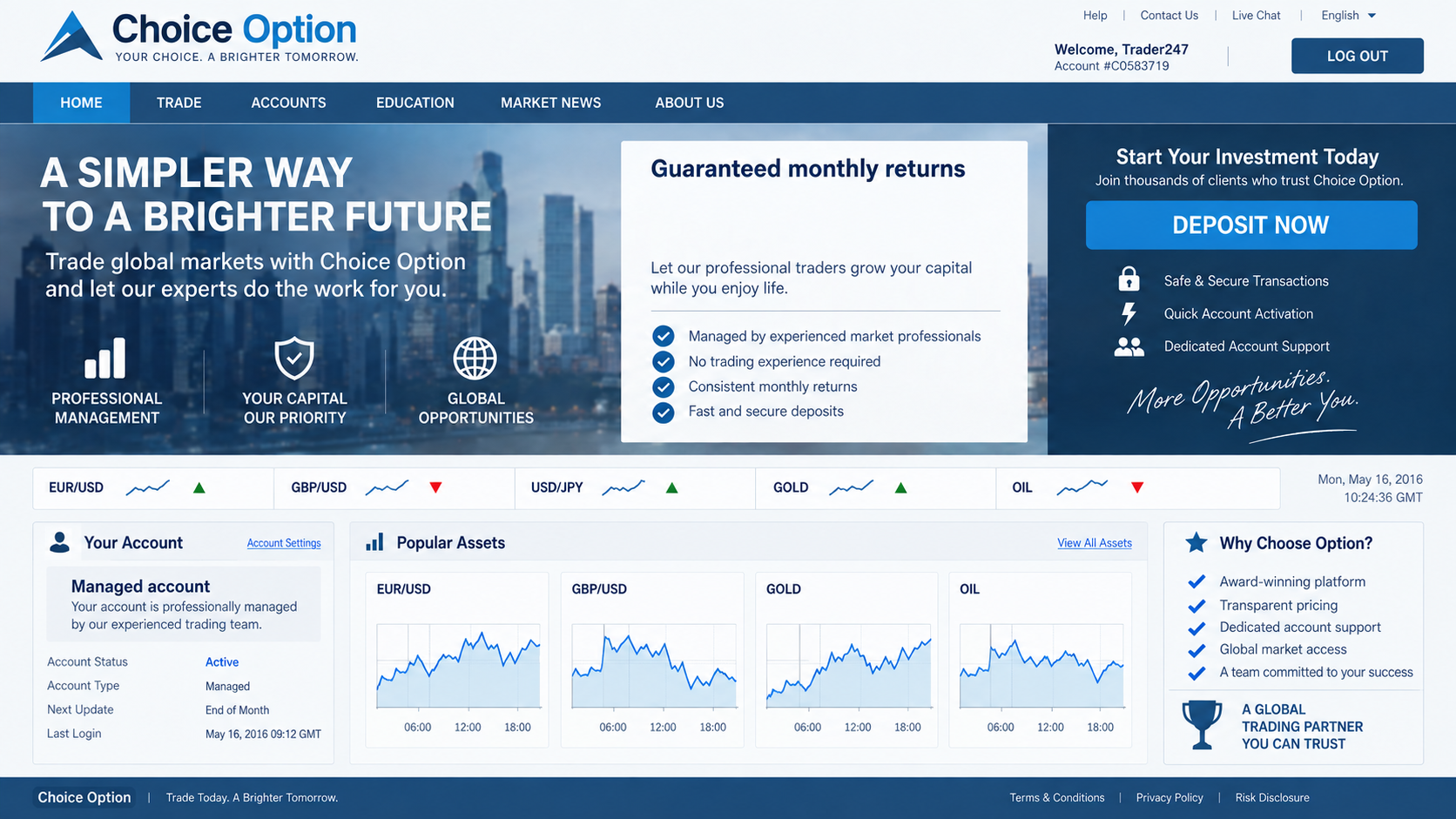
Investors were shown a trading platform and periodic figures. Police say the Choice Option platform was not connected to a banking system.
That means a displayed profit was not proof of profitable trading. It was information controlled by the operation collecting investor money.
Investigators found incoming funds were used to pay earlier investors and the operators, a Ponzi-style pattern that can keep confidence alive temporarily.
By October 2016, clients could not access their online accounts, reach staff, or withdraw their funds, police reported.
The case has a documented outcome, not just suspicion
Police say 74 investors were affected. Three brokers were convicted and sentenced in 2024, and ringleader James Gillingham was jailed in 2026.
Those outcomes distinguish this case from an unverified complaint about a slow withdrawal. Courts and investigators examined the underlying conduct.
Keep these three questions in view whenever a managed account is pitched:
- Who has custody of the money after it leaves your bank?
- Can you independently verify the firm and its authorization?
- Can you withdraw funds without the seller’s permission or delay?
- Are the reported trades supported by statements from an independent custodian?
The images in this article illustrate the type of interface described by investigators. They are reconstructions, not recovered Choice Option or BCCO screenshots.
What the Police Investigation Established
Choice Option’s brokers cold-called prospective clients. They said investors would deposit funds while the company traded binary options on their behalf.
Clients were told they could not execute their own trades. The brokers alone supposedly controlled the strategy, promising fixed monthly returns and a later profit.
The 2024 police account says staff used aliases, including names drawn from films and television.
They also had elaborate marketing materials, some copied from respected trading firms. Such presentation can make an untested claim feel like established finance.
Investigators identified a serviced office, recruitment of staff, account documentation, and bank arrangements under Gillingham’s control.
Those are the trappings of a business. They also show how much infrastructure an investment fraud can build before the money trail is understood.
One broker said he believed the trades were genuine because he saw activity on the platform. That detail is important: even insiders may mistake a screen for proof.
Financial records, not a dashboard animation, established where investors’ money went. Police described the arrangement as a Ponzi scheme accepted at trial.
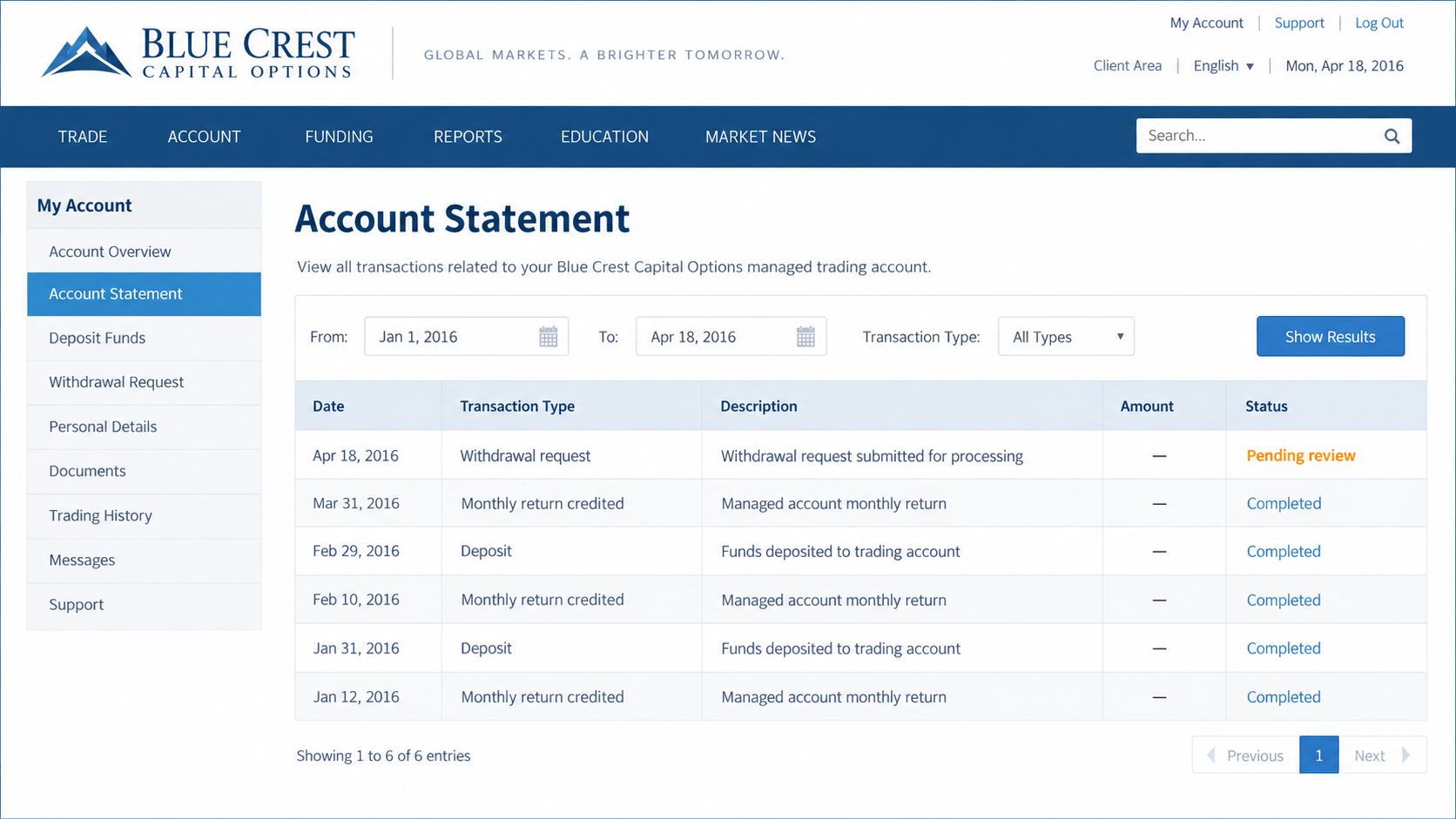
The second image illustrates why an account statement can be persuasive. The verified case involved promises of credited returns and, eventually, blocked access.
It does not reproduce a specific victim’s statement. Treat any screenshot from a seller as a claim to verify, not independent proof of custody.
The relevant event sequence is clear: the operation drew deposits, displayed apparent progress, and later failed when investors attempted to retrieve funds.
How the Guaranteed Binary Options Returns Scam Worked
Step 1: Cold callers offered an easier route into trading
Rather than asking a novice to learn binary options, brokers presented a managed account. That removed the most obvious objection: “I do not know how to trade.”
They could describe a team, a method, and a predictable outcome. The listener was asked to trust the firm’s expertise instead of assessing the underlying risk.
A legitimate adviser may explain risk and suitability. Guaranteed returns from speculative binary options are a very different claim.
Step 2: The buyer deposited funds with the operation
Clients were told their money would be placed with the firm and traded for both sides’ benefit. The transfer shifted control away from the investor.
The most important document at this stage is not a glossy brochure. It is the legal explanation of custody, counterparty, fees, and withdrawal rights.
If a broker cannot identify the bank or regulated custodian holding funds, a growing on-screen balance tells you very little.
Step 3: Exclusive broker control prevented an independent trading check
Police say clients were told only brokers could make trades. The investor could watch reported results but could not independently execute or verify them.
That arrangement might sound convenient. It also concentrates information and control in the hands of the people asking for more deposits.
Ask how trades are confirmed by an external institution. A proprietary dashboard operated by the seller is not that external institution.
Step 4: Apparent monthly returns reinforced trust
Fixed monthly payments can feel like evidence the strategy works. In a Ponzi-style scheme, early payments may instead come from newer investors.
That is what investigators found here. The operation used investor contributions in ways inconsistent with the promised independent trading profit.
A person who received one payment could reasonably feel reassured. It would still not prove the account held enough assets to meet all withdrawal requests.
Step 5: Professional trappings muted warning signs
Serviced premises, staff, aliases, copied marketing material, and account records can make the business look substantial. None proves authorization or honest custody.
A false name can complicate a complaint later. Confirm the individual and firm on the regulator’s register before making an investment.
Do not let a real office address end the inquiry. A rented office is a location, not independent oversight.
Step 6: Withdrawals exposed the gap between screen and money
By October 2016, clients could not access accounts or staff, according to police. They could not recover the funds shown on their screens.
The collapse made a hidden issue visible: what investors thought was a trading account was not a reliable claim on accessible assets.
This is why small test withdrawals before a larger deposit can be useful, although even a successful small withdrawal cannot prove the whole operation legitimate.
Some operators may approve early withdrawals precisely to build trust. The stronger test is whether all funds remain independently accounted for under ordinary market conditions.
Watch for a sudden change in explanation when you request a substantial withdrawal. A new fee or vague “review” should be documented, not accepted automatically.
Do not let the dashboard substitute for bank records. If the displayed balance rises while independent statements never show assets under your control, investigate.
Who Controlled the Trading Accounts and Investor Money?
A second brand name did not create a second safeguard
The operation used Choice Option and then Blue Crest Capital Options. A new trading name can make an offer appear refreshed without changing its money path.
Compare company-registration details, directors, bank payee, terms, and regulator entries. Similar sales staff or payment routes can reveal a connection.
Do not infer that every business with a similar name was part of this case. Match exact entities and dates before making that claim.
A serviced office is not financial authorization
Police say Gillingham secured serviced office premises. Such space can be entirely legitimate, but it cannot demonstrate that an investment business is supervised.
Use the Financial Conduct Authority register to check the precise firm and people, then contact the regulator if details differ.
Be cautious of clone firms that borrow a real company’s address or registration number. Verify contact details on the register itself.
Support must work when you ask for your money back
Friendly sales calls are easy to provide. The meaningful test is whether the firm answers a clear written withdrawal request and explains any delay.
In this case, investors eventually could not reach staff. Keep all correspondence and avoid being pushed into another deposit to unlock existing funds.
Do not rely on a phone number from a persuasive email alone. Call a verified channel and ask who has authority over the account.
The trade and money trail need outside confirmation
Demand independently issued account and transaction records. A seller-generated chart or PDF is only the seller’s representation of what happened.
Ask where assets sit, who can move them, and whether an independent custodian confirms the balance. An evasive answer is a warning.
If a supposed investment relies on fresh deposits to fund earlier customers’ returns, it cannot sustain the promised outcome indefinitely.
Regulatory authorization also has a scope. A firm permitted for one activity may not be permitted to hold client money or provide the product being sold.
Search warning lists and company records using all trading names. A name change can scatter complaints, so also compare telephone numbers and payee details.
How to Test a Managed Trading Pitch Today
This case ended years ago, but its sales logic remains recognizable. New names can use the same “we trade for you” promise.
Begin with an independent search for the exact legal entity, not only the brand. Check the firm, permissions, individual representatives, and official warnings.
Ask for a plain explanation of binary-options risk. If the caller says there is no risk, the conversation is already inconsistent with the product.
Read the withdrawal procedure before depositing. Consider who approves a request, what fees can be imposed, and whether any holding period is disclosed.
Seek advice from a regulated professional you chose independently. A broker introduced by the seller is not an independent reviewer.
Finally, resist the “small amount first” tactic if the basic questions remain unanswered. A low initial transfer can still expose your details and invite pressure.
Ask for written risk disclosures rather than a verbal promise. A refusal to put the guaranteed-return claim in writing tells you something important.
Take time away from the call. Discuss the offer with someone who has no financial stake in your decision and no connection to the caller.
Be especially careful if the person says the opportunity closes today. Pressure reduces the time available to compare registrations, terms, and independent records.
A professional-looking identity document from a broker can also be fabricated. Verify the representative through the regulated firm’s published switchboard, not a number in a message.
Keep in mind that a trustworthy manager can explain where losses may occur. A salesperson who cannot describe downside risk is not offering meaningful financial advice.
What to Do if You Have Fallen Victim to This Scam
- Stop depositing immediately. Do not pay a new tax, compliance fee, or withdrawal charge demanded by the same operator to release existing funds.
- Contact your bank or card provider. Explain that an investment may have been misrepresented. Provide dates, transfer references, payee names, and the account used.
- Save the whole account record. Preserve statements, platform screenshots, emails, phone numbers, contracts, broker names, and any promised return schedule.
- Submit a written withdrawal request. Use a traceable channel, state the amount requested, and keep the response or lack of one.
- Report the matter to UK authorities. Use Report Fraud and check with the FCA about the precise firm and available protections.
- Protect credentials and devices. Change passwords if shared. If you installed trading software, use Malwarebytes to scan and AdGuard to reduce malicious ad exposure.
- Reject recovery agents who contact you first. A promise to retrieve lost investments for an upfront fee may be another attempt to take money.
- Get independent financial and legal help. A qualified adviser can review the payment route and realistic recovery options without promising a guaranteed result.
Reporting can be worthwhile even when the original scheme is old. Provide the exact firm name and dates so investigators can distinguish unrelated lookalikes.
Frequently Asked Questions
Were Choice Option and Blue Crest Capital Options real fraud cases?
Yes. City of London Police describe a prosecuted binary-options investment fraud using those names, with convictions and a later sentence for its central operator.
Does an online account balance prove my investment exists?
No. A seller controls its own dashboard. Seek independent custody and transaction records, and verify that withdrawals can actually be completed.
Can binary options produce guaranteed monthly income?
No credible provider can remove market uncertainty. Treat guaranteed results from speculative trading as a major warning sign.
Why did some investors receive apparent returns?
Investigators described a Ponzi-style pattern in which incoming investor funds supported earlier payments. An early payment does not validate the claimed trading strategy.
Does a registered office prove a trading firm is regulated?
No. An address or incorporation record is not authorization to provide a financial service. Check the relevant regulator’s register directly.
Were the images in this article recovered from the defendants?
No. They are illustrative reconstructions of the kind of interface and account statement described in the case, not original evidence or victim records.
The Bottom Line
Choice Option and BCCO sold certainty through binary options pitches and managed-account screens. Police records show the money did not follow the story investors were sold.
When an investment promises guaranteed returns, verify the legal entity, authorization, custody, and withdrawal path before trusting any dashboard.








