

Esos Rings sounds like the kind of payment product that could be everywhere next year. An investor presentation makes that future feel close enough to touch.
When patents, major retailers, and a promised buyback enter the conversation, the opportunity can seem unusually concrete. The records behind those claims deserve a closer look.
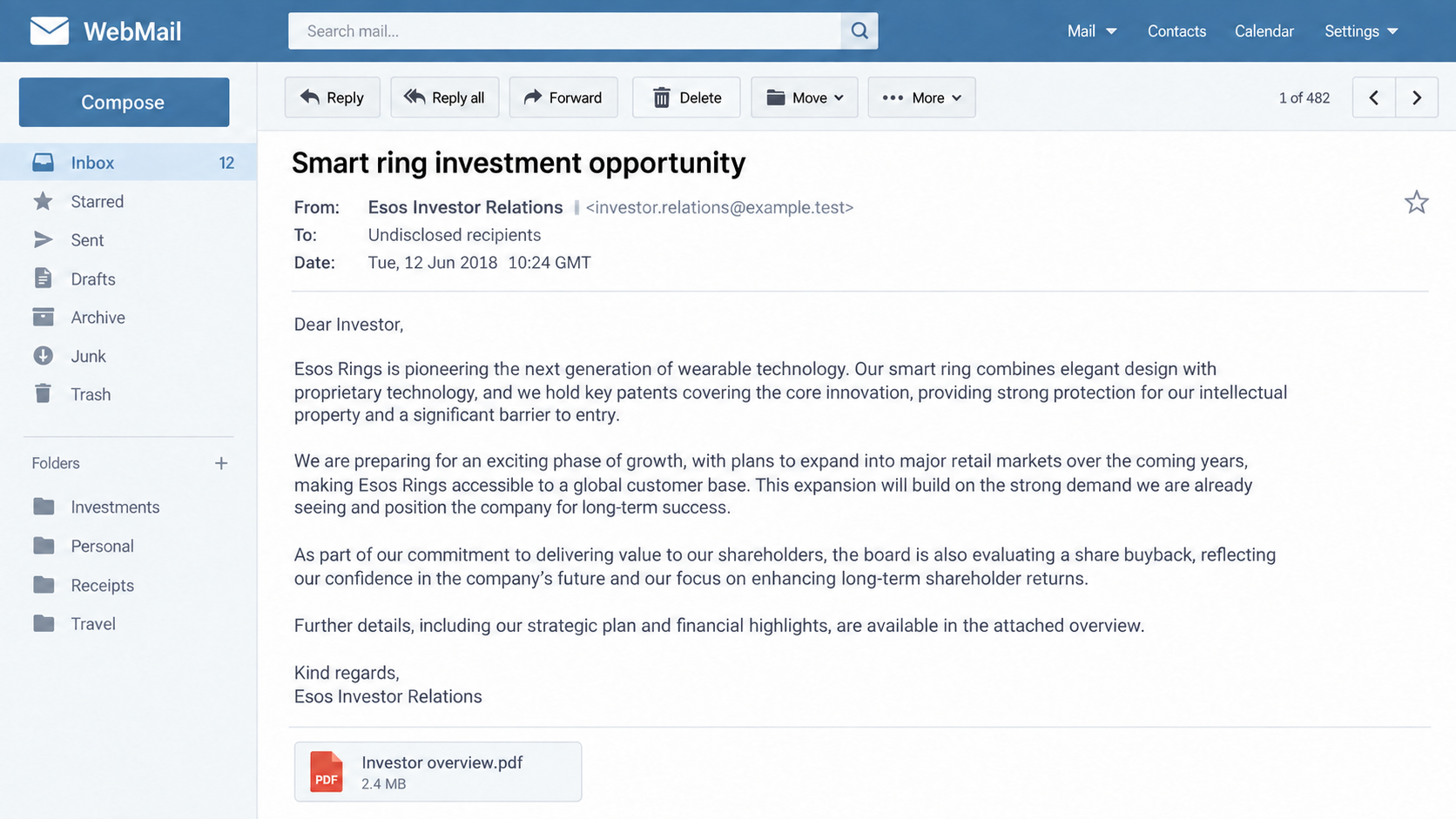
Overview
The technology was plausible, but the ownership story was not
Near-field communication payment rings are a real product category. They can store payment credentials and allow a tap at compatible terminals.
That credible idea sat at the center of an investor pitch by Esos Rings. A federal jury later found its leader, Michelle Bisnoff, guilty of multiple fraud counts.
The U.S. Justice Department says Bisnoff had been hired to develop the American market for McLear’s patented rings.
According to trial evidence, she then falsely claimed ownership of key patents and used a falsified patent assignment while raising money for Esos.
That distinction is essential. McLear’s technology was not the fraud; the misrepresentation about who owned and could exploit it was.
The growth narrative leaned on famous names
Investors were told Esos had retailer demand, manufacturing expansion, and major capital or licensing opportunities around the corner.
Prosecutors say the pitch invoked Target, Walmart, Apple, Roc Nation, and a possible licensing arrangement involving Middle Earth Enterprises.
Those references were not evidence of actual deals. The Justice Department says Esos had no Target agreement and received no Apple or Roc Nation investment.
The product was not selling at the scale suggested. The release says only six rings sold on Walmart.com, and three were returned.
The investor losses were not a hypothetical risk
Prosecutors say Bisnoff obtained nearly $2 million from investors and caused approximately $1.4 million in losses.
Most of the invested money went to personal expenses and payments to other investors rather than the expansion described in the pitch, according to trial evidence.
A useful way to evaluate this case is to separate four claims:
- Did Esos own the patent it said it owned?
- Did named retailers or investors actually make commitments?
- Were sales and manufacturing figures independently documented?
- Could the proposed share buyback be funded from real operations?
The images here are visual reconstructions of pitch and portal themes, not original Esos records. The facts come from court proceedings and regulator materials.
The Real Ring Company and the False Investor Story
Bisnoff worked with McLear Ltd., a UK company, to help develop its US market. That relationship could make her sound knowledgeable about the product.
But knowledge of a technology is not ownership of the patent. The DOJ says the key intellectual property belonged to her former employer.
Investors may hear “we have the patent” and assume a defensible business. The underlying document matters more than the speaker’s familiarity with the product.
According to the government, a false patent assignment was used to reinforce the ownership story. A professional-looking paper can still misstate legal rights.
The SEC’s 2023 case alleged false statements about patents, an Apple acquisition, and Ponzi-like payments.
Esos and Bisnoff agreed to settle the SEC’s charges without admitting or denying the allegations. That civil resolution preceded the 2026 criminal jury verdict.
Do not collapse those different procedural stages. A regulator complaint states allegations; the later criminal convictions reflect what a jury found proved.
The DOJ said a sentencing hearing was scheduled for January 2027. At the time of this article, the verdict should not be described as a completed sentence.
The civil and criminal records also speak to different remedies. A penalty or disgorgement order is not the same thing as a direct refund to every investor.
Anyone offering a quick recovery should be able to identify an official claims process. If they cannot, do not send identity documents or a fee.
How the Esos Rings Investor Scam Worked
Step 1: A believable product opened the conversation
A ring that pays at a terminal is easy to picture. That made the business story more tangible than an abstract technology startup.
The investment question, however, was not whether such rings could exist. It was whether this company owned the rights and had a viable business.
Fraud can attach itself to a real innovation. Buyers and investors should examine the seller’s claims rather than dismissing or endorsing the entire category.
Step 2: Patent ownership became the supposed competitive moat
Esos investors were told the company controlled crucial patents. If true, that could help justify forecasts and a higher share price.
Trial evidence showed the ownership claim was false. The patent rights belonged to McLear, and the purported assignment was falsified, prosecutors said.
A prospective investor should search official patent records, review assignment history, and ask independent counsel to reconcile ownership claims before payment.
Step 3: Retailer and celebrity-company names supplied borrowed credibility
The pitch referred to retailer demand and potential investment from household names. Each recognizable name made the small company seem closer to mass distribution.
The DOJ says there was no Target agreement, no Apple or Roc Nation investment, and no completed licensing deal with Middle Earth Enterprises.
Do not treat a logo on a deck, an email discussion, or a seller’s statement as a binding agreement. Ask for counterparty-confirmed documents.
Step 4: Financial documents appeared to support the story
Prosecutors say investors received financial statements, a tax return, and a patent valuation that were not prepared or signed by the professionals named.
This is a deeper deception than optimistic forecasting. A document can appear independently reviewed when the supposed preparer had no role in it.
Verify auditors, appraisers, and filing professionals through contact details found independently. Never use the address supplied solely by the company raising funds.
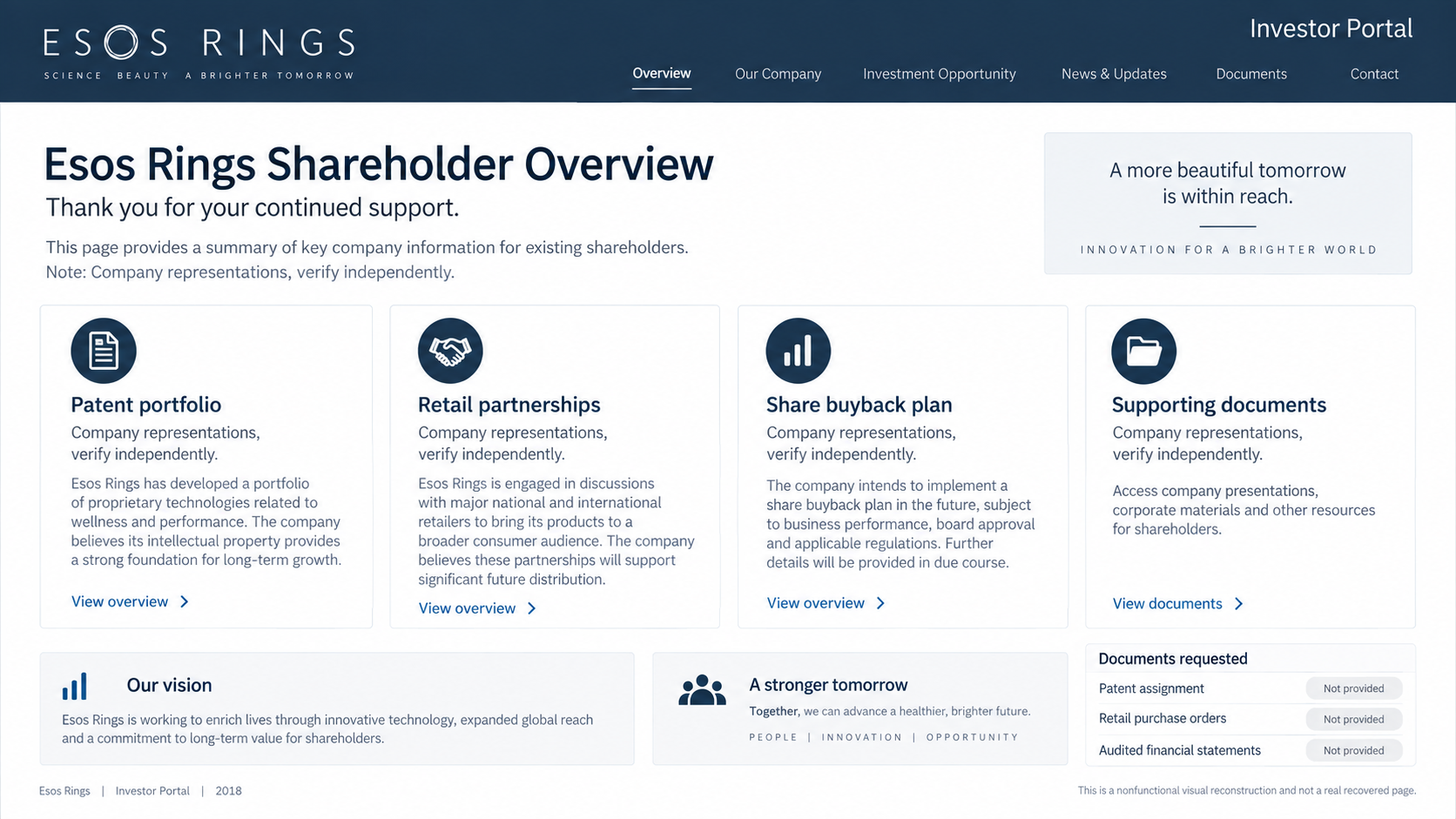
The second visual illustrates the gap between an attractive investor portal and documentary support. It is not a recovered Esos site.
In the actual case, the paper trail and trial testimony exposed contradictions that a surface-level pitch would not reveal.
That is why due diligence should work backward from a claim to a primary record, then to the person or institution able to verify it.
Step 5: A future buyback gave investors a reason to act now
Bisnoff also told investors Esos would repurchase their shares above the original price, according to the Justice Department.
A buyback promise can make a private investment feel temporary and low-risk. Its value depends on real cash, enforceable terms, and honest financial statements.
If the company’s revenues are thin, ask exactly where buyback funds will come from. Future retailer deals cannot be treated as money already in the bank.
Step 6: New investments helped cover old obligations
Prosecutors say investor funds paid personal expenses and Ponzi-type payments. That can create a misleading impression that earlier investors are receiving legitimate returns.
When promised outcomes did not arrive, explanations changed. One trial witness described the excuses as “dog-ate-my-homework” explanations, according to the release.
Failed or bounced checks can be the point when optimism becomes a clear payment problem. Preserve them and seek independent advice promptly.
The verdict does not mean every emerging wearable business is fraudulent. It shows how an investor can be misled when attractive market potential replaces verified company facts.
In particular, a buyback funded by new investors can look successful for a while. That appearance fades when new money slows or obligations accumulate.
Four Checks the Esos Investment Pitch Could Not Pass
Esos and McLear were not interchangeable
Esos was the company selling shares. McLear was the patent-owning company behind the underlying ring technology described by prosecutors.
Confusing the two could make an investor assume rights had moved when they had not. Demand a complete assignment chain, not a summary slide.
Search the exact legal names in corporate, court, patent, and securities records. Similar products do not prove common ownership.
An impressive location would not settle ownership
A company can have a real address and still misrepresent patents or sales. Location is a starting point for diligence, not the end.
Check where the entity is incorporated, who its officers are, and whether the documents you receive match that entity’s records.
Do not infer from a mailing address that manufacturing, inventory, or retail distribution exists there. Ask for inventory records and independent shipping evidence.
Investor support must survive hard questions
Ask who prepared the valuation and how to contact that professional. Request direct confirmation of claimed retailer or financing relationships.
Beware a representative who will discuss the opportunity for hours but refuses to provide basic verification documents before a transfer.
Once invested, keep written records of buyback dates, missed payments, and explanations. Those details matter if a complaint or recovery process follows.
The supply chain and sales must be traceable
Physical inventory can be counted. Retail orders can be verified. Payment-ring activations can be documented without relying only on promotional projections.
The DOJ’s figure of six Walmart.com sales, three returned, starkly contrasts with claims of large-scale demand. Do not substitute claimed distribution for documented sales.
A product existing in small numbers does not validate a much larger investment proposition. Verify unit economics, revenue, returns, and customer adoption separately.
What This Case Teaches About Startup Investment Pitches
Private companies often discuss future partners before signing agreements. The key is whether a seller accurately describes a conversation as a possibility, not a completed deal.
Ask for a signed contract, purchase order, or confirmation from the named organization. If confidentiality is cited, independent counsel can sometimes verify documents privately.
Patent searches should include assignments and licensing restrictions. A founder can be named on a project without owning the rights a new company claims.
Financial statements deserve the same skepticism. Confirm the preparer’s identity and the scope of work, especially when a document bears a familiar professional title.
Compare claimed retail demand with sales data, return rates, and cash received. Public marketplace listings are not evidence of a profitable national rollout.
Finally, treat a promised buyback as a financial obligation, not reassurance. Ask whether the company has reserves or enforceable financing to honor it.
If the answer depends on a future acquisition, ask whether there is a signed agreement, a closing timetable, and conditions that could stop the deal.
Look for the same claim across versions of the pitch. A partnership described as “in discussion” in one deck should not become “secured” in another without proof.
Be wary of a rushed deadline tied to an anticipated announcement. Public companies disclose significant transactions through established channels, not a private sales call.
Sometimes the most useful question is mundane: how many paying customers used the product, and what revenue did those transactions actually produce?
What to Do if You Have Fallen Victim to This Scam
- Collect your investment file. Save the share agreement, pitch emails, bank transfers, statements, claimed patent assignment, valuations, and every promised buyback date.
- Stop sending additional funds. Do not pay a “release” or “processing” fee to someone claiming they can unlock an old investment.
- Contact your bank and financial adviser. Ask about possible payment recovery and have an independent professional assess the documents, without promising a guaranteed outcome.
- Report new misconduct. Use the SEC’s investor complaint channel and the FBI’s IC3 for relevant information, especially if someone is reusing the old pitch.
- Watch official case updates. Restitution or claims processes, if any, should be verified through government or court channels, not unsolicited recovery messages.
- Protect exposed information. If identity or financial documents were shared, monitor accounts and consider appropriate fraud alerts or freezes.
- Check devices if files or software were supplied. Malwarebytes can scan for unwanted programs. AdGuard can help reduce exposure to malicious investment ads.
- Talk with other affected investors carefully. Compare facts and report them, but do not publish private data or assume every person connected to a pitch committed wrongdoing.
The verdict addresses the conduct at issue. Recovering money is a separate process, and no third party can honestly guarantee a payout.
Frequently Asked Questions
Was the smart ring itself a fake invention?
No. Payment-ring technology existed. The fraud involved false claims about Esos’s rights, commercial progress, financial records, and use of investor money.
Did Esos really own the important ring patents?
According to the DOJ’s account of trial evidence, no. The key rights belonged to McLear, and the ownership assignment presented in the pitch was falsified.
Were Target, Apple, and other named companies involved?
The DOJ says Esos had no Target agreement and received no Apple or Roc Nation investment. Do not infer wrongdoing by the companies whose names were invoked.
What did the SEC do before the criminal verdict?
The SEC announced a civil settlement in 2023 involving fraud allegations. The later 2026 criminal jury verdict is a distinct event.
Has Michelle Bisnoff already been sentenced?
At the time of the September 2026 DOJ release, a sentencing hearing was scheduled for January 2027. The jury verdict had occurred; sentencing had not.
Are the pitch images authentic Esos communications?
No. They are illustrative reconstructions. The claims and outcome discussed here are grounded in DOJ and SEC records, not the generated visuals.
The Bottom Line
Esos Rings sold an investable future around a real kind of product. The jury found that the patent, partnership, financial, and buyback story was dishonest.
When a startup pitch relies on rights and relationships you cannot independently verify, pause before funding it. A believable product is not proof of a believable company.

Join the discussion
0 commentsShare your experience or ask a question about this article.
Discussion
Start the conversation
Have a question or something useful to share? Add the first comment.