

A business owner opens a Business Poster Compliance mailing that looks like one more required task. It names a deadline, cites labor laws, and asks for $97.58.
When you are already managing permits, payroll, and deadlines, a form like that can feel urgent. The most important detail is easy to miss.
Overview
The letter borrows urgency from a real workplace duty
Many employers really do need to display certain workplace notices. Federal and state labor laws can impose posting obligations, depending on the business.
That genuine rule is the opening used by a mailing from “Business Poster Compliance,” according to the Pennsylvania Department of State.
The notice went to recently formed Pennsylvania businesses. It warned about penalties if required posters were not displayed and offered a paid poster package.
The state called the solicitation a “partial scam.” That wording matters: the posting requirement is real, but paying this sender is not required.
The payment box is more prominent than the seller’s status
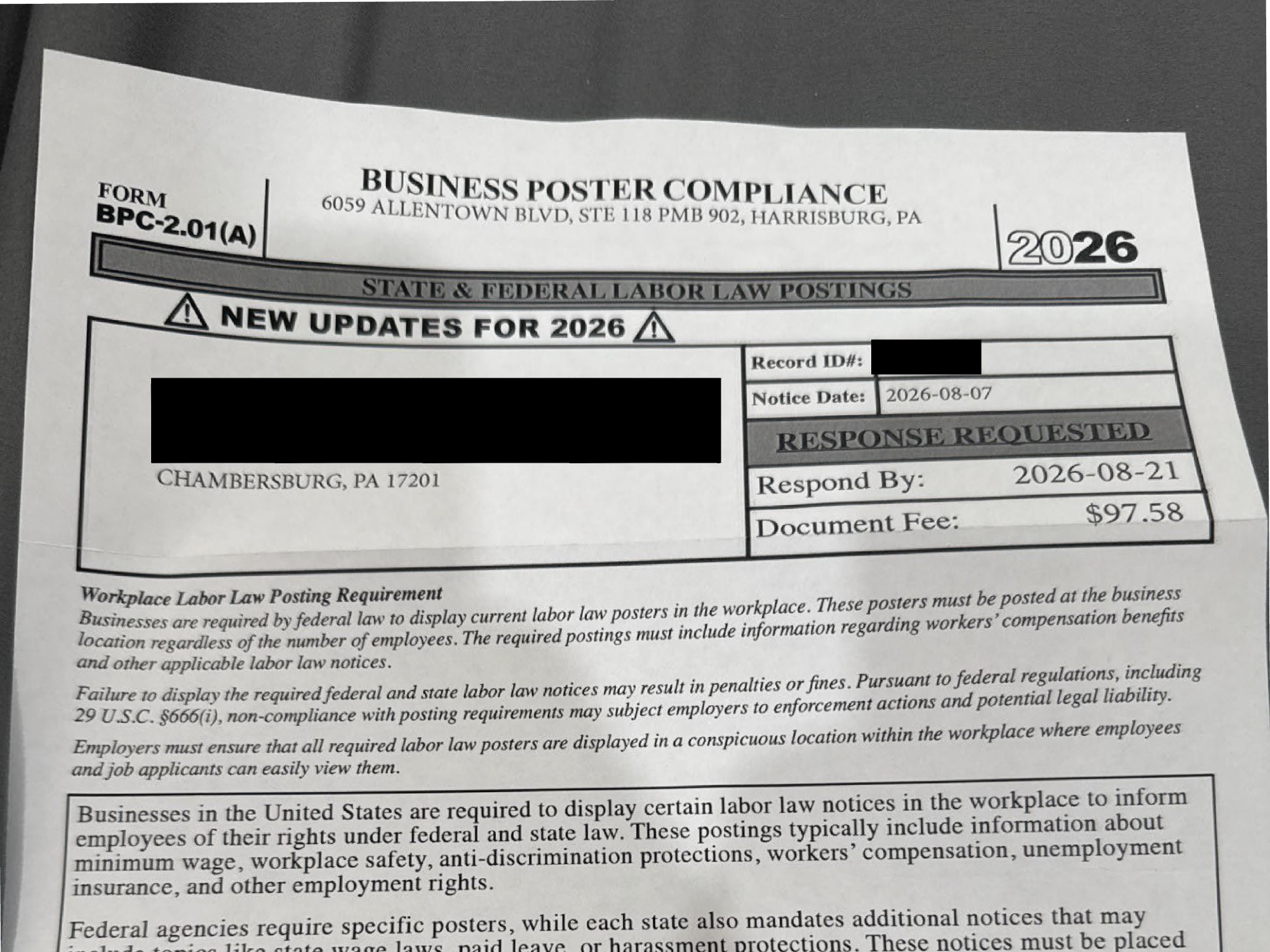
The example published by Pennsylvania lists a $97.58 document fee and a response date. It offers a check, money order, or QR-code payment route.
Its name sits beside “state and federal labor law postings,” language that can sound official to a new owner moving quickly through a stack of mail.
Yet the state says no business named Business Poster Compliance was registered to do business in Pennsylvania. The mailing address resolves to a UPS store.
The state also reported no telephone number on the notice. The example has an email address, but that is not the same as verified government authority.
Free official posters change the calculation
Pennsylvania’s Department of Labor and Industry provides links to state postings for free and points employers to federal notices.
That does not mean every poster sold by a private company is worthless. It means a seller should not imply the owner must pay that seller to comply.
Before paying any compliance mailing, separate these questions:
- Which notices does this specific workplace actually need?
- Are the required notices available directly from an agency at no cost?
- Is the mailing a government requirement or an optional private offer?
- Who receives the money, and what exactly is delivered?
The answer may differ by location, workforce, and industry. A generic packet is not a substitute for checking the official list that applies to your workplace.
What the Published Notice Actually Shows
The state posted a redacted copy of the form. Its header reads “Business Poster Compliance” and “State & Federal Labor Law Postings.”
A “new updates for 2026” banner sits above a box with a record identifier, notice date, response deadline, and document fee.
The redacted sample gives a Harrisburg mailing address at 6059 Allentown Boulevard, Suite 118, PMB 902. Pennsylvania identifies the address as a UPS store.
On the lower portion, the form directs the recipient to include a check or money order, scan a QR code, or visit the seller’s website.
There is also small print describing it as an offer to assist businesses, not a government agency. A disclosure can be technically present yet easily lost beneath bolder urgency.
None of those details alone proves a crime by the sender. Together, they explain why the state warned businesses not to mistake the offer for an obligation.
The letter also includes a record identifier. That number may resemble a case number, but the sample does not show that it belongs to a government file.
Likewise, a notice date tells you when the sender prepared the form. It is not evidence that a labor inspector reviewed your workplace.
A business address printed in the recipient box can be drawn from publicly available registration information. Its accuracy should not make the demand seem official.
Look at who the check is payable to. On the sample, it is the private sender, not a Pennsylvania agency collecting a statutory fee.
How the Business Poster Compliance Mailing Works
Step 1: A new business appears in public records
Registration creates information that marketers can use. A recently formed company is especially likely to receive official and unofficial business mail.
A new owner also has real administrative work ahead. That makes a letter about “compliance” plausible, even when it comes from an unrelated private sender.
The Pennsylvania advisory says these notices targeted recently formed entities. It does not establish exactly how the sender assembled its mailing list.
Step 2: The notice presents a genuine requirement as a buying decision
The letter describes workplace posting rules and potential penalties. Its factual hook is powerful because failing to display required notices can indeed have consequences.
But the form then channels that concern toward one seller’s $97.58 package. It blurs the line between “you may need posters” and “you must pay us.”
Those are different statements. The first may be true for an employer; the second is not established by a private order form.
Step 3: The deadline compresses the owner’s review time
The redacted sample shows a short window between notice and response dates. Deadlines can make a routine purchase feel like a legal emergency.
Owners may pay simply to clear the item from their desk. That is especially likely when the requested amount feels small compared with feared fines.
A private response date does not create a new statutory deadline. Check actual posting duties through Pennsylvania’s labor agency and the U.S. Department of Labor.
Step 4: The form offers several routes to payment
The mailing accepts a mailed payment and advertises a QR code and web address. Multiple routes reduce the friction of ordering.
The QR code is not automatically malicious. It is still an unverified destination until you inspect the address and know who operates the page.
Do not scan merely to “see what it says” on a device holding business banking credentials. Search the seller and the agency independently first.
Step 5: The buyer may receive something yet still have been misled
A poster packet might arrive. Delivery would not make the implied government connection true or prove the package contains every notice your business needs.
The risk is paying for material available free, then assuming the purchase alone settles compliance. Different workplaces may require different postings.
The state specifically warned that businesses need not obtain mandatory posters through this unregistered intermediary.
That is the commercial trap: a delivered item can create the feeling of completion while the buyer has still overpaid or missed a required notice.
Keep purchase quality and legal compliance separate. A durable poster may be convenient, but convenience should be evaluated against its price and actual contents.
Who Sent the $97.58 Poster Notice?
A compliance-sounding name is not a state office
The letter’s name describes the product it sells. It does not identify the Pennsylvania Department of State or Department of Labor and Industry.
The state says it found no company registered in Pennsylvania under “Business Poster Compliance.” That is a specific record finding, not proof about every possible entity elsewhere.
Compare the name on the letter with the name on any website, checkout, receipt, and card statement. Ask what legal entity stands behind the offer.
The Harrisburg address leads to a mailbox service
Pennsylvania states that the mailing’s listed address is a UPS store. A private mailbox can receive correspondence, but it is not evidence of a regulatory office.
If the address is presented as a headquarters, that distinction matters. Search it yourself and note whether it appears on other unrelated solicitations.
Do not send identity documents, checks, or sensitive employee information to an address solely because the city matches the state capital.
Support should answer practical questions before payment
The state noted no phone number on the mailing. Its sample shows an email contact, which could be used to request clarification.
Ask which exact posters are included, which employer types need them, the refund rule, shipping method, and the company’s legal name.
An inability to answer those basic questions is a reason to stop. Even a prompt reply does not replace independent verification of the offer.
The delivered packet must match your workplace
Poster compliance depends on actual laws and worksite circumstances. A mass-produced bundle may include notices you do not need while omitting specialized ones.
Keep a list of required state and federal notices from the relevant agencies. Compare any paid packet to that list before relying on it.
If the seller promises “complete compliance,” ask what happens when a rule changes. A printed product cannot guarantee future legal compliance on its own.
Federal and state poster requirements are maintained by different agencies. One seller’s packet should be checked against both, rather than accepted as universally complete.
Photograph your posted notices and keep the source URLs. That simple record can help demonstrate when and where you displayed the version you downloaded.
Where to Get Labor Law Posters Without This Mailing
Pennsylvania’s Mandatory Postings page explains that employers can download state notices for free.
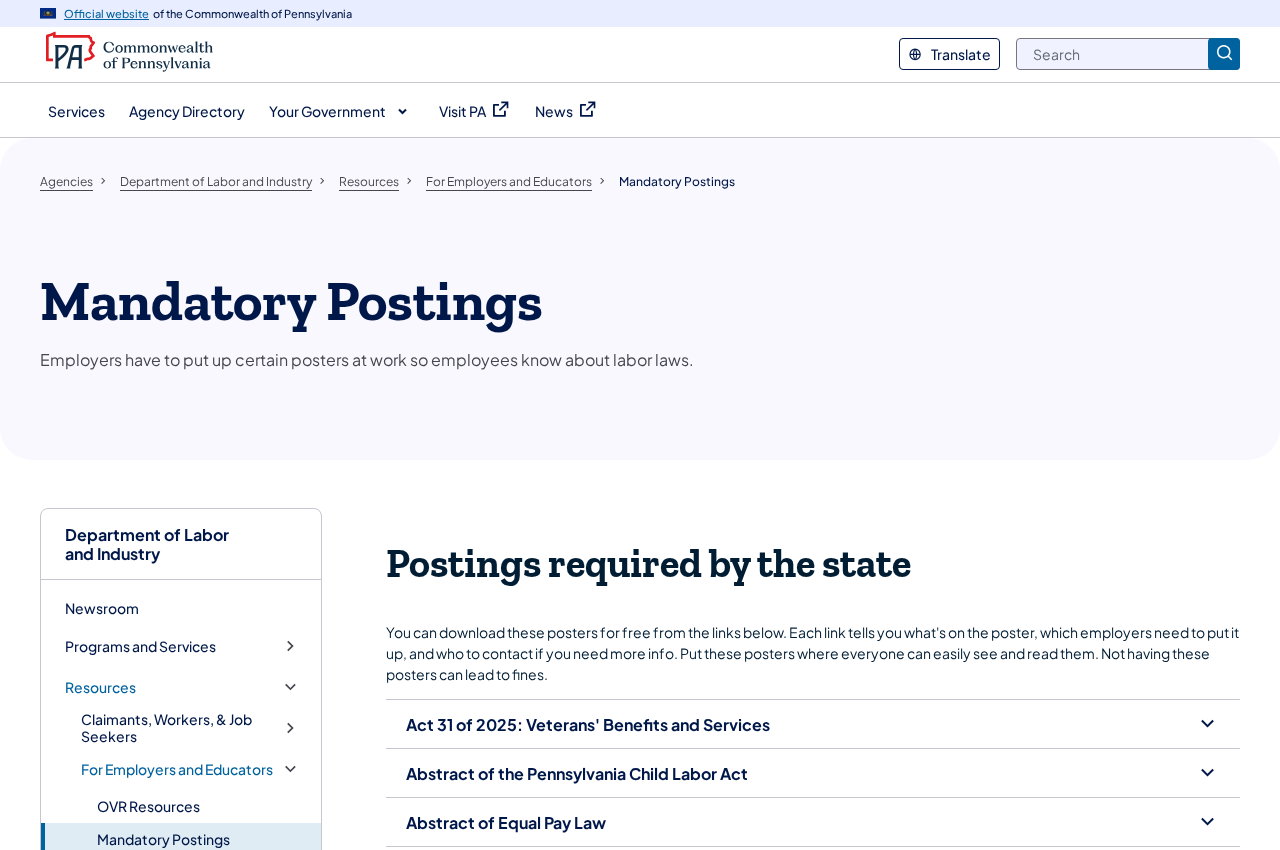
The page tells employers which notices are applicable and where workers should see them. It also links to federal posting resources.
The U.S. Department of Labor maintains federal workplace poster guidance. Some posters are mandatory only for covered employers, so check the conditions.
Print directly from official sources when practical. If you choose to buy a laminated or consolidated version, understand that you are buying convenience, not a government approval.
Retain a record of the versions and dates displayed at each site. Compliance is about having the right notices where employees can read them.
When uncertain, speak with the state labor agency or qualified employment counsel. A mass mailing cannot evaluate your workforce better than your own facts.
For a home-based business without employees, do not assume a generic employer letter applies unchanged. Check which laws cover your precise situation first.
For a company with multiple worksites, verify placement at each location. One packet mailed to headquarters may not address posting duties elsewhere.
When a new poster edition appears, confirm it on the issuing agency’s site. A seller’s claim that every notice changed in a particular year may be overstated.
Pay particular attention to the phrase “required by law.” A real underlying duty does not mean the sender is the only authorized route to meet it.
The state’s warning is best read as a purchasing warning and a compliance reminder together. Avoid the fee, but do not ignore genuine posting obligations.
What to Do if You Have Fallen Victim to This Scam
- Stop further payment. Do not treat the response date as a government deadline. Check the requirements through the labor agency before sending anything else.
- Preserve the entire mailing. Keep the envelope, form, QR destination preview, payment page, canceled check, receipt, and any poster packet that arrived.
- Ask the seller for a written refund. State when you paid, what the form led you to believe, and what was delivered. Keep the response.
- Contact your bank or card issuer. Ask what options apply to an unauthorized or misrepresented charge. A check and a card payment have different remedies.
- Replace assumptions with the official poster list. Download the required state and federal notices and check your worksite, even if a package arrived.
- Report the solicitation. Send a copy to the Pennsylvania Department of State and, where appropriate, your state consumer-protection office or the FTC.
- Secure accounts if you used the QR page. If you entered credentials, change them. Malwarebytes can check the device for unwanted software; AdGuard can help block risky ad destinations.
- Warn the person who processes company mail. Ask them to route compliance demands for verification before payment. This prevents a repeat with a different sender name.
If you already paid, focus on the charge and the actual posting requirement separately. Fixing one does not automatically resolve the other.
Frequently Asked Questions
Is Business Poster Compliance a Pennsylvania government agency?
No. Pennsylvania describes it as a private solicitation and says no business by that name was registered to do business in the state.
Are labor law posters really mandatory?
Some are, for covered employers. The obligation depends on your business and workforce; the state and federal agencies provide applicable guidance.
Do I have to pay $97.58 for the required posters?
No. The state says the relevant posters can be downloaded free from official sources. Paying a private vendor is not required.
Does the UPS store address prove the mailing is criminal?
No single address proves criminal conduct. It does show the sender is not operating from the state agency an owner might imagine.
What if I scanned the QR code but entered nothing?
Close the page, check your browser downloads, and avoid further interaction. If you supplied information, act based on what you entered.
Can a private poster seller still provide a useful product?
Yes, convenience products can be legitimate. Verify the seller, price, refund terms, and whether the package actually fits your workplace.
The Bottom Line
Business Poster Compliance uses a real workplace duty to sell an optional $97.58 packet through an urgent-looking notice. Pennsylvania calls it a partial scam.
Do not let the form decide the law for you. Check the official free posters, confirm what your business needs, and treat the mailing as a private offer.

Join the discussion
0 commentsShare your experience or ask a question about this article.
Discussion
Start the conversation
Have a question or something useful to share? Add the first comment.