

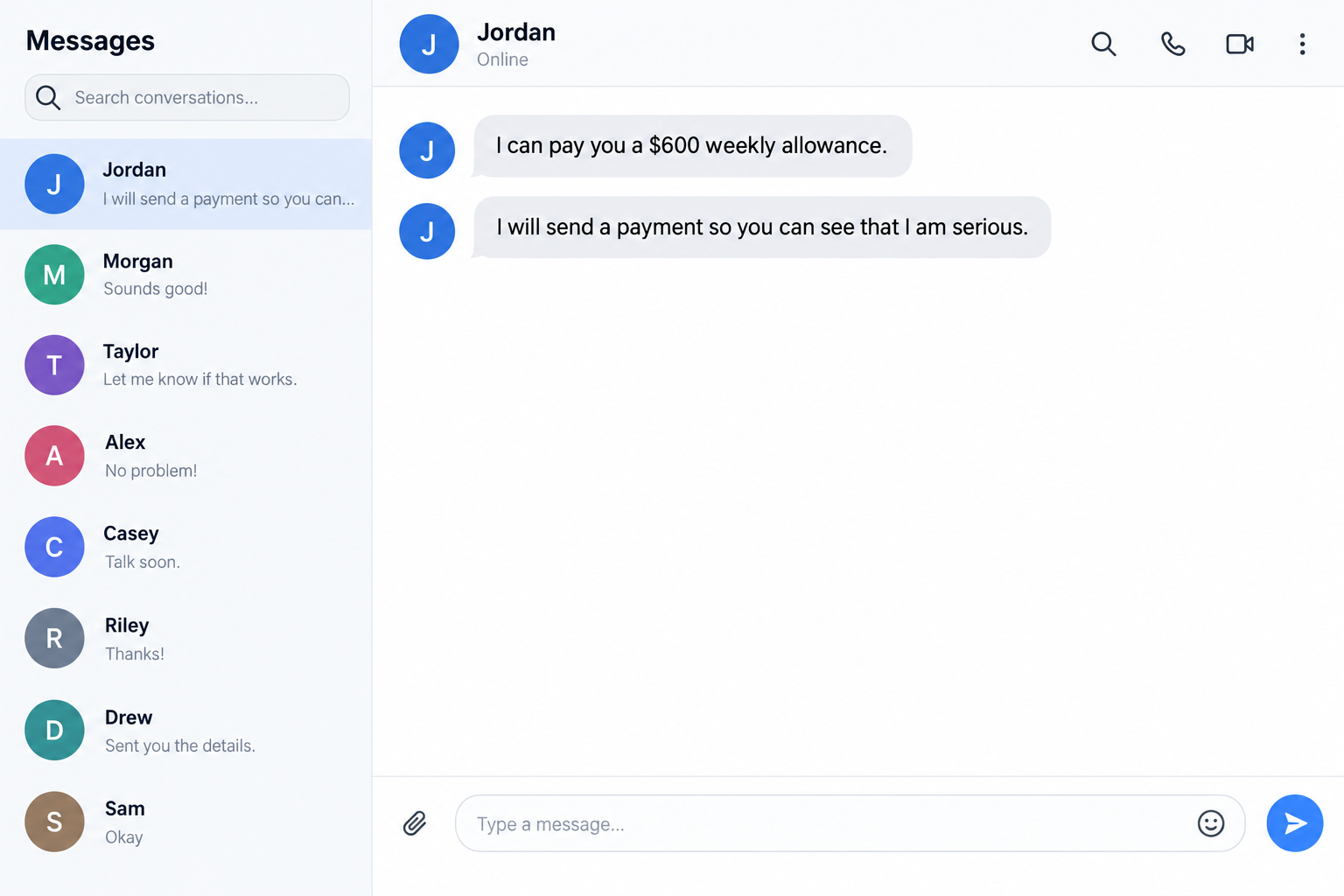
A stranger offers to cover your bills with a weekly allowance. The conversation is friendly, the promise is generous, and the first payment supposedly proves their sincerity.
The sugar daddy scam becomes easier to recognize when you follow the money. Before accepting the offer, look closely at the favor attached to it.
Overview
The promised benefactor turns you into the payer
The scammer offers an allowance, debt relief, or financial support, then asks you to send money, buy gift cards, cover a fee, or provide account access.
The person may call themselves a sugar daddy, sugar momma, or another type of generous supporter. The financial maneuver matters more than the profile’s chosen label.
A BBB advisory published in January 2025 describes this allowance-pretext fraud, including pretend transfers, checks, and requests to forward value elsewhere.
This report explains the documented deceptive mechanism. It does not identify a particular dating service, legitimate adult arrangement, or named profile as fraudulent without evidence.
The underlying lead dates to 2020, with later independent corroboration. No newly intercepted conversation or verified offer to a particular reader is claimed.
An incoming payment claim is not proof of usable money
A screenshot or payment email can be fabricated. A check can also produce apparently available funds before the bank discovers a problem.
The FTC’s fake-check guidance explains why a visible balance does not validate the check. Money forwarded afterward can become a loss for the recipient.
Other versions ask for an activation or processing payment before anything arrives. Those do not require an actual deposited check at all.
Keep the promised incoming amount, any real deposit, and the requested outgoing payment separate. Treating them as one transaction hides the point of risk.
The small favor is the warning you can act on
Pause when a supposed supporter asks you to fund their instructions. A trust test, charitable explanation, or refundable-fee promise does not authenticate the payment.
- You are promised recurring money by someone you have not independently verified.
- The payment supposedly includes funds you must forward.
- You must buy gift cards or send cryptocurrency to complete the arrangement.
- An incoming amount is supported only by a screenshot or the sender’s message.
- The person wants your account login or a security code to make the deposit.
The images are invented examples involving adults’ financial deception. Their sample amounts are not quotes from a real victim, and no genuine payment details are displayed.
Why the Allowance Story Can Be Persuasive
Help with bills is easy to picture
A weekly allowance sounds concrete. You can imagine rent, groceries, or a debt payment becoming easier, which makes the offer feel immediately useful.
The scam does not need to sell a complicated investment. It presents a person who appears willing to solve an existing problem.
That appeal is understandable. Needing money or enjoying someone’s attention does not make the recipient responsible for the deception.
Separate the promise from the required action. An offer can sound generous while its next step still puts your own money or account at risk.
You do not need to prove that the entire profile is fabricated before declining a suspicious payment condition. The unsafe request is enough to stop.
A favor changes the direction of the relationship
The person first appears to be the giver. Once a payment is supposedly sent, the recipient may feel an obligation to help with a small administrative problem.
The requested favor can be described as a donation, bill payment, or transfer to someone the benefactor knows. That gives an outgoing payment a sympathetic purpose.
Ask why you need to act as the intermediary. The explanation should not depend on trusting money that an unfamiliar sender alone says is secure.
A genuine charitable intention does not authenticate a stranger’s recipient. Verify charities independently and do not use an unknown payment to carry out someone else’s instructions.
How the Sugar Daddy Scam Works
Step 1: An unsolicited profile offers generous support
The approach may begin through a social network, dating service, or private message. The contact promises to pay expenses or provide an allowance.
A polished profile can contain stolen pictures or invented claims, but this article does not assume every attractive or wealthy-looking profile is fraudulent.
Evaluate the identity and proposed transaction independently. Follower counts, friendly conversation, and a recognizable name do not establish access to genuine funds.
Do not send financial documents to demonstrate need or qualify for support. Those documents can reveal far more than the contact requires to make a plausible offer.
Keep the conversation’s first promise. It may later differ from the conditions attached to receiving the money.
Step 2: The person presents an apparent first payment
The contact may email a check, supply a payment screenshot, or claim that a transfer is pending. The supposed payment makes the earlier promise feel proven.
Those are different forms of evidence. A message saying payment sent is not your bank’s record, and a deposit record is not necessarily final validation.
Log into the real financial service independently if you need to examine your own activity. Do not use the benefactor’s link to reach an account.
Never give the contact your online banking password so they can deposit funds. A promised allowance is not a reason to hand another person control.
If nothing appears in your account, do not pay an activation charge to make it appear. That adds an actual outgoing transaction to an unsupported incoming claim.
Step 3: Part of the apparent payment is assigned to someone else
The person explains that you should keep your allowance and forward the remainder. They choose the destination and usually want you to act promptly.
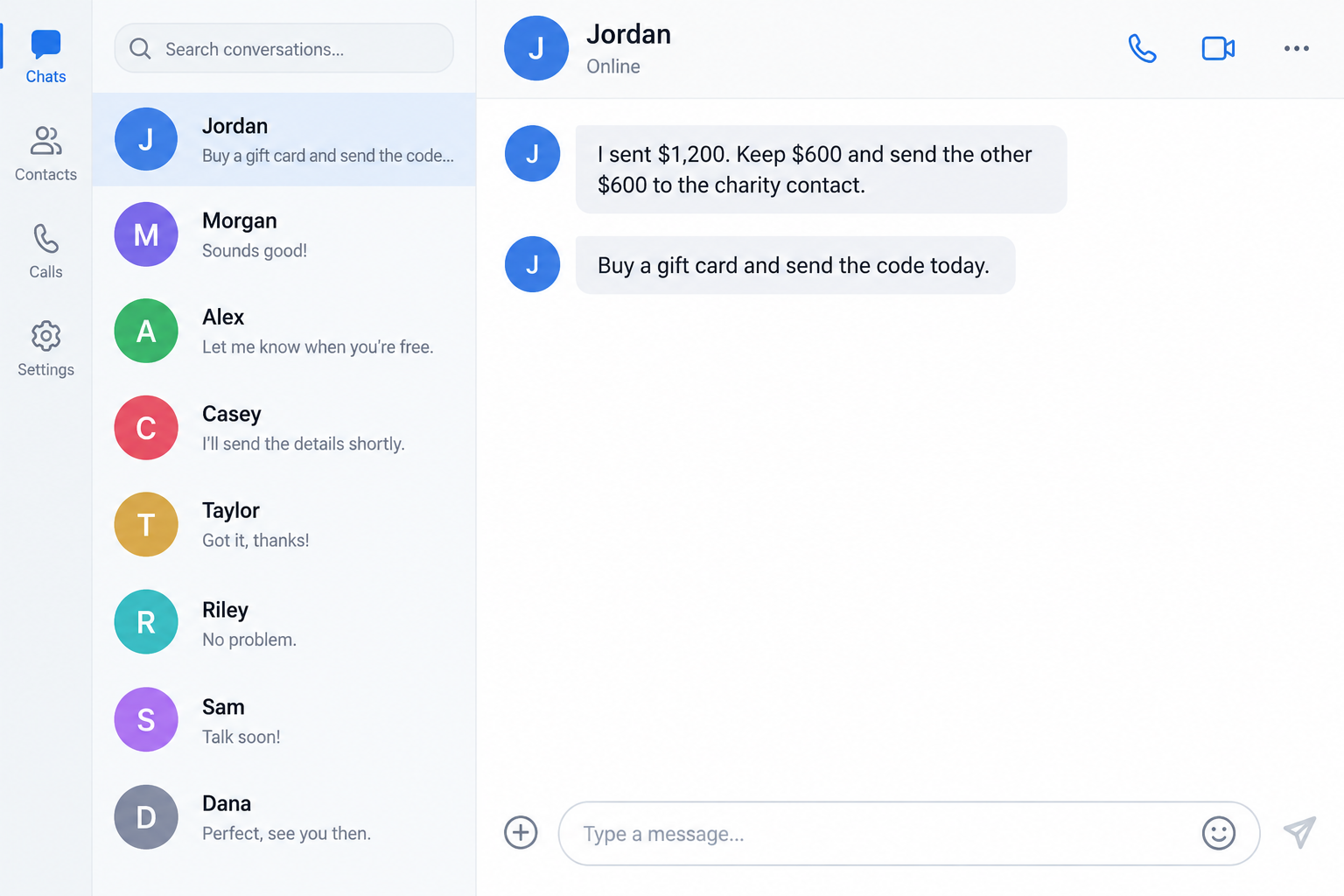
In the fictional example, the claimed payment is $1,200. The recipient is told to keep $600 and send $600 elsewhere.
The arithmetic is straightforward, which can distract from the missing verification. Correct subtraction does not make the incoming payment genuine.
The illustration below uses a gift-card request to show this turn. Its amounts and conversation are invented, not a captured incident or valid payment instruction.
Do not buy a card, expose its code, or transfer funds to test the explanation. The contact’s chosen destination is part of the unverified arrangement.
Step 4: Your outgoing payment can be real while theirs is not
A fake check may eventually be returned, leaving the recipient responsible for money already forwarded. The reassuring balance did not remove that risk.
A fabricated transfer email can create the same outgoing loss without a deposit. The recipient pays a supposed release fee from funds already in their account.
The timing and available remedies depend on the actual method. Do not assume all checks, payment-app transfers, and card transactions have identical protections.
A legitimate electronic check can exist, so its format alone is not the verdict. The unfamiliar sender and forward-payment demand are the relevant combination.
No universal waiting period makes this arrangement safe. Ask your bank about the specific deposit and explain the sender’s full instructions.
Step 5: Pressure keeps the recipient trying to recover the promise
The person may frame hesitation as ingratitude or a failure of trust. A new fee can be presented as the last obstacle to receiving regular support.
That is a possible escalation, not a required stage in every case. You should not wait for a threat before deciding that the payment condition is unacceptable.
Keep personal boundaries separate from the transaction. You do not owe continued contact, explanations, or financial access to someone because they promised money.
If the contact becomes threatening, preserve the messages and seek help from the appropriate authorities or platform. Do not pay to keep the conversation friendly.
How to Evaluate the Payment Without the Profile
Use your own account, not a screenshot of theirs
A sender controls the image they show you. A familiar app layout and confirmation number can be copied into a message without a genuine payment.
Check account activity from the provider’s real app or website. Keep incoming and outgoing entries separate, including their dates, status, and reference numbers.
If a payment email requests action, compare it with that independent record. Do not pay merely because the email claims your account needs an upgrade.
A real provider can explain a real account limitation. An unsolicited benefactor should not decide which fee or verification route is necessary.
Explain the entire arrangement to the bank
Do not ask only whether a balance is visible. Tell the bank that an unfamiliar online contact wants you to deposit a payment and forward part of it.
The instruction to send value elsewhere is important context. A narrow question about availability can leave out the feature that makes the situation dangerous.
If a check is already deposited, ask how the bank wants it handled. Do not send a separate refund to the stranger as your own solution.
Reversing an incoming payment through its provider differs from sending new money to an account supplied in a chat. Let the provider guide the appropriate process.
A photo search cannot guarantee financial honesty
Checking a profile’s pictures can reveal reuse, but a clean result does not prove the person owns the identity or that the payment is valid.
A video conversation can also leave the financial question unresolved. Seeing a person does not authenticate a check or the source of an incoming transfer.
Likewise, a supposedly genuine identification image may belong to someone else. Do not publish it as proof that its named owner committed the scam.
The practical boundary is financial: do not make an outgoing payment or share account access to qualify for money from an unverified benefactor.
When Nothing Was Deposited
An advance fee can replace the fake-check stage
Some contacts never attempt a deposit. They claim a processing charge, account upgrade, or initial trust payment is required before the allowance starts.
The absence of a check does not make that version safer. Your payment can leave while the promised incoming funds remain entirely fictional.
Do not compare the small fee only with the large promise. Compare it with the amount genuinely received and the independently verified reason for paying.
Account access creates a different exposure
If the person obtained login information, respond to that separately even if no money has moved. Review access, recovery details, and unusual activity.
Give the provider an accurate account of passwords, codes, or approvals shared. Do not reduce every incident to a disputed allowance transfer.
A clean payment history today does not prove exposed credentials are harmless. Secure the account through a route the contact does not control.
What to Do if You Have Fallen Victim to This Scam
-
Stop forwarding money or buying gift cards. Decline another trust test, release fee, or charitable errand attached to the promised allowance.
Preserve the messages before blocking the profile. Save the original payment promise and every change in the instructions.
-
Contact your bank about any deposited check. Explain the unfamiliar sender and the request to pass money to another recipient.
Do not spend the remaining apparent proceeds or send a private refund while the bank assesses the deposit. Ask what steps apply to your specific record.
A visible amount is not enough to settle the issue. Keep the deposit reference and the bank’s guidance together.
-
Ask the outgoing payment provider about available action. Report the gift-card use, transfer, or other payment promptly through the provider’s genuine support.
For a gift card, keep the card and purchase receipt where available. Do not send the code to someone claiming they can recover it for a fee.
Reversal options vary. Be honest about what you authorized and avoid treating a promised recovery as a guaranteed result.
-
Secure financial and email access you disclosed. Replace exposed or reused passwords using a trusted device, and review recovery contacts and unfamiliar account activity.
If a code or security prompt was shared, describe its purpose to the provider. That is different from merely giving a contact your payment-app username.
Do not approve new instructions from the benefactor to undo the earlier action. End their role in the recovery process.
-
Respond to identity-document exposure proportionately. Keep a private list of the identifiers and images you sent, without posting them as evidence publicly.
For U.S. identity misuse, IdentityTheft.gov provides relevant recovery guidance. Use the appropriate local routes if you are elsewhere.
An exposed email address and a full identification document create different concerns. Avoid assuming that every possible misuse has already occurred.
-
Investigate technical exposure only if it was part of the interaction. A suspicious download, remote session, or continuing redirect may need trusted technical help.
Malwarebytes can help inspect questionable software. AdGuard addresses unwanted browser advertising, not fake deposits or the source of a gift-card request.
Reading a private message is not itself proof of infection. Account and payment recovery remain necessary even when a device scan finds nothing.
-
Report the exact profile and financial conduct. Use the platform’s reporting controls and preserve transaction references, dates, and the payment requests.
The FTC’s fake-check guidance provides U.S. reporting routes. Report threats or documented identity misuse to the appropriate authorities as well.
A copied photo or name may identify another victim of impersonation. Do not publicly accuse its genuine owner solely from the profile.
-
Keep paid recovery offers out of your plan. A new contact may promise to retrieve the allowance, correct the check, or unlock the transfer.
The FTC warns about recovery-fee scams. Continue through the providers you contacted yourself rather than buying another promise from a stranger.
Frequently Asked Questions
Does every adult allowance arrangement count as a scam?
No. The warning concerns deceptive payment and access conditions. It does not declare every consensual adult arrangement or legitimate dating service fraudulent.
Why would a supposed benefactor ask me to donate part of a payment?
That explanation can make forwarding money feel helpful. It does not establish that the incoming payment or chosen recipient is genuine.
Does money showing in my balance prove a check is valid?
No. Funds can appear available before a check problem is discovered. Explain the unfamiliar sender and forwarding instructions to your bank before acting.
Is an emailed check always fraudulent?
No. The format alone does not establish fraud. The combination of an unverified sender, generous promise, and outgoing-payment demand deserves scrutiny.
What if they only want a small processing fee?
A small fee is still your real money. A large promised allowance does not validate the charge or make an unsupported transfer arrive.
Should I give the person my bank password to receive support?
No. An allowance promise is not a reason to hand over account control. Secure any access already shared through the genuine financial service.
The Bottom Line
The sugar daddy scam reverses its generous opening: the person promising money makes you pay, forward funds, or share access first. A friendly profile cannot validate that condition.
Stop the outgoing transaction and verify actual account activity independently. If money or credentials were shared, involve the relevant provider rather than trusting another release or recovery promise.








