

For someone struggling with disturbed nights, a small device can carry an enormous amount of hope. The prospect of a simpler bedtime routine is understandably attractive.
DERYTHM Pro was promoted to that audience with unusually confident promises. Looking closely at what was promised reveals the questions buyers should have been able to answer first.
Overview
This investigation concerns an indexed pitch, not a current checkout
The original DERYTHM product URL, derythm.com/pages/rythmpro, returned a not-found page when checked on October 26, 2026. The store itself still had other accessible pages.
A search-indexed version of that original seller page preserved the Pro pitch. It is historical advertising evidence, not confirmation that the same offer remains available today.
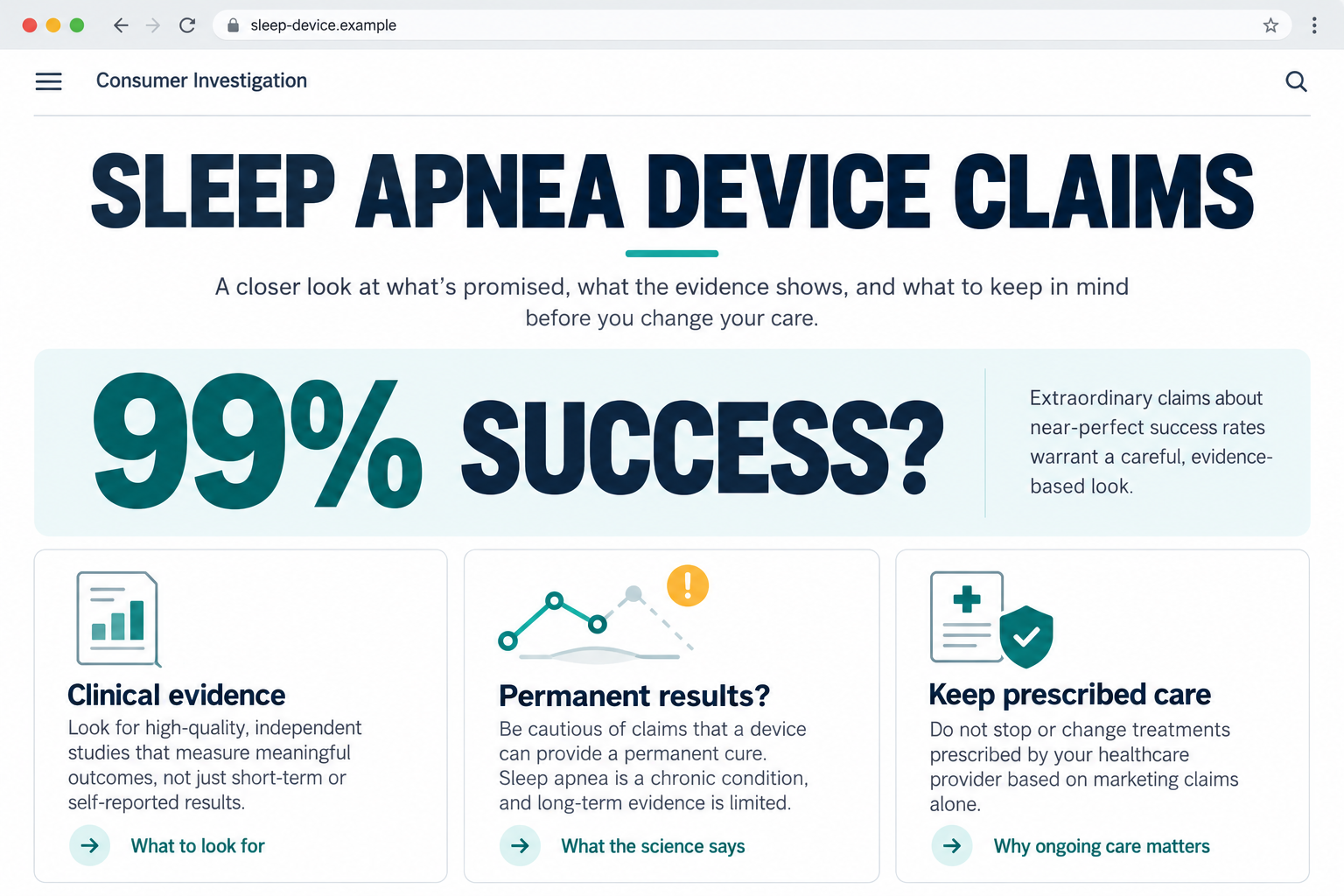
The opening image is an editorial illustration, not a screenshot of that advertisement. Findings below distinguish the indexed claims from the current page’s absence.
The offer promised much more than quieter snoring
The indexed sales copy claimed success against both snoring and sleep apnea in 99% of users. It described electrical muscle stimulation and lasting improvement after several months.
It also presented the approach as relevant across different apnea severities. That is a medical proposition, not merely a claim that a bedtime accessory feels comfortable.
Quiet sleep and adequately treated sleep apnea are not interchangeable outcomes. A partner noticing less noise cannot establish that a breathing disorder has been controlled.
The practical priority is protecting treatment and purchase records
The unavailable product page does not prove fraud. It does make independent product identification and preservation of the original guarantee more important for existing buyers.
No delivered unit was tested here, and no identifiable clinical report for the exact advertised Pro device was authenticated. The claimed cure should not guide treatment decisions.
- Do not replace prescribed apnea treatment with an unverified external stimulation device.
- Keep the exact advertisement and terms attached to your purchase.
- Ask for the manufacturer, model and evidence matching that unit.
- Act on refund concerns before your payment provider’s deadline expires.
How the DERYTHM Pro Sales Story Was Built
Step 1: Frustration with existing treatment becomes the opening
Managing sleep apnea can involve uncomfortable equipment, repeated adjustments and a routine that takes patience. An advertisement offering a much easier alternative reaches a vulnerable point.
The indexed DERYTHM pitch contrasted its approach with the inconvenience of CPAP and the concerns surrounding surgery. A small external device was positioned as the simpler choice.
That comparison can make an established treatment feel outdated before the replacement has demonstrated comparable results. Convenience becomes a stand-in for medical effectiveness.
A less cumbersome option would be welcome if it were appropriately validated. The need for that option does not validate the particular item being advertised.
The first question is therefore not whether CPAP can be frustrating. It is whether the exact alternative has evidence for the patient’s diagnosis and intended use.
Step 2: A mechanism explanation makes the outcome feel inevitable
The sales material described external electrical muscle stimulation around the area beneath the chin. Its explanation connected stimulation with retraining muscles involved in keeping the airway open.
A mechanism can sound plausible without establishing clinical benefit. Explaining what electricity might do to a muscle is different from demonstrating effective treatment of apnea during sleep.
The positioning, electrical settings, treatment schedule and individual anatomy all matter. A generic reference to muscle training cannot settle those questions for an unidentified device.
There are legitimate medical treatments involving stimulation. Their existence does not create evidence for every consumer product using the same broad terminology.
Implanted nerve stimulation, selected daytime oral devices and an external adhesive-style gadget are not automatically interchangeable. Evidence needs to match the method, device and patient group.
Without that match, a detailed explanation can create confidence without providing the information needed for a safe decision.
Step 3: A near-universal success rate removes room for uncertainty
The 99% claim is especially consequential because the pitch linked it with both snoring and sleep apnea. Those are not identical outcomes.
What counted as success? Was the result measured objectively during sleep, reported by a partner or collected through a customer satisfaction questionnaire?
Was improvement large enough to change the patient’s treatment needs? Were unsuccessful users, withdrawals and adverse effects included in the reported result?
A percentage without those details can look much more informative than it is. Readers see mathematical precision while the underlying definition remains unclear.
The preserved material referred readers toward a clinical report, but a complete, identifiable report was not retrieved and authenticated for this investigation.
That is a limit on what can be verified, not proof that no research document exists anywhere. The seller still needs to supply the evidence supporting its claim.
Ask for a publication or full report that names the exact device, describes participants and explains the measured outcome. A promotional summary is not an adequate substitute.
Step 4: A short course is presented as a permanent solution
The indexed copy paired first-night improvement with a longer transformation over roughly three to four months. It suggested users could obtain lasting results rather than ongoing dependence.
That promise is stronger than saying an accessory may help while it is worn. It implies a durable change after a limited course of use.
To support it, evidence would need follow-up after treatment stopped, not merely a favorable result during active use.
The duration of follow-up matters. A result one night after stopping cannot establish a permanent cure across years or changes in health.
Different severity levels also require explanation. A claim spanning mild, moderate and severe apnea needs evidence addressing those groups, rather than treating every diagnosis as interchangeable.
A buyer should not have to supply those missing details from optimism. When medical certainty is used to sell the product, the evidence must be available before purchase.
Step 5: A long guarantee makes trying it seem harmless
The indexed offer advertised a 100-night refund promise and stated that a return would not be required. That language could make the financial risk seem negligible.
A refund, even when honored, cannot compensate for a period of inadequately managed breathing problems. Financial reassurance does not establish that experimenting is medically appropriate.
The exact old guarantee also needs to be preserved. The current product link cannot supply all the conditions a previous buyer relied on.
Do not assume a current store-wide policy silently replaces the purchase terms. Equally, do not assume a search extract contains every requirement of the historical offer.
Existing customers should request the terms applicable to their order date and product. Keep the answer alongside the advertisement, receipt and delivery record.
If the seller cannot identify the product or explain the guarantee, that is a reason to escalate the purchase issue, not to keep experimenting indefinitely.
DERYTHM Product Identity, Store Contacts and Purchase Records
The product name is not enough to identify the medical device
DERYTHM Pro is a marketing name. Buyers need the manufacturer, precise model, intended use and instructions printed on the unit or packaging.
Those details allow a clinician or regulator to distinguish the item from other products using similar language. A photograph of a generic device may not be enough.
This investigation did not establish the delivered unit’s manufacturer or authenticate a device-specific regulatory authorization. It would be wrong to invent either a certification or a counterfeit finding.
The current store should not be confused with the removed Pro offer
The missing Pro URL and the continued availability of other store pages are separate observations. Neither means that every product currently sold there makes the old medical claims.
A renamed product, a changed catalog or a broken page can have several explanations. The relevant issue is whether the seller can support and service this particular purchase.
Keep the URL you used even if it now fails. A changed website does not erase the invoice, payment record or promises saved at the time.
Published support details are a starting point, not a support test
The current store publishes support@derythm.com and a WhatsApp contact associated with +31 6 85683624. These were observed contact details, not a successful communication test.
No message or call was made for this article. It therefore does not claim that the seller ignores every customer or that the number is inoperative.
Send the order number and identify DERYTHM Pro specifically. Ask for a written answer about the product, its evidence and the purchase-specific refund procedure.
A correspondence address is not automatically a return authorization
The privacy material includes an Amsterdam address entry, but it was not authenticated as a return facility. Its formatting does not provide a reliable basis for mailing goods.
Request the full authorized address if a return is actually required. That is especially important if your original offer promised a refund without returning the device.
Do not send a parcel merely to the first address found in a policy. Retain the seller’s instructions and tracked delivery evidence if a return is agreed.
What Genuine Sleep Apnea Evidence Needs to Address
The National Heart, Lung, and Blood Institute describes several treatment approaches, including positive airway pressure, oral devices and selected stimulation-based options.
That range is a reason for individualized medical advice, not a reason to treat every device as equivalent. Suitability depends on the condition and the specific treatment.
An advertisement should identify whether it addresses obstructive apnea, another diagnosis or snoring alone. Broad wording can conceal important differences in who was actually studied.
Evidence should also distinguish symptom impressions from objective outcomes. Feeling more rested or hearing less snoring may be welcome without establishing adequate control of a breathing disorder.
A responsible comparison explains benefits, limitations and adverse effects. A nearly perfect success rate paired with broad severity claims deserves more scrutiny, not less.
Bring the exact advertisement and product details to your sleep clinician. Ask whether any evidence applies to your situation before changing an established treatment plan.
If prescribed equipment is uncomfortable, ask about adjustments or appropriate alternatives. Discomfort deserves help, but it is not a reason to trust an unsupported cure promise.
What to Do If You Bought or Considered DERYTHM Pro
- Keep prescribed apnea care in place.
Do not stop CPAP or another prescribed treatment because an advertisement promises a permanent fix. Discuss the device with your sleep clinician before making changes.
If you already stopped treatment, contact the clinician promptly for guidance. A refund conversation with customer support cannot answer the medical question.
- Identify what you actually received.
Photograph the packaging, model number, manufacturer information and instructions. Record the seller and purchase date from the invoice rather than guessing from the product’s appearance.
Do not assume a device shown in an unrelated video is identical. Keep your own unit’s details available for professional assessment and any purchase dispute.
- Preserve the original medical and refund promises.
Save advertisements, emails, receipts and any screenshot describing the 99% result or 100-night guarantee. Include dates and URLs where possible.
If the product page no longer loads, document that fact without deleting older records. A current error page is not a replacement for the terms you accepted.
- Request specific evidence and the applicable remedy.
Ask support for the full report identifying the exact model, plus the refund conditions attached to your order. State clearly whether you want cancellation, clarification or reimbursement.
A reply about another DERYTHM product does not resolve a Pro claim. Keep the correspondence focused on the device and promise involved in your purchase.
- Do not let a guarantee discussion exhaust other deadlines.
Ask your card issuer or payment provider when a dispute must be raised. Explain the actual issue, such as non-delivery, misdescription or a promised refund not received.
Provide the purchase records and seller correspondence. An advertised 100-night trial does not necessarily pause an independent payment-provider deadline.
- Report a safety concern through the appropriate route.
If using the device caused harm or worrying symptoms, stop experimenting and obtain medical advice. Preserve the unit, packaging and details of what happened.
Your clinician or local device regulator can advise on reporting. Describe the actual product and event rather than repeating an unverified claim about every stimulation device.
Frequently Asked Questions
Is DERYTHM Pro currently available at the investigated link?
The original /pages/rythmpro URL returned a not-found page during the check. This article does not represent the indexed historical pitch as a currently available checkout.
Does the missing page prove DERYTHM Pro was a scam?
No. The concern is the strength of the medical promises without authenticated matching evidence. A removed page alone cannot establish fraud.
Has the 99% sleep apnea claim been verified?
No device-specific study supporting that advertised figure was authenticated here. The seller should provide a complete identifiable report, including participants, measured outcomes and follow-up.
Does quieter snoring mean sleep apnea is cured?
No such conclusion should be drawn from noise alone. Follow the assessment and follow-up recommended by your clinician rather than judging treatment solely by a partner’s impression.
Are all electrical stimulation treatments for apnea unproven?
No. Some medical approaches use stimulation in selected circumstances. Their evidence cannot automatically be transferred to an unidentified external consumer device.
What should an existing buyer do first?
Protect prescribed care, identify the exact unit and save the original purchase promises. Then request the applicable refund terms without letting payment-dispute deadlines expire.
The Bottom Line
Do not buy or rely on DERYTHM Pro as a permanent sleep apnea cure on this evidence. The indexed promises are not a substitute for validated, individualized treatment.
Already purchased? Keep prescribed care, take the device details to your clinician and pursue the documented purchase remedy promptly. Do not wait for a missing page to reappear.

Join the discussion
0 commentsShare your experience or ask a question about this article.
Discussion
Start the conversation
Have a question or something useful to share? Add the first comment.