


The caller says a prescription was filled in your name. You weren’t expecting a health department call, but the possibility of a mistake gets your attention.
Before you can ask your pharmacy, the conversation becomes urgent. Someone wants you to verify details immediately, and another supposed official is ready to take over.
Overview
A prescription claim opens the door to private information
The CDPH prescription scam impersonates California Department of Public Health employees. Its starting story is a prescription supposedly issued or filled under your identity.
The caller presents immediate verification as the way to clear the problem. That can make an intrusive question feel like a necessary step toward protecting yourself.
Don’t let that explanation decide whether the prescription exists. Your established pharmacy or healthcare provider can address a real concern separately.
State and local authorities have identified the impersonation
CDPH’s warning describes multiple reports involving invented credentials, spoofed numbers, personal information requests, and sometimes a handoff to a fake police video call.
Pasadena repeated the warning, while explicitly saying it had received no reports of this particular scam locally. The documented reports were to CDPH.
These are warnings about impostors. Genuine public health investigations still exist, and a surprise call should be checked rather than used to dismiss a real health issue.
The request matters more than the official-looking details
CDPH says its legitimate public health calls do not request Social Security numbers, credit card information, or payment. A badge claim cannot override that boundary.
- Pause when a prescription problem becomes a demand for unrelated identity or financial information.
- End the call before independently checking the agency and the alleged pharmacy issue.
- Refuse a video meeting, app installation, or device access arranged by the unverified caller.
- Base recovery on what you shared or approved, not simply on having answered the phone.
Why This Story Can Catch a Careful Person
Medication records are personal. Hearing that someone used your name can trigger two concerns at once: a health mistake and possible identity misuse.
You may want to correct the record before an insurer, doctor, or pharmacy relies on it. The scammer offers to help while creating that urgency.
That changes the mood of the call. Instead of asking who is calling, you start explaining why the alleged prescription cannot be yours.
An explanation can reveal information the caller never had. Your pharmacy, insurer, birth date, and recent appointments may emerge while you try to prove a negative.
You don’t need to solve the mystery during the first conversation. A genuine concern can be checked after hanging up and locating the right contact.
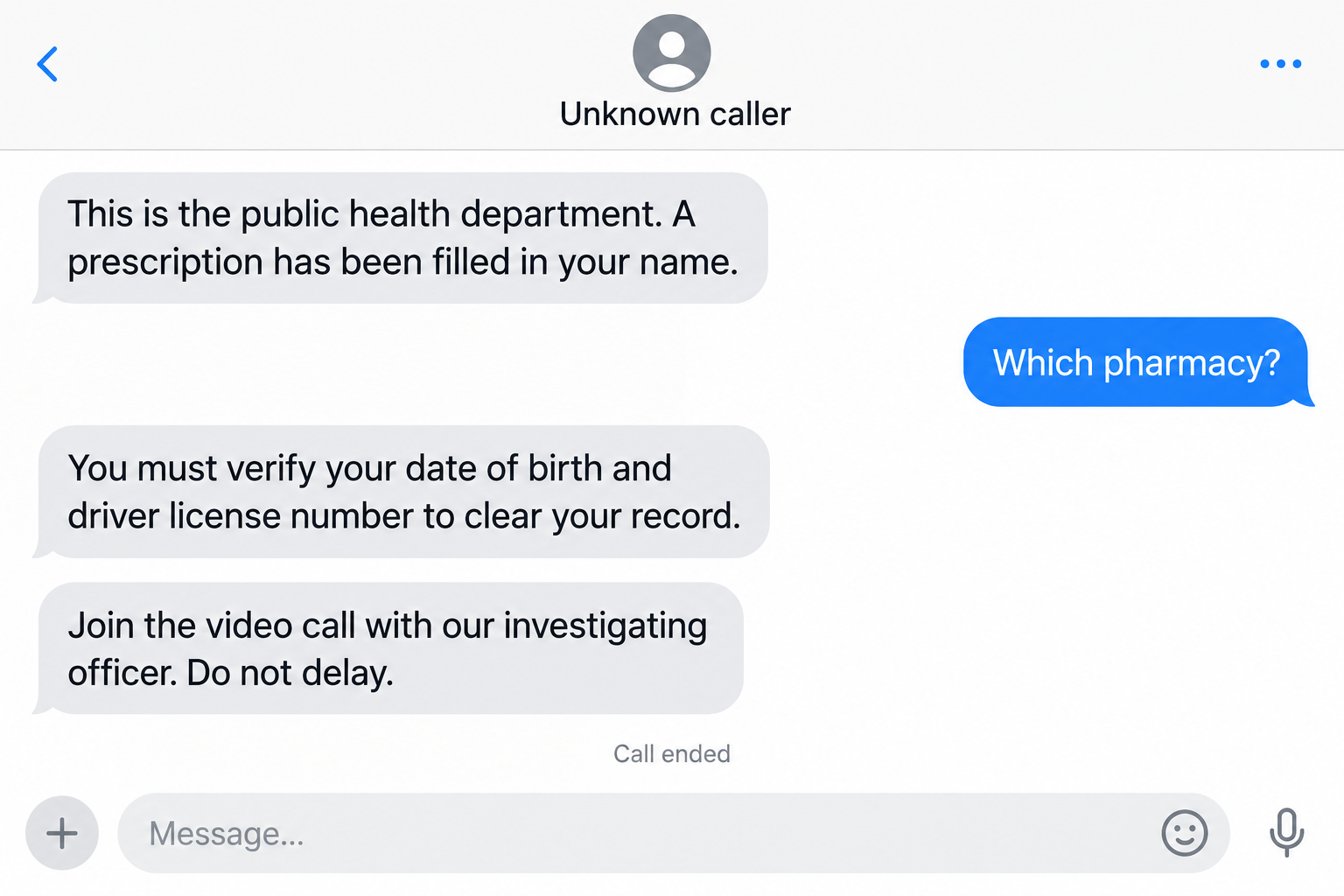
The lead image is a fictional conversation illustrating the pressure. It is not a received CDPH message, an actual transcript, or proof of a particular victim’s interaction.
How the CDPH Prescription Scam Works
Step 1: A caller introduces a prescription you don’t recognize
The conversation begins with an alleged record, not a request to buy something. That makes it feel closer to an administrative problem than a sales pitch.
A person who doesn’t take medication may be just as concerned as someone who does. The claim suggests that another person could be using their identity.
Don’t supply your usual medication, pharmacy address, or insurance details to help the caller narrow it down. First establish whether you are speaking to the right organization.
If the claim concerns a real pharmacy, reach that pharmacy using your existing prescription paperwork or established account. Leave the caller’s proposed verification route behind.
Step 2: Verification becomes the price of clearing your record
The caller asks for information under the pretext of fixing the alleged problem. Details such as your birth date or driver license number can sound routine.
But familiarity with a verification question does not make this requester entitled to the answer. An unsolicited caller must be verified before receiving sensitive data.
A useful response is simply to end the conversation and contact the agency independently. You don’t need a better argument or the caller’s permission.
Don’t correct a deliberately wrong detail with the right one. Even saying which address or birth date is inaccurate can help someone assemble a more convincing profile.
Step 3: Caller ID and credentials make the claim feel official
A displayed agency number can be spoofed. A name, badge number, or document shown on screen can also be presented without proving employment or authority.
Looking up the number while remaining on the call doesn’t establish who placed that call. You may only confirm that a real public number exists.
End the connection and start a new one through the department’s official website. Explain the request before providing personal details to the independently contacted office.
Someone who insists independent verification will cause legal trouble is asking you to trust their control of the conversation more than the institution they claim to represent.
Step 4: Another supposed official raises the stakes
Some reported versions move into a video call with someone impersonating a police officer. The staged setting helps turn an unverified story into apparent authority.
There is no need to determine whether the scene uses editing or artificial intelligence. Clothing, a badge, and an official-looking room do not authenticate a caller.
A transfer arranged by the first stranger is still part of the same unverified contact. The second voice or face does not independently confirm the first.
If an officer’s identity needs checking, find the agency yourself. Do not use a contact card, meeting invitation, or callback number supplied during the disputed interaction.
Step 5: Pressure pushes the interaction onto devices or into real life
The warnings describe requests involving communication apps, attempted device access, threatening follow-up messages, and sometimes an instruction to attend a Sacramento address.
Those variations don’t happen in every call. The common danger is letting an unverified contact choose the next channel and define what compliance requires.
Don’t travel to a meeting to prove your innocence, install a recommended app, or share your screen. Verify the alleged purpose through a separately located agency.
If threats make you feel physically unsafe, contact appropriate local emergency services. Preserve the communications without meeting the sender or trying to investigate them personally.
Checking the Health Concern Without Feeding the Scam
Separate the medication question from the identity demand
You can ask your genuine pharmacy whether an unfamiliar prescription appears in your records. That conversation doesn’t require continuing with the person who introduced the claim.
Use the patient portal or telephone number you normally use. If your usual contact isn’t available, locate the provider through its independently verified website.
Explain that an unknown caller alleged a prescription problem. Ask what the pharmacy can verify and what its real process is for correcting an error.
Do not change a prescribed treatment because of this call. Medication decisions belong with your treating clinician or pharmacist, who can assess your actual care.
Keep information requests within the real purpose
A healthcare service may legitimately verify a patient during a call you initiated. That doesn’t justify every question from an unknown caller claiming a health role.
Ask why the information is needed, how the contact was initiated, and whether you can use an established secure portal instead.
A real organization may need time to locate an issue. A stranger demanding an immediate answer should not become the shortcut around normal verification.
If you are helping a relative, make the independent call together. Let them describe what happened without criticism or pressure to remember every detail perfectly.
Recognize what the warning does and doesn’t establish
The caller may have invented the prescription story entirely. Check it with your pharmacy before assuming someone accessed your medical records or used your insurance.
The public warnings don’t identify a universal app or payment page. Recovery should follow your actual interaction rather than an imagined sequence of additional events.
Receiving threatening texts after hanging up doesn’t make the threat legitimate. Keep a record and report it through independently located channels instead of negotiating.
What to Do if You Have Fallen Victim to This Scam
-
Stop the caller’s access to you. End the voice or video connection. Don’t answer follow-up questions intended to finish verification or cancel an alleged case.
Save relevant messages, voicemails, handles, and meeting details before blocking the contact. Keep this record private, especially if it contains health or identity information.
If another household member is still talking to the caller, let them know the contact is unverified. Avoid forwarding an active invitation that could restart it.
-
Contact CDPH through its published route. The department’s warning lists its main line as (916) 558-1784. Obtain current contact information from the official CDPH website.
Describe the impersonation and ask how to report it. A number displayed on your incoming call is not evidence that the department placed that call.
If the caller named another agency, verify that identity separately. Don’t accept a transferred connection as a substitute for starting contact yourself.
-
Write down exactly what was disclosed. List identity numbers, account credentials, payment details, documents, and any screen sharing or software permissions involved.
Separate what you stated from what the caller merely claimed to know. That distinction helps you choose useful protections without assuming every record has been exposed.
Check whether anyone else supplied information on your behalf. A helpful relative may have read a code or sent a document while trying to resolve the problem.
-
Protect affected financial accounts promptly. If card or bank information was shared, contact the institution using its app or the number printed on your card.
Explain whether a payment was made under deception or whether information was disclosed without a transaction. Ask about blocking, replacement, alerts, and available recovery options.
Never send another payment to prove ownership or unlock a refund. The FTC’s recovery guidance explains which actual provider to contact.
-
Address identity exposure with a specific plan. If you supplied sensitive identity information, use IdentityTheft.gov for guidance appropriate to what was exposed or misused.
For a disclosed driver license number, contact the issuing motor vehicle authority about its procedures. Keep any report reference and follow-up instructions.
Consider credit protections where appropriate to your circumstances. A credit freeze concerns new credit access; it does not reverse a payment or correct a medical record.
-
Secure any account or device you handed over. Change exposed passwords through the genuine service, using a device you trust, and end unfamiliar sessions.
If you installed software or granted remote control, stop using that device for private activity and get qualified help. Record the application’s exact name and permissions.
An encrypted calling app is not automatically malware. The issue may be screen sharing, account access, or separate software; a technician should assess what actually occurred.
Answering the telephone alone is not evidence that your device needs a factory reset. Avoid destructive cleanup based solely on the caller’s threats.
-
Check genuine health records independently. Ask your pharmacy or provider about the alleged prescription through its normal contact process.
If an actual error or misuse is found, follow the provider’s correction process. Preserve relevant records without sending medical documents to the original contact.
A genuine record problem deserves attention even though the caller was fraudulent. Resolve it with the organization that holds the record, not the person demanding compliance.
-
Report the impersonation and keep watching for follow-ups. Use ReportFraud.ftc.gov and contact local law enforcement when money, threats, or identity misuse are involved.
Someone who later claims to be recovering your money may reuse details from the first interaction. Verify them afresh and refuse advance recovery fees.
Review provider alerts and account notices over time. Keep a simple incident timeline so you don’t have to reconstruct the entire call for every organization.
Frequently Asked Questions
Does CDPH ever call members of the public?
Yes, legitimate public health contact can occur. CDPH says those calls do not request Social Security numbers, card information, or payment.
Does the prescription claim prove someone used my identity?
No. It is the caller’s allegation. Ask your real pharmacy or provider to check through a contact route you established independently.
Can the department’s real number appear on a scam call?
Yes. Caller ID can be spoofed. End the call and contact the department yourself rather than trusting the displayed number.
Does a uniform on a video call prove the officer is real?
No. The warnings describe staged police impersonation. Verify the claimed agency separately; the video presentation cannot authenticate the person.
Were these calls confirmed to be affecting Pasadena residents?
Pasadena’s warning said it had no reports of this particular scam locally at that time. It cited reports made to CDPH.
Must I erase my phone because I answered?
No. Match your response to any information, installation, screen sharing, or access you actually provided. Receiving a call alone doesn’t establish device compromise.
The Bottom Line
Don’t clear a supposed prescription record through an unsolicited CDPH caller or their police video handoff. The impersonation uses a health concern to demand private information.
Hang up, verify with the real department and pharmacy, and protect whatever you disclosed. If money or device access was involved, contact the relevant provider promptly.

Join the discussion
0 commentsShare your experience or ask a question about this article.
Discussion
Start the conversation
Have a question or something useful to share? Add the first comment.