


An agreement promises to turn a loan into digital HKD assets. Official-looking references make the proposal sound connected to the territory’s monetary authority.
Before signing anything, separate the promise from the paperwork. A document can look formal while leaving a very different financial problem behind.
Overview
A loan agreement is used to sell a false digital asset claim
The e-HKD loan agreement scam deceives people into signing documents while claiming their loans will be converted into digital HKD assets.
The Hong Kong Monetary Authority’s warning identifies the scheme as fraudulent and denies any connection. It says the authority received many public inquiries about it.
The authority’s name supplies false reassurance
The proposal borrows the HKMA’s identity to make the supposed conversion sound official. A reference to real digital currency work does not authorize a private offer.
The warning also rejects public fundraising or associated investment offers presented as part of the relevant pilot or sandbox programs.
The decisions that need an immediate pause
- Someone asks you to sign a loan agreement linked to promised e-HKD assets.
- The paperwork claims or implies approval from the HKMA.
- A representative treats the regulator’s name as enough proof that the proposal is genuine.
- A supposed pilot or sandbox connection is used to attract public money or investment.
- You are asked to proceed before independently checking the agreement and the parties involved.
Why the Loan Part Deserves Particular Attention
A promise about future digital assets can draw attention away from what someone is agreeing to now. That is especially dangerous when the document concerns borrowing.
The exciting part of the pitch may be a conversion, allocation, or official connection. The practical questions concern the actual agreement, signatures, money, and obligations.
Do not assume that a promised digital asset will repay or replace a loan. The HKMA has rejected the scheme’s claimed connection to the authority.
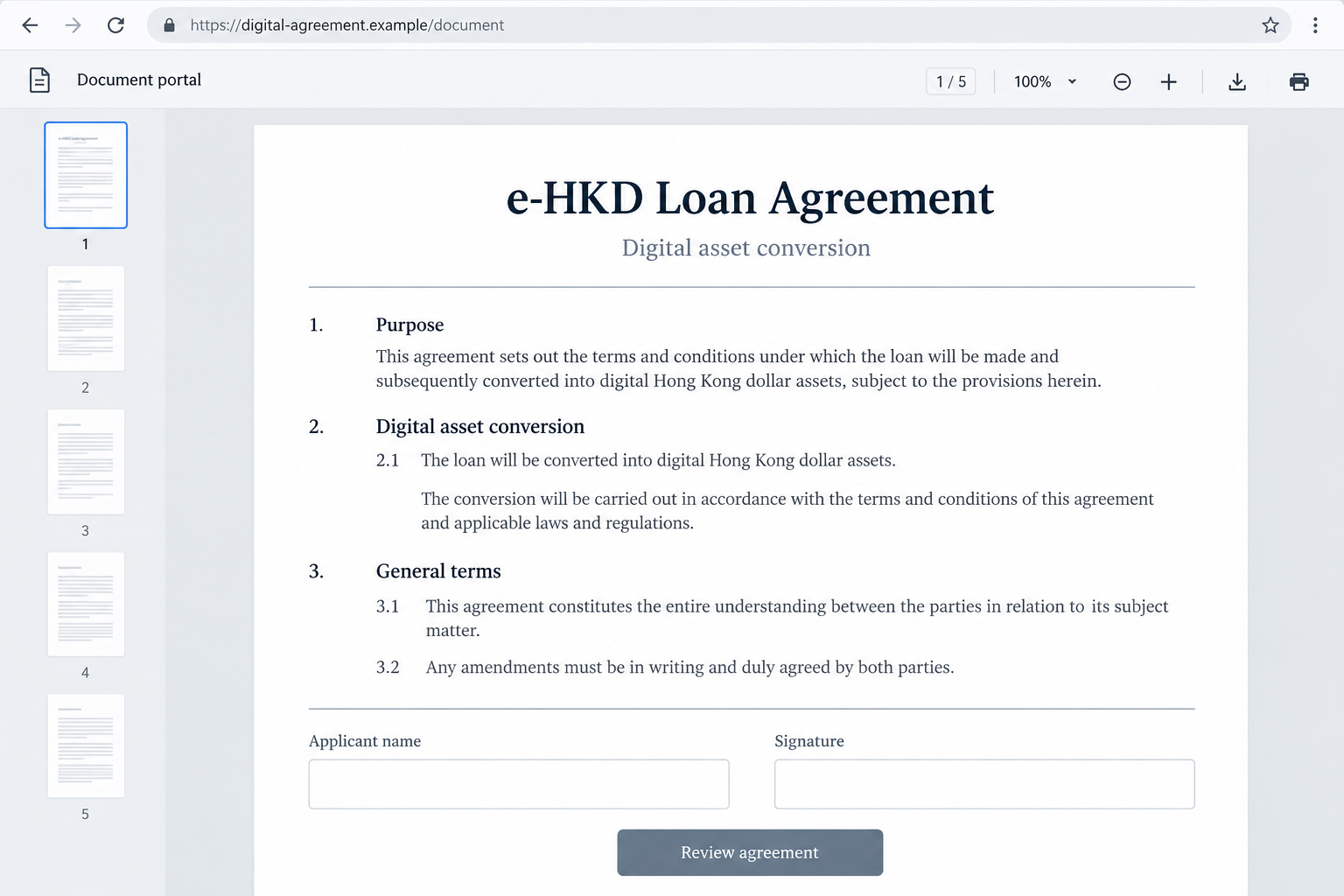
The illustration above is a fictional agreement screen with blank fields. It demonstrates the loan conversion pitch, rather than reproducing a signed document or genuine HKMA paperwork.
The public warning does not identify every lender, website, fee, or contract term. Those details should be checked from the documents actually received.
If you signed, do not assume the warning automatically cancels your obligations. Get the actual agreement reviewed independently before deciding how to handle any genuine borrowing.
The fraudulent asset promise and any genuine borrowing must be investigated separately. Ignoring one because the other was deceptive can create an additional problem.
How the e-HKD Loan Agreement Scam Works
Step 1: A digital currency story makes the proposal sound current
The offer uses e-HKD terminology to describe a supposed financial opportunity. Familiarity with real digital currency discussions can make the words feel credible.
You do not need to be a technical expert to assess the immediate request. Ask who is proposing the agreement and what they want you to sign or provide.
A reference to technology is not an explanation of legal authority. It should not substitute for a clear account of the parties and their roles.
Step 2: The HKMA’s name is used to support the claim
The scheme claims a connection to the monetary authority. That borrowed authority is important because it can make a private proposal appear government-backed.
The HKMA explicitly denies involvement. Its warning also says it does not approach individuals or request transfers in connection with personal financial matters.
If a representative claims special authorization, verify it with the authority itself. A document, logo, or contact supplied by that representative is not independent confirmation.
Step 3: Signing is presented as part of obtaining digital assets
The confirmed scheme induces people to sign agreements by claiming loans will be converted into digital HKD assets.
That is the central deception. It turns a formal act involving a loan into what may seem like an administrative step toward receiving something else.
Read every agreement according to what it actually says. Do not rely on a verbal assurance that an official process will take care of the borrowing later.
If the explanation cannot be checked outside the sales conversation, stop before signing. A signature should not be used as a way to investigate whether the promise works.
Step 4: The supposed official connection discourages further checking
Once someone accepts the authority claim, requests may seem easier to justify. The useful safeguard is to move verification outside the person promoting the agreement.
There is no single published sequence of later fees or transfers in this warning. Check any charge against the actual documents, recipient, and independent advice you obtain.
Any money request associated with the proposal should still be paused and independently examined. Preserve the actual request rather than assuming it matches another e-HKD story.
What the HKMA Has Actually Confirmed
The authority identifies fraudulent activities involving loan agreements and a claimed conversion into e-HKD assets. It says it has reported the matter to the police.
It also states that participating firms in the relevant pilot or sandbox programs do not solicit public funding or offer associated wealth management or investment products.
That statement is directly relevant when someone uses a program connection to attract your money. A real initiative does not make every offer borrowing its name legitimate.
The HKMA’s consumer information provides additional guidance about suspicious financial messages and contacting genuine institutions.
Keep the October loan agreement warning distinct from older impersonation stories. A different investment advertisement or earlier fee demand is not proof of this agreement’s exact terms.
The public notice does not establish a universal loss amount or a complete list of operators. Do not treat an unnamed individual as a confirmed offender without evidence.
Likewise, a real lender or payment provider appearing in your records is not automatically the organizer of the deception. Establish what each party actually did.
Before You Sign, Check These Questions Independently
Who is asking you to enter the agreement?
Identify the legal name, contact details, and claimed role of each party. Compare them with independent records rather than relying only on the document’s header.
If a real institution is named, contact it through its official channel. Ask whether the particular agreement and representative are authorized.
Do not let the promoter conduct that verification on your behalf. A call they arrange can keep you inside the same deceptive conversation.
What does the document require from you?
Look for borrowing amounts, repayment obligations, permissions, personal guarantees, and information sharing. Ask an independent qualified adviser to explain unclear terms before you sign.
A promise made outside the contract should not be assumed to change the written obligations. Preserve both the agreement and the messages explaining the supposed conversion.
If someone discourages independent review, do not proceed to satisfy their deadline. You are entitled to understand what your signature is being used to authorize.
Where is the money actually going?
Trace any proposed transfer to its named recipient and stated purpose. Do not assume that an account belongs to the HKMA because a message says so.
Ask the real financial provider about a suspicious recipient before sending money. A small test payment would still expose funds without proving the proposal’s legitimacy.
Keep verification separate from the person collecting payment. Their receipt or dashboard cannot independently establish regulatory approval or ownership of digital assets.
What to Do if You Have Fallen Victim to This Scam
- Stop further signatures and payments. Do not provide another agreement, identity document, authorization, or transfer while the proposal remains unverified.
- Preserve the complete record. Keep documents, messages, advertisements, representative details, recipient accounts, and payment references. Save the original versions where possible.
- Contact your financial provider. Explain any transfer induced by the false HKMA or e-HKD claim. Ask whether stopping, recalling, or disputing it is possible.
- Verify any named lender separately. Use its official contact information. Establish whether an actual loan exists, what was authorized, and where any disbursement went.
- Seek independent advice about signed documents. A qualified adviser can assess the agreement and appropriate steps. Do not assume the fraudulent promise cancels genuine borrowing.
- Report the impersonation. The HKMA warning directs affected people to the Hong Kong Police Crime Wing Information Centre at 2860-5012.
- Address exposed personal or account information. Tell the relevant institution exactly what was supplied. Secure affected logins through their real providers.
- Reject paid recovery promises. Verify anyone offering to recover assets or erase the agreement. Do not send another fee because they know details of the first approach.
If you signed but have not paid
Do not treat the absence of a transfer as the end of the issue. Establish what the signature authorized and whether any real institution received the paperwork.
Ask for independent advice promptly. Keep the full document, including schedules and attachments, instead of saving only the page showing the promised digital assets.
Do not sign a replacement agreement described as a cancellation without checking it. Another document can introduce new obligations or permissions.
If money has already moved
Give your provider the amount, time, recipient, and transaction reference. Explain the promise that induced the transfer, rather than describing it only as an investment disappointment.
Ask which recovery options exist for that payment method. Available processes and outcomes vary; neither a police report nor a complaint guarantees the money returns.
Record reference numbers and follow-up instructions from genuine institutions. Avoid discussing recovery only through the representative who arranged the original proposal.
If you supplied identity documents or banking information
List each item and who received it. Contact the relevant bank, account provider, or issuing authority for advice specific to that exposure.
Review genuine account notifications for unfamiliar applications or changes. Do not approve a code or login request just because the promoter says it completes a cancellation.
A copied identity document and an exposed password present different problems. Describe both accurately if both occurred, so the appropriate institutions can respond.
Help Someone Else Without Taking Over the Decision
If a relative received this proposal, ask to see the agreement and the messages explaining it. Focus on the actual request rather than debating digital currency generally.
Show them the HKMA warning and help them find an independent contact. A calm check is more useful than pressing them to defend why the offer seemed plausible.
If they already signed, help preserve the documents and arrange qualified advice. Do not reassure them that every obligation disappears merely because the pitch was fraudulent.
If they paid, encourage immediate contact with their provider. Keep payment records available while the details are still easy to establish.
Be cautious about anyone contacting the family with a guaranteed recovery plan. Knowledge of the agreement does not prove that the new person represents the police or regulator.
Keep a timeline of the agreement
Write down when the proposal arrived, when you signed, and when any funds moved. Separate what you were told from what your records show.
Include which version of the document you received at each stage. A revised page or later attachment may matter when an adviser reviews what was agreed.
If a representative made promises by phone, record your recollection promptly. Keep it clearly identified as your account of the conversation.
Do not edit the original files to add explanations. Save notes alongside them so a genuine institution can inspect the documents as received.
Ask your adviser which communications or deadlines require a response. Avoid relying on the promoter’s assurance that no action is necessary.
If a real lender contacts you, verify that contact independently before discussing the case. Then explain the fraudulent conversion promise and ask for the relevant records.
A careful timeline helps separate the false pitch, any genuine financial transaction, and the actions still available to you.
Frequently Asked Questions
Is the HKMA offering to convert personal loans into e-HKD?
No. The authority denies connection with the fraudulent loan agreement scheme and says it does not approach individuals about personal financial transfers.
Does mentioning an e-HKD pilot make an offer official?
No. The HKMA warns that relevant pilot or sandbox participants do not solicit public funding or offer associated wealth management or investment products.
Are all digital currency projects scams?
No. This warning concerns a specific false authority claim and loan conversion scheme. Assess other proposals on their own evidence rather than applying a blanket accusation.
Does the warning automatically cancel a loan I signed?
No automatic legal outcome is established. Verify any genuine borrowing separately and seek independent qualified advice about your documents and circumstances.
What fee does this scheme charge?
The warning does not establish a universal fee or payment sequence. Preserve the actual requests you received and report them without adding details from other schemes.
Who should I contact after responding?
Contact your actual financial provider and seek advice about any signed agreement. The HKMA notice also lists the police Crime Wing Information Centre at 2860-5012.
The Bottom Line
The HKMA has rejected this loan conversion scheme. Its name on paperwork does not create official backing or turn a promised digital asset into a genuine entitlement.
Do not sign or transfer money through the proposal. If you already acted, preserve the records, contact your provider, and get independent advice about any actual borrowing.

Join the discussion
0 commentsShare your experience or ask a question about this article.
Discussion
Start the conversation
Have a question or something useful to share? Add the first comment.