

Imagine opening your inbox and seeing an email with the subject line “Deposit info4636 Ref#7995” that looks urgent and professional. The email features the Xodo Sign logo and claims that your ACH/EFT (Automated Clearing House / Electronic Funds Transfer) processing documents have been successfully verified and are ready for review. It emphasizes the time-sensitive nature of these financial documents and urges you to click a “Review Document” button immediately.
On the surface, it looks like a routine financial communication. But in reality, this is a phishing scam designed to trick you into handing over your email login credentials. Once scammers gain access to your account, they can exploit it in countless damaging ways, including identity theft, spreading malware, and financial fraud.
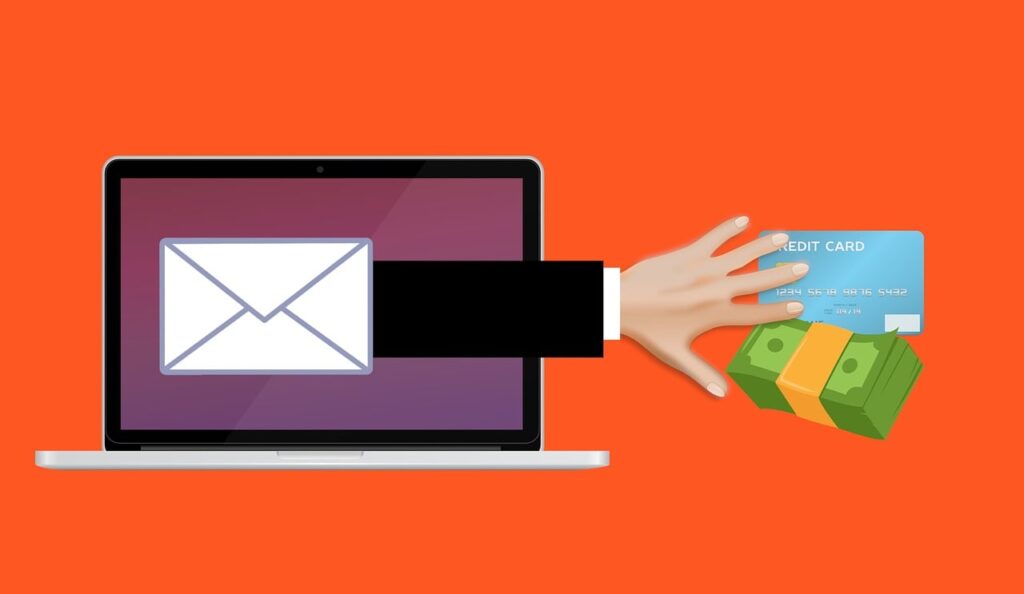
Scam Overview
The ACH-EFT Processing Documents Verified email scam is a phishing campaign disguised as a financial services notification. It impersonates Xodo Sign, a legitimate e-signature platform, to trick users into believing they need to review financial documents. The fraudsters carefully design the email to look professional, exploiting urgency and trust to drive clicks.
Key Features of the Scam Email
- Subject Lines
Examples include:- “Deposit info4636 Ref#7995”
- “ACH-EFT Processing Documents Verified”
- “Important Financial Update: ACH/EFT Processing Complete”
- “ACH-EFT Document Ready for Review”
- Branding Abuse
The emails prominently feature the Xodo Sign logo and corporate-styled formatting. Scammers rely on brand impersonation to build false trust. Importantly, this scam has no actual connection to Xodo Sign or any legitimate financial institution. - Body Content
The email message claims:- Your ACH/EFT documents were processed and verified.
- They contain time-sensitive financial information.
- You must review them immediately.
- Action Button
The email includes a large “Review Document” button. Clicking it leads to a fraudulent site rather than any real document. - Phishing Pages
- The first fake page mimics an official Xodo Sign page.
- It offers options like “View Document” or “Download PDF.”
- Both buttons redirect the user to a credential phishing site.
- Data Harvesting
The phishing page asks for the victim’s email address and password. Once entered, this information is captured and sent to scammers.
Why This Scam Works
The ACH-EFT scam succeeds because it:
- Appears legitimate – leveraging a real company logo and professional formatting.
- Creates urgency – stressing that the documents are time-sensitive.
- Targets financial context – ACH/EFT are common banking terms that sound official.
- Exploits curiosity – victims fear missing important deposits or financial documents.
Real Risks
Falling victim to this scam can have serious consequences. Once attackers have your email credentials, they may:
- Access sensitive personal or financial data in your inbox.
- Reset passwords on linked accounts (banking, PayPal, e-commerce, social media).
- Impersonate you to scam your friends, colleagues, or clients.
- Use your account to spread further phishing emails or malware.
- Sell your credentials on dark web marketplaces.
In corporate environments, compromised email accounts can lead to:
- Business email compromise (BEC) fraud, including fake invoices.
- Network infiltration, where attackers spread malware like ransomware.
- Data breaches, exposing confidential client or company information.
How the Scam Works
Understanding the step-by-step mechanics of this scam helps you spot red flags and avoid falling victim.
Step 1: Delivery of the Email
The victim receives a phishing email that appears to come from Xodo Sign or another trusted service. Attackers often use spoofed addresses or compromised servers to increase credibility.
Here is how it usually looks:
Subject: Deposit info4636 Ref#7995
xodo sign
by apryseImportant Financial Update: Your ACH-EFT processing documents have been successfully verified and are ready for your review.
Review Document
IMPORTANT:
Your secure financial document contains time-sensitive information regarding your payment processing account.Do Not Share This Email
To protect your information and prevent unauthorized access, do not share this email or forward these links to anyone.Processed by Xodo Sign on behalf of [removed]
Secured by 256-bit encryption
Step 2: Social Engineering
The email exploits psychological triggers:
- Authority – presenting as an official financial document notice.
- Urgency – stressing that the documents are time-sensitive.
- Fear of loss – implying you may miss out on financial processing if you don’t act quickly.
Step 3: The Call-to-Action
The email urges the victim to click a “Review Document” button. It is designed to look like a secure link to important documents.
Step 4: Redirect to Fake Site
Clicking the button leads to a fake webpage branded with Xodo Sign logos. It appears convincing and may offer options like “View Document” or “Download PDF.”
Step 5: The Phishing Trap
Regardless of which option the victim clicks, they are taken to a phishing page that mimics an email provider’s login screen. Here, they are asked to enter their email and password.
Step 6: Credential Theft
Once submitted, the login information is immediately transmitted to the scammers’ servers. Some phishing kits even automatically test credentials on multiple providers in real-time.
Step 7: Exploitation of Credentials
After stealing credentials, attackers can:
- Access the victim’s email account to steal data.
- Reset passwords for online banking, PayPal, Amazon, or social media.
- Send phishing emails to the victim’s contacts.
- Commit financial fraud using stolen accounts.
- Spread malware via infected attachments or links.
Step 8: Long-Term Abuse
For high-value targets, attackers may:
- Monitor email communications for weeks or months.
- Insert themselves into financial transactions (invoice fraud).
- Spread ransomware or trojans across corporate networks.
What To Do If You Have Fallen Victim
If you clicked the link or entered your login credentials, act quickly. The faster you respond, the less damage scammers can do.
1. Change Your Password Immediately
Go directly to your email provider’s official website (not through the phishing link). Change your password to a strong, unique one.
2. Enable Two-Factor Authentication (2FA)
Turn on 2FA for your account. Use an authenticator app or hardware key for stronger protection than SMS codes.
3. Check for Unauthorized Activity
Review your account’s login history. Look for unusual logins from unknown locations or devices.
4. Revoke Suspicious App Connections
Go to your email settings and remove any unauthorized third-party connections or forwarding rules.
5. Notify Your Contacts
If your account was compromised, warn friends, family, or colleagues that they may receive phishing messages from your email.
6. Scan Your Device for Malware
Run a full scan using reputable antivirus software. Some phishing campaigns also attempt to drop malware.
7. Secure Linked Accounts
If you used the same password for other accounts, change them immediately. Enable 2FA wherever possible.
8. Monitor Your Finances
Check bank accounts, PayPal, and credit card statements for suspicious activity. Report unauthorized transactions to your financial institution.
9. Report the Scam
- Report the phishing email to your provider.
- Forward it to reportphishing@apwg.org (Anti-Phishing Working Group).
- In the U.S., report to the FTC.
- In the U.K., forward to report@phishing.gov.uk.
- In the EU, report to your national cybercrime authority.
10. Consider Identity Protection
If sensitive data was exposed, consider enrolling in a credit monitoring or identity theft protection service.
Is Your Device Infected? Run a Free Malware Scan
Slow performance, constant pop-ups, or strange behavior? These are classic signs of a malware infection. The fastest way to find out is to scan your device with Malwarebytes Free — one of the most trusted malware removal tools available.
The free version detects and removes the most common threats, including:
- Adware — the cause of those annoying pop-ups
- Browser hijackers — unwanted redirects and changed homepages
- Trojans and spyware — hidden programs stealing your data
- Potentially unwanted programs (PUPs) — software you never asked for
👉 Select your device below — Windows, Mac, or Android — then follow the simple steps to download Malwarebytes, scan your system, and remove any threats it finds. The scan usually takes 5 to 20 minutes.
Run a Malware Scan with Malwarebytes for Windows
Malwarebytes is one of the most popular and trusted anti-malware tools for Windows — and it’s completely free for removing infections. It catches threats that many antivirus programs miss, including adware, browser hijackers, and trojans. Follow the steps below to scan and clean your PC in just a few minutes.
Download Malwarebytes
Click the button below to download the latest version of Malwarebytes for Windows from the official source. The free version is all you need — it will scan your computer and remove adware, browser hijackers, and other malicious software at no cost.
Download MalwarebytesOfficial installer for Windows 11 and 10. Your download starts right away.Want real-time protection? See Malwarebytes Premium Malwarebytes Free for WindowsScans and removes malware at no cost
-
Install Malwarebytes
When the download finishes, open your Downloads folder and double-click the MBSetup file. If Windows shows a User Account Control pop-up, click “Yes” to allow the installation.
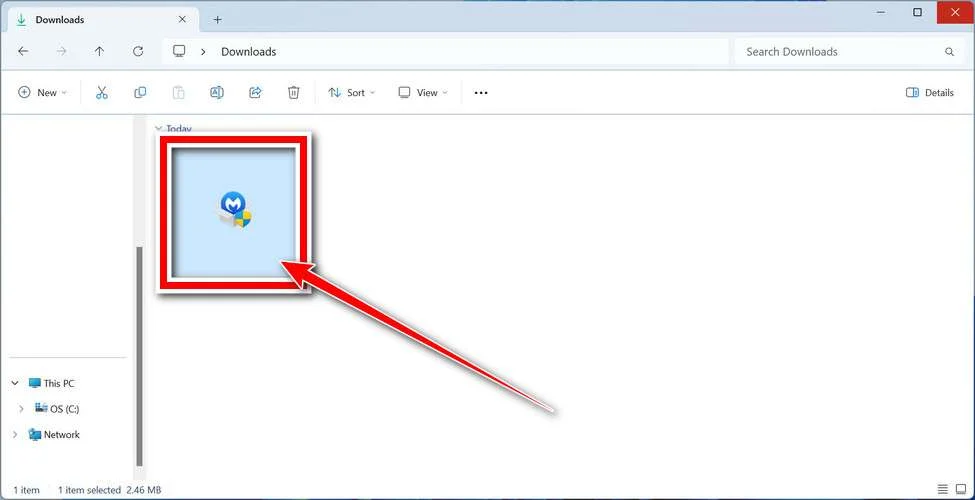
Follow the On-Screen Prompts to Install Malwarebytes
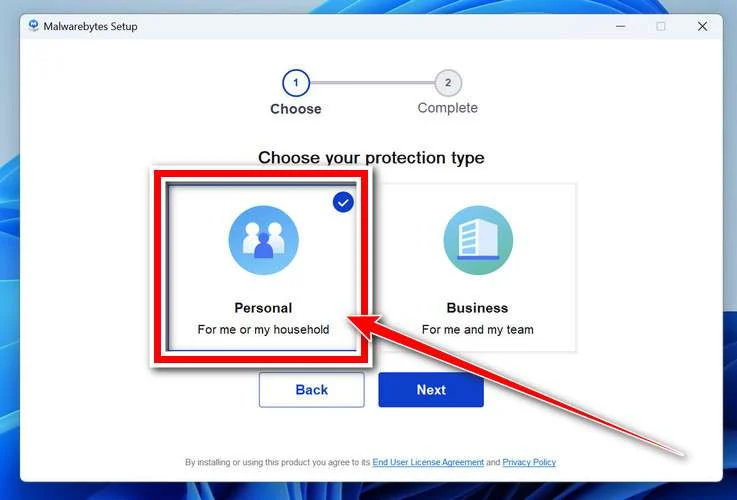
The setup wizard will walk you through a few quick screens:
-
Choose where you’re installing the program — “Personal Computer” or “Work Computer” — then click Next.
-
Malwarebytes will now install on your device. This usually takes under a minute.

-
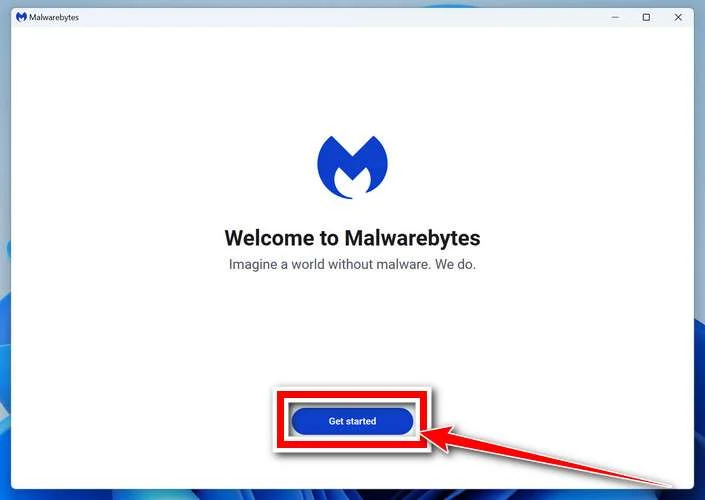
When installation is complete, the “Welcome to Malwarebytes” screen will open automatically.
-
On the final screen, click Open Malwarebytes to launch the program.

-
Enable “Scan for Rootkits”
Before scanning, turn on rootkit detection so Malwarebytes can find even the most hidden threats. Click the Settings gear icon on the left side of the screen.
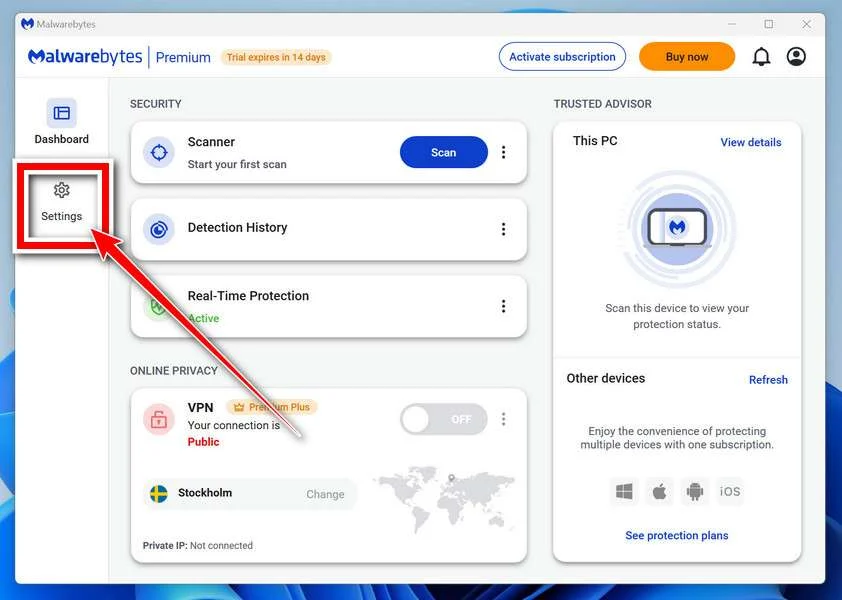
In the settings menu, find “Scan for rootkits” and click the toggle so it turns blue.

Done? Click “Dashboard” in the left pane to return to the main screen.
Start the Scan
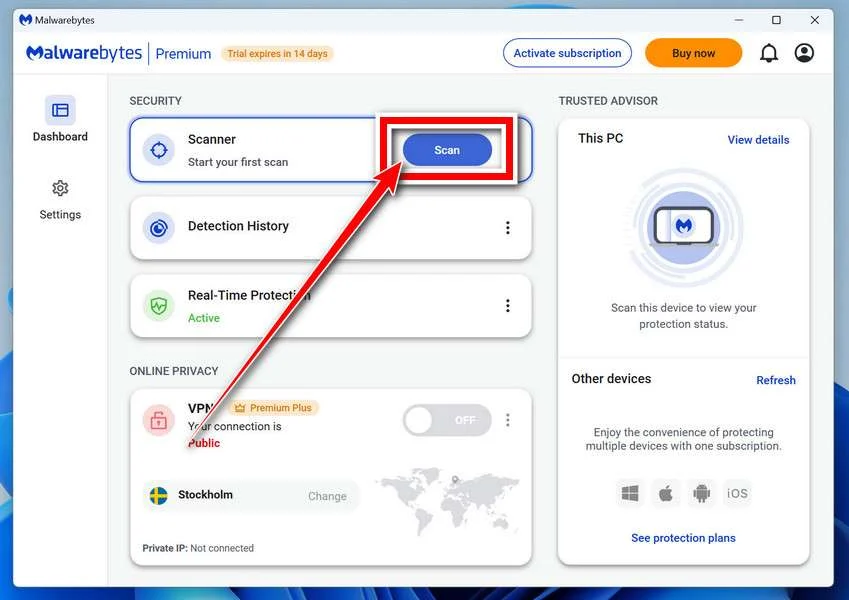
Click the blue Scan button. Malwarebytes will automatically update its virus database and start checking your computer for malware.
-
Wait for the Scan to Finish
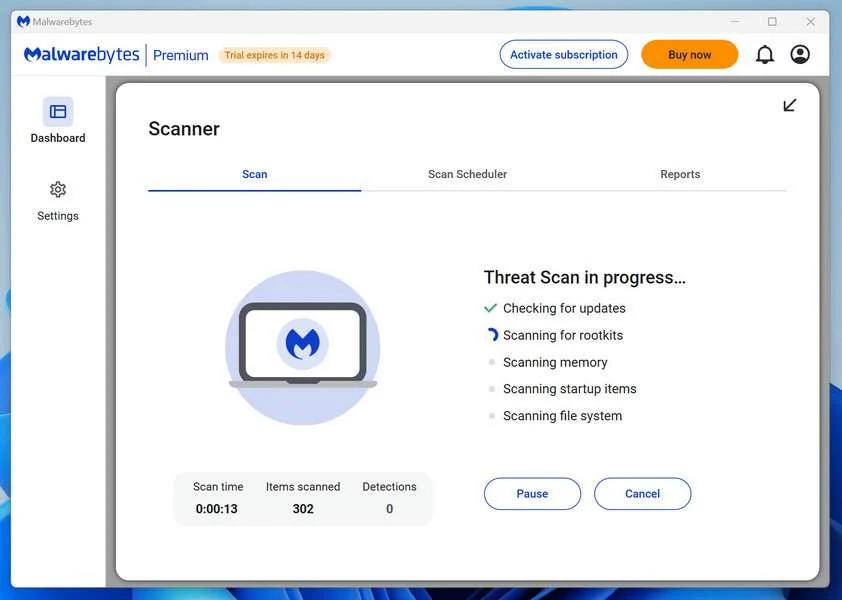
The scan checks your entire system for browser hijackers and other malicious programs, so it can take 5 to 20 minutes depending on your computer. Feel free to do something else — just check back occasionally to see the progress.
-
Quarantine the Detected Threats
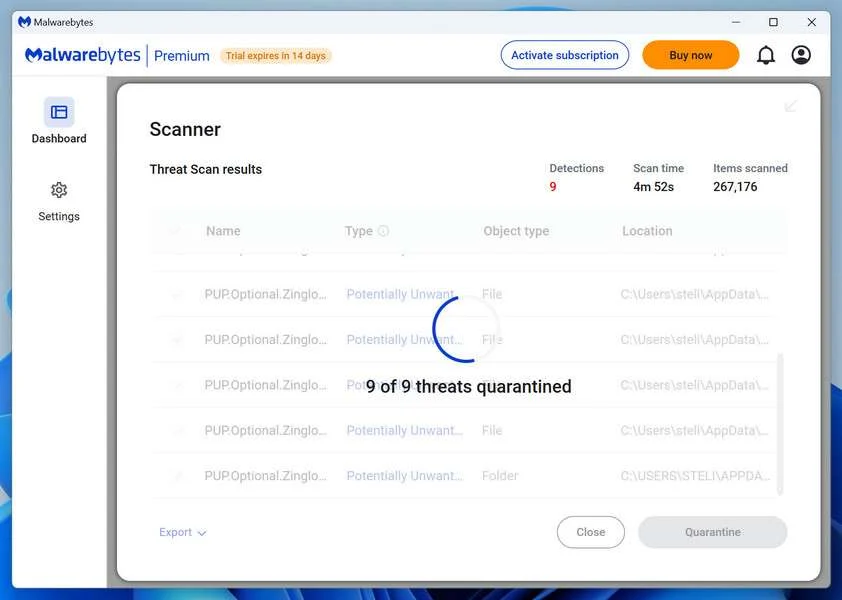
When the scan is done, you’ll see a list of everything Malwarebytes found — malware, adware, and potentially unwanted programs. Click the “Quarantine” button to remove all of them at once.
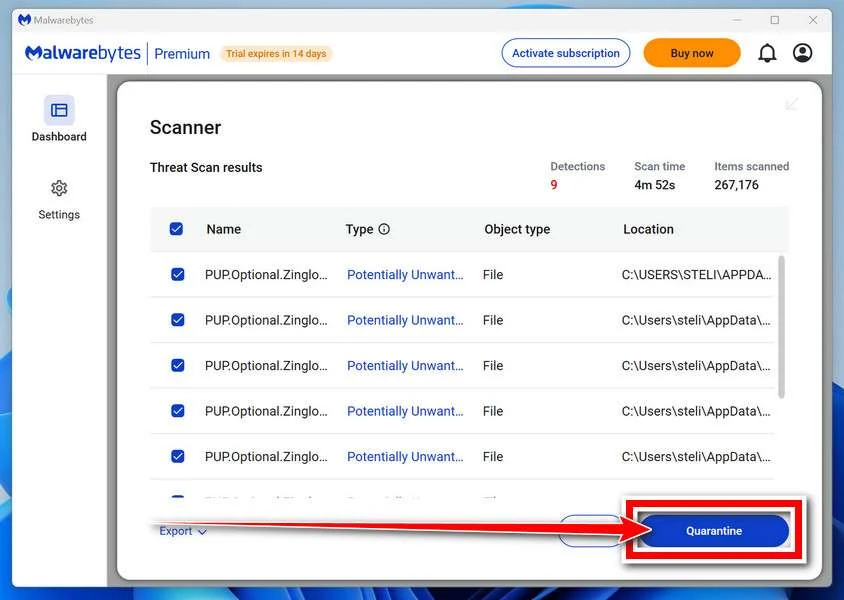
Malwarebytes will now remove the malicious files and registry entries and move them safely into quarantine.
-
Restart Your Computer
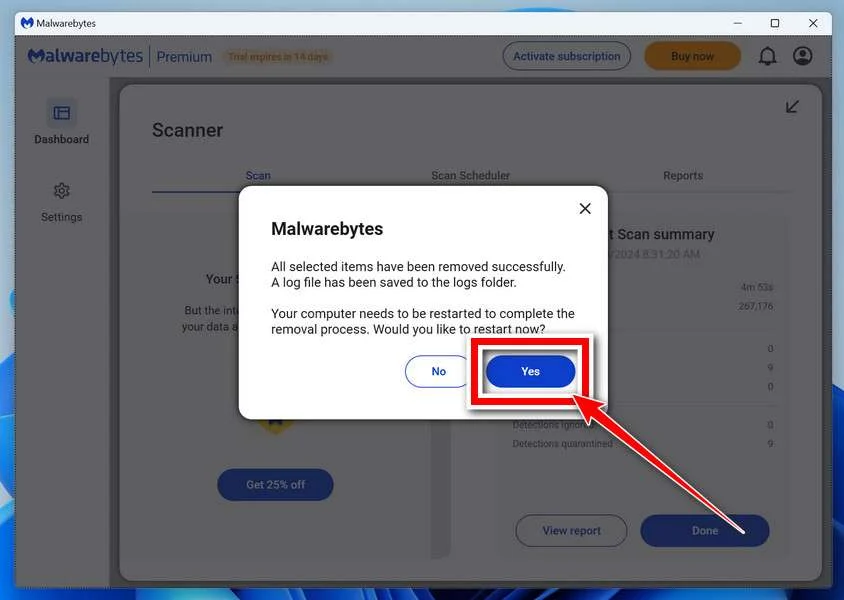
Some threats can only be fully removed after a reboot. If Malwarebytes asks you to restart, click Yes. Once you’re logged back in, Malwarebytes has finished removing the threats it found.
That’s it — your Windows PC is now clean of trojans, adware, and other malware, and should be back to running smoothly.
If you are still having problems with your computer after completing these instructions, then please follow one of the steps:
- Run a computer scan with ESET Online Scanner
- Ask for help in our Windows Malware Removal Help & Support forum.
Run a Malware Scan with Malwarebytes for Mac
Malwarebytes for Mac is a free on-demand scanner that removes the malware other security software tends to miss — adware, browser hijackers, and unwanted programs included. Cleaning an infected Mac with Malwarebytes has always been completely free, and it’s our go-to recommendation. Follow the steps below to scan and clean your Mac in just a few minutes.
-
Download Malwarebytes for Mac
Click the button below to download the latest version of Malwarebytes for Mac.
Download MalwarebytesOfficial installer for macOS. Your download starts right away.Want real-time protection? See Malwarebytes PremiumMalwarebytes Free for MacScans and removes malware at no cost -
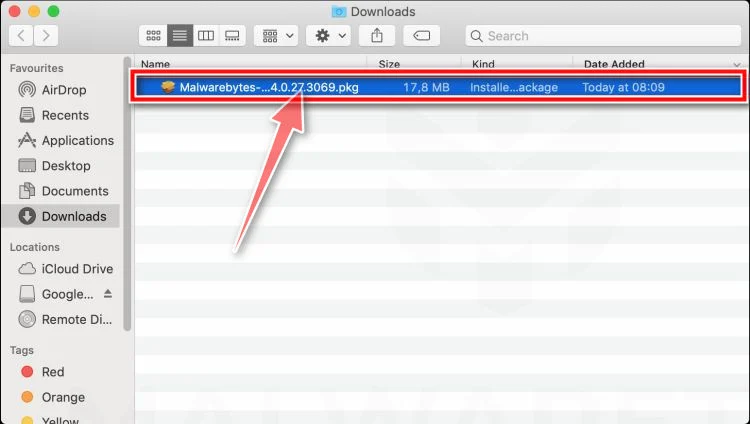
Open the Malwarebytes setup file
When the download finishes, open your Downloads folder and double-click the setup file to begin the installation.
-
Follow the On-Screen Prompts to Install Malwarebytes
The Malwarebytes for Mac Installer will guide you through a few quick screens. Click “Continue” and keep following the prompts until the installation completes.
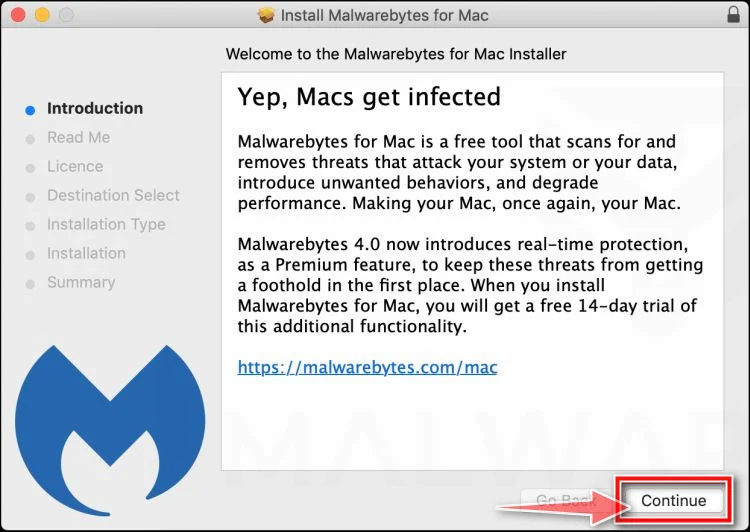
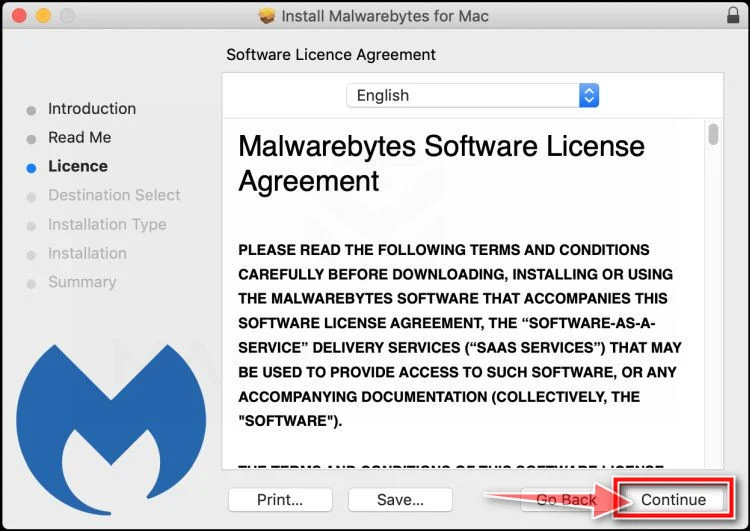
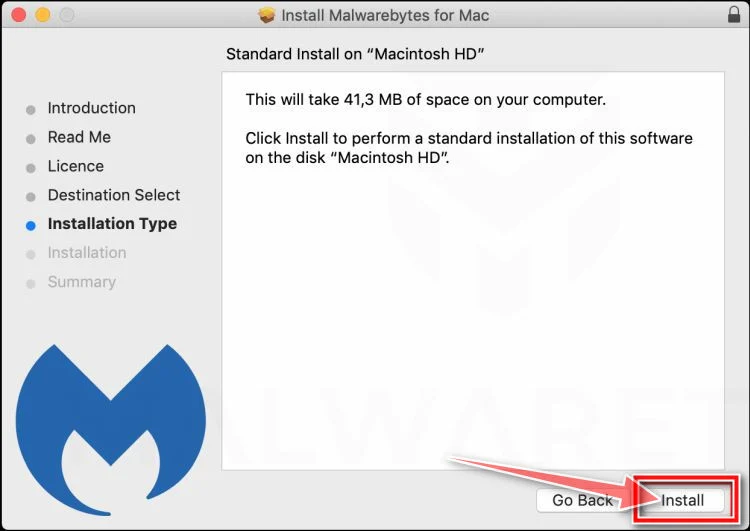
When the installation is complete, Malwarebytes opens to the Welcome to Malwarebytes screen. Click “Get started“.
-
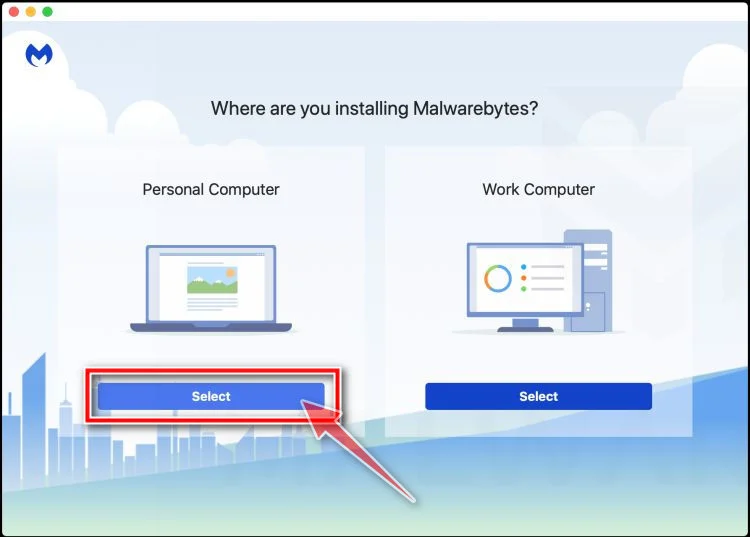
Select “Personal Computer” or “Work Computer”
Malwarebytes will ask what type of computer you’re installing it on. Click either Personal Computer or Work Computer, whichever applies.
-
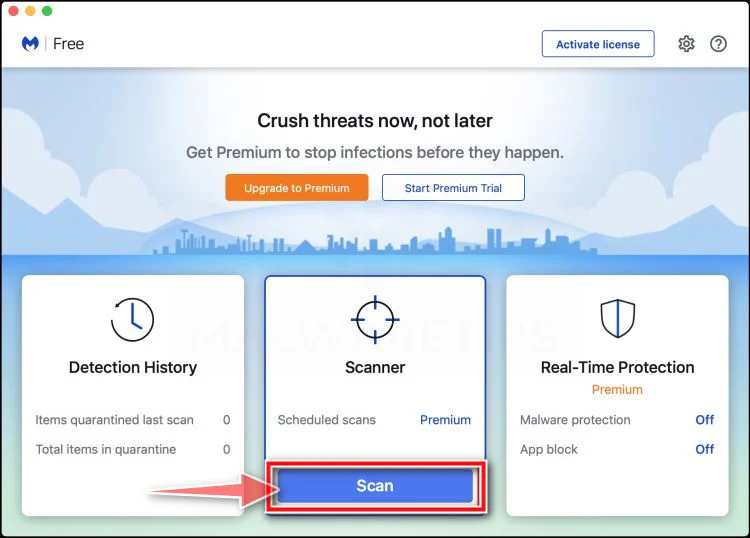
Start the Scan
Click the “Scan” button. Malwarebytes will automatically update its detection database and begin checking your Mac for malware.
-
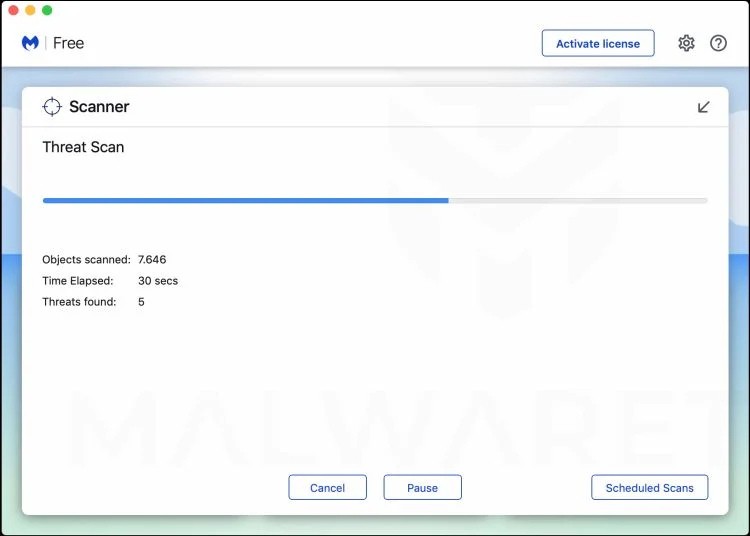
Wait for the Scan to Finish
Malwarebytes will scan your Mac for adware, browser hijackers, and other malicious programs. This can take a few minutes, so feel free to do something else — just check back occasionally to see the progress.
-
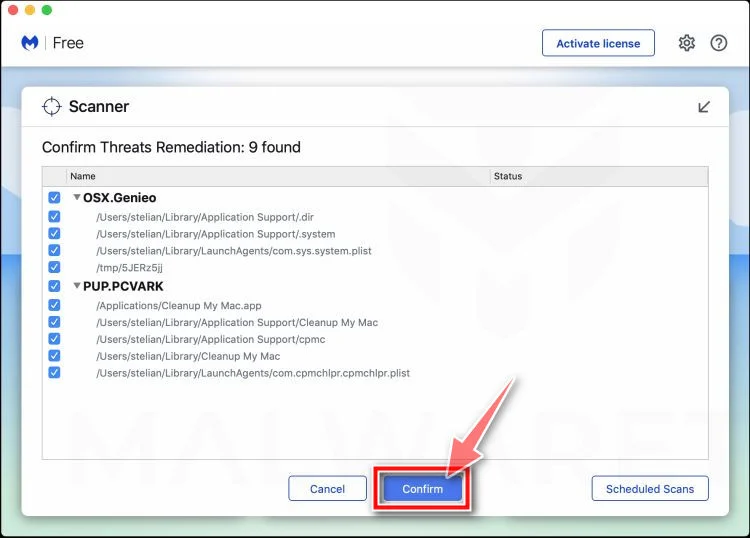
Quarantine the Detected Threats
When the scan is done, you’ll see a list of everything Malwarebytes found. Click the “Quarantine” button to remove all the threats at once.
-
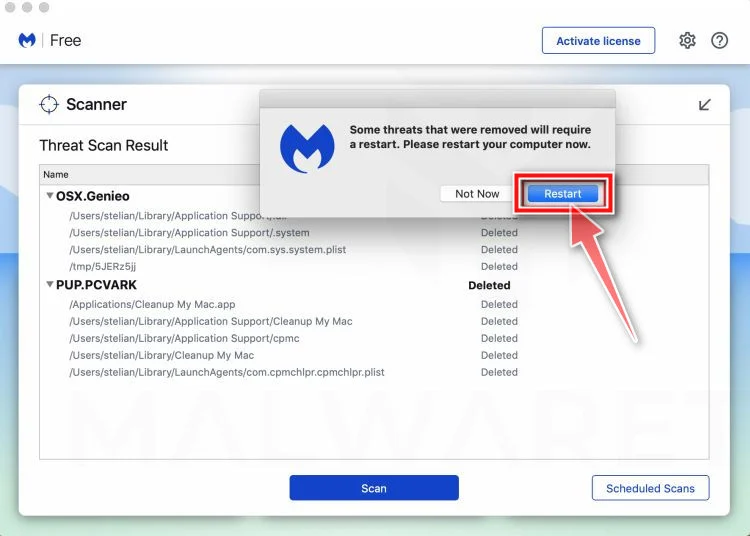
Restart Your Mac
Malwarebytes will now remove all the malicious files it found. Some threats can only be fully removed after a reboot — if Malwarebytes asks you to restart, allow it. Once you’re logged back in, your Mac is clean.
That’s it — your Mac is now free of adware, rogue browser extensions, and other potentially harmful software.
If you are still experiencing problems while trying to remove a malicious program from your computer, please ask for help in our Mac Malware Removal Help & Support forum.
Run a Malware Scan with Malwarebytes for Android
Malwarebytes for Android automatically detects and removes dangerous threats like malware and ransomware so you don’t have to worry about your most-used device being compromised. Aggressive detection of adware and potentially unwanted programs keeps your Android phone or tablet running smooth.
-
Download Malwarebytes for Android.
You can download Malwarebytes for Android by clicking the link below.
Get Malwarebytes for AndroidOpens Google Play in a new tab.Want real-time protection? See Malwarebytes Premium for AndroidMalwarebytes for AndroidScans your phone and removes malware at no cost -
Install Malwarebytes for Android on your phone.
In the Google Play Store, tap “Install” to install Malwarebytes for Android on your device.

When the installation process has finished, tap “Open” to begin using Malwarebytes for Android. You can also open Malwarebytes by tapping on its icon in your phone menu or home screen.

-
Follow the on-screen prompts to complete the setup process
When Malwarebytes will open, you will see the Malwarebytes Setup Wizard which will guide you through a series of permissions and other setup options.
This is the first of two screens that explain the difference between the Premium and Free versions. Swipe this screen to continue.
Tap on “Got it” to proceed to the next step.
Malwarebytes for Android will now ask for a set of permissions that are required to scan your device and protect it from malware. Tap on “Give permission” to continue.
Tap on “Allow” to permit Malwarebytes to access the files on your phone.
-
Update database and run a scan with Malwarebytes for Android
You will now be prompted to update the Malwarebytes database and run a full system scan.

Click on “Update database” to update the Malwarebytes for Android definitions to the latest version, then click on “Run full scan” to perform a system scan.

-
Wait for the Malwarebytes scan to complete.
Malwarebytes will now start scanning your phone for adware and other malicious apps. This process can take a few minutes, so we suggest you do something else and periodically check on the status of the scan to see when it is finished.

-
Click on “Remove Selected”.
When the scan has been completed, you will be presented with a screen showing the malware infections that Malwarebytes for Android has detected. To remove the malicious apps that Malwarebytes has found, tap on the “Remove Selected” button.

-
Restart your phone.
Malwarebytes for Android will now remove all the malicious apps that it has found. To complete the malware removal process, Malwarebytes may ask you to restart your device.
That’s it — your Android phone is now clean — no more malicious apps, adware, or browser redirects.
If you are still having problems with your phone after completing these instructions, then please follow one of the steps:
- Restore your phone to factory settings by going to Settings > General management > Reset > Factory data reset.
- Ask for help in our Mobile Malware Removal Help & Support forum.
Stay Protected: Block Ads and Malicious Sites
Now that your device is clean, keep it that way. Most infections start with a malicious ad or a fake download button — so blocking them at the source is your best defense.
We recommend AdGuard, which blocks malicious ads, phishing pages, and dangerous redirects before they can reach you.
👉 Download AdGuard and browse safely
Frequently Asked Questions
What is the ACH-EFT Processing Documents Verified email scam?
The ACH-EFT Processing Documents Verified email scam is a phishing attack designed to steal email account credentials. The email typically arrives with a subject line such as “Deposit info4636 Ref#7995” and displays the Xodo Sign logo to appear legitimate. It falsely claims that your ACH/EFT (Automated Clearing House / Electronic Funds Transfer) documents have been successfully verified and are ready for review. The email includes a “Review Document” button, which redirects to a fake site that prompts victims to enter their login details. These credentials are then harvested and exploited by scammers.
Is this email really from Xodo Sign?
No, this email is not from Xodo Sign or any genuine financial service provider. Cybercriminals are misusing the Xodo Sign branding and logos to make the message appear trustworthy. The company has no connection to this phishing campaign, and any email requesting that you review “ACH-EFT documents” through unsolicited links should be treated as fraudulent.
Why do scammers use ACH/EFT terminology in the email?
Scammers use ACH/EFT terminology because these terms sound official, financial, and urgent. ACH (Automated Clearing House) and EFT (Electronic Funds Transfer) are real banking processes used for electronic payments, payroll deposits, and financial transactions. By referencing these terms, scammers exploit the victim’s fear of missing an important payment or banking notification, increasing the likelihood of a quick, uncritical response.
What happens if I click “Review Document” in this email?
Clicking “Review Document” will not show any legitimate files. Instead, it redirects you to a phishing page that mimics a login portal. This page may include the Xodo Sign logo and options like “View Document” or “Download PDF,” but both links lead to a fake login form. If you enter your credentials, they are immediately sent to the attackers. This can result in full compromise of your email account.
What can scammers do with my stolen email credentials?
Stolen email credentials give scammers control over your inbox and potentially all accounts linked to it. With access, they can:
- Read sensitive emails and download financial documents.
- Reset passwords for banking, PayPal, shopping, and social media accounts.
- Send phishing or scam messages to your contacts.
- Impersonate you for identity theft, loan requests, or donation scams.
- Spread malware and ransomware within corporate networks if the account is work-related.
- Sell your credentials on dark web marketplaces to other cybercriminals.
How can I recognize the ACH-EFT Processing Documents Verified scam email?
You can identify this scam by checking for red flags:
- The sender address does not match the official Xodo Sign domain.
- The subject line references “Deposit info” or “ACH/EFT documents verified” unexpectedly.
- The message emphasizes urgency, claiming the documents are time-sensitive.
- The links in the email do not direct to the official Xodo Sign or your financial institution.
- The message uses generic greetings rather than addressing you by name.
- The formatting may look professional, but it often contains inconsistencies.
What should I do if I entered my login credentials on the phishing page?
If you submitted your details, act immediately:
- Change your email password directly through the official website of your provider.
- Enable two-factor authentication (2FA) using an authenticator app or hardware key.
- Review account activity and log out unknown sessions.
- Remove unauthorized forwarding rules or app integrations from your email settings.
- Warn your contacts not to trust suspicious messages from your account.
- Scan your device for malware with updated antivirus software.
- Secure linked accounts (banking, PayPal, social media) by changing passwords and enabling 2FA.
- Report the phishing email to your provider and forward it to reportphishing@apwg.org.
Can this scam also install malware on my device?
The primary goal of this scam is to steal login credentials. However, some phishing variants may also offer fake PDF downloads or malicious links that install malware, spyware, or ransomware. That is why it is essential to run a full system scan after interacting with suspicious emails to ensure no hidden infections are present.
How can I protect myself from scams like this?
To avoid falling victim to phishing scams:
- Never click on links in unsolicited financial emails.
- Verify any notification by going directly to the provider’s official website.
- Use strong, unique passwords for each account.
- Enable two-factor authentication for all critical accounts.
- Keep your operating system and antivirus software updated.
- Be cautious of emails that stress urgency or financial consequences.
Should I report the ACH-EFT Processing Documents Verified email scam?
Yes, reporting phishing emails helps providers and security agencies fight these campaigns. You can:
- Use your provider’s built-in “Report phishing” option.
- Forward the email to reportphishing@apwg.org (Anti-Phishing Working Group).
- In the U.S., report to the FTC at reportfraud.ftc.gov.
- In the U.K., forward to report@phishing.gov.uk.
- In the EU, report to your national cybercrime authority.
The Bottom Line
The ACH-EFT Processing Documents Verified email scam is a dangerous phishing campaign that abuses trust in financial notifications and brand impersonation. By pretending to come from Xodo Sign, the scam tricks victims into believing they must urgently review time-sensitive financial documents.
Key takeaways:
- The email is not legitimate and has no connection to Xodo Sign or financial institutions.
- Clicking the link leads to a phishing page that steals email login credentials.
- Stolen credentials can lead to identity theft, financial fraud, and corporate breaches.
- If you interacted with this email, secure your accounts immediately by changing passwords, enabling 2FA, and reporting the scam.

Join the discussion
0 commentsShare your experience or ask a question about this article.
Discussion
Start the conversation
Have a question or something useful to share? Add the first comment.