

Choking emergencies are scary, and products like the Aluvria Emergency Airway Kit are marketed as the quick, simple answer. The site claims it can clear an airway blockage in seconds and leans on phrases like “clinically proven” and “trusted by first responders.”
Before you buy, it’s worth examining the claims, the sales tactics, and what these signals often mean for product quality, support, and refunds.
Overview
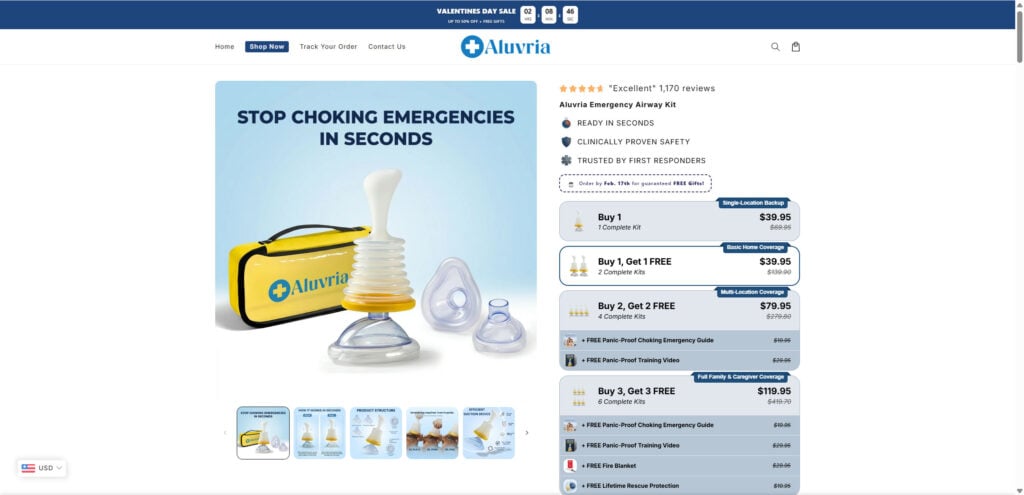
The Aluvria Emergency Airway Kit is marketed as a fast-acting airway clearing device, often shown as a manual suction-style tool with different mask attachments, plus a small carry case. The sales message typically hits these points:
- “Stops choking emergencies in seconds”
- “Ready in seconds”
- “Clinically proven safety”
- “Trusted by first responders”
- Positioned as something to keep in the kitchen, car, diaper bag, and travel kit
- Promoted as a solution when traditional methods “fail,” sometimes even hinting it helps when CPR fails
From a consumer-protection perspective, the marketing approach matters as much as the product itself. Your screenshots show classic direct-response selling patterns:
1) Aggressive discounting and bundle pressure
The offer is framed with deep discounts like 50% off, plus multiple “Buy 1, Get 1 Free” and larger bundle tiers. This is designed to move you from one device to multiple devices quickly, usually by implying you need one in every room and vehicle.
2) Urgency mechanics
A visible countdown timer and limited-time sale language pushes people to purchase before they can research the product, compare alternatives, or verify claims.
3) Medical-style claims without clear proof shown on-page
When a site says “clinically proven” or “trusted by first responders,” you should expect specifics you can verify, such as:
- the clinical study name or link
- sample size and outcomes
- who conducted it
- where it was published
- what exact model was tested
If the page uses the language but does not provide the evidence, that is not “proof.” It’s persuasion.
4) Signs of reused or copied images
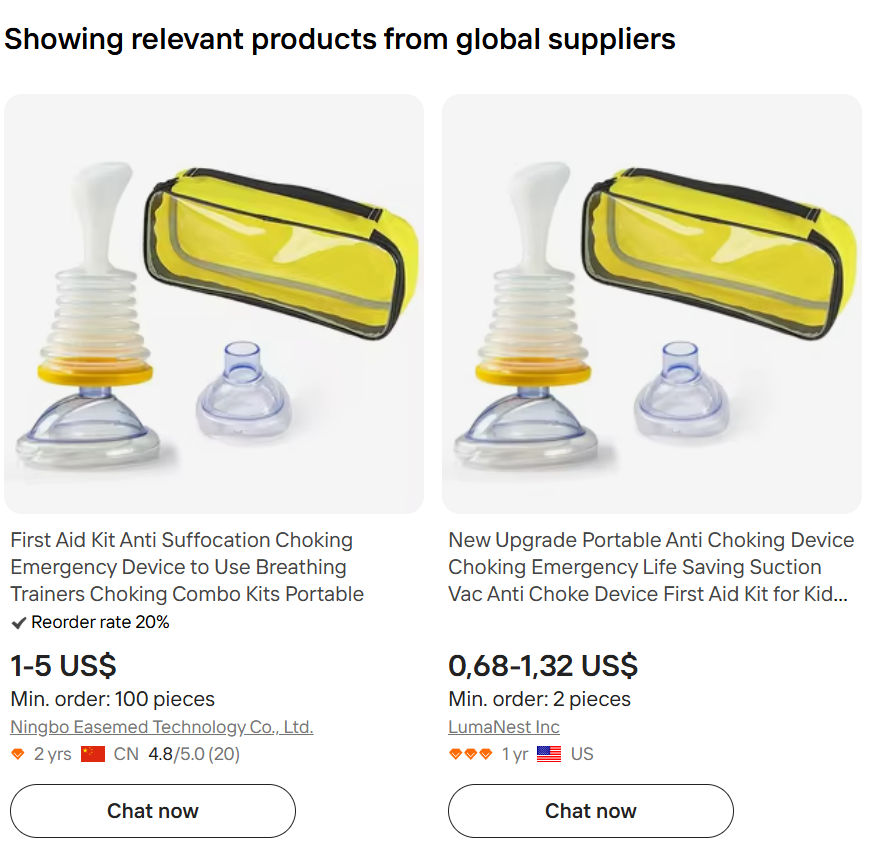
When product images appear copied from other listings or other brands, it raises a practical concern: are you buying a specific tested device from a traceable manufacturer, or a generic look-alike product sold through a storefront brand?
In safety devices, that distinction matters. A generic copy may look identical in photos but differ in seal quality, valve behavior, material, and reliability.
Why “anti-choking devices” sell so well
This category is uniquely vulnerable to hype because the fear is real.
Most people have had a choking scare or know someone who has. Parents especially get targeted because the messaging hits an emotional nerve: “You can’t afford to be unprepared.”
That emotional leverage can be used responsibly, or it can be used to push a questionable product.
A trustworthy medical or safety product seller usually does not need:
- dramatic timers
- “viral” style landing pages
- repeated bundle pressure
- sweeping claims about CPR failure
They rely on product documentation, training, and credibility.
How the operation works
This section is not about conspiracy. It’s about how these offers are commonly built online, and why the buying experience can diverge from the promise.
Step 1: A generic product format is sourced
Suction-style airway clearing devices are widely manufactured and sold by multiple suppliers. Many storefront brands do not design or manufacture the device. They source it, label it, and build a sales page.
When you see signs like reused images and “global supplier” style product photos, it suggests the product may not be unique to the brand.
Step 2: The device is positioned as “medical-grade”
Landing pages often borrow credibility language:
- “clinically proven”
- “first responder trusted”
- “tested and approved”
This language creates a medical halo effect even if the product is not supported by clear, public clinical evidence.
Step 3: The page is optimized for emotional conversion
The structure typically includes:
- a fear-based headline (“Stop choking emergencies in seconds”)
- urgency (timer)
- discounts and bundles
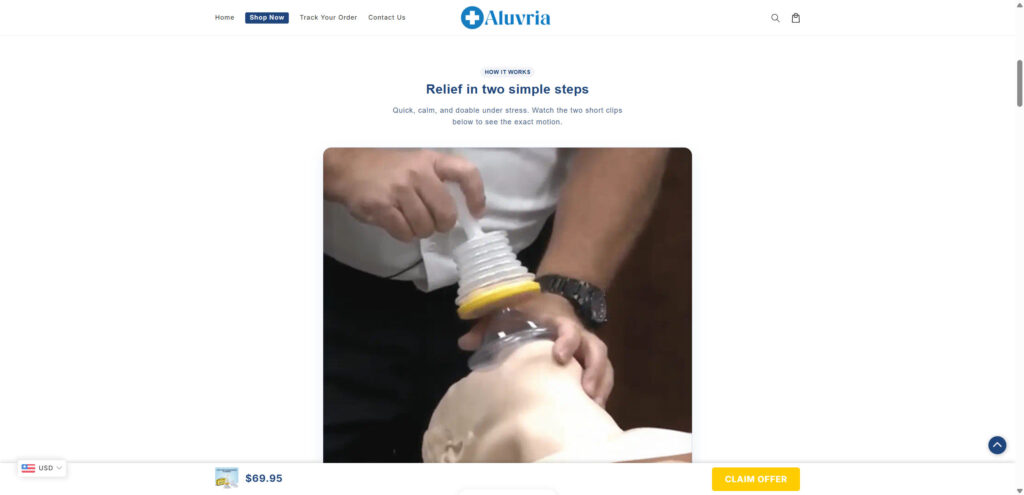
- simplified “2-step” usage framing
- social proof (star ratings, review counts)
- claims that imply superiority over standard protocols
This matters because in a true emergency, clarity and accuracy are everything. Marketing that implies “this works when CPR fails” should be treated as a high-risk claim unless rigorously supported.
Step 4: Checkout increases order size
Bundles like:
- Buy 1 for $39.95
- Buy 1, Get 1 Free
- Buy 2, Get 2 Free
- Buy 3, Get 3 Free
are designed to multiply revenue per customer. Many people end up spending $79.95 or $119.95 because they feel guilty buying “only one” safety device.
Step 5: The support and return layer may be weaker than the sales layer
This is where many direct-response storefronts fall apart. The front end looks polished, but when you need:
- a cancellation
- a refund
- a replacement
- documentation
the process becomes slow, vague, or frustrating.
That’s not guaranteed, but it’s common enough that you should evaluate the seller’s return policy and support channels before buying.
The red flags in Aluvria’s pitch
Let’s translate the red flags you listed into what they mean for a buyer.
Product images appear copied from the internet
Why it matters:
- You may not be seeing the exact item you will receive.
- The seller may not control manufacturing.
- Quality control and consistency can vary.
What to look for:
- real photos of the product in packaging
- a consistent brand model name and manufacturer identity
- documentation unique to that specific device
Heavy discounts and stacked BOGO offers
Why it matters:
- Extreme discounting is common in dropship funnels because the margin supports it.
- It also pressures you to buy multiples quickly.
What to look for:
- stable pricing across time
- distribution through reputable retailers
- fewer “today only” gimmicks
Countdown timer urgency
Why it matters:
- This reduces research and increases impulse buys.
- In safety products, rushed buying is risky.
A legitimate safety product can run promotions, but it usually does not need a ticking clock to sell.
Bold medical claims without clear clinical proof
Why it matters:
- “Clinically proven” is meaningless unless the clinical data is available, specific, and verifiable.
- Claims like “works when CPR fails” can create dangerous misunderstandings.
A device should never be marketed in a way that encourages people to delay calling emergency services or skip standard protocols.
Suggests effectiveness when CPR fails
Why it matters:
- CPR is not a “choking removal” technique in the way the public thinks about it. CPR is for cardiac arrest and unresponsive emergencies.
- Messaging that implies “this is the answer when CPR fails” is a marketing hook, not a responsible medical statement, unless backed by strong evidence and careful wording.
At minimum, that claim should trigger skepticism.
So, should you buy the Aluvria Emergency Airway Kit?
If your decision is purely about having an airway device in the home, there are two separate questions:
1) Could a suction-style airway clearing device be useful in some scenarios?
Possibly, depending on the situation, the user, the device design, and training. But evaluating that properly requires evidence, product documentation, and ideally guidance from reputable medical or first-aid organizations.
2) Is Aluvria, as presented on this site, a trustworthy purchase?
Based on the marketing signals you provided, the safer conclusion is:
Proceed with caution, and do not buy impulsively.
If you still want a device in this category, the better approach is to choose one that has:
- transparent manufacturer identity
- clearly accessible testing and documentation
- stable customer support and returns
- consistent distribution channels
- verifiable reviews outside the seller’s site
A choking emergency is not the moment you want to wonder whether the device is a generic copy, whether the seal will hold, or whether the valve will work as expected.
What to do before buying any “anti-choking” device
Use this checklist before spending money.
Verify the company
- Is there a real business address and company registration?
- Do they have a support phone number, or only a form?
- Is the return policy clear about time limits, conditions, and return shipping?
Verify the product identity
- Is there a model name you can search outside their site?
- Is the manufacturer named?
- Are there instructions and warnings that look like real safety documentation, not marketing copy?
Verify the evidence
If they claim “clinically proven,” look for:
- a study you can find independently
- outcomes and limitations
- the exact device tested
If the evidence cannot be checked, treat the claim as unproven.
Verify independent reviews
Look beyond the site’s “1,170 reviews” style widget.
- Search the product name plus “complaint,” “refund,” “returns”
- Search the company name plus “charge,” “billing,” “subscription”
- Look for third-party retail reviews, not just testimonials
Avoid buying under pressure
If the timer forces you to decide now, that’s the point. Step away anyway.
What to do if you already bought it
If you already ordered the Aluvria Emergency Airway Kit, focus on control and documentation.
1) Screenshot everything
Save:
- product page claims
- price and bundle selected
- return policy
- shipping policy
- order confirmation
- email receipts
2) Check your statement for billing descriptors
Make sure the charge matches what you expected. If you see extra charges, flag them immediately.
3) If it hasn’t shipped and you want to cancel, act fast
Email support with:
- order number
- a clear cancellation request
- request written confirmation
Keep it short and specific.
4) If the return policy is difficult, escalate through your payment method if needed
If you cannot get a reasonable resolution and you believe the product was misrepresented, consider:
- a credit card dispute
- a PayPal dispute if PayPal was used
Your screenshots and saved policy pages help here.
5) Do not treat it as a replacement for first-aid training
Regardless of what you bought, the most important “tool” in a choking emergency is knowing what to do and calling emergency services immediately.
If you have kids or elderly family members, a certified first-aid course is often a better investment than a device bought under a timer.
Practical alternatives that are actually worth considering
If your goal is real preparedness, these typically provide more value per dollar:
- A reputable, in-person first-aid and CPR course
- A clearly labeled first-aid kit (not just a gadget)
- A plan for emergencies (who calls, who assists, where key items are kept)
- For families, having emergency numbers and address details posted clearly
A device can be an additional layer, but it should never be the primary plan.
The Bottom Line
The Aluvria Emergency Airway Kit is marketed with high-pressure tactics and strong medical-sounding claims that are not clearly supported on the sales page. The signs you highlighted, reused images, heavy discounting, countdown urgency, and “works when CPR fails” style messaging, are all major credibility problems for a product meant to be used in a life-threatening moment.
If you want an airway-clearing device, do not buy under pressure. Verify the manufacturer, verify evidence, and verify support and returns. If you cannot independently confirm what you’re buying and what backs the claims, the safest choice is to skip it and invest in proven preparedness instead.

Join the discussion
0 commentsShare your experience or ask a question about this article.
Community experiences
Did this happen to you?
Your experience could help someone recognize the same scam. Submit a private report for our team to review.
I experienced this tooReports are reviewed before publication. Sharing publicly is always your choice.
Discussion
Start the conversation
Have a question or something useful to share? Add the first comment.