


The watch looks right, the dealer’s name sounds familiar, and the price is tempting. Then the conversation moves to Telegram before you’ve settled who you’re paying.
If you’re checking Andiotwatches.net before ordering, or waiting for a watch that hasn’t arrived, a few details deserve a closer look.
Overview
A familiar dealer name sits over a convincing catalog
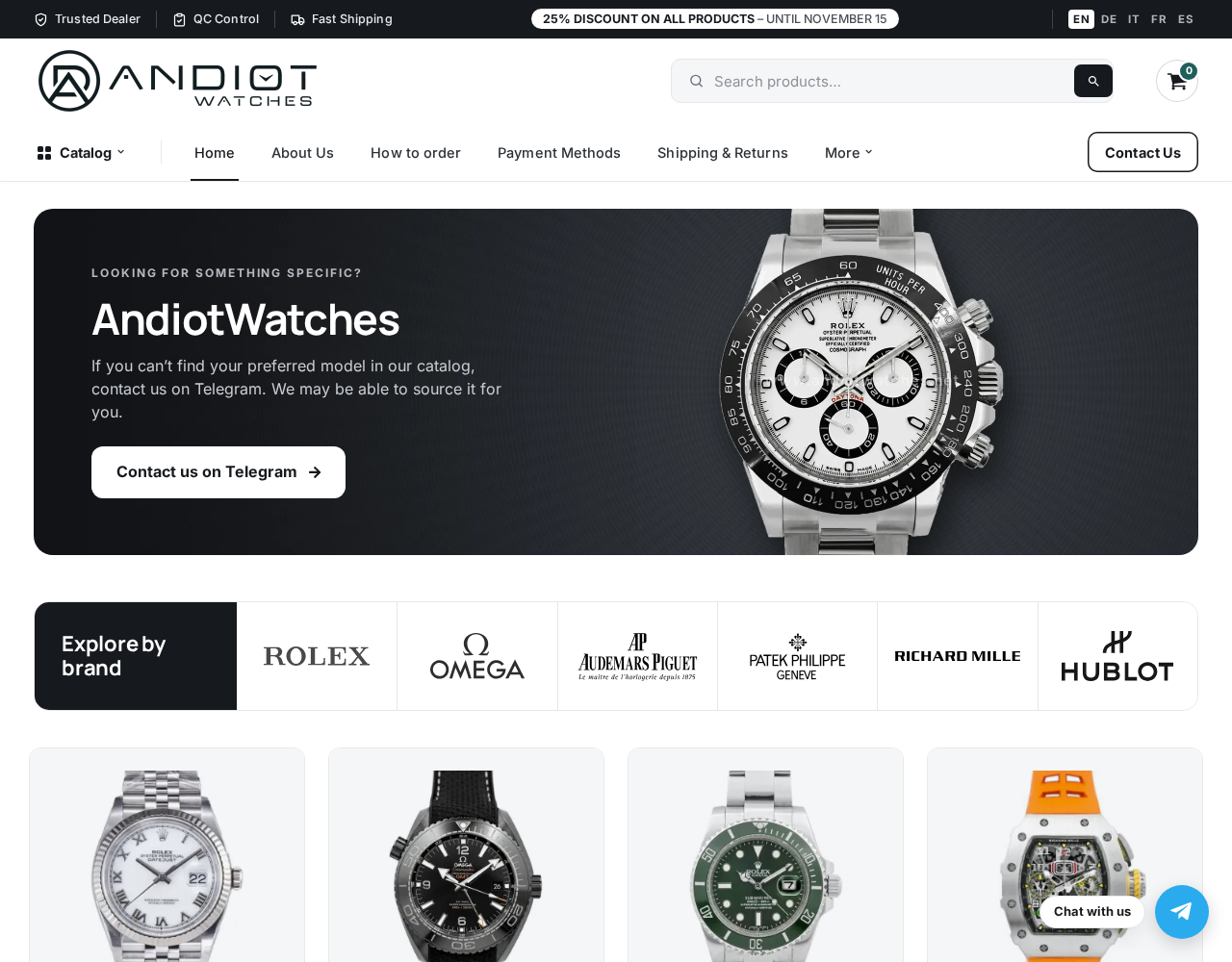
Andiotwatches.net presents itself as an established watch dealer. Its storefront combines recognizable watch designs, customer ratings, quality-control promises, and a prominent Telegram contact button.
The catalog uses replica-watch terminology, including factory and model references. That context matters: this is not an authorized luxury-watch retailer verification or an authentication of any listed watch.
The offer includes several layers of reassurance:
- A banner advertising 25% off all products.
- Claims of dealer trust, inspection, and fast shipping.
- A separate 12% discount for cryptocurrency payments.
- Promises of inspection photographs before dispatch and a 14-day return period.
Those details explain why someone might stay on the page. None answers the more important question: is this the dealer whose reputation the buyer recognizes?
The Andiot operator explicitly identifies the .net domain as fake
The strongest finding is an exact-domain warning, not a low trust score or an assumption based on cheap prices.
The Andiot operator’s website verifier lists andiotwatches.net among fake or impersonator sites. Its current listed official website is andiotwatches.vip.
The older andiotwatches.com address currently redirects to that .vip site. The verifier also distinguishes the operator’s own Telegram contacts from impersonators.
Meanwhile, the .net homepage’s Telegram button points to @Li_contact, not either of the two Telegram usernames listed by the .vip operator.
The risk follows the payment, not just the website
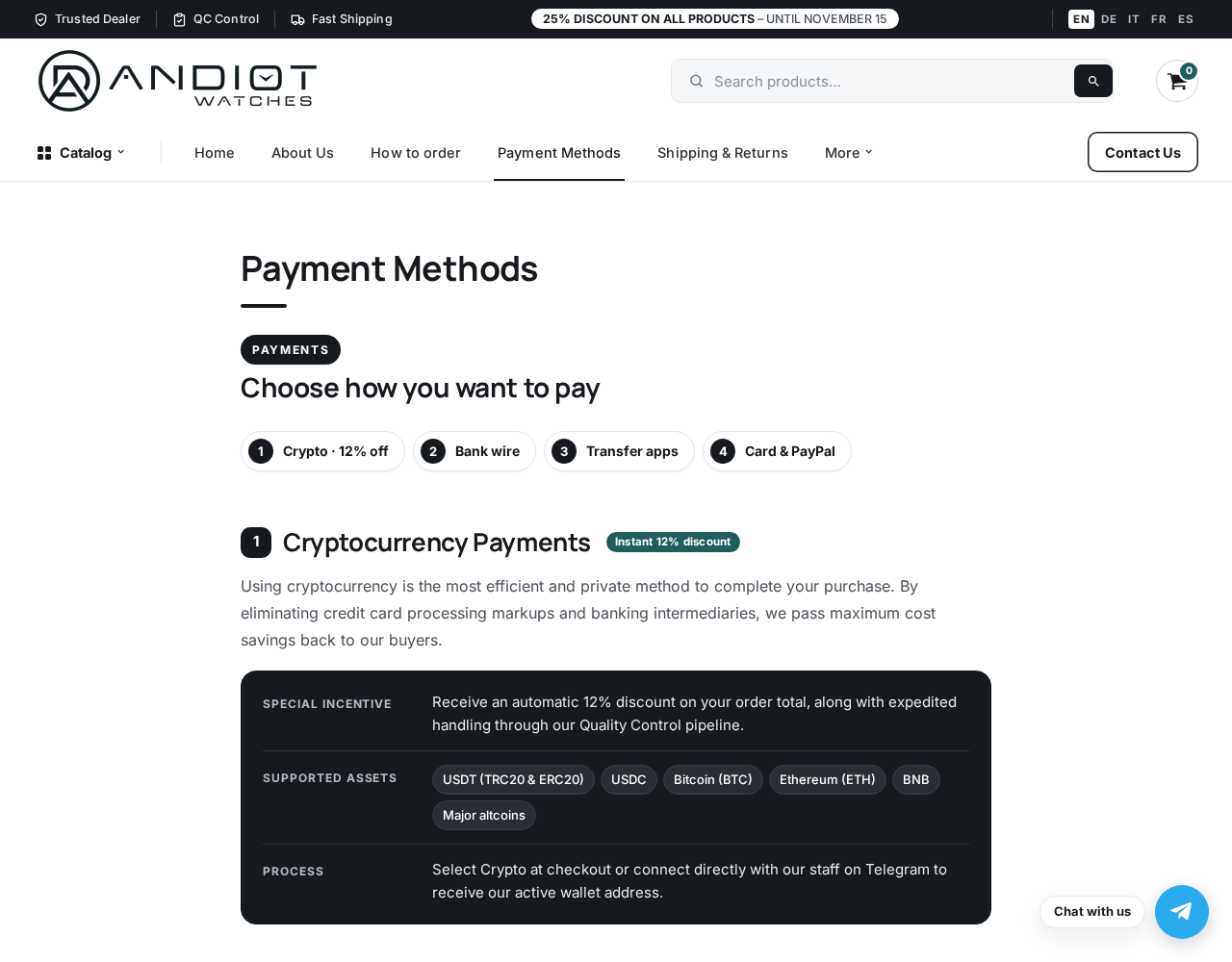
The .net payment page encourages cryptocurrency and directs buyers toward Telegram for payment details. Other payment methods are listed, but card and PayPal availability require contacting staff.
A public buyer report describes an undelivered order and payment confirmation through Telegram. That report is an allegation, not an independently verified transaction history.
The operator’s explicit impersonation warning provides the firmer reason to avoid this domain. A polished catalog cannot resolve that conflict.
Why This Isn’t Just a Question About Replica Watch Quality
Two separate questions can get tangled together here: whether a watch matches its description, and whether the seller is who it claims to be.
A buyer might spend hours comparing dial details, movements, factory names, and inspection photographs while giving the website address only a quick glance.
That leaves an opening for impersonation. Knowledge of watch terminology can make a stranger sound like a specialist without connecting them to an established business.
The same applies to forum logos and familiar dealer branding. A picture of a community’s name is not a current endorsement from that community.
Nor does a copied or convincing photograph prove the seller owns the pictured stock. It shows what the page wants you to expect.
This investigation concerns the .net site’s use of the Andiot identity and its payment route. It does not recommend replica goods or authenticate another seller’s merchandise.
How the Andiotwatches.net Scam Works
Step 1: The storefront makes the dealer feel familiar
The page opens with the Andiot name, a watch-focused catalog, and navigation for ordering, payment, shipping, and returns.
A shopper looking for a known dealer can mistake that familiarity for continuity. The logo seems recognizable, so the rest of the transaction begins to feel routine.
There is an important difference between recognizing a name and confirming who controls the site. The ending after the name, including .net versus .vip, still matters.
A browser padlock doesn’t solve that problem. Encryption protects the connection to the address you opened; it doesn’t authenticate the business story told on that page.
Step 2: Discounts and service promises reduce hesitation
The storefront advertises a sitewide 25% discount with a deadline. Its payment page separately promotes a 12% cryptocurrency discount and expedited quality-control handling.
These are separate advertised incentives. Buyers shouldn’t assume the discounts combine, or calculate a final payable amount without an actual order summary.
The more consequential point is what the saving asks you to overlook. A lower price cannot compensate for paying a party the named dealer disowns.
Promises about inspection, replacements, and delivery can make the remaining uncertainty feel manageable. But a promise is useful only when the party making it is accountable.
Step 3: Telegram becomes the bridge to payment
The homepage invites visitors to ask about models through Telegram. The payment instructions also use that channel for wallet addresses, bank details, and transfer confirmation.
Telegram itself is not proof of fraud. Here, the problem is the mismatch between the .net contact and the contacts named by the operator it imitates.
A conversation can strengthen the illusion of dealing with a specialist. Quick answers, model references, and an order number still don’t establish affiliation.
Keep the distinction clear: the website supplies a contact, and that contact supplies a payment destination. Both come from the same disputed source.
Asking that person whether they are genuine is not an independent check. Their reassurance cannot overrule the named operator’s warning about the exact domain.
Step 4: Payment moves toward a harder-to-recover route
The .net page lists crypto, bank transfers, and transfer apps. It says card and PayPal processing may depend on availability and asks buyers to request access.
That is not the same as offering a normal, immediately available card checkout. A familiar payment logo should not be mistaken for confirmed protection.
Before any transfer, the recipient matters as much as the amount. A bank account name or wallet address is not authenticated by a branded Telegram profile.
Cryptocurrency adds another problem. An ordinary confirmed blockchain transfer cannot simply be canceled like an unpaid shopping cart.
Do not make a small test payment to settle the identity question. It would show only that the recipient can receive money, not that a watch will follow.
Step 5: Inspection and tracking promises create a waiting period
The payment page describes inspection media within five business days, a 24-hour review window, and dispatch after approval. It allows time for tracking updates afterward.
Those advertised stages can keep a buyer waiting for the next milestone. A promised inspection photograph feels like progress even before a shipment exists.
If photographs arrive, examine what they actually establish. They may show a watch, but they do not by themselves prove ownership, shipment, or the identity of the payee.
The same applies to tracking. An order number is created by a store; a carrier record should independently connect the shipment to your destination.
Don’t let a sequence of promised updates stop you from asking your payment provider about its reporting deadline. A seller’s timetable doesn’t control that deadline.
Step 6: A problem sends the buyer back to the same contact
The .net return instructions require prior contact before sending anything back. They place return postage on the customer and make reimbursement dependent on inspection.
That leaves the buyer relying again on the contact whose affiliation was never established. Written return promises don’t give the unrelated Andiot operator responsibility for this transaction.
Keep the identity warning with any refund request. It explains why you’re questioning the transaction without claiming that every late shipment, by itself, proves fraud.
You don’t need a proven loss on your own account to avoid the domain. The exact impersonation warning is already a sufficient reason not to order there.
Seller Identity, Support, and Return Promises
The branding does not identify the party receiving your money
“AndiotWatches” across a header is a brand claim. It isn’t a legal identity, a payment receipt, or proof that the established dealer controls the transaction.
For an existing order, compare the domain, Telegram username, receipt, and actual payment recipient. Keep differences visible rather than merging everything under the familiar trading name.
An unrelated recipient isn’t automatically a criminal finding. It is a detail your bank or investigator needs when assessing an impersonation complaint.
The long trading history is a claim, not transferable reputation
The .net About page describes a business founded in 2011 and a reputation built in collector communities.
An impersonator can borrow a history as easily as a logo. The useful check is whether that established business recognizes this exact address and contact.
Here, the operator’s verifier does the opposite: it identifies the .net address as fake. An old-looking copyright line does not undo that denial.
A responsive chat is not an identity check
The .net contact page calls Telegram its fastest support channel. An advertised response time doesn’t tell you whether the person replying belongs to the business.
The visible usernames already tell a different story: the .net button and the established operator’s contact list do not match.
If you’ve already paid, preserve the actual profile link. A display name and profile picture are easier to confuse than the username attached to the conversation.
The 14-day return promise has practical conditions
The current .net policy starts its return window on arrival and excludes watches that have been worn, fitted, or resized. It requires intact protective materials.
It also requires instructions before a return, customer-paid registered postage, and inspection before reimbursement. Its shipping assurances remain seller promises, not independently demonstrated performance.
These conditions matter if an item arrives, but they don’t cure the identity problem. A favorable-looking return policy is not a reason to pay an impersonator.
If You Already Ordered, Separate Delivery Evidence From Reassurance
Start with what can be checked outside the seller’s conversation: a payment record, the carrier’s own tracking system, and the exact identity warning.
A message saying “payment received” confirms only what the sender claims. Your bank, payment app, or exchange has the record of where the funds actually went.
If you receive a tracking link, reach the carrier independently. Don’t enter a card number into a seller-supplied page to pay a surprise redelivery or release charge.
Describe your situation accurately when seeking help. If you authorized a transfer after being misled, say that; don’t describe it as a transaction you never made.
If merchandise arrives but differs from the order, document that separately. Photograph the packaging, label, item, and distinguishing features without modifying or discarding them.
Different problems may require different remedies. Your payment provider needs to know whether the concern is impersonation, non-delivery, a disputed description, or an additional unauthorized charge.
What to Do If You Responded or Paid
-
Stop further transfers. Don’t send another deposit, verification payment, replacement fee, or supposed release charge to resolve the first transaction.
-
Save a compact evidence file. Include the order, exact .net URL, Telegram profile link, messages, promised delivery dates, and the operator’s domain warning.
-
Contact your payment provider immediately. Explain the impersonation concern and ask which recall, dispute, or fraud-reporting process applies to your payment method.
-
For cryptocurrency, preserve the transaction details. Give your exchange the network, asset, amount, destination address, transaction hash, and time. Ask about available fraud-reporting assistance.
-
Request cancellation in writing if appropriate. Keep the message and response, but don’t wait indefinitely for the seller before notifying your bank.
-
Secure reused credentials. If you created an account using a password from another service, replace that reused password and enable additional account protection.
-
Report the impersonation. Report the relevant Telegram account and provide the domain and payment details to the appropriate fraud authority in your country.
-
Reject paid recovery approaches. A stranger promising guaranteed recovery after an upfront fee creates another risk, not a reliable route to your refund.
The FTC’s payment-recovery guidance explains where to start for different payment methods. Ask promptly; a refund is not guaranteed.
For a U.S. cryptocurrency report, the FBI’s IC3 guidance identifies useful transaction evidence and warns about fee-charging recovery services.
A malware scan cannot reverse a payment. Merely viewing this storefront does not establish an infection, so don’t treat a security product as the solution to a merchant dispute.
Frequently Asked Questions
Is Andiotwatches.net the official Andiot website?
The Andiot operator’s verifier explicitly lists the .net domain as fake. Its listed website is .vip, and the older .com address currently redirects there.
Does this mean every business using the Andiot name is a scam?
No. The warning concerns this exact domain and its claimed affiliation. Don’t transfer allegations about an impersonator to the business whose identity it is using.
Does the 12% crypto discount make payment safer?
No. A discount does not verify the recipient or create refund protection. Crypto transfers can be difficult to recover even when the transaction remains publicly traceable.
Can I rely on the site’s inspection photos or ratings?
Not to establish who controls the store. Product pictures, ratings, and promised inspection media cannot override an explicit warning about the domain’s affiliation.
What if I paid through a card or PayPal link?
Check the transaction directly in that provider’s official app or website. Report the facts and ask about the applicable dispute process, deadlines, and protection limits.
Should I return a delivered watch straight away?
Document the item first and ask your payment provider what evidence it needs. Don’t send it to an unverified address or assume the unrelated operator handles returns.
The Bottom Line
Do not order through Andiotwatches.net. The named operator explicitly identifies the domain as an impersonator, and the store directs buyers toward a different Telegram contact.
If you’ve already paid, preserve the transaction and conversation now, then contact your payment provider. Don’t send more money while waiting for the promised watch.

Reviews & discussion
0 commentsShare a firsthand experience, or ask a question.
Community reviews
andiotwatches.net
Moderated reader experiences, not an editorial verdict.
Start the conversation
Have a question or something useful to share? Add the first comment.