


An email says almost $1 million has been approved in your name. Before replying, check who supposedly authorized that payment.
The Financial Compensation Commission notice uses an official-sounding decision and a choice of delivery methods to make an unsolicited award feel settled.
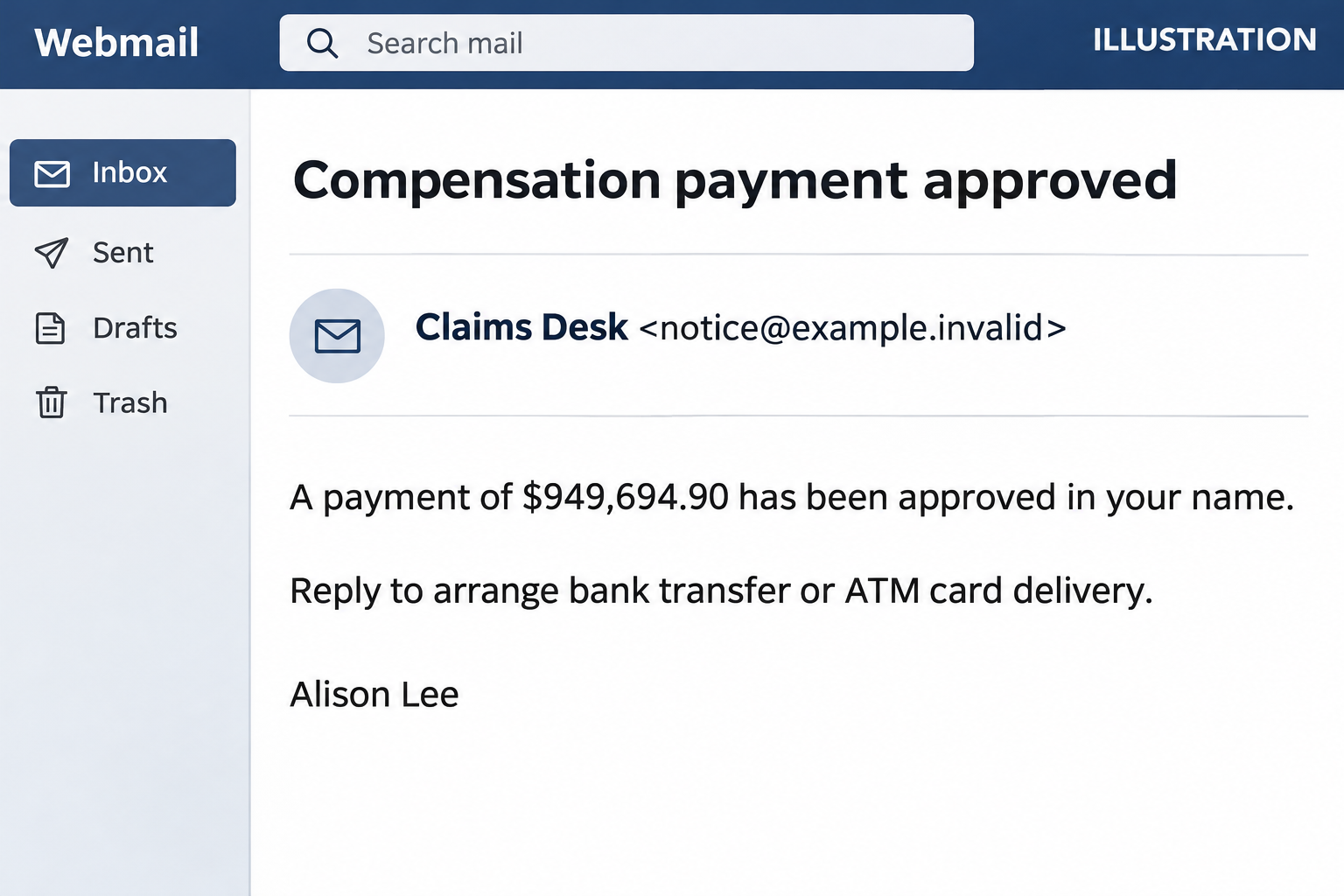
Overview
The $949,694.90 award is the bait
- Claimed authority: Financial Compensation Commission.
- Proposed payment: $949,694.90 by bank transfer or ATM card.
- Immediate request: reply to arrange the supposed claim.
The reported message claims a fraud-case review has produced compensation. It offers bank transfer or an ATM card and asks the recipient to reply.
This is a recovery-scam approach, not evidence that a real compensation fund has approved money for you. Do not enter its claims process.
A reply starts the conversation
The initial notice does not include a payment demand. Its immediate purpose is to get you talking to whoever controls the sender’s account.
That distinction matters: an opening message can be fraudulent before it asks for a processing fee, identity document, or banking information.
The right response depends on what you shared
If you only received the email, report it as phishing and delete it. If you sent money or sensitive information, take the matching recovery steps below.
Receiving this message does not establish that your device is infected. A compulsory antivirus purchase would not resolve the payment deception.
What the Financial Compensation Commission Email Actually Says
The reported example has the subject “IMPORTANT NOTICE!” and names a supposed Financial Compensation Commission. It ends with the name Alison Lee.
It claims a review of an earlier scam case led to a $949,694.90 payment. The proposed delivery options are a bank payment or an ATM card.
Instead of identifying a verifiable case administrator and explaining an existing claim, the sender asks for a reply to discuss documentation and delivery arrangements.
The amount creates the attraction. The supposed review supplies a reason you might deserve it. The delivery choice moves attention toward collecting rather than verifying.
None of those details establishes an entitlement. A precise payment figure is still only a number typed into an email.
The signatory is part of the message, not an independently verified official identity. Do not pursue a person with that name or assume unrelated people are involved.
Why This Is a Scam, Not a Compensation Approval
The notice gives you a conclusion without a verifiable process
A real payout should connect to an identifiable proceeding or scheme. You need an independently verifiable administrator, relevant eligibility rules, and a way to confirm your claim.
This message substitutes an official-sounding commission and an unexplained review for that evidence. The sender’s willingness to discuss arrangements does not fill the gap.
Ask what you could verify without contacting the sender. If the answer is only the email’s own assurances, you do not have proof of an award.
It steers you toward the sender instead of an independent check
Replying lets the same person who announced the money explain why you qualify, what you must provide, and where any requested payment must go.
That is a closed loop. A reassuring follow-up remains unverified when it comes from the account responsible for the original approach.
A letterhead, case number, or identity document sent later would need its own independent verification. Criminals can attach documents as easily as they send promises.
Similar names do not transfer legitimacy
The name used here should not be confused with a real compensation scheme, financial regulator, or dispute-resolution organization with similar words in its title.
For example, the UK’s Financial Services Compensation Scheme has its own official domain and eligibility process. Its existence does not validate this email.
Do not ask the suspicious sender to prove its legitimacy by sending another link. Locate the relevant institution through a source you already trust.
How the Compensation Scam Works
Step 1: Present an unexpected award as already approved
The opening assumes the important decision has been made. You are invited to arrange collection, not assess whether a legitimate claim exists.
This framing can be especially persuasive after a previous loss. It offers a way out without asking the recipient to revisit the underlying fraud.
Step 2: Borrow authority from an invented case review
The supposed commission and review make the offer sound administrative. They imply someone has already checked the facts and calculated the amount.
But an administrative tone is not an official record. The notice supplies no independently established connection between the recipient and a genuine award.
Step 3: Offer a choice that keeps you inside the story
Bank transfer versus ATM card sounds like a practical decision. Both choices assume that the promised money exists and the sender controls access to it.
You do not need to select the safer delivery option. You need to reject the unverified payment premise before giving the sender more information.
Step 4: Move the exchange into personal correspondence
A reply confirms that someone reads the mailbox and is considering the claim. It also gives the sender an opportunity to adapt the pitch.
A recipient might disclose a previous loss, country, bank, or financial pressure while trying to explain their situation. Those details can make subsequent approaches more convincing.
Step 5: Watch for the fee or information request
Recovery scammers commonly demand payment or sensitive information before releasing supposed funds. The FTC describes that pattern in its refund and recovery scam guidance.
For this notice, the first message documents the reply request, not an observed fee. Any later demand must be assessed from the actual follow-up.
Do not pay to unlock the award, purchase an activation card, or send documents to keep the process moving. Stop the conversation instead.
How to Check a Genuine Compensation Claim Safely
Start outside the email
If you have an existing claim, return to the administrator’s website or contact details you previously verified. Do not use a replacement supplied in this notice.
If you never filed a claim, that does not make every unexpected refund impossible. It does make independent confirmation essential before acting.
Find the relevant court, regulator, settlement administrator, or financial institution through its established public channel. Check the exact program rather than a similarly named organization.
Match the proceeding, not just the logo
Compare the affected business, eligible customers, relevant dates, claim reference, and administrator. An attractive payment amount is not one of those verification points.
Look for instructions published by the authority responsible for that specific scheme. A genuine administrator should be identifiable without accepting the sender’s explanation.
Do not publish personal claim references in public comments. Verification should not expose documents that another impersonator could reuse.
Distinguish a representative’s service from an award-release fee
A separately chosen professional representative may charge for legitimate work. That is different from an unsolicited correspondent demanding money to release a supposed government payment.
The FSCS explains that direct claims are free, while a claims-management representative may charge. Check the real scheme’s rules.
Do not let a scammer use the existence of legitimate professional fees to justify an unexplained transfer to a stranger.
What to Do if You Received or Replied to This Email
You received it but did not respond
- Do not reply to decline, test the sender, or ask whether the offer is genuine.
- Use your email service’s phishing or junk-reporting option.
- Delete the message after reporting it. Keep a private copy first if you need to document an existing loss or complaint.
You do not need to reset every password because the email reached your inbox. Delivery alone does not demonstrate account access.
If you want to warn someone, describe the scam without forwarding active links or exposing your own address and message headers publicly.
You replied without sending sensitive information
End the correspondence. Keep the exchange privately if you may need to report it, and block further messages from that account.
A reply by itself does not give the sender access to your bank or device. It can, however, bring more personalized attempts.
Be wary of another person who suddenly offers to investigate the commission or recover money for a fee. Switching names does not make the approach independent.
You sent an identity document or banking information
List exactly what you supplied. A name and email address, a passport scan, a bank account number, and an online-banking password require different responses.
Tell the relevant bank or document issuer what was exposed. Ask which safeguards fit that exposure rather than closing every account without advice.
If you see signs of identity misuse, follow an official recovery plan through IdentityTheft.gov in the United States or your country’s equivalent.
If you disclosed a password, change it through the real service from a trusted device. Replace it anywhere else you reused the same password.
What to Do if You Already Sent Money
Contact the payment provider immediately
Use the number in your banking app, on your card, or on the provider’s established website. Do not call a number supplied by the supposed commission.
Describe the transaction accurately: you were persuaded to send money by a false compensation claim. Do not describe an authorized transfer as an unauthorized card purchase.
Ask whether the provider can stop, recall, investigate, or dispute the payment. Availability depends on the payment method and circumstances; recovery is not guaranteed.
Keep the records that connect the approach to the payment
Save the original email, follow-up messages, payment receipt, destination account or wallet, and the date you contacted the provider. Keep originals as well as screenshots.
Do not edit the original evidence to make it look more convincing. If you share a public warning, make a separate redacted copy.
Give investigators the amount you actually paid, not the fictitious $949,694.90 award. The distinction helps separate real loss from the bait.
Do not send a second payment to rescue the first
A new demand for tax, insurance, compliance clearance, or reimbursement is not evidence that the original payment is close to being released.
Likewise, a stranger claiming to be a hacker, investigator, or recovery agent should not receive your wallet phrase, account password, or another deposit.
Report the approach through ReportFraud.ftc.gov in the United States, or the appropriate consumer-protection or police channel where you live.
Why the Follow-Up Can Sound More Convincing
Once you describe your situation, the sender can repeat your details back. That familiarity may look like a case file when it actually came from your reply.
Keep a simple timeline of what the sender knew before you answered and what you revealed afterward. It helps expose this circular claim to authority.
A more polished message is not a reason to reopen the discussion. Judge any new contact by an independently verified identity and process.
Someone helping you genuinely should be comfortable with you contacting the relevant institution yourself. Pressure to keep the exchange secret is a reason to disengage.
Use a second person to check the payment story
If you are unsure, ask someone you trust to review the notice before you take another action. Give them the facts, not the sender’s deadline.
Ask them to identify the real administrator independently. A useful check ends with a verified institution, not another discussion with the email account.
If you are helping a relative, focus on stopping the next transfer. Criticism can make it harder for them to tell you about later demands.
Write down one clear rule together: no additional payment or document goes to this correspondent. Contact the actual bank or authority separately.
Separate reporting from claiming the promised award
A fraud report records what happened. It is not an application to receive the amount printed in the scam email, and a report number does not guarantee repayment.
Keep those processes separate when someone calls back. Confirm who is contacting you through the institution’s published number before discussing private financial details.
Never let a caller use your own report as proof that their payment-release instructions are official. Knowing about a complaint is not authority to collect a fee.
Frequently Asked Questions
Is the Financial Compensation Commission email legitimate?
No. The reported notice uses an unsupported commission claim to announce an unsolicited award and solicit a reply. Do not treat it as approval of compensation.
Does the $949,694.90 amount mean my earlier report was successful?
No. A specific amount does not connect the message to a genuine claim. Check an existing case through the administrator’s independently verified channel.
Is Alison Lee a verified compensation official?
The name appears as the signatory, but the message does not establish an official identity. Do not assume an unrelated person sharing that name is responsible.
What if the first email does not ask for a fee?
The opening asks for contact. You should not wait for a payment demand before rejecting it. Later fees are a known recovery-scam risk, not documented initial wording.
Should I choose an ATM card instead of a bank transfer?
No. Neither option verifies the money or the sender. Do not provide a delivery address, pay activation charges, or choose a method for collecting an invented award.
Do I need to scan my computer after reading the notice?
Not because of the message alone. If you also ran an unexpected file or granted remote access, handle that separate exposure with appropriate technical help.
The Bottom Line
Do not reply to the Financial Compensation Commission email or send money to collect its supposed award. The payment claim is the lure, not verified compensation.
If you already engaged, stop the exchange and protect what you actually exposed. Contact the payment provider promptly for real losses and keep your records.
For an existing compensation claim, return to the independently verified administrator. A new correspondent promising an easier route to the money is not a shortcut.

Join the discussion
0 commentsShare your experience or ask a question about this article.
Discussion
Start the conversation
Have a question or something useful to share? Add the first comment.