

Apple Security Alert scam texts are designed to look like urgent fraud notifications. They claim your Apple ID was used for a recent purchase, warn of suspicious sign-ins or Apple Pay activity, and push you to call a “support” number immediately.
If you call, you reach a fake tech support center. The scammer will try to scare you into giving remote access to your device, sharing account or banking details, or paying with gift cards.
Treat these messages as smishing. Do not call the number in the text.
Scam Overview
This is a classic smishing setup.
“Smishing” is phishing by SMS text message. The FBI defines smishing as a phishing variation that happens through text messages, and the same playbook applies here: impersonate a trusted brand, create urgency, and push the victim into an action that benefits the scammer.
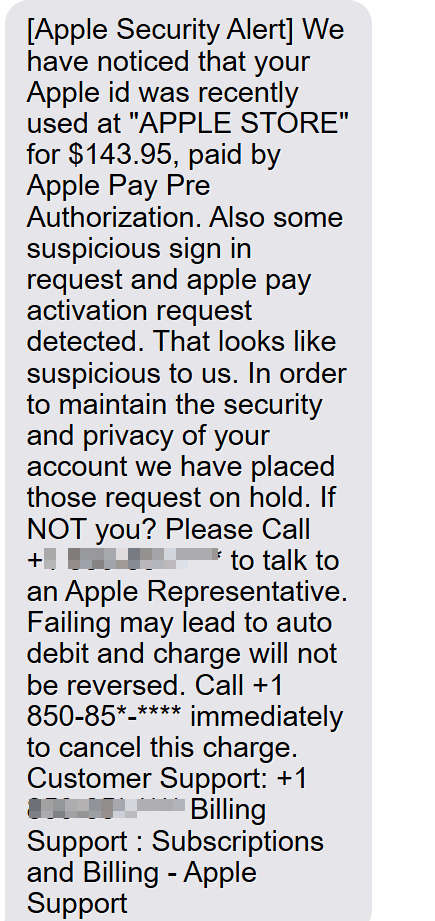
The Apple Security Alert scam message pretends to be an “Apple Security Alert” and uses a very specific charge amount of $143.95.
That number is not random.
Scammers use exact-looking amounts because vague messages feel fake. A number like $143.95 makes the alert feel like a real transaction record. It pushes your brain into reaction mode before you slow down and verify anything.
The text also includes multiple triggers in one message:
- A recent Apple Store purchase
- A suspicious sign-in request
- An Apple Pay activation request
- A warning that the charge may be auto-debited
- A demand to call a number immediately
This is deliberate layering.
If one claim does not scare you, another one might. If you do not care about the purchase, you might panic about account access. If you ignore the sign-in warning, the threat of an irreversible charge may push you to act.
Why this scam feels believable to so many people
The message is written to sound like a fraud department or billing alert.
Even though the grammar is sloppy, the structure mimics real support communications. It mentions “Customer Support,” “Billing Support,” “Apple Support,” and “Apple Pay Pre Authorization” to create the impression that the message came from a legitimate corporate system.
This is a common tactic in social engineering.
Apple explains that social engineering attacks rely on impersonation, deception, and manipulation, and scammers often pretend to be a trusted company to persuade you to hand over credentials, security codes, or financial information. Apple also notes that scam calls and messages may impersonate Apple Support or other well-known organizations.
The scammer does not need perfect grammar.
They only need enough credibility to get you to call.
Once you call, the text message has already done its job.
The biggest red flags in the text you received
The wording in your message has several clear warning signs.
1) It pressures you to call immediately
The message says failing to act may lead to an automatic debit and the charge will not be reversed.
That is emotional pressure, not normal support behavior.
The FTC warns that real security warnings and messages will not ask you to call a phone number, and legitimate tech companies do not contact people by phone, email, or text to tell them there is a problem with their device.
2) It tells you to use the phone number inside the suspicious message
This is the central trap.
The scammers want you to use their number, not Apple’s real support channels. The FTC specifically advises that if a message seems real, contact the company directly using a phone number you know is real, not the number included in the message. The FBI gives similar advice and tells people to look up the company’s number on their own.
3) It mixes billing language with security panic
The message mentions billing, account security, sign-in activity, and Apple Pay activation in one breath.
That is a common scam pattern because it broadens the attack surface. The scammer is trying to hook both types of people:
- People who panic about money
- People who panic about account security
It is not a real fraud investigation. It is a conversion script.
4) It uses awkward phrasing and inconsistent formatting
Phrases like “That looks like suspicious to us” and “Failing may lead to auto debit” are not how legitimate Apple messages are normally written.
Scam texts often contain awkward grammar, inconsistent capitalization, or strange phrasing because they are mass-produced, copied, or adapted from other scams.
This alone does not prove a scam.
But when combined with urgency and a phone number, it is a major red flag.
5) It creates a false deadline
The message implies you must act immediately or lose the ability to reverse the charge.
Scammers use this because urgency shuts down careful thinking.
Apple’s own guidance says if you are suspicious about an unexpected message or request for personal information or money, it is safer to presume it is a scam and contact the company directly if needed.
Why the phone number is the real weapon in this scam
A lot of people think the danger is the text itself.
The real danger starts when you call.
The phone number in this kind of Apple Security Alert scam usually routes you to a fake support center. It may sound organized, with hold music, scripted agents, department transfers, and case numbers. The person answering may introduce themselves as “Apple Support,” “Apple Billing,” “Fraud Prevention,” or “Senior Security Specialist.”
That polished phone experience is part of the scam.
The goal is to make you feel like you reached the right place, then guide you step by step into giving away access, information, or money.
Apple warns that scammers may even call from a number that appears legitimate due to caller ID spoofing, and advises hanging up and dialing a vetted company number yourself if the call seems suspicious.
So even if the text looks fake, the follow-up call can feel real.
That is where many victims get pulled in.
How this scam often turns into fake tech support
This is not only an Apple impersonation scam.
It often becomes a fake tech support scam once you call.
The FTC describes this exact pattern across many brands. Tech support scams can start with a bogus warning or a text message. Once the victim calls, scammers ask for remote access, pretend to scan the device, claim to find malware or security issues, and then push for payment or personal information.
Your added detail matches that pattern closely.
You noted that the scammers may claim your device is infected or hacked, ask to connect remotely through AnyDesk or a similar app, and then try to extract bank information or steal money. That is a very common escalation path in these scams.
AnyDesk itself warns that scammers can misuse remote access software to connect to a victim’s device and steal data, access codes, and money, and it emphasizes a simple rule: never give unknown people access to your devices.
That is why this text is so dangerous.
It starts as a fake billing alert, but it can quickly turn into a full account takeover or financial theft operation.
Why scammers mention Apple Pay and suspicious sign-ins
Those phrases are not accidental.
Scammers choose Apple-specific terms because they sound technical enough to feel legitimate but familiar enough that most people understand them.
“Apple Pay activation request” is especially effective because it suggests someone is trying to link your payment credentials to another device.
Even if the victim does not use Apple Pay often, the phrase feels serious.
The “suspicious sign in request” wording is also designed to trigger fear about identity theft. The victim may think someone already has their Apple account password, or that their account is actively being accessed.
That emotional state is exactly what the scammer wants before the phone call begins.
Apple warns that scammers seek passwords, security codes, and financial information, and that users should never share Apple Account passwords or verification codes. Apple also states that it does not ask for this information to provide support.
Why gift cards show up in these scams
Gift cards are a major sign that the call is fraudulent.
In many cases, the fake support agent will eventually say they need to “secure your account,” “reverse a refund error,” or “verify a safe payment method.” Then they ask for gift cards and the codes on the back.
That is always a scam.
Apple warns users never to use Apple Gift Cards to make payments to other people. The FTC also states that no legitimate company will ask you to pay for tech support with a gift card.
Scammers ask for gift cards because they are fast, hard to reverse, and easy to cash out or resell.
Once the codes are sent, the money is usually gone.
The hidden risk most people miss
Many people focus only on the fake charge.
The bigger risk is what happens after the call starts.
Even if no charge exists, the scammer can still steal from you by doing any of the following:
- Getting remote access to your phone or computer
- Watching you log into banking or email accounts
- Asking for Apple verification codes
- Sending you to a fake site that looks like Apple
- Convincing you to “refund” money that was never sent
- Pressuring you into gift card purchases
- Installing software or profiles that give them ongoing access
The FBI notes that phishing and spoofing scams are designed to manipulate victims into downloading malware, sending money, or disclosing sensitive information. It also warns that spoofed phone numbers and lookalike websites are used to build trust.
That is why this is more than an annoying spam text.
It is the front end of a broader fraud and identity theft attempt.
How The Scam Works
Step 1: The fake Apple Security Alert text arrives
The scam usually begins with a text message that claims there was an Apple purchase, account problem, or Apple ID security issue.
The message often includes:
- A specific dollar amount
- A suspicious login warning
- A request to call immediately
- A fake support number
- A threat that the charge will go through if you do nothing
This works because it creates a false emergency.
The FTC has documented similar scam messages that claim a purchase or subscription charge and instruct people to call if they did not authorize it. That same pattern appears here, just tailored to Apple branding.
Here is how it might look:
[Apple Security Alert]
We have noticed that your Apple id was recently used at “APPLE STORE” for $143.95, paid by Apple Pay Pre Authorization. Also some suspicious sign in request and apple pay activation request detected. That looks like suspicious to us. In order to maintain the security and privacy of your account we have placed those request on hold. If NOT you? Please Call +1 850-[removed] to talk to an Apple Representative. Failing may lead to auto debit and charge will not be reversed. Call +1 850-[removed] immediately to cancel this charge.
Customer Support: +1 850-[removed]
Billing Support : Subscriptions and Billing – Apple Support
Step 2: Panic and urgency override verification
Most victims do not call because they are gullible.
They call because the message hits a normal human fear.
People worry about:
- Fraud charges
- Account takeover
- Identity theft
- Losing money
- Not acting fast enough
Scammers know this.
They write the text to make “call now” feel safer than “pause and verify.”
That is the psychological pivot of the scam.
Apple’s guidance directly addresses this dynamic by telling users to presume suspicious requests may be scams and contact the company directly through official channels if needed.
Step 3: The victim calls the number in the text
This is the moment the scam becomes much more dangerous.
Once the victim calls, the scammer has a live target who is already anxious and seeking help. The fake support agent may sound calm, polite, and professional. They may thank the caller for “reporting the fraud quickly.”
That script is intentional.
A calm voice lowers suspicion and increases compliance.
The scammer may also use fake internal language like:
- “Pre-authorization hold”
- “Fraud case number”
- “Apple server breach”
- “Device security sync issue”
- “Suspicious token activation”
The words sound technical enough to discourage questions.
Step 4: Fake verification and trust-building
Before asking for anything obvious, scammers often build trust first.
They may ask for harmless-looking details such as:
- Your name
- Phone number
- ZIP code
- Device type
- Whether you use iPhone, iPad, or Mac
- Whether you use Apple Pay
This serves two purposes.
First, it makes the call feel like a real support process.
Second, it helps them tailor the scam. If you say you use a MacBook and iPhone, they know what instructions to give next. If you say you do not use Apple Pay, they may shift the story and claim someone is trying to add your card to another device.
Some scammers also read back public information about you to sound legitimate.
Apple warns that scammers may mention personal information in an attempt to build trust.
Step 5: The scammer introduces a fake threat on your device
Now the caller starts the technical scare.
They may say:
- Your Apple account is compromised
- Your device is infected
- A hacker is connected to your phone or computer
- Your banking apps are exposed
- They need to “secure the device” before canceling the charge
This is where the scam blends Apple impersonation with a fake tech support script.
The FTC describes this exact behavior in tech support scams. Scammers pretend there is a virus or security issue, push the victim to call, then claim they can fix it.
If the victim sounds hesitant, the scammer increases pressure:
- “The charge is pending”
- “Your account could be locked”
- “We need to act before the fraud completes”
- “If we disconnect now, I cannot guarantee reversal”
Everything is built around urgency and authority.
Step 6: Remote access software enters the picture
This is one of the most dangerous escalation points.
The scammer tells the victim they need to connect remotely to “inspect,” “clean,” “secure,” or “process a refund” on the device. They may ask the victim to install:
- AnyDesk
- TeamViewer
- Another remote support tool
- A screen-sharing app
- A device management profile
- A browser extension
They may walk the victim through the setup step by step.
Once the victim installs the software and shares the access code, the scammer may be able to control the device, watch the screen, and manipulate what the victim sees.
The FTC warns that tech support scammers often ask for remote access and pretend to scan the computer for issues. AnyDesk also warns that scammers misuse remote access tools to steal data, access codes, and money.
This is why “I only called them” can still become a serious compromise.
Step 7: The scammer harvests information while pretending to help
Once connected, the scammer can move fast.
They may direct the victim to log into accounts “to verify identity” or “check fraud status.” The victim thinks they are working with support, but they are actually exposing sensitive information in real time.
Common targets include:
- Apple account login
- Email account
- Bank account
- Credit card portal
- Payment apps
- Password manager
- Texted verification codes
Scammers may also send the victim to a spoofed website that looks official.
The FBI warns that phishing scams often use lookalike websites to steal passwords, credit card numbers, and other sensitive information.
Some scammers go further and manipulate what appears on the screen.
They may edit a page, use browser tools, or rely on a fake portal to make it look like a refund was processed or a larger amount was sent by mistake. Then they demand that the victim pay back the “difference.”
Step 8: The fake refund or overpayment trap
This is a very common endgame.
After the remote session starts, the scammer claims they issued a refund for the fake Apple charge. Then they say an “agent error” caused too much money to be refunded.
Example script:
- “We accidentally refunded $1,439.50 instead of $143.95”
- “You need to return the difference right now”
- “If you do not send it, it will be reported”
This is pure fraud.
The FTC has documented this exact pattern in tech support scams, including fake charges, calls to dispute them, remote access, a spoofed site, and a false claim that the refund amount was entered incorrectly.
Then comes the payment demand.
Step 9: The payment demand through gift cards or other hard-to-reverse methods
Once the scammer claims there is a refund problem or account security issue, they push for payment in ways that are hard to recover.
Common methods include:
- Gift cards
- Wire transfer
- Bank transfer
- Cryptocurrency
- Payment apps
The FTC specifically warns that tech support scammers often insist on these payment methods because they work like cash and are hard to get back.
In the Apple-themed version of this scam, gift cards are especially common because the scammer may pretend they are part of Apple billing, App Store verification, or account restoration.
Apple and the FTC both make this point clear in different ways:
- Apple says never use Apple Gift Cards to make payments to other people.
- The FTC says no legitimate company will ask you to pay for tech support with a gift card.
If a caller asks for gift cards, the scam is confirmed.
Step 10: Credential theft and account compromise continue after the call
Even after the payment part, the scam may not be over.
If the scammer got remote access or credentials, they may continue trying to exploit the victim later. They might:
- Attempt password resets
- Try to access email
- Reuse passwords on other sites
- Use saved browser credentials
- Contact the victim again pretending to be a “recovery department”
- Sell the victim’s information to other scammers
This is why response speed matters.
If a victim changes passwords quickly, removes remote access, and contacts their bank, they can often stop further damage.
Apple advises changing your Apple Account password immediately if you believe it was compromised or you entered information on a scam site, and to make sure two-factor authentication is enabled.
Step 11: The scammers may spoof numbers and recontact victims
A lot of victims block the first number and assume that solves it.
Sometimes it does not.
Scammers often use different numbers, spoofed caller IDs, or follow-up texts to continue the attack. They may claim to be:
- Apple escalation team
- Bank fraud department
- Refund department
- Law enforcement
- Gift card verification team
The story changes, but the goal stays the same.
Apple explicitly warns that suspicious calls may appear to come from a legitimate company number due to spoofing. The FBI also explains spoofing as disguising a phone number, sender name, or website to make the communication appear trusted.
That is why it is not enough to judge a call by the number shown on your screen.
Step 12: Why the scam keeps working
This scam keeps working because it combines several proven tactics in one message and one phone call:
- Brand impersonation (Apple)
- Financial fear (unauthorized charge)
- Security fear (suspicious sign-in)
- Time pressure (call immediately)
- Authority language (support, billing, case handling)
- Phone control (you call them)
- Tech confusion (remote access, diagnostics, infection claims)
- Hard-to-recover payment methods (gift cards, crypto, transfers)
Each piece alone might not be enough.
Together, they create a very effective fraud funnel.
The best defense is simple but powerful:
Do not use the number in the message. Use only Apple’s official support path if you want to verify anything.
Apple and the FBI both emphasize this same principle in different ways: do not trust unsolicited contact details, and use known official channels.
Is Your Device Infected? Run a Free Malware Scan
Slow performance, constant pop-ups, or strange behavior? These are classic signs of a malware infection. The fastest way to find out is to scan your device with Malwarebytes Free — one of the most trusted malware removal tools available.
The free version detects and removes the most common threats, including:
- Adware — the cause of those annoying pop-ups
- Browser hijackers — unwanted redirects and changed homepages
- Trojans and spyware — hidden programs stealing your data
- Potentially unwanted programs (PUPs) — software you never asked for
👉 Select your device below — Windows, Mac, or Android — then follow the simple steps to download Malwarebytes, scan your system, and remove any threats it finds. The scan usually takes 5 to 20 minutes.
Run a Malware Scan with Malwarebytes for Windows
Malwarebytes is one of the most popular and trusted anti-malware tools for Windows — and it’s completely free for removing infections. It catches threats that many antivirus programs miss, including adware, browser hijackers, and trojans. Follow the steps below to scan and clean your PC in just a few minutes.
Download Malwarebytes
Click the button below to download the latest version of Malwarebytes for Windows from the official source. The free version is all you need — it will scan your computer and remove adware, browser hijackers, and other malicious software at no cost.
Download MalwarebytesOfficial installer for Windows 11 and 10. Your download starts right away.Want real-time protection? See Malwarebytes Premium Malwarebytes Free for WindowsScans and removes malware at no cost
-
Install Malwarebytes
When the download finishes, open your Downloads folder and double-click the MBSetup file. If Windows shows a User Account Control pop-up, click “Yes” to allow the installation.
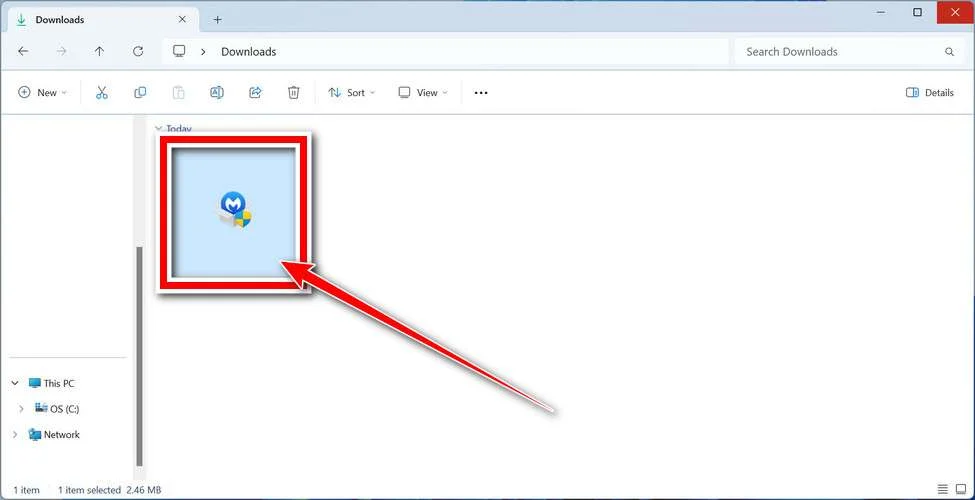
Follow the On-Screen Prompts to Install Malwarebytes
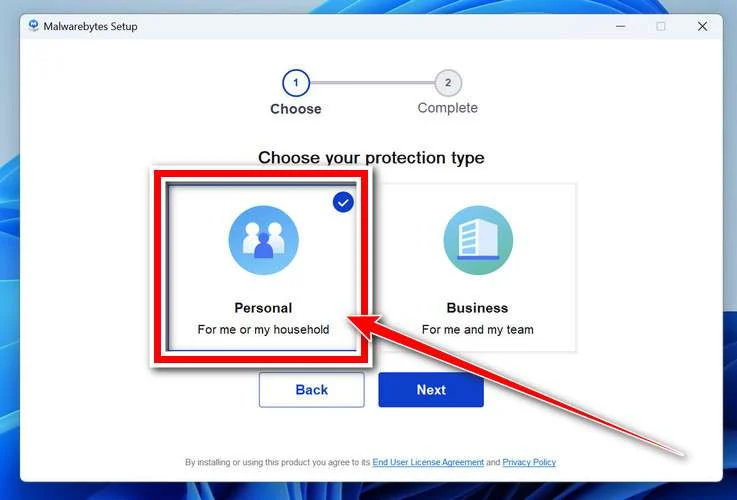
The setup wizard will walk you through a few quick screens:
-
Choose where you’re installing the program — “Personal Computer” or “Work Computer” — then click Next.
-
Malwarebytes will now install on your device. This usually takes under a minute.

-
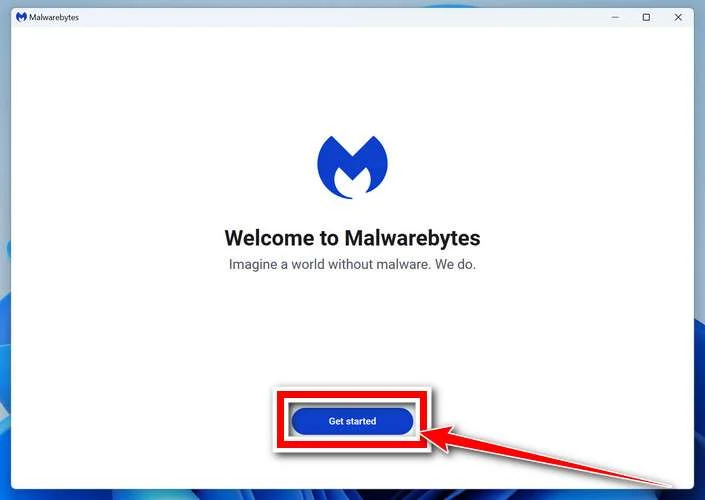
When installation is complete, the “Welcome to Malwarebytes” screen will open automatically.
-
On the final screen, click Open Malwarebytes to launch the program.

-
Enable “Scan for Rootkits”
Before scanning, turn on rootkit detection so Malwarebytes can find even the most hidden threats. Click the Settings gear icon on the left side of the screen.
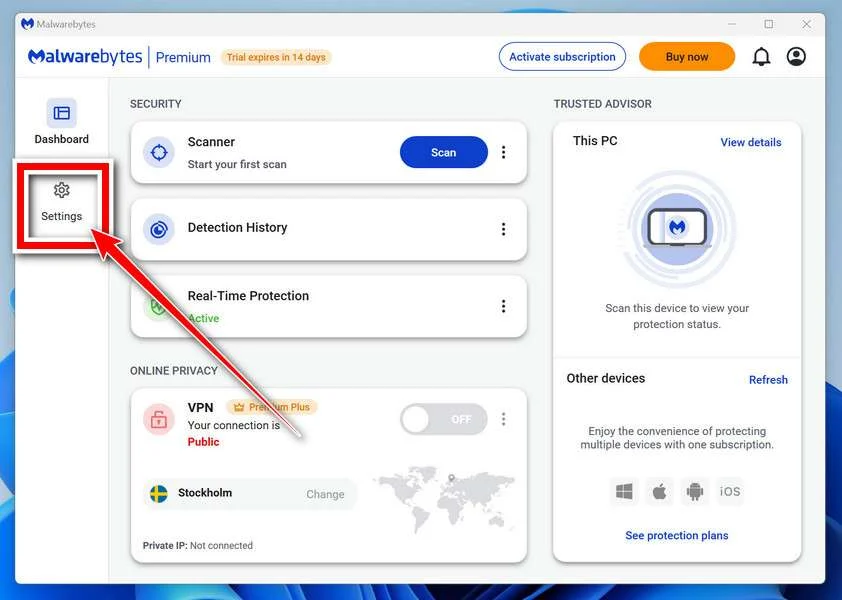
In the settings menu, find “Scan for rootkits” and click the toggle so it turns blue.

Done? Click “Dashboard” in the left pane to return to the main screen.
Start the Scan
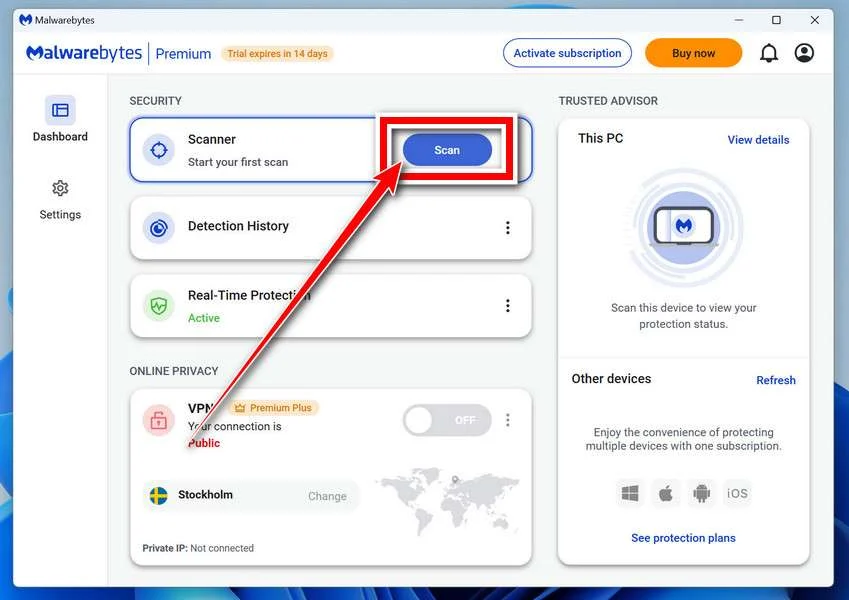
Click the blue Scan button. Malwarebytes will automatically update its virus database and start checking your computer for malware.
-
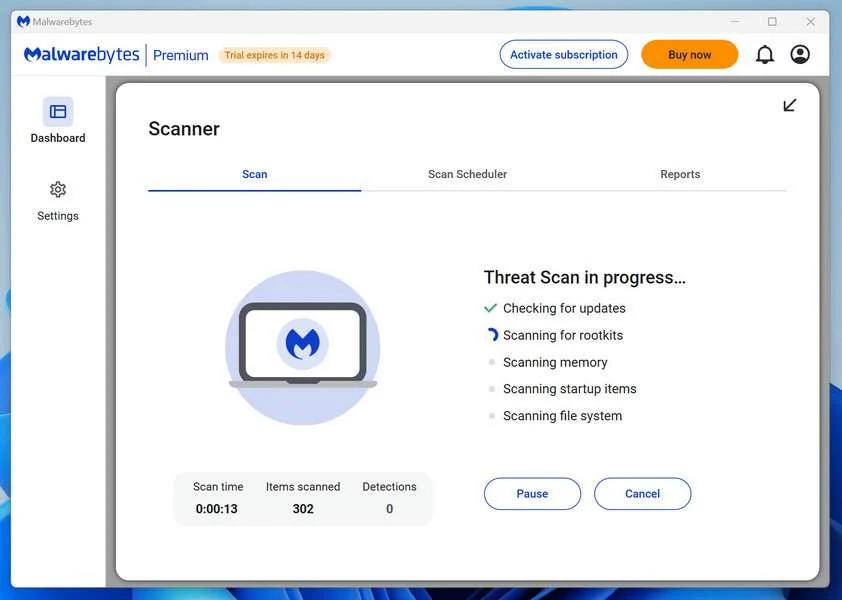
Wait for the Scan to Finish
The scan checks your entire system for browser hijackers and other malicious programs, so it can take 5 to 20 minutes depending on your computer. Feel free to do something else — just check back occasionally to see the progress.
-
Quarantine the Detected Threats
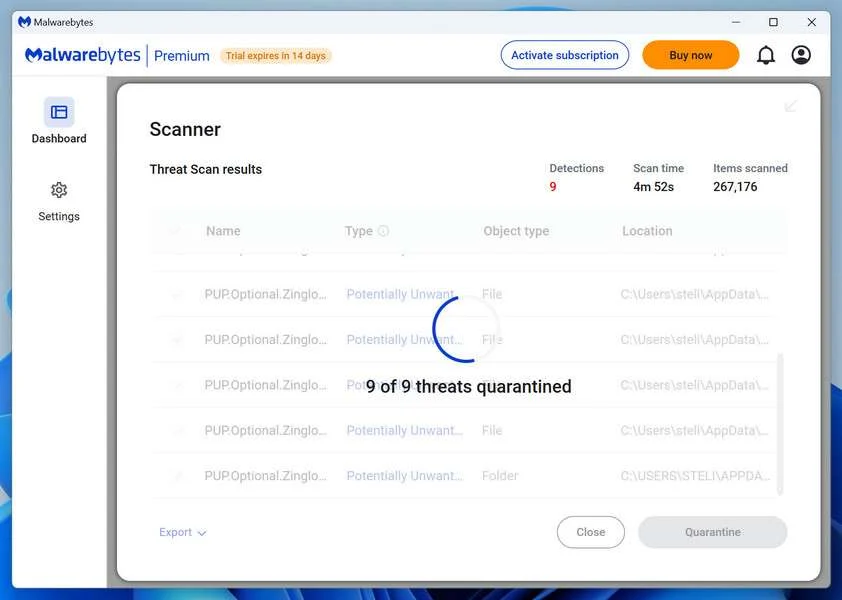
When the scan is done, you’ll see a list of everything Malwarebytes found — malware, adware, and potentially unwanted programs. Click the “Quarantine” button to remove all of them at once.
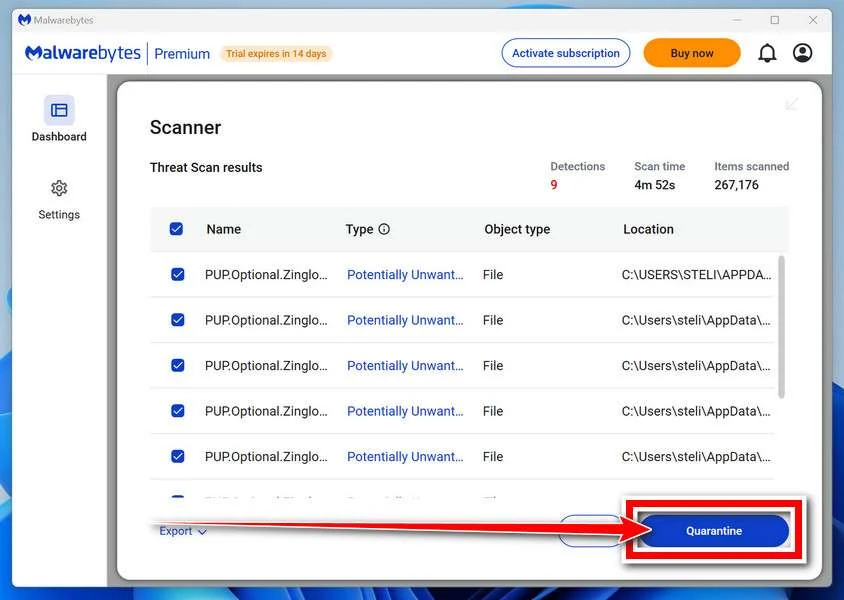
Malwarebytes will now remove the malicious files and registry entries and move them safely into quarantine.
-
Restart Your Computer
Some threats can only be fully removed after a reboot. If Malwarebytes asks you to restart, click Yes. Once you’re logged back in, Malwarebytes has finished removing the threats it found.
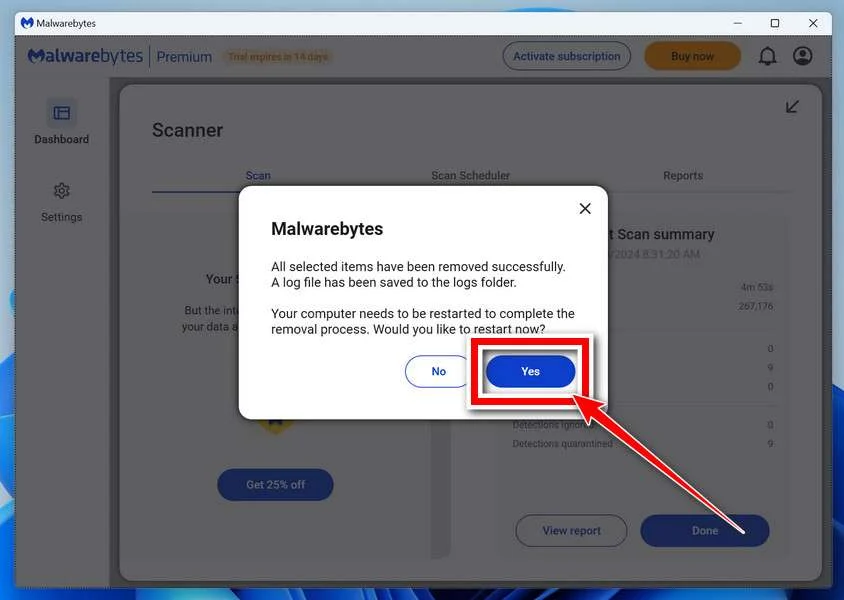
That’s it — your Windows PC is now clean of trojans, adware, and other malware, and should be back to running smoothly.
If you are still having problems with your computer after completing these instructions, then please follow one of the steps:
- Run a computer scan with ESET Online Scanner
- Ask for help in our Windows Malware Removal Help & Support forum.
Run a Malware Scan with Malwarebytes for Mac
Malwarebytes for Mac is a free on-demand scanner that removes the malware other security software tends to miss — adware, browser hijackers, and unwanted programs included. Cleaning an infected Mac with Malwarebytes has always been completely free, and it’s our go-to recommendation. Follow the steps below to scan and clean your Mac in just a few minutes.
-
Download Malwarebytes for Mac
Click the button below to download the latest version of Malwarebytes for Mac.
Download MalwarebytesOfficial installer for macOS. Your download starts right away.Want real-time protection? See Malwarebytes PremiumMalwarebytes Free for MacScans and removes malware at no cost -
Open the Malwarebytes setup file
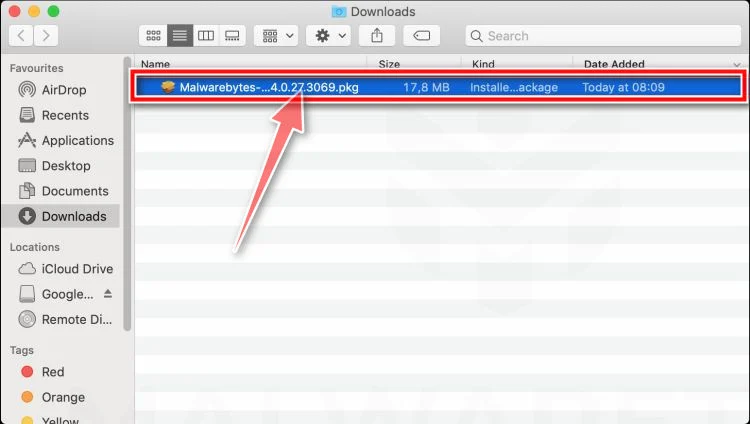
When the download finishes, open your Downloads folder and double-click the setup file to begin the installation.
-
Follow the On-Screen Prompts to Install Malwarebytes
The Malwarebytes for Mac Installer will guide you through a few quick screens. Click “Continue” and keep following the prompts until the installation completes.
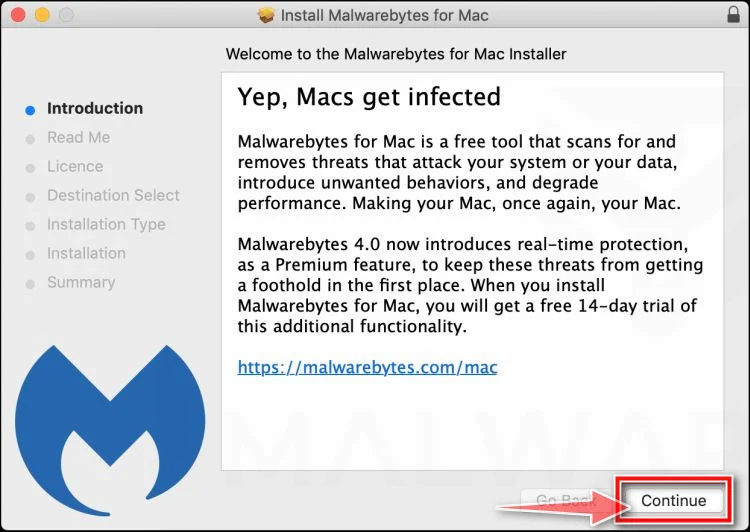
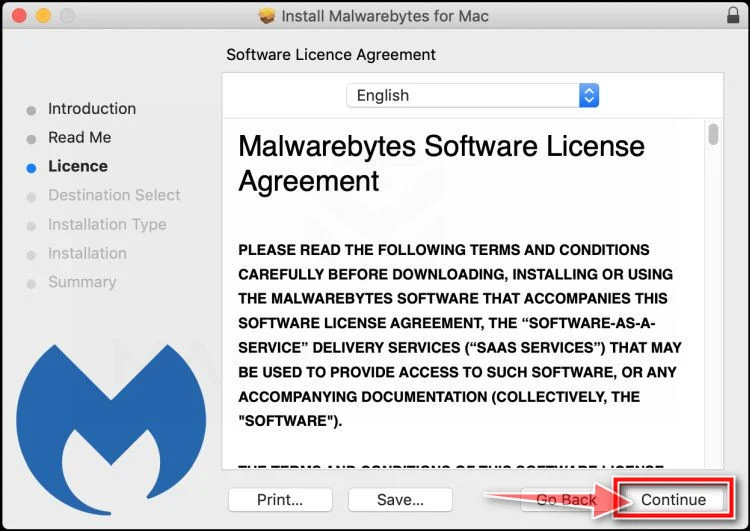
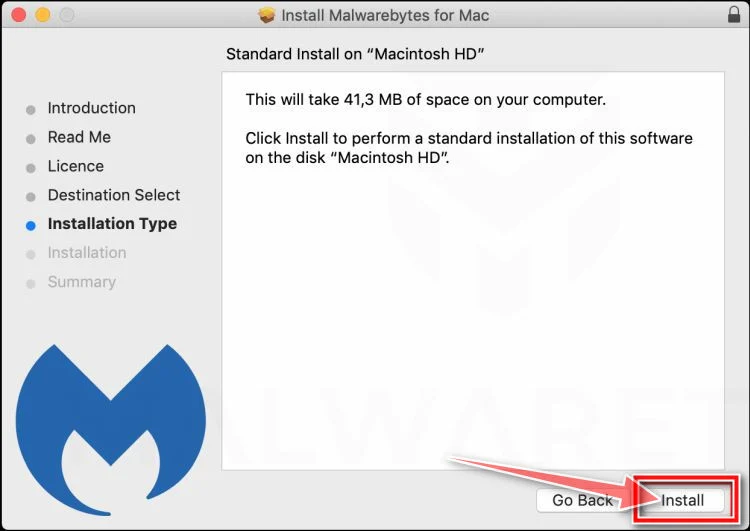
When the installation is complete, Malwarebytes opens to the Welcome to Malwarebytes screen. Click “Get started“.
-
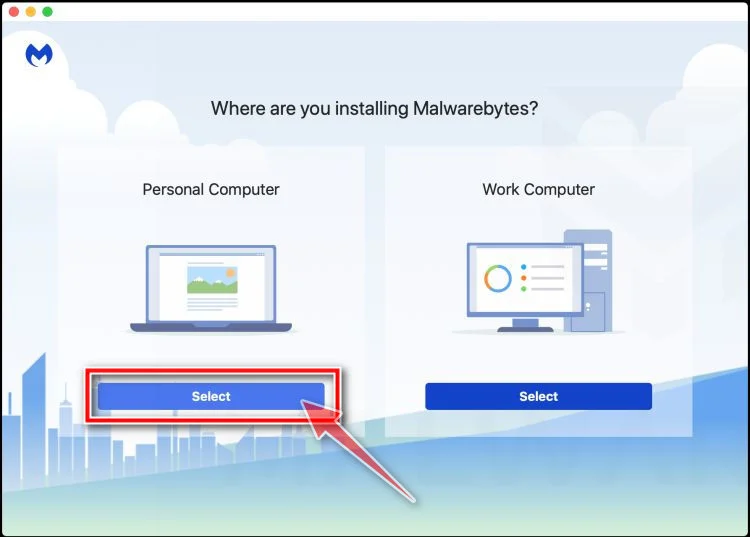
Select “Personal Computer” or “Work Computer”
Malwarebytes will ask what type of computer you’re installing it on. Click either Personal Computer or Work Computer, whichever applies.
-
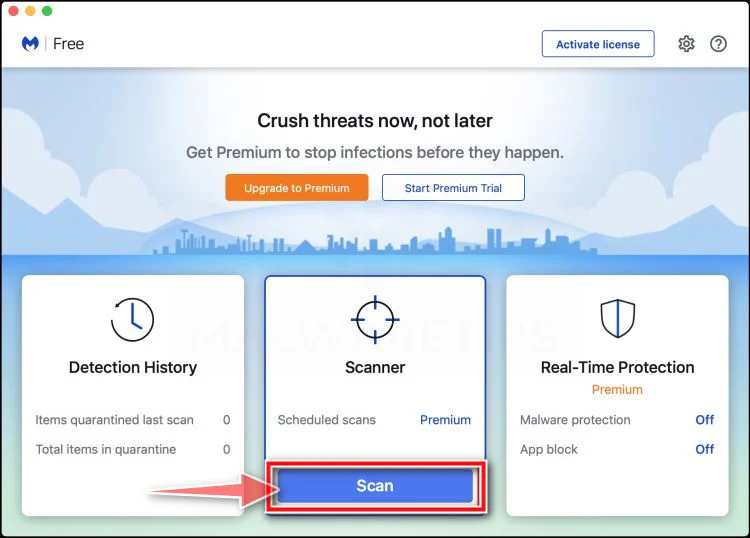
Start the Scan
Click the “Scan” button. Malwarebytes will automatically update its detection database and begin checking your Mac for malware.
-
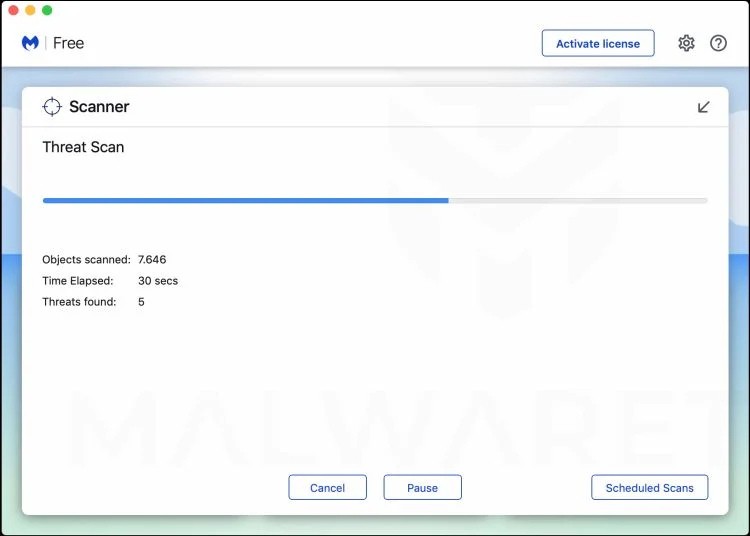
Wait for the Scan to Finish
Malwarebytes will scan your Mac for adware, browser hijackers, and other malicious programs. This can take a few minutes, so feel free to do something else — just check back occasionally to see the progress.
-
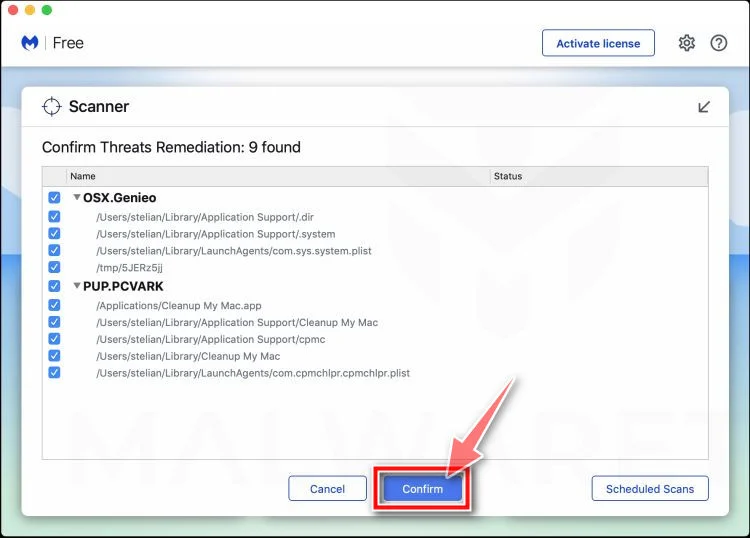
Quarantine the Detected Threats
When the scan is done, you’ll see a list of everything Malwarebytes found. Click the “Quarantine” button to remove all the threats at once.
-
Restart Your Mac
Malwarebytes will now remove all the malicious files it found. Some threats can only be fully removed after a reboot — if Malwarebytes asks you to restart, allow it. Once you’re logged back in, your Mac is clean.
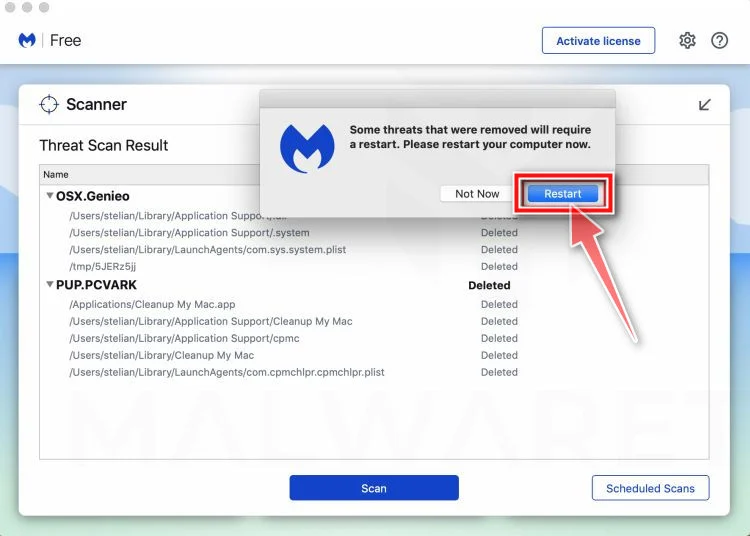
That’s it — your Mac is now free of adware, rogue browser extensions, and other potentially harmful software.
If you are still experiencing problems while trying to remove a malicious program from your computer, please ask for help in our Mac Malware Removal Help & Support forum.
Run a Malware Scan with Malwarebytes for Android
Malwarebytes for Android automatically detects and removes dangerous threats like malware and ransomware so you don’t have to worry about your most-used device being compromised. Aggressive detection of adware and potentially unwanted programs keeps your Android phone or tablet running smooth.
-
Download Malwarebytes for Android.
You can download Malwarebytes for Android by clicking the link below.
Get Malwarebytes for AndroidOpens Google Play in a new tab.Want real-time protection? See Malwarebytes Premium for AndroidMalwarebytes for AndroidScans your phone and removes malware at no cost -
Install Malwarebytes for Android on your phone.
In the Google Play Store, tap “Install” to install Malwarebytes for Android on your device.

When the installation process has finished, tap “Open” to begin using Malwarebytes for Android. You can also open Malwarebytes by tapping on its icon in your phone menu or home screen.

-
Follow the on-screen prompts to complete the setup process
When Malwarebytes will open, you will see the Malwarebytes Setup Wizard which will guide you through a series of permissions and other setup options.
This is the first of two screens that explain the difference between the Premium and Free versions. Swipe this screen to continue.
Tap on “Got it” to proceed to the next step.
Malwarebytes for Android will now ask for a set of permissions that are required to scan your device and protect it from malware. Tap on “Give permission” to continue.
Tap on “Allow” to permit Malwarebytes to access the files on your phone.
-
Update database and run a scan with Malwarebytes for Android
You will now be prompted to update the Malwarebytes database and run a full system scan.

Click on “Update database” to update the Malwarebytes for Android definitions to the latest version, then click on “Run full scan” to perform a system scan.

-
Wait for the Malwarebytes scan to complete.
Malwarebytes will now start scanning your phone for adware and other malicious apps. This process can take a few minutes, so we suggest you do something else and periodically check on the status of the scan to see when it is finished.

-
Click on “Remove Selected”.
When the scan has been completed, you will be presented with a screen showing the malware infections that Malwarebytes for Android has detected. To remove the malicious apps that Malwarebytes has found, tap on the “Remove Selected” button.

-
Restart your phone.
Malwarebytes for Android will now remove all the malicious apps that it has found. To complete the malware removal process, Malwarebytes may ask you to restart your device.
That’s it — your Android phone is now clean — no more malicious apps, adware, or browser redirects.
If you are still having problems with your phone after completing these instructions, then please follow one of the steps:
- Restore your phone to factory settings by going to Settings > General management > Reset > Factory data reset.
- Ask for help in our Mobile Malware Removal Help & Support forum.
Stay Protected: Block Ads and Malicious Sites
Now that your device is clean, keep it that way. Most infections start with a malicious ad or a fake download button — so blocking them at the source is your best defense.
We recommend AdGuard, which blocks malicious ads, phishing pages, and dangerous redirects before they can reach you.
👉 Download AdGuard and browse safely
What To Do If You Have Fallen Victim to This Scam
If you interacted with the scam, do not panic.
A lot of people freeze after realizing what happened. The right move is to act in a calm, structured order. The faster you respond, the better your chances of limiting damage.
1) If you only received the text and did not call, do this first
If you did not call the number and did not click anything, the risk is much lower.
Take these basic steps:
- Do not reply to the text.
- Take a screenshot of it.
- Delete the message.
- Block the number.
- Report it as junk/spam in your Messages app if available.
- Forward the text to 7726 (SPAM) to help your carrier filter similar texts.
- Report the scam to the FTC.
Apple says suspicious SMS texts that appear to be from Apple can be reported by taking a screenshot and emailing it to reportphishing@apple.com. Apple also notes you can use the “Report Junk” option in Messages. The FTC also advises forwarding unwanted texts to 7726 and reporting them to ReportFraud.ftc.gov.
2) If you called the number but did not share information
You still need to treat it seriously, but you may have avoided the worst outcome.
Do this next:
- Hang up immediately if the call is still active.
- Do not call back.
- Block the number.
- Watch for follow-up calls from new numbers.
- Do not trust caller ID if “Apple” appears.
- Verify your Apple account only through official Apple channels.
Apple warns that scammers can spoof legitimate-looking numbers and advises using vetted contact methods instead of responding to suspicious calls.
3) If you gave personal information or Apple account details
This is where you need to move quickly.
If you shared any of the following, respond right away:
- Apple account password
- Verification code
- Email password
- Billing address
- Card details
- Bank details
- Date of birth
- Security answers
Take these actions immediately:
- Change your Apple Account password from a device you trust.
- Make sure two-factor authentication is enabled.
- Change the password on your email account, especially if it is tied to your Apple account.
- Change any other accounts where you reused the same password.
- Review recent account activity and trusted devices.
- Remove any device you do not recognize.
- Check payment methods linked to your Apple account.
Apple specifically advises changing your Apple Account password immediately if you think it was compromised or you entered information on a scam site, and to ensure two-factor authentication is enabled. Apple also states it does not ask for your password or verification codes to provide support.
4) If you installed AnyDesk or another remote access app
This is the highest priority if the scammer connected to your device.
Do this now:
- Disconnect from the internet immediately (Wi-Fi and mobile data if needed).
- End the remote session.
- Uninstall AnyDesk or the remote app they had you install.
- Restart your device.
- Run a security scan on your computer with trusted security software.
- Check for unknown apps, browser extensions, device profiles, or startup items.
- If possible, use a second trusted device to change important passwords.
The FTC warns that tech support scammers use remote access to carry out the scam, and AnyDesk warns that scammers can misuse remote access tools to steal data and money.
If you are unsure whether the device is safe after a remote session, consider getting in-person help from a trusted local technician or a known support provider.
5) If you logged into bank or card accounts while they were watching
Assume the scammers may have seen what you typed.
Do not wait for fraud to appear.
Contact your bank or card issuer using the number on the back of your card or the official website, not any number from the text or caller.
Tell them clearly:
- You may have been targeted by a tech support scam
- You may have exposed account access or card information
- You want fraud monitoring and account protection now
Ask about:
- Freezing or replacing cards
- Disputing unauthorized charges
- Temporary account holds
- New account numbers if needed
- Extra verification on your account
The FTC advises people to check bank and credit card accounts for unauthorized transactions and report them directly to the bank or card company.
6) If you paid with gift cards, act fast anyway
Gift card scams are hard to reverse, but fast action still matters.
Do this immediately:
- Find the gift card receipt.
- Contact the gift card company right away.
- Tell them the payment was part of a scam.
- Ask if the balance can be frozen or recovered.
- Save all card numbers, receipts, and screenshots for your report.
Apple says never use Apple Gift Cards to pay other people, and the FTC says gift card payment requests for tech support are scams.
Even if recovery is not possible, reporting helps build cases and may help other victims.
7) If you paid by bank transfer, wire, crypto, or payment app
Time is critical here.
Contact the payment provider immediately and report fraud.
Ask whether they can:
- Reverse the transaction
- Freeze the transfer
- Flag the destination account
- Escalate the case to fraud investigations
The FTC notes that scammers prefer these payment methods because they are difficult to recover, which is exactly why you should report quickly.
8) Secure your Apple account the right way
Do not use links from the scam text.
Use only official Apple support and account settings.
Apple’s guidance for suspicious messages and phishing response includes:
- Change your Apple Account password if compromised
- Keep two-factor authentication enabled
- Do not share passwords or verification codes
- Contact Apple through official support channels, not suspicious messages
- Report suspicious Apple impersonation texts to reportphishing@apple.com
If you are unsure what to check, start with:
- Password
- Trusted devices
- Payment methods
- Recent sign-in activity
- Recovery phone and email details
9) Report the scam to Apple, the FTC, and the FBI
Reporting is not a waste of time.
It helps investigators identify patterns, numbers, scripts, and fraud infrastructure.
Here is a practical reporting checklist:
- Apple
- Take a screenshot of the suspicious text
- Email it to reportphishing@apple.com (Apple’s reporting address for Apple impersonation messages)
- FTC
- File a report at ReportFraud.ftc.gov
- Include the phone number used and what happened on the call
- FBI IC3
- Report spoofing/phishing to IC3 at ic3.gov
- Especially important if money was stolen, remote access was granted, or identity data was exposed
Apple’s support page specifically lists reporting suspicious Apple texts and scam phone calls. The FBI also directs users to report spoofing and phishing to IC3.
10) Report the text to your carrier and block future attempts
This step helps reduce repeat attacks.
The FTC recommends forwarding scam texts to 7726 (SPAM), which helps wireless providers identify and block similar messages. It also recommends using your messaging app’s junk or spam reporting feature.
Do both if you can.
Then block the number, but remember that scammers may switch numbers or spoof new ones.
11) Watch your accounts for the next several weeks
Some scammers do not steal immediately.
They wait.
Monitor:
- Bank accounts
- Credit card statements
- Apple account email notifications
- Login alerts
- Payment app activity
- Wireless account activity
If anything looks off, report it right away.
Also pay attention to new scam calls claiming to “help you recover” money from the first scam. Recovery scams are common after an initial fraud.
12) If you shared sensitive identity information, consider credit protection steps
If you gave enough personal information for identity theft risk, take extra precautions.
Depending on what you shared, consider:
- Fraud alert with credit bureaus
- Credit freeze
- Monitoring for new accounts or loans
- Reviewing your credit reports
This is especially important if you gave a combination of name, address, date of birth, phone number, and financial account details.
13) Save evidence before deleting everything
It is normal to want the message gone immediately.
But evidence helps when reporting and disputing transactions.
Save:
- Screenshot of the scam text
- Phone number used
- Call logs
- Voicemails
- Screenshots of remote access apps they asked you to install
- Receipts for gift cards or transfers
- Names the scammers used
- Any fake case numbers they gave you
This documentation can help Apple, your bank, the FTC, and the FBI understand what happened.
14) Use a simple rule for future Apple alerts
If you remember only one rule, make it this:
Never use the phone number in a security text.
Instead:
- Open your Apple account or device settings yourself
- Check your purchase history directly
- Contact Apple through official support channels you navigate to on your own
This matches the core advice from Apple, the FTC, and the FBI:
- Assume suspicious messages may be scams
- Do not trust the contact info inside the message
- Use known official channels instead
15) If you are helping a family member, slow the process down
These scams hit hardest when someone is rushed and alone.
If a parent, spouse, or friend receives this kind of Apple Security Alert text, help them follow a calm checklist:
- Do not call the number
- Screenshot the text
- Check the account directly
- Report and delete
- Review what was shared
- Secure passwords if needed
The FTC makes a useful point that talking to someone you trust can help you realize it is a scam before you act. That advice is simple, but it works.
The Bottom Line
The “Apple Security Alert” text you shared is a scam designed to trigger panic and push you into calling a fake support number.
From there, scammers may pretend your device is hacked, ask for remote access through tools like AnyDesk, send you to fake websites, steal account and banking information, and pressure you to pay with gift cards or other hard-to-reverse methods. Apple, the FTC, the FBI, and AnyDesk all describe pieces of this same pattern and the same core defense: do not trust unsolicited alerts, do not use the contact details in the message, and do not give unknown people access to your device or your codes.
If you already interacted with the scam, act quickly and methodically.
Secure your Apple account, secure your email and banking accounts, remove remote access tools, report the incident, and monitor for follow-up fraud attempts.
FAQ
Is the “Apple Security Alert” text message real?
No. The message you shared matches a common scam pattern.
It uses fear, urgency, and a fake support phone number to push you into calling scammers. Real companies do not want you to rely on a phone number inside a suspicious text.
What is the main goal of this Apple Security Alert scam?
The main goal is to get you on the phone.
Once you call, the scammers try to impersonate Apple support, scare you with fake security claims, and pressure you into sharing account details, giving remote access to your device, or sending money.
What should I do if I get this text?
Do not call the number in the message.
Take a screenshot, block the number, report it as spam/junk, and then check your Apple account or purchase history directly using official Apple channels that you open yourself.
What if the text mentions a real-looking charge like $143.95?
That is part of the scam.
Scammers often use specific amounts because it makes the message feel more believable. A precise charge amount does not make the text legitimate.
How can I check if there was a real Apple charge?
Check through official sources only.
Use your Apple account purchase history, your Apple Pay transaction history, and your bank or card statement. Do not use links or phone numbers from the text.
What happens if I call the number?
You may reach a fake support center.
The person may sound professional and claim your Apple ID, iPhone, or computer is hacked. From there, they may ask you to install remote access software, share codes, or make payments.
Why do scammers ask me to install AnyDesk or similar apps?
They want remote access to your device.
If you install a remote access app and give them the connection code, they may be able to see your screen, control your device, and steal passwords, banking information, or other private data.
If I installed AnyDesk, what should I do right away?
Act quickly.
Disconnect from the internet, end the remote session, uninstall the app, restart your device, and change important passwords from a trusted device. Then contact your bank if you logged into any financial accounts during the call.
Can scammers really steal money during these calls?
Yes.
They often use fake refund or fake security stories to get access to banking details, trick victims into sending payments, or pressure them into buying gift cards and sharing the codes.
Why do they ask for gift cards?
Because gift cards are hard to trace and hard to recover.
If anyone claiming to be Apple support asks for gift cards, it is a scam. That is a major red flag.
What if I gave them my Apple ID password or a verification code?
Change your Apple account password immediately.
Then review your account security settings, check for unknown devices, confirm your recovery information, and change the password on your email account too, especially if it is linked to your Apple account.
What if I only called but did not give any information?
That is better, but you should still be cautious.
Block the number, watch for follow-up calls from different numbers, and ignore any callbacks claiming to be Apple, billing, or fraud departments.
Can scammers spoof Apple or make the caller ID look real?
Yes.
Scammers can spoof caller ID so a call may appear to come from a legitimate name or number. Caller ID alone is not proof that the call is real.
Does Apple send security alerts by text?
Apple may send legitimate notifications in some situations, but scammers copy that style all the time.
The safest rule is simple: never trust the contact details in an unexpected text. If you want to verify something, contact Apple through the official support page or your device settings.
How do I report this scam text?
You can report it in several ways:
- Report it as junk/spam in your Messages app
- Forward the text to 7726 (SPAM) for your carrier
- Report it to the FTC
- Send a screenshot of Apple impersonation texts to Apple’s phishing reporting address
How can I avoid this scam in the future?
Use this rule every time:
Never call the number in a security text.
Always verify directly through the official app, website, or support page that you open on your own. That one habit prevents most scams like this.

Join the discussion
0 commentsShare your experience or ask a question about this article.
Discussion
Start the conversation
Have a question or something useful to share? Add the first comment.