


Audizen is a liquid supplement sold as ear health support for people with tinnitus, the ringing that no one else hears. It has been promoted with celebrity-style video ads.
Searches for Audizen and Audiozen reviews now turn up a long complaint trail. Here’s what buyers report, what the Better Business Bureau found, and what actually helps tinnitus.
Overview
What Audizen is
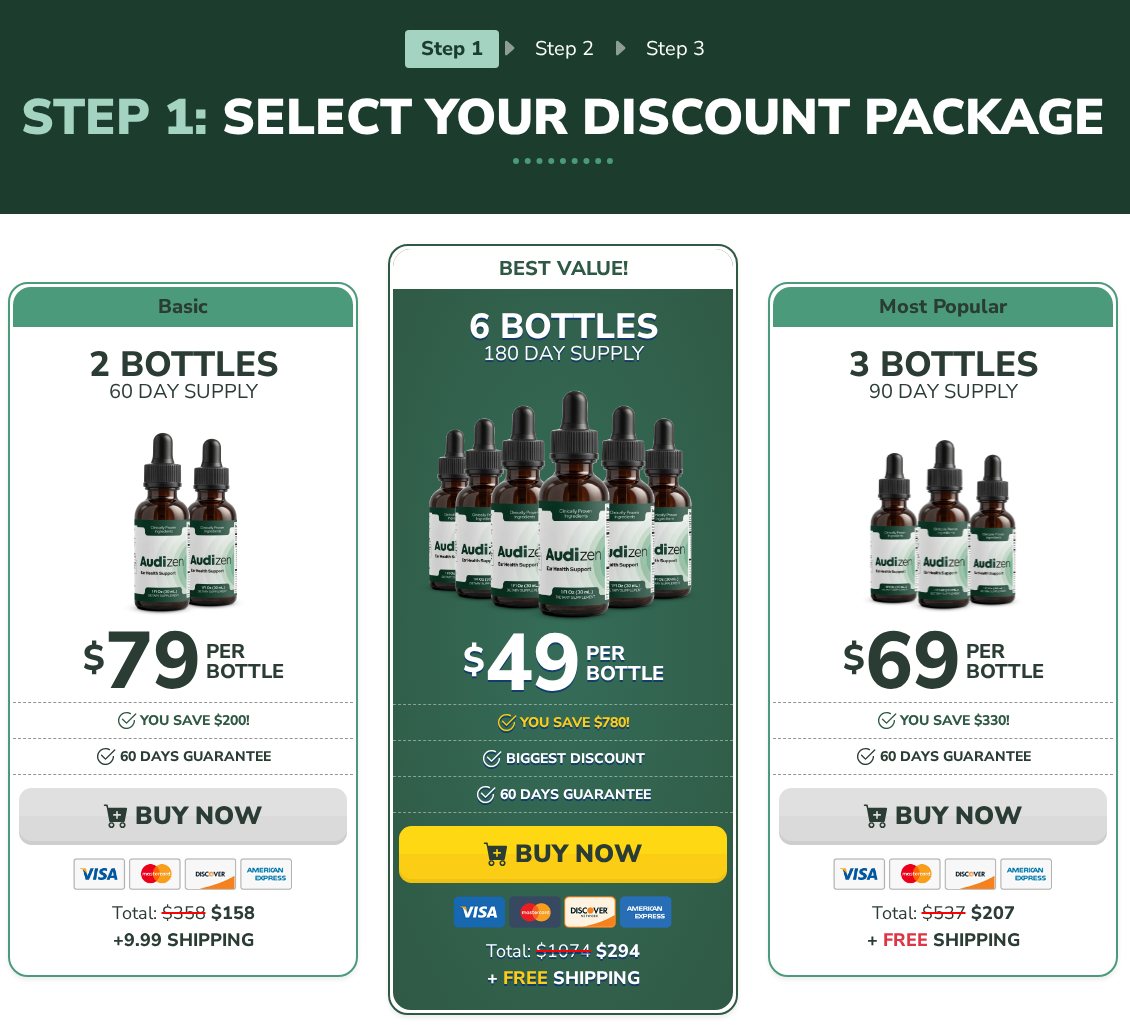
Audizen comes in dropper bottles sold through getaudizen.com, with ClickBank listed as the retailer. A six-bottle order is priced at $294, or $49 a bottle.
What do Audizen complaints say?
The BBB lists 24 complaints and says Audizen failed to respond to 18 of them. All five Trustpilot reviews give one star, mostly over refunds that didn’t arrive.
Can Audizen stop tinnitus?
No supplement has been shown to.
The National Institute on Deafness and Other Communication Disorders (NIDCD) states that there’s currently no cure for tinnitus, though some treatments reduce symptoms.
Other key points about Audizen:
- The BBB opened an advertising review in March 2026 over price, guarantee, results and fulfillment claims.
- The order page still carries a You Save $780 claim with no stated basis.
- ClickBank’s checkout for Audizen returns a VENDOR_NO_SALES error, so new orders can’t go through.
- Our 2025 report described ads using AI-made videos of celebrities, which none of them endorsed.
- Sudden hearing loss is a medical emergency, and new tinnitus deserves a doctor’s check.
Audizen Reviews: What Buyers Report
Audizen’s Trustpilot page, listed as Getaudizen, is unclaimed and has five reviews. All five give one star, and all were posted between September and October 2025.
A reviewer in October 2025 says the drops didn’t work and that 16 days after returning them, no refund had arrived. They also tried calling ClickBank, which processed the order.
A September 2025 reviewer says the product had no effect on their tinnitus and that the seller stopped responding when they asked for a refund.
Another says they gave their order and return numbers repeatedly over several weeks without getting money back, despite the 60-day guarantee on the site.
One more reviewer says the seller offered to refund half the money right away. When they insisted on a full refund, they were told the case had to be reviewed.
Five reviews are a small sample, and Trustpilot doesn’t verify each purchase. Still, they describe the same problem the BBB records show: refunds that stall after a return.
Our earlier Audizen refund terms report walks through the guarantee’s deadlines and the six-bottle shipping condition in detail.
This report focuses on the complaint record, the ads and the health facts.
Because the checkout pays affiliate commissions, some pages presented as Audizen reviews may be written by promoters. Check whether a review links straight to a checkout before trusting it.
What the BBB Found About Audizen
The BBB file for Audizen opened on September 3, 2025. It gives the business an F rating and lists it as not accredited.
Its rating reasons cite 24 complaints filed against the business and a failure to respond to 18 of them.
The profile carries a Pattern of Complaints alert. It says refund problems dominate, including returns confirmed as received but not refunded, with typical losses of about $280 to $300.
Separately, on March 20, 2026, the BBB contacted Audizen about advertising claims on getaudizen.com.
The BBB listed concerns about You Save and comparative pricing claims without a clear basis, urgency statements, and money-back guarantee wording.
It also flagged claims of results within a specific timeframe, and disclosures about six-bottle packages where only part of the order ships at first. Testimonial disclosures were questioned too.
What Audizen promised the BBB
In its reply, Audizen said it would provide pricing history and update its order pages to disclose the basis for its savings claims, or remove claims it couldn’t support.
It also promised to make the six-bottle fulfillment terms clear at the point of sale and to audit refund timelines and customer-service response times.
Audizen said it would send supporting documents by April 10, 2026, and schedule a meeting.
The BBB says that as of April 11, 2026, Audizen “has not scheduled a meeting or provided additional follow-up or response.”
The BBB also says Audizen’s replies may have been AI-generated. They arrived within minutes of long letters and didn’t directly address many of the issues raised.
What the order page shows now
The getaudizen.com order page still lists a You Save $780 badge on the six-bottle package, next to a crossed-out total of $1,074 and a sale price of $294.
The three-bottle package shows $537 crossed out and $207, and the two-bottle package shows $358 crossed out and $158 plus $9.99 shipping. No basis for the higher prices is given.
The guarantee text says buyers may notice reduced auditory discomfort and better mental clarity within days. That’s the kind of timeframe claim the BBB asked Audizen to substantiate.
Audizen Checkout Is Currently Disabled
Each Buy Now button on getaudizen.com links to a ClickBank checkout. Opening the six-bottle link brings up a ClickBank error instead of an order form.
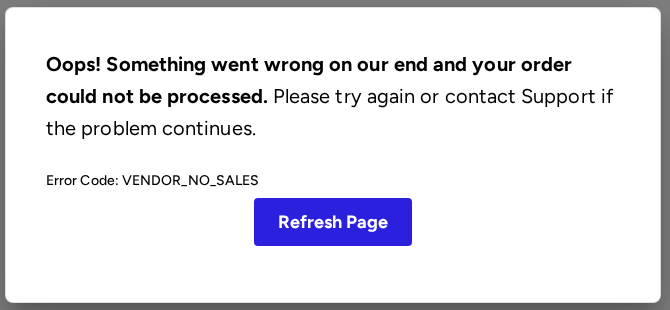
The error code is VENDOR_NO_SALES, which indicates that sales are switched off for the ClickBank vendor account behind Audizen.
The page doesn’t explain why. It may be temporary, but for now, anyone trying to buy through the official site can’t complete an order.
That matters for anyone who already bought. With the product off sale, getting a refund may depend more on ClickBank’s own process than on the seller.
The site’s footer tells buyers to contact ClickBank for order support and the vendor for product support. Keep both routes in mind if a refund stalls.
If Audizen turns up for sale on another site or marketplace, it isn’t going through the official ClickBank checkout. Check who the seller is before paying anything.
The Celebrity Ads Behind the Audizen Hype
Our August 2025 report described Audizen ads that used AI-generated videos of well-known figures, including Dr. Oz, Joe Rogan and Kevin Costner, to suggest they backed the drops.
There’s no evidence that any of those people backed Audizen or took part in the videos.
The tactic isn’t new to tinnitus products.
In 2024, Science Feedback found that Facebook videos of Kevin Costner promoting a tinnitus product called EchoEase weren’t genuine but were the product of AI modification.
Science Feedback pointed to awkward, sometimes mismatched mouth movement as one sign of the AI editing.
Our EchoZen report covers another tinnitus drop sold with the same set of celebrity faces.
A video of a famous person praising a supplement proves nothing about the product. Check the person’s own verified channels before believing any endorsement.
What Tinnitus Is and What Helps
Tinnitus is the perception of sound with no external source. The NIDCD says it’s common, with surveys estimating that 10 to 25% of adults have it.
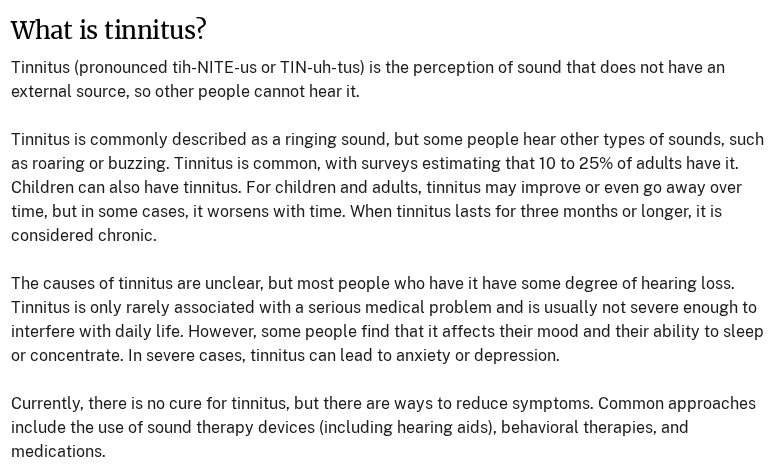
Its causes are unclear, but most people who have tinnitus have some degree of hearing loss. The NIDCD says it’s only rarely tied to a serious medical problem.
Some people find it affects their mood, sleep or concentration. In severe cases, the NIDCD says, tinnitus can lead to anxiety or depression.
The same page says there’s currently no cure. Common approaches include sound therapy devices such as hearing aids, behavioral therapies and medications.
Treatments the NIDCD describes
When tinnitus has a physical cause, such as earwax or a jaw joint problem, treating that cause can greatly reduce it. For many people, though, it lasts months or years.
Sound therapy is one main approach. It ranges from bedside or smartphone sound generators to wearable devices that play soft sounds in the ear throughout the day.
For people with hearing loss, hearing aids are one of the main options. They make outside sounds louder, which can make the tinnitus less noticeable.
Behavioral therapies help with the distress. The NIDCD describes counseling, cognitive behavioral therapy and tinnitus retraining therapy, which combines counseling with low-level sound.
There are no medications made specifically for tinnitus. Doctors may prescribe medicine to help with mood or sleep when tinnitus affects them.
On supplements, the NIDCD is direct: vitamins, herbal extracts and dietary supplements are often advertised as cures, but “none of these has been proven to be effective.”
Tinnitus can point to a treatable cause
The NIDCD advises seeing a primary care doctor first. The doctor can check for earwax or fluid from an ear infection that may be blocking the ear canal.
You may then be referred to an ear, nose and throat doctor, and to an audiologist who can measure your hearing. Imaging may be ordered, especially if the tinnitus pulses.
Some medications can cause tinnitus, especially at high doses. The NIDCD lists NSAIDs such as ibuprofen and aspirin, certain antibiotics, cancer drugs, malaria drugs and antidepressants.
Head or neck injuries and Ménière’s disease, an inner ear disorder that also affects balance and hearing, can cause it too.
Loud noise is another common trigger, at work, at concerts or at sporting events. The NIDCD notes that tinnitus is the most common service-related disability among veterans.
Counseling often includes advice on limiting exposure to loud noise, which helps avoid making symptoms worse.
In rare cases the sound pulses in time with your heartbeat. The NIDCD says that when a doctor can also hear it, the cause can often be identified and treated.
Sudden hearing loss is an emergency
The NIDCD says sudden deafness symptoms should be treated as a medical emergency, and that you should visit a doctor immediately.
People often notice it on waking, sometimes after a loud pop, and may also have ear fullness, dizziness or ringing. Don’t wait to see whether drops help.
Who Sells Audizen?
The site’s copyright line names Audizen Research, but no page gives a full company name with a registration number.
Audizen Research and two BBB addresses
The BBB lists Audizen in Aurora, Colorado, with a second location in Lakeland, Florida. Yet the BBB says it couldn’t verify a physical business address in Colorado.
The BBB says USPTO records list Vivalis LLC of Phoenix, Arizona, as the Audizen trademark owner. Audizen didn’t answer its ownership questions, and the BBB couldn’t independently verify ownership.
A ClickBank product
The site says ClickBank is the retailer of Audizen and handles order support.
ClickBank’s role doesn’t mean it endorses or reviewed the product’s claims, a point the site’s own footer makes.
The checkout links carry an affiliate code, which means the sale page is set up to pay commissions to promoters who send buyers there.
A 2025 domain and a short-lived second site
The getaudizen.com domain was registered on May 20, 2025, through Namecheap, with the owner’s details hidden by a privacy service.
Another Audizen sales site, audizenpro.com, registered in November 2025, offered the same packages and prices. It no longer loads.
A short domain history isn’t proof of wrongdoing. It does mean the brand has little track record beyond the complaints filed since it launched.
Contact details for refunds
The contact page lists support@getaudizen.com and an order status line at (323) 372-9102, the same number the BBB lists. It promises replies within 48 hours.
The same page says return shipping costs are the buyer’s responsibility. Include your order number, name and email with any return package.
The refund policy sends returns to an Ohio address. It says to get a support agent’s confirmation before mailing anything, or the refund may be delayed.
What Changed Since Our 2025 Report
Our August 2025 report focused on the celebrity videos, fake-looking testimonials and the lack of evidence for tinnitus relief.
Since then, the complaint record has grown, the BBB has opened an advertising review, and the official checkout has stopped processing orders.
The health picture hasn’t changed. There’s still no cure for tinnitus, and a doctor’s check remains the right first step.
No published study of Audizen itself has appeared either, so its tinnitus claims still rest on marketing copy and testimonials.
What to Do If You Bought Audizen
- Stop using the drops.
Keep taking any medicine you’ve been prescribed, and show the bottle to your pharmacist or doctor.
- See a doctor about your tinnitus.
A primary care doctor can check for earwax, infection, medication side effects or hearing loss.
- Treat sudden hearing loss as an emergency.
If hearing drops suddenly in one or both ears, see a doctor immediately.
- Ask for a refund in writing.
Email support@getaudizen.com with your order number, and keep every reply and tracking number.
- Contact ClickBank within 60 days.
The window runs from purchase, and returns are at ClickBank’s discretion. Request one at clkbank.com; after 60 days, it refers buyers to the seller.
- Dispute the charge if needed.
Card issuers often allow about 120 days. PayPal disputes close 180 days after payment, so that window has passed for 2025 orders.
- Report the problem.
File with the BBB or at ReportFraud.ftc.gov. Ignore anyone who offers to recover your money for a fee.
Frequently Asked Questions
Is Audizen legit?
It’s a real product sold through ClickBank, but its claims aren’t backed by evidence. Its BBB file lists 24 complaints, and checkout currently fails.
Is Audiozen the same as Audizen?
Audiozen is a common misspelling. Check the label and your order email, since other businesses use similar names.
What are the most common Audizen complaints?
Refunds. Buyers say returns went unanswered, refunds took weeks or never arrived, and half refunds were offered instead of full ones.
Did Dr. Oz or Joe Rogan endorse Audizen?
There’s no evidence they did. Our 2025 report found ads using AI-made celebrity videos, a tactic also documented for other tinnitus products.
Can tinnitus drops cure tinnitus?
No. The NIDCD says there’s no cure for tinnitus. Hearing aids, sound therapy and behavioral therapies can reduce symptoms for some people.
Our Silen Sense CalmEars report covers another tinnitus product sold with similar relief promises.
When should I see a doctor about tinnitus?
See a doctor for any new, worsening or pulsing tinnitus. Go immediately if your hearing drops suddenly, since sudden hearing loss is a medical emergency.
The Bottom Line
Don’t buy Audizen. Its savings and results claims drew a BBB review, its complaint file is long, and no supplement has been shown to cure tinnitus.
If you already bought it, stop using it, request a refund in writing through the seller and ClickBank, and see a doctor about the ringing itself.

Join the discussion
0 commentsShare your experience or ask a question about this article.
Community experiences
Did this happen to you?
Your experience could help someone recognize the same scam. Submit a private report for our team to review.
I experienced this tooReports are reviewed before publication. Sharing publicly is always your choice.
Discussion
Start the conversation
Have a question or something useful to share? Add the first comment.