

When the usual formula is hard to find, an online shop showing full shelves can feel like relief. The listing promises fast shipping and a price that seems manageable.
Before placing an urgent order, there is a quieter question: can this seller actually deliver the exact product it displays?
Overview
What the baby formula store scam promises
A baby formula store scam presents an online listing or social-media shop as a source for a product families need promptly.
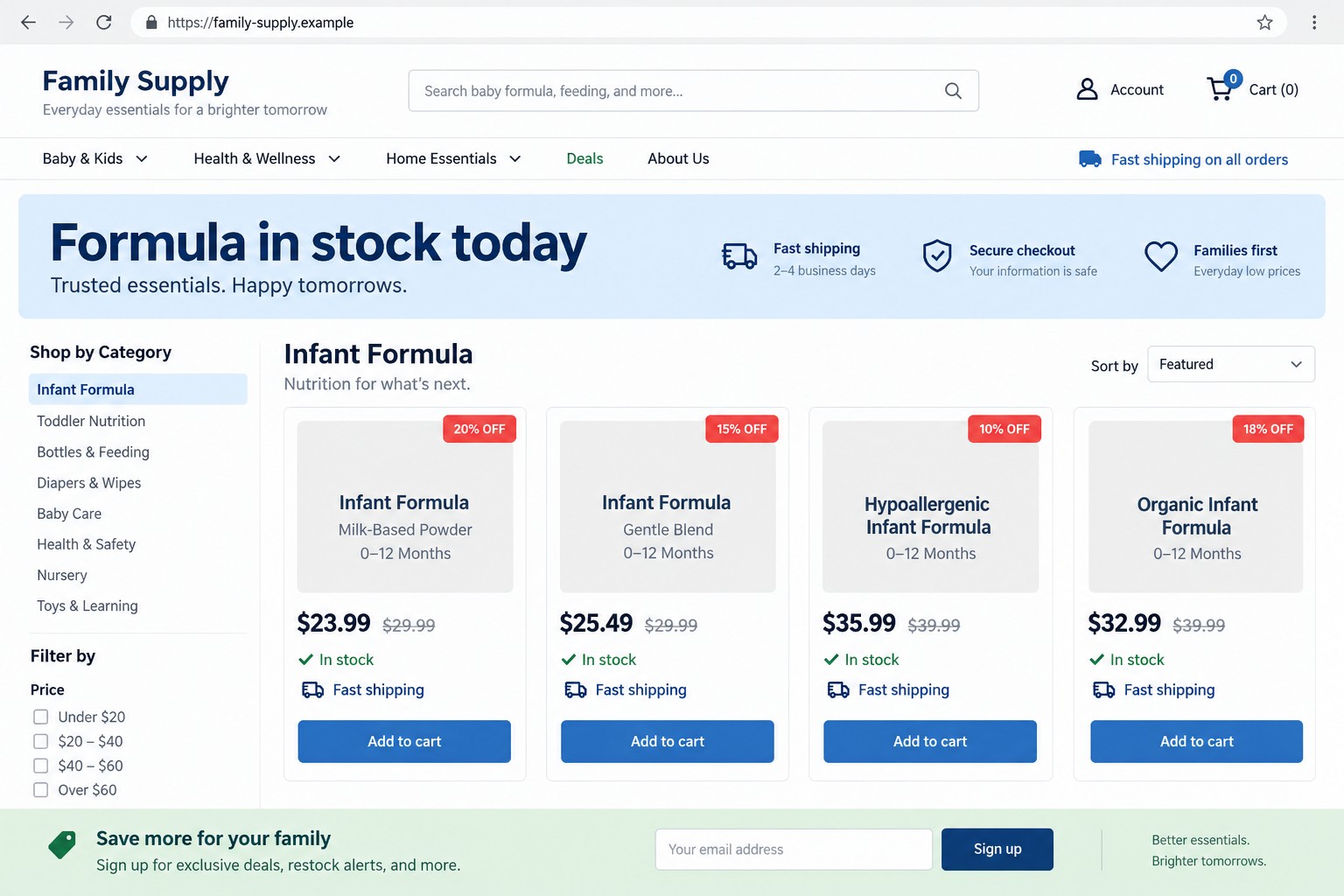
The page may show familiar product descriptions, availability claims, quick dispatch, and a checkout that looks like a normal retail purchase.
OnlineThreatAlerts describes fake formula sellers and orders that never arrive. That report is a lead, not proof against any specific shop you are viewing.
The FTC has warned that scammers create fake websites and social profiles during periods of high demand, take payment, and send nothing.
What is established and what needs checking
The confirmed deceptive mechanism is selling formula through a fake or impersonated store without fulfilling the order.
A brand logo, product photo, or “in stock” badge does not show that a seller has inventory, supplier relationships, or a shipment ready.
That does not mean every unfamiliar pharmacy or small retailer is fraudulent. The question is whether this particular seller can be independently verified.
Both images in this guide are fictional screen reconstructions. They are not captures of a real seller or evidence against a named store.
Signals to check before spending
- The store appeared only through an ad or social post and has no verifiable history.
- Its contact page gives no working business details or answers only through direct messages.
- The product is widely unavailable elsewhere but supposedly plentiful at this one new site.
- Checkout switches from ordinary card payment to a gift card, wire, payment app, or cryptocurrency.
- The seller pressures you to order before confirming the exact formula and delivery date.
- The product page copies images or text but omits useful return, shipping, or business information.
Any one clue deserves a pause. Several together make an urgent purchase especially risky.
Why Formula Shopping Creates an Opening for Fraud
The buyer has a genuine immediate need
Parents and caregivers are not browsing for a novelty item. They may be trying to maintain a feeding routine that already works for a child.
A seller that claims to have the exact formula can feel more valuable than a cheaper general alternative.
That urgency can narrow the time available to examine the merchant. Scammers exploit the pressure without needing special access to retailers.
The FTC’s warning was tied to a shortage period, but the same online-store deception can appear whenever demand outpaces local availability.
A copied storefront looks more substantial than a social post
A fake shop may contain categories, customer-service pages, a cart, and a branded checkout. Those features can be copied or generated quickly.
Product descriptions may come from legitimate sellers. A familiar image is evidence of what the page displays, not evidence of what the seller holds.
Reviews on the same site are controlled by the site owner. Read independent records and check whether the business name matches payment details.
If the only contact route is a social account, ask whether that account is linked from the manufacturer’s official channels.
Payment method often reveals the point of risk
A seller may display card icons, then claim checkout is temporarily unavailable and ask for a transfer or gift card instead.
The FTC specifically flags gift cards, wire transfers, and cryptocurrency as risky payment requests from unknown formula sellers.
Those methods can be difficult to reverse. A credit card generally provides stronger dispute options for a product that never arrives.
Do not let a promise of same-day dispatch justify a payment route you would reject for any other online purchase.
How the Baby Formula Store Scam Works
Step 1: A listing meets a worried shopper
The first contact can be a search result, sponsored social post, local marketplace listing, or direct message from someone claiming to have stock.
The listing uses the product name and an availability promise. It may mention recent delivery to other families or limited remaining units.
Neither claim is proof. A site can advertise stock it does not possess, and a social profile can reuse someone else’s photos.
Start by asking how you found the seller. A new ad deserves more scrutiny than an established retailer already known to you.
Step 2: The storefront builds a sense of reliability
A fake store can list several formulas, display ordinary prices, and offer shipping estimates. It may use generic trust badges or copied policy pages.
A “secure checkout” label means little if the seller itself is not verifiable. Encryption does not guarantee that an order will be fulfilled.
Check whether the business address, phone number, and legal name are consistent across its site, receipts, and public records.
A typo alone is not proof of fraud, but contradictory identities and unreachable support are material concerns.
Step 3: The buyer enters personal and order details
Checkout asks for a shipping address, phone number, and email. A fake seller can retain those details even if payment later fails.
Some pages may offer several shipping methods. An expedited label does not demonstrate that a parcel will be handed to a carrier.
Verify the exact item before paying. A vague listing might omit size, formulation, age range, or other details important to the purchase.
Do not substitute a product based solely on an online seller’s advice. Ask a pediatrician or appropriate healthcare professional when feeding guidance is needed.
Step 4: Payment moves to a hard-to-recover channel
The scammer may claim cards are unavailable, offer a “special reserve” method, or ask you to pay a person rather than the listed business.
The fictional checkout below illustrates that kind of switch. It is not a record of a real seller’s payment page.
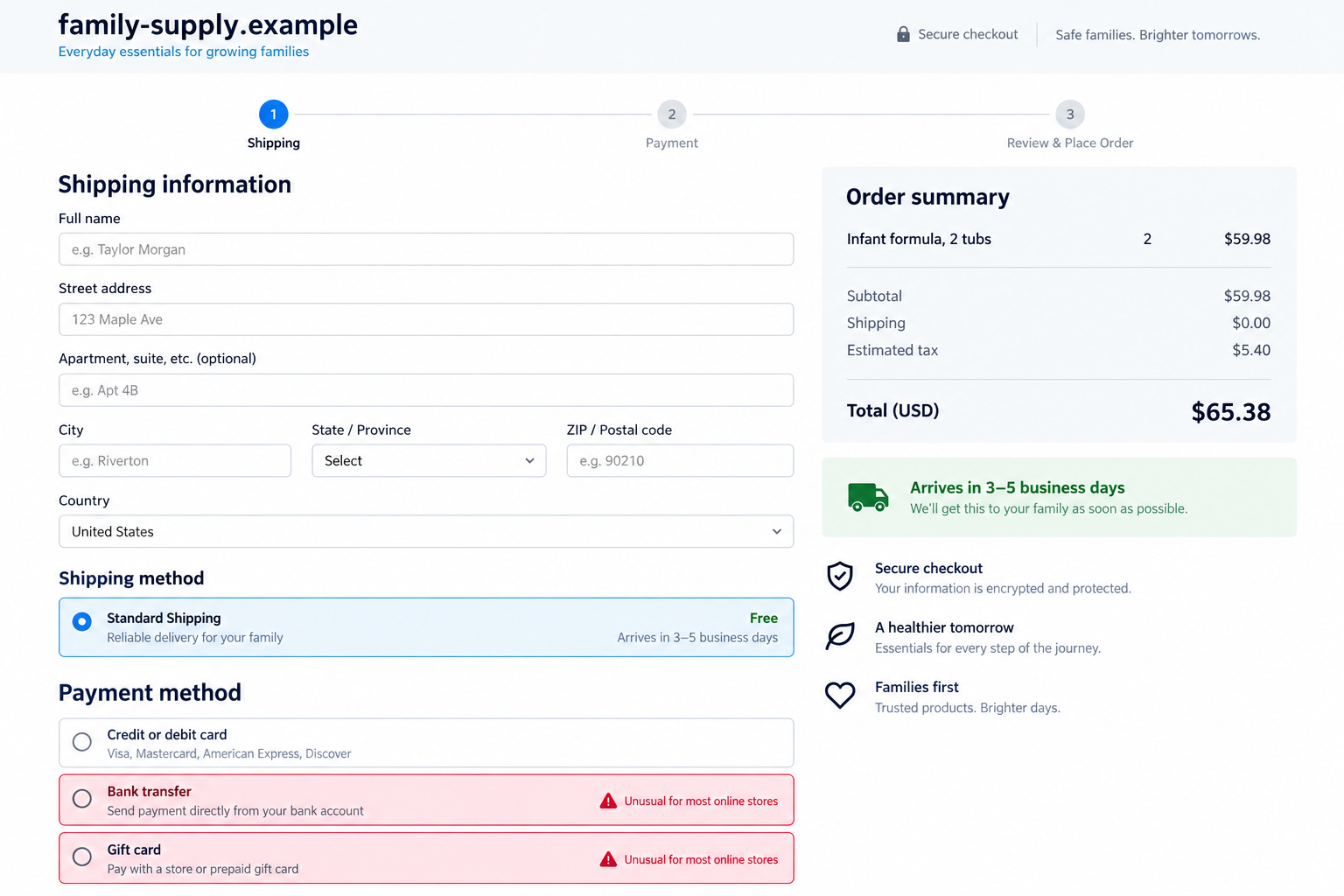
Bank transfers and gift cards are warning signs when an unknown store insists on them. The FTC advises using a credit card when possible.
Do not send a deposit merely to hold stock. A small first payment can be followed by shipping, insurance, or customs demands.
Step 5: Tracking excuses replace the promised delivery
After payment, the seller may provide no tracking, an unrelated tracking number, or repeated explanations for a delay.
A tracking number only helps if the carrier confirms that the correct parcel was accepted and addressed to you.
Some buyers may receive nothing. Others may receive an incorrect item. These are possible outcomes, not proof about every suspicious listing.
Once the promised delivery date passes, document the facts and contact your payment provider before dispute deadlines run out.
How to Check a Formula Seller Without Wasting Precious Time
Begin with sellers you can verify
Use a known retailer, pharmacy, manufacturer-approved seller, or established marketplace with meaningful buyer protection where available.
If you find a new site, search its full business name and domain separately. Look for a history that predates the current product demand.
Check contact details by calling a number obtained independently. A working number is useful, but a polished conversation alone is not final proof.
Compare the seller named in its terms with the name shown at checkout. A mismatch needs explanation before payment.
Review the exact formula and fulfillment terms
Read the product’s size, type, expiration information if supplied, and delivery estimate. Verify that the listing matches the item you intended to buy.
Look for a clear return and non-delivery policy. A copied policy that names another business is a serious sign that the storefront was assembled carelessly.
Do not assume a low price is automatically fraudulent. But a deep discount plus scarce stock and pressure deserves careful verification.
If a family needs help finding an appropriate formula, a pediatrician or WIC office may offer safer guidance than an unknown reseller.
Choose a payment route with a record
A credit card can support a dispute when goods do not arrive. Keep the order confirmation and correspondence.
A payment app transfer to an individual does not become a protected retail purchase merely because the description says “baby formula.”
Never pay with gift cards or cryptocurrency because a seller says normal checkout is down. That is a change in risk, not a minor convenience.
If the site redirects you to another merchant name, pause. Confirm who will bill you and what protections the payment method provides.
Who Is Behind the Store?
Who is actually taking the order?
Record the store name, legal business name, checkout merchant, and card-statement descriptor if available. They should tell a coherent story.
A marketplace listing may name a third-party seller rather than the platform. Read the seller information, not just the platform logo.
If the only identity is a social-media username, that is not enough for a high-stakes order. Ask for verifiable business details.
Do not accuse a real company just because a scammer copied its branding. Identify the actual payment recipient before assigning responsibility.
Where is the order supposed to ship from?
An address can be a legitimate warehouse, an unrelated mailbox, or fabricated. Check whether it matches the seller and advertised shipping time.
A shipping promise is meaningful only when the carrier confirms acceptance of your parcel. A generated label is not the same as delivery.
If the seller claims local inventory but sends changing explanations about overseas transit, keep the messages and ask for a documented refund.
Do not infer where a product was manufactured from an address or package route alone.
Can support explain a missing order?
Try the listed contact route before purchase when possible. A real support team should be able to explain stock, shipping, and refunds.
After payment, save each answer and promised date. Repeated scripted replies with no carrier acceptance may support a non-delivery dispute.
Beware a “shipping agent” who asks for another transfer to release the formula. Verify any carrier fee through the carrier itself.
Keep the discussion in a channel where you can export it, rather than relying only on disappearing social messages.
What does the seller actually know about the product?
A trustworthy listing should identify the exact formula, packaging size, and manufacturer. Missing details create real uncertainty for a caregiver.
Do not treat a copied product photo as traceability. Ask for an unopened, properly labeled product from a reliable supply chain.
Questions about suitability, shortages, or alternatives belong with a healthcare professional, not an anonymous online seller.
The fraud verdict concerns payment and fulfillment claims. It is not a medical judgment about a legitimate formula brand.
What to Do if You Have Fallen Victim to This Scam
- Stop sending money. Do not pay a new shipping, insurance, customs, or reservation fee. A changing explanation does not validate the original seller.
- Preserve the order evidence. Save the product page, seller identity, checkout screen, payment receipt, promised delivery date, messages, and any tracking information.
- Contact your payment provider promptly. Explain that the formula was not delivered or the seller was misrepresented. Ask about chargeback or dispute deadlines specific to your method.
- Protect payment details. If the site captured a card number outside a trusted checkout, ask the issuer whether the card should be replaced and monitor for unauthorized charges.
- Report the seller’s listing. Use the marketplace or social platform’s fraud-reporting route. Give the exact account and URL, not just a screenshot.
- Find a safe replacement source. Contact a trusted retailer, pharmacist, pediatrician, or WIC office for availability or appropriate guidance. Do not improvise a formula substitute based on a scammer’s suggestion.
- Report the incident. Submit details through ReportFraud.ftc.gov and any relevant state consumer-protection channel. A report can help identify repeat sellers.
- Watch for recovery offers. Someone claiming to return your payment for an upfront fee may be another scammer. Work directly with your payment provider.
If you reused an account password on the fake store, change it on the other services and enable multifactor authentication where available.
If the site triggered a file download or browser notification permission, remove that access and run a reputable security scan.
Frequently Asked Questions
Are all online baby formula sellers scams?
No. Many legitimate retailers sell formula online. Verify the seller, exact product, delivery terms, and payment protection before placing an unfamiliar order.
Does a familiar formula logo prove a store is authorized?
No. Logos and product photos can be copied. Check the merchant independently and look for a consistent business identity.
Is a bank transfer safe if the seller promises faster shipping?
That promise does not remove the recovery risk. The FTC flags wire transfers and similar hard-to-reverse methods as warning signs with unknown sellers.
What if I received a tracking number?
Confirm it directly with the carrier and check whether a parcel was accepted for your address. A label or unrelated number is not delivery proof.
Can I dispute a formula order that never arrived?
Possibly. Contact your card issuer or payment provider quickly, preserve the promised delivery date, and ask about the method’s dispute window.
Where should I turn if my child needs formula now?
Ask a pediatrician, pharmacist, trusted retailer, or WIC office about availability and appropriate options. Do not rely on medical advice from an unknown seller.
The Bottom Line
A fake baby formula store can exploit an urgent family need with convincing stock and shipping claims. The real test is a verifiable seller and protected payment route.
Pause before paying an unfamiliar shop, especially through a gift card or transfer. If an order never arrives, document it and contact your payment provider promptly.








