

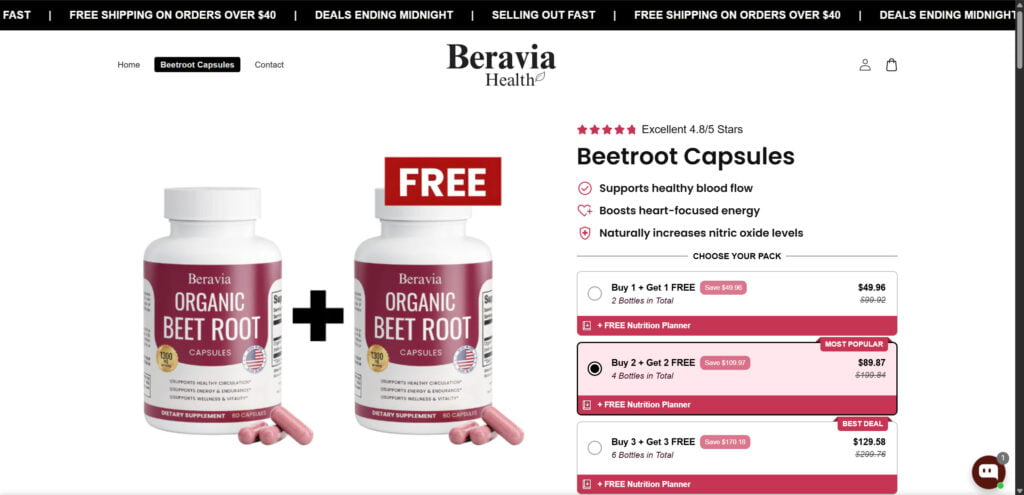
Beravia Beetroot Capsules are marketed as an “organic beetroot” shortcut to better circulation, higher energy, and even blood pressure support. Before you buy, it is worth looking past the “nitric oxide” story and the polished reviews to see what this product likely is: a mass-produced supplement sold through aggressive ads, inflated promises, and a return process that can be frustrating or effectively unusable.
Overview
Beravia Beetroot Capsules sit in a familiar category: beetroot supplements positioned as a natural way to “support circulation” and “boost nitric oxide.”
That concept is not invented from nothing.
Beetroot contains dietary nitrates, and dietary nitrates can convert into nitric oxide in the body, which plays a role in blood vessel function.
That is why beetroot juice and beetroot powders show up in sports performance circles and why some people associate beetroot with blood pressure support.
The problem is not that beets are fake.
The problem is the way products like Beravia are marketed, and the gap between what the evidence supports and what the ads imply.
What Beravia Beetroot Capsules claim to do
Based on the sales messaging, Beravia frames the product as a broad solution to a long list of issues.
The pitch typically revolves around a “nitric oxide decline” narrative, then connects that narrative to symptoms that many people feel regularly.
Common claims and themes include:
- Supporting healthy circulation and cardiovascular function
- Helping with high blood pressure support
- Improving energy and stamina
- Reducing brain fog and “mental decline”
- Helping with cold hands and feet and “poor circulation”
- Supporting endurance and oxygen delivery
This type of positioning is designed to catch a wide audience.
If someone feels tired, gets cold extremities, or wants better stamina, the message feels personal.
That is intentional.
The “nitric oxide decline” storyline is persuasive, but oversimplified
A lot of these pages present nitric oxide as the missing key that explains nearly everything.
They often add age-based decline numbers to create urgency, then point to the supplement as the fix.
The issue is not that nitric oxide is irrelevant.
The issue is that human biology is rarely a single lever.
Energy, blood pressure, circulation, and cognitive performance are influenced by sleep, diet, medications, hydration, underlying conditions, fitness level, stress, and more.
A beetroot capsule cannot realistically cover that entire landscape.
When marketing suggests it can, you are no longer in a “supplement support” conversation.
You are in a persuasion funnel.
What beetroot supplements can realistically do
Beetroot products can make sense for some people, in some contexts, with realistic expectations.
In plain terms, beetroot is most often associated with:
- A modest effect on blood vessel function in some people
- Possible small blood pressure reductions in some studies, depending on dose and individual response
- Possible exercise performance support in certain scenarios
Notice what is missing.
It is not a guaranteed blood pressure fix.
It is not a reliable “energy reversal” for everyone.
It is not a treatment for brain fog, aging, or chronic circulation problems.
Any page that implies predictable, dramatic, across-the-board outcomes is pushing past what a basic beetroot supplement can credibly deliver.
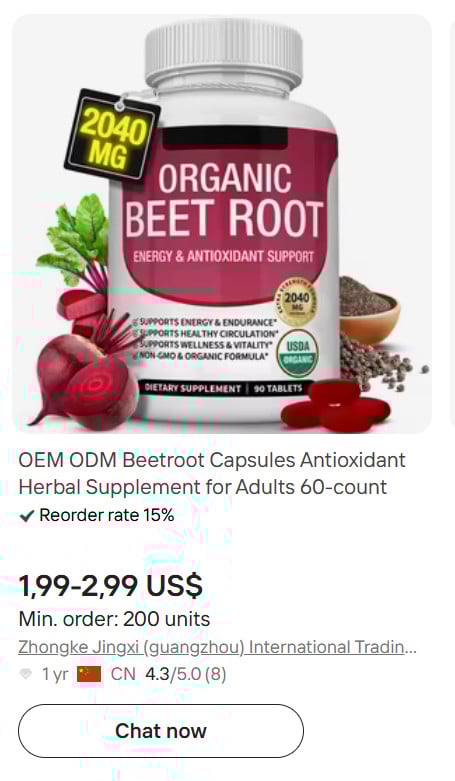
Why “2040 mg” and “organic” can mislead
Many beetroot supplements advertise a large milligram number on the front.
That number usually refers to the amount of beetroot powder (or beetroot extract) per serving.
It does not automatically tell you the nitrate content, the standardization, or how potent the formula is.
Two beetroot capsules can both say “2000 mg” and still deliver very different real-world effects.
The same applies to “organic” cues.
A label can say “organic beetroot,” but what matters is the supply chain documentation, the manufacturing controls, and whether the branding is using “organic” as a trust symbol more than a verifiable standard.
If a product leans heavily on badges and front-label credibility, but gives limited transparent manufacturing details, treat that as a signal.
The trust-building layer: reviews, photos, and emotional stories
Beravia’s page structure uses a common format:
- A problem narrative many people relate to
- A scientific-sounding mechanism (nitric oxide)
- A list of symptoms it supposedly solves
- Testimonial tiles with smiling faces and dramatic one-liners
- Star ratings that look definitive
This is effective marketing.
It is not proof.
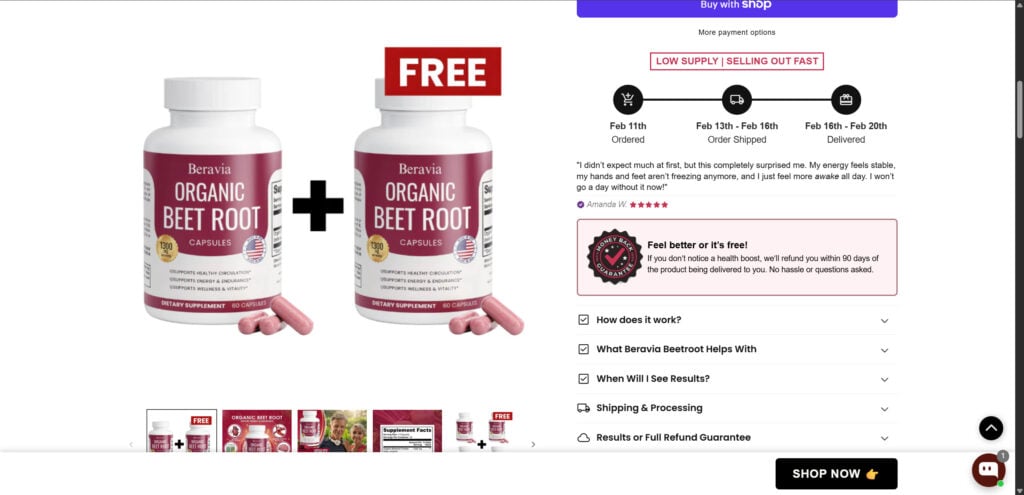
When reviews are presented only on the seller’s site, with no verification, no neutral platform context, and no way to confirm purchase authenticity, they function as persuasion assets.
In this type of funnel, testimonial images can be staged, licensed, or curated to fit the story.
Even if some customers are real, the presentation is designed to remove doubt, not to inform.
Pricing and the markup gap
A major red flag with dropshipping supplement offers is the value mismatch.
The raw product itself is typically inexpensive to manufacture at scale.
The profit is created through storytelling, bundling, and urgency, not through premium formulation.
You often see:
- Buy-more-save-more bundles
- “Free bottle” offers that still increase the total order value
- Add-ons at checkout
- Multiple-unit shipments that some buyers say they did not intend to purchase
If a buyer thinks they are ordering “one bottle to test,” but the order confirmation ends up reflecting two or three bottles, the funnel is doing exactly what it was built to do.
Shipping and returns are where many buyers get stuck
The most consistent problem pattern in these operations is not only product disappointment.
It is what happens after.
Even when a page claims a guarantee, the practical steps can become a maze:
- Slow replies from support
- Vague instructions
- Requirements to return internationally
- Return shipping costs that exceed the refund value
- Requests for photos, forms, and repeated confirmations
- Time windows that are hard to meet once shipping delays occur
If the item ships from China or is fulfilled through a supply chain that routes internationally, the return can become functionally unrealistic.
That is not always stated clearly at the moment of purchase.
The “same product, different name” pattern
Another hallmark of this style of operation is rebranding.
The exact same supplement format, bottle style, and claim set can appear under different brand names and domains.
When negative feedback accumulates, the funnel can rotate:
- New product name
- New site design
- Same core claims
- Same “limited-time” pricing strategy
That does not automatically prove fraud.
But it does explain why these offers can feel like they “appear out of nowhere,” dominate ads for a while, then fade and reappear under a new identity.
Who should be cautious before taking any beetroot supplement
Even when a supplement is “only beetroot,” it can still matter medically for some people.
If you are in any of these groups, you should be cautious and consider asking a clinician before use:
- People on blood pressure medications
- People taking nitrate medications (for chest pain) or certain heart medications
- People using PDE5 inhibitors for erectile dysfunction
- People with kidney issues or a history of kidney stones
- Anyone with significant cardiovascular symptoms that need medical evaluation
A supplement should never be used to self-manage serious symptoms like chest pain, fainting, severe fatigue, or sudden blood pressure changes.
If the marketing suggests you can “skip the medical workup” and just take capsules, that is a major red flag.
The quick reality check
If you strip away the storytelling, Beravia Beetroot Capsules appear to be a generic beetroot supplement offer.
The risks are not mysterious.
They tend to look like this:
- You may receive an ordinary product that does not match the intensity of the claims.
- You may be charged for more units than you intended, depending on how the checkout is structured.
- Returns may be difficult, expensive, or practically blocked by international shipping requirements.
That is why this is less about beetroot itself and more about the sales operation behind it.
How The Operation Works
What follows is the typical step-by-step playbook used to sell products like Beravia Beetroot Capsules at a high markup.
Even if specific details vary, the structure is remarkably consistent.
Step 1: The ad targets a universal pain point
The entry point is usually a social media ad.
The ad does not lead with “beetroot capsules.”
It leads with a problem that feels personal and urgent, such as:
- “Why you are tired all the time”
- “The real cause of poor circulation”
- “A simple fix for cold hands and feet”
- “The nitric oxide problem nobody told you about”
This is not education.
It is targeting.
The goal is to get the click from people who feel a symptom and want a clean explanation.
Step 2: The landing page simplifies your health into one cause
Once you land on the page, the story tightens.
Instead of acknowledging multiple causes of fatigue or circulation issues, it frames one root cause as the main explanation.
This technique works because it reduces uncertainty.
If the page can make you think, “This explains everything,” your brain wants the solution to be equally simple.
That is where the product slides in.
Step 3: A “scientific” mechanism is used as proof
The page leans on scientific-sounding language.
Nitric oxide is real, and dietary nitrates are real.
But the way it is presented is often more persuasive than precise.
You may see:
- Bold decline statistics tied to age
- Broad claims that link nitric oxide to nearly every symptom
- Lists of benefits that read like a medical symptom checklist
This creates an authority halo without providing the level of detail that would allow a buyer to verify the claims.
For example, pages often do not clearly quantify nitrate content, standardization, or what dose is actually used in supporting research.
Step 4: The product is framed as concentrated and special
At this stage the product is positioned as more than “beetroot.”
It becomes “concentrated,” “premium,” “high potency,” or “advanced.”
A large milligram number on the label reinforces that perception.
But milligrams of beet powder are not the same thing as guaranteed active nitrate delivery.
Without transparent standardization, it is mostly a marketing metric.
Step 5: Testimonials are used to collapse doubt
Then come the testimonials.
They are usually written to hit specific triggers:
- “I feel warmer again”
- “Total transformation”
- “My doctor is impressed”
- “I feel 10 years younger”
These statements are powerful because they imply medical validation and dramatic outcomes.
They are also exactly the kind of language that is easiest to write and hardest to verify.
When testimonial photos and names appear only on the brand’s site, without a neutral review platform or verification, you should assume they are curated as marketing content.
Step 6: A “free” offer increases order size
Many pages include a “free bottle” style offer.
In practice, “free” often means:
- You must buy a bundle to qualify
- The total order price increases
- Shipping or handling is built into the final checkout
- The offer is designed to move you away from a one-bottle trial
The seller makes more money on multi-bottle orders, and the buyer becomes less likely to fight for a return because the process is already inconvenient.
Step 7: Checkout design nudges you into more units
This is where “I ordered one and received three” stories often begin.
There are several common mechanisms:
- Pre-selected bundles (the default option is not the single bottle)
- Quantity toggles that are easy to miss
- Upsells that appear like necessary add-ons
- Confirm buttons that move fast through steps without clear summaries
Some buyers only realize what happened when the confirmation email arrives.
Others realize it when the box shows up with multiple units.
Step 8: Payment processing can be opaque
On many dropshipping-style supplement funnels, the payment descriptor on your statement may not match the brand name.
That makes support harder to find and disputes harder to explain if you are not prepared.
It is not always malicious, but it is a known friction point.
Step 9: Fulfillment is routed through an international pipeline
The product may be marketed like a local premium brand.
Fulfillment often tells a different story.
Common outcomes include:
- Tracking numbers that take time to activate
- Long shipping windows
- Packages that originate internationally or move through forwarding partners
- Limited delivery transparency
When a product is mass-produced and shipped through a broad supplier network, the “brand” is mostly a website and an ad budget.
Step 10: The return policy becomes a wall
Even when a page mentions a guarantee, the real experience can be difficult.
Typical friction tactics include:
- Slow or scripted support responses
- Requests for extra documentation (photos, batch numbers, packaging)
- Requirements to ship returns back to China
- Return shipping costs that are not reimbursed
- Time limits that expire due to shipping delays
- Partial refunds offered as “resolution”
In practice, the operation often relies on the reality that many customers will not complete an international return.
That is how the funnel stays profitable even when some buyers are unhappy.
Step 11: If complaints rise, the brand can rotate
If enough negative feedback accumulates, the operation can shift.
New domain, new product name, same pitch.
This is why consumers sometimes see “the same beetroot offer” resurface under a different brand identity.
The product is replaceable.
The funnel is the asset.
What To Do If You Have Bought This
If you already purchased Beravia Beetroot Capsules and now have concerns, focus on practical steps that protect your money and your personal information.
- Find and save your proof of purchase
Save the order confirmation page, confirmation email, receipt, and any tracking number.
Take screenshots of the offer details, pricing, and any guarantee language shown at checkout. - Check your bank or card statement for the exact charge
Look for the transaction descriptor and the final amount.
Confirm whether you were charged for multiple units, shipping, or add-ons you did not intend to purchase. - Review the order confirmation for quantity and subscription language
Look carefully for words like “subscription,” “membership,” “auto-ship,” “monthly,” or “recurring.”
Some funnels hide continuity terms in small print or post-purchase emails. - Contact support in writing and keep it simple
Request three things: your order details, your cancellation status (if applicable), and a clear refund or return instruction.
Keep the message short. Do not argue. Ask for the return address and the required steps. - Set a deadline for a response
If they do not respond within a reasonable window (for example, 48 to 72 hours), prepare to escalate.
Slow support is a common strategy to run out the clock on refund windows. - If you were charged incorrectly, dispute quickly
If you ordered one unit and were charged for more, that is a clear dispute basis.
Contact your card issuer or payment platform and explain that the final charge did not match the intended purchase. - If the product has not shipped, try to cancel immediately
Many sellers will say “processing” for days.
Request cancellation while the order is still in that stage, and keep a copy of the request. - If it arrives and you want to return it, document everything
Photograph the package, label, contents, and the products received.
If they require international return shipping, ask for that instruction in writing and calculate the cost before sending anything. - Do not rely on the supplement for medical issues
If you purchased this due to blood pressure concerns, fatigue, or circulation symptoms, treat those as medical topics, not marketing problems.
A supplement should not replace evaluation, especially if symptoms are persistent or worsening. - Monitor for additional charges
If your order experience felt unclear, keep an eye on your statements for the next 30 to 60 days.
If anything unexpected appears, report it immediately.
The Bottom Line
Beravia Beetroot Capsules are best approached as a high-risk purchase, not a premium health product.
Beetroot as an ingredient is not inherently suspicious, but the way Beravia is marketed checks multiple boxes associated with dropshipping supplement funnels: broad medical-style promises, heavy reliance on unverified testimonials, urgency-driven bundles, and a return process that may require international shipping and become effectively impractical.
If you want beetroot supplementation, you are usually better off choosing a widely distributed product with transparent labeling, stable customer support, and a straightforward domestic return policy.
If you buy Beravia, assume you may receive a generic mass-produced supplement that does not match the intensity of the ads, and assume that getting your money back could be harder than the sales page suggests.









Thank you for your research Lapain. It is very informative.
I’ve found out that the company is based in China, but is apparently entitled to sell Dietary supplements; Nutritional supplements; Food supplements . https://www.trademarkelite.com/trademark/trademark-detail/99603321/BERAVIA-HEALTH
The BERAVIA HEALTH mark is filed in the USPTO classes of Pharmaceutical Products . The legal correspondent for BERAVIA HEALTH trademark is CHEN CHEN, 6TH FLOOR,NORTH BUILDING,DAHENG TECHNOLOGY PLAZA, 3 SUZHOU STREET,HAIDIAN DISTRICT BEIJING, 100080 China . The current status of the BERAVIA HEALTH filing is NEW APPLICATION FILED.
Based on ZHENZHOU HEZHE NETWORK TECHNOLOGY CO., LTD., the BERAVIA HEALTH trademark will be used in the following business: Dietary supplements; Nutritional supplements; Food supplements .
Best Wishes
Ron
Ron, thank you for sharing this. One important point: a trademark filing or registration does not validate a product’s quality, claims, or business practices. It simply covers branding rights, so it should not be treated as proof that the supplement is legitimate or effective.