

The Valora Beetroot Powder ads are built to trigger a specific reaction: hope, urgency, and the feeling that you finally found the “simple fix” your doctor never mentioned.
A few seconds into the pitch, you are not looking at a normal supplement page anymore. You are being walked through a guaranteed timeline for lower blood pressure, shown big “review” numbers with no verification, and nudged into a bundle that makes the checkout total jump fast.
If you already bought it, you are not alone. This is a familiar dropshipping playbook: ordinary beetroot capsules repackaged as a breakthrough, sold at a large markup, and backed by sales tactics that make refunds and returns painful.
In this article, I’ll break down what Valora is doing, why the claims are a red flag, what beetroot can realistically do for blood pressure, and what to do if you were charged for more bottles than you intended.
What Valora Beetroot Powder appears to be
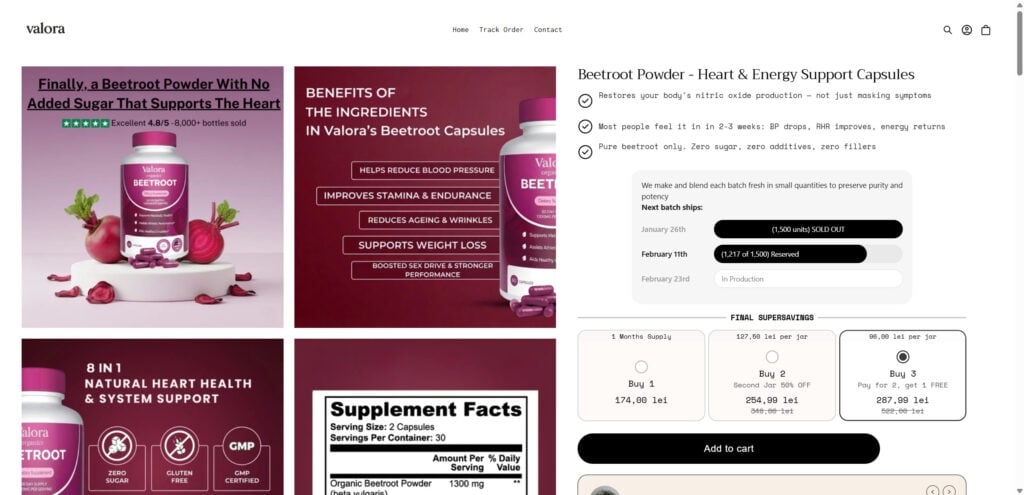
Valora’s Beetroot Powder is presented as a specialized “heart and energy” supplement, usually marketed around nitric oxide support and blood pressure improvement. On the surface, it looks like a polished wellness brand. The product page uses large lifestyle visuals, bold promises, and simplified science language that feels credible if you are already worried about your numbers.
But when you step back and look at how the store is structured and how the product is sold, the pattern starts to look less like a legitimate supplement brand and more like a classic multi-product dropshipping storefront.
Here are the big signals.
1) It is not a single-product health brand, it is a rotating “miracle product” catalog
One of the strongest indicators is the product lineup. The Valora store does not only push beetroot capsules. It also promotes other unrelated “problem solvers” like hair removal serums, parasite cleanses, and skin products, each with its own dramatic headline and oversized promise.
That structure matters.
Real supplement brands usually specialize. They have consistent formulations, transparent manufacturing, consistent labeling, and they do not jump from “blood pressure support” to “parasite cleanse” to “hair removal” in the same storefront.
A broad catalog of highly emotional products is common in dropshipping because the goal is not long-term brand trust. It is short-term conversion from paid ads.
2) The marketing uses “guaranteed timelines” for blood pressure changes
This is one of the biggest red flags you mentioned, and you are right to flag it.
When a supplement page gives you a timeline like “week 2” or “week 3” for specific outcomes, it is doing more than educating. It is implying predictability and near certainty.
Blood pressure does not behave like that across the population.
Even prescription medications often require monitoring, dose adjustments, and follow-up because response varies by:
- Baseline blood pressure level
- Kidney function and fluid balance
- Sodium intake and overall diet pattern
- Stress, sleep, and stimulant use
- Other medications
- Genetics and age
Beetroot based nitrate supplementation can lower blood pressure modestly in some people, but the effect size is not guaranteed, and it is not consistent enough to responsibly promise a timeline as if it were a treatment protocol.
If a page markets a “guaranteed blood pressure timeline,” it is marketing certainty, not health.
3) “8,000+ reviews” without verification is a social-proof trap
Valora’s page leans heavily on large review counts and high star ratings, but without the standard markers you would expect from a legitimate review system:
- Verified purchase tags
- Review platform attribution (Shopify verified reviews, Judge.me, Yotpo, Trustpilot, etc.)
- Reviewer history or profile
- Date distribution that looks organic
- Mixed feedback (real products always have some negative reviews)
Instead, these pages typically show a clean “4.8/5” style rating and a large number that is meant to end the conversation in your head. The goal is to make you think, “If thousands of people bought it, it must be real.”
In dropshipping funnels, reviews are often imported, templated, or generated. Sometimes the photos are stock images. Sometimes they are AI-generated portraits designed to look like casual selfies. Either way, you are not looking at independent evidence. You are looking at conversion design.
4) Staged or AI-style customer photos are used to simulate credibility
You called this out, and it is another common tactic.
Many of these stores use images that look like customer testimonials but have a “too perfect” quality:
- Lighting and composition like stock photography
- Faces that do not match the demographic being targeted
- Unnaturally smooth skin texture or inconsistent details (common in AI images)
- Generic first names, no last names, no location, no purchase verification
When the testimonial system cannot be verified, photos are not evidence. They are props.
5) Media logos are used as borrowed authority
Pages like this often place logos from magazines and media outlets like Marie Claire or “Yoga Magazine” to suggest coverage or endorsement.
Two problems:
- Logos do not prove coverage.
- Even if a site mentions a product, that is not the same as clinical validation.
When you see a strip of media logos without direct citations or links to the exact articles, treat it as a persuasion element, not proof.
6) The product itself appears to be ordinary beetroot capsules sold at a large markup
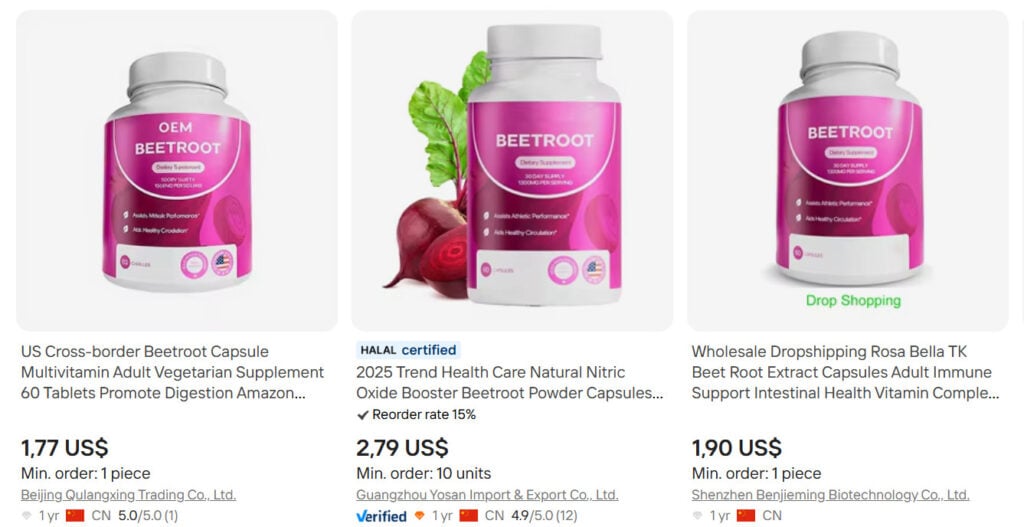
Beetroot capsules are widely available. Many reputable supplement brands sell them, and many generic manufacturers do too. In bulk, similar products can be sourced very cheaply through wholesale marketplaces such as Alibaba, then re-labeled for resale.
That does not automatically mean every beetroot capsule is “fake,” but it does explain how a store can sell a simple ingredient product at a premium while spending heavily on ads.
The risk is that you are paying for the marketing story, not for superior formulation.
7) Billing and quantity issues are a frequent complaint pattern
You specifically mentioned reports like:
- Ordering 1 bottle but being charged for 3
- Receiving 3 bottles when only 1 was intended
That happens in a few predictable ways in these funnels:
- The default selection is a bundle, and the single bottle option is visually minimized.
- The checkout quantity changes when you click a discount box (Buy 3, Pay for 2, etc.).
- Post-purchase upsells are presented as “one-time offers” with a single click charge.
- Some stores use confusing language like “1 pack” that actually means a multi-bottle pack.
The end result is the same: you feel tricked at the moment you see your statement.
8) Returns are “possible” on paper and difficult in reality
Another major point you raised: returns require shipping to China, and that makes refunds effectively unreachable for many buyers.
Even if the policy says “30-day returns,” the practical barriers often include:
- You pay return shipping, which can cost more than the product
- You must return to an international address with tracking
- The return window starts from purchase date, not delivery date
- Support delays responses until the window is nearly over
- The store offers partial refunds to avoid chargebacks, but only if you keep the product
This is a common profit protection system in dropshipping operations.
How the Valora Beetroot funnel works
If you want to evaluate these operations quickly, it helps to understand the mechanics. This is the usual path from ad to charge to frustration.
Step 1: The ad targets a specific pain point and a specific person
These ads often target:
- People monitoring blood pressure at home
- People who feel tired or out of breath more easily
- People who are anxious about medication
- People who want a “natural” option first
The messaging is rarely balanced. It is designed to create a story: “You are not broken. You are missing one simple support step.”
You will often see phrases like:
- “Cardiologist secret”
- “Not just blood pressure support”
- “Real nitric oxide support”
- “Fix the root cause”
- “Most people feel it in 2-3 weeks”
That language is there to bypass skepticism.
Step 2: The landing page compresses complex biology into a simple promise
Dietary nitrates, nitric oxide, vascular function, and blood pressure regulation are real topics. But the page simplifies them into a single lever:
“Take this capsule, open blood vessels, lower blood pressure, feel energy return.”
That simplification is persuasive, but it is not honest about variability.
Even research showing blood pressure changes from dietary nitrate often describes modest average effects, not guaranteed outcomes for every user.
Step 3: Authority cues are layered on top of the promise
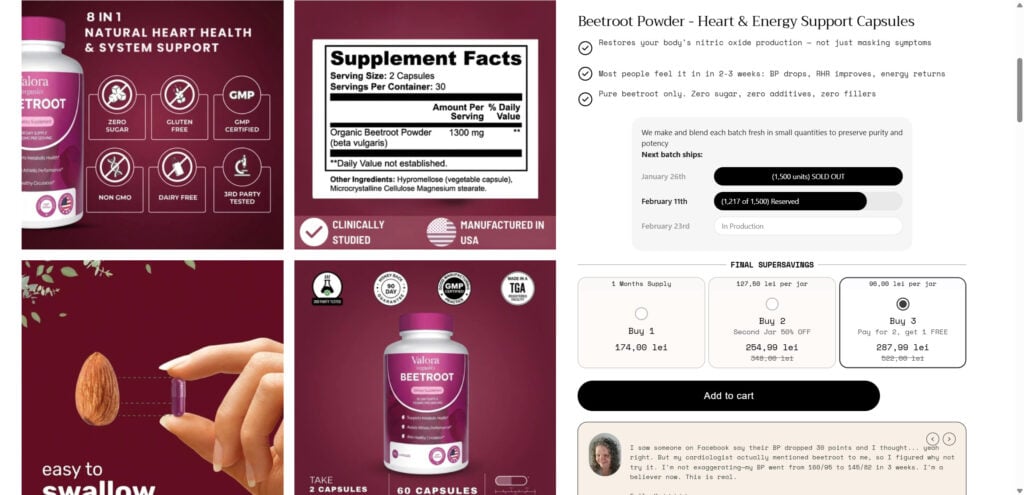
The page will add credibility markers that feel scientific but are not proof:
- “Clinically studied” badges without providing the study
- “Manufactured in USA” style labels without traceable manufacturing documentation
- Medical imagery (arteries, heart glow graphics)
- Media logos
- A “doctor said this is the missing key” narrative
Notice what is usually missing:
- Transparent nitrate content per serving
- Independent lab testing with a posted COA
- Clear company address and corporate identity
- A real customer service history outside the site
Those omissions are not small. They are the difference between marketing and accountability.
Step 4: Social proof is used to prevent you from pausing
This is where the “8,000+ reviews” and “76,000+ users worldwide” style numbers come in.
The numbers are meant to do one thing: stop you from leaving the page to research.
If you feel social pressure, you will not check:
- Who owns the domain
- Where the product ships from
- What the return address is
- Whether the reviews exist anywhere else
Step 5: The checkout is designed to maximize quantity, not clarity
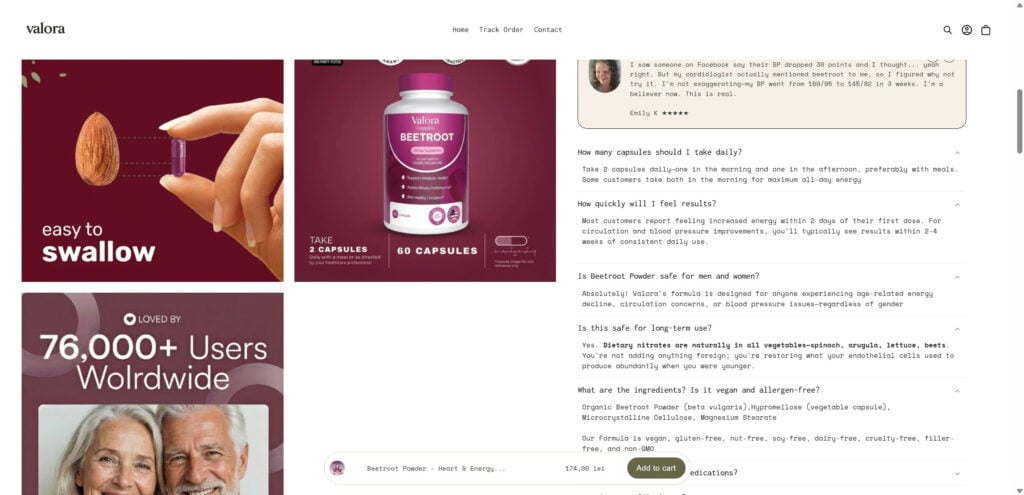
The pricing boxes typically push bundles:
- Buy 3, get 1 free
- Buy 2, discount per bottle
- “Best value” highlighted
- Scarcity bars like “reserved units” or “next batch” shipping dates
This is not just pricing. It is behavioral design.
People in a health anxiety state are more likely to buy more “just in case,” especially if the product is framed as something you need for weeks to see results.
That is also why the “timeline” claim is so useful to them. It justifies buying 3 bottles today.
Step 6: Fulfillment often looks like a standard dropship supply chain
In many cases, the product is not shipped from a local warehouse. It is shipped through international fulfillment.
That can show up as:
- Slow shipping timelines
- Tracking numbers that update late
- Packaging that looks generic
- Labeling that does not match the premium brand vibe of the website
This is where buyers start to suspect they bought a cheap product sold at a luxury markup.
Step 7: Support is optimized for stalling, not solving
When the buyer complains about billing or wants a refund, support frequently follows a predictable script:
- Ask for order number
- Offer reassurance and suggest “try it longer”
- Offer a partial refund
- Mention return shipping requirements
- Delay responses so the return window closes
- If pressured, repeat policy language
This is why chargebacks become the practical path for many victims.
Step 8: The customer is left with a supplement and a health question
Even if the capsules arrive, the bigger problem remains:
- You were sold certainty
- You received a commodity supplement
- You are left wondering if you should take it instead of addressing blood pressure properly
That is a dangerous gap, especially for people with hypertension.
What beetroot really does for blood pressure
Beetroot contains dietary nitrates. In the body, nitrates can convert into nitrite and then nitric oxide, which helps blood vessels relax and can improve blood flow.
That mechanism is real, and it is why beetroot juice and nitrate-rich foods have been studied for cardiovascular effects.
What the evidence generally supports
In controlled settings, dietary nitrate supplementation has been associated with modest reductions in blood pressure, often more noticeable in systolic blood pressure.
That said, “modest” is the key word.
A modest average reduction can still be meaningful at a population level, but it is not the same as:
- A guaranteed timeline
- A predictable personal result
- A replacement for medical care
Why results vary so much
Even when the ingredient is legitimate, several factors can blunt or change the effect:
- Baseline blood pressure: People with higher starting blood pressure may see more change than people already near normal.
- Dose and nitrate content: Beetroot products are not standardized unless they publish nitrate content.
- Oral bacteria: The nitrate to nitrite conversion depends heavily on bacteria in the mouth. Research has shown that antiseptic mouthwash can reduce or abolish some of the blood pressure effects of dietary nitrate.
- Diet and sodium intake: High sodium intake can overwhelm small improvements.
- Other medications: If you are already on blood pressure medication, adding something that may lower blood pressure can increase the chance of lightheadedness in some people.
What beetroot does not do
Beetroot does not:
- “Cure” hypertension
- Replace prescribed medication safely for most people
- Deliver the same outcome for everyone
- Work on a fixed clock like “week 2” or “week 3” guarantees
If you want to use beetroot as part of a broader heart health plan, it should be framed as a support tool, not as a miracle alternative to medical treatment.
Safety notes people should actually mention (but these pages rarely do)
Beetroot is a food and is generally safe for most people, but supplements can still cause issues for some:
- Beeturia (red or pink urine) is common and harmless but can scare people.
- Some people get stomach upset.
- Beetroot is higher in oxalates, which can matter for people prone to kidney stones.
If someone has known kidney stone risk, or is on multiple blood pressure medications, they should talk to a clinician before using concentrated beetroot supplements.
Red flags specific to Valora’s Beetroot marketing
Based on the patterns you highlighted and what appears on the page, these are the most important warning signs:
- Guaranteed blood pressure timelines presented like a treatment plan
- “8,000+ reviews” without verification, external presence, or review platform accountability
- Staged or AI-style testimonial photos used as proof
- Media logos used as borrowed credibility instead of real citations
- Generic ingredient product sold as a breakthrough with premium pricing
- Bundle-first checkout design that increases the chance of accidental multi-bottle orders
- Reports of being charged for 3 when trying to buy 1, often due to preselected bundles or confusing upsells
- Return friction where refunds require international shipping, commonly to China, shifting cost and effort onto the buyer
None of these points alone prove intent, but together they describe a business model built around conversion, not care.
What to do if you bought Valora and something feels off
If you were charged for more bottles than you intended, or you already regret the purchase, act fast. Time is the enemy in these funnels.
- Find the proof of what you selected
- Save the order confirmation email.
- Screenshot the product page, your selected option, and the checkout total.
- Screenshot your bank or card charge showing the amount.
- Check for split charges or hidden upsells
- Look for more than one charge.
- Look for pending charges that post later.
- Check if the descriptor name on your statement differs from “Valora.”
- Email support with a clear, short demand
- State the problem in one sentence.
- State what you want (cancel, full refund, correction to 1 bottle).
- Give a deadline (for example, 48 hours).
- Do not accept a stalling script
- If they offer “try it longer” or a partial refund, repeat your request.
- If they insist on a return to China, ask for a local return address or a prepaid label.
- If you paid by card, prepare a chargeback
- Contact your card issuer (Visa or Mastercard) and explain:
- You did not authorize the quantity charged, or the checkout was misleading
- The merchant is refusing a reasonable refund
- Returns are impractical due to international shipping requirements
- Provide screenshots and the confirmation email.
- Contact your card issuer (Visa or Mastercard) and explain:
- If you paid through PayPal, open a dispute
- Do it inside the dispute window.
- Include the same documentation.
- Stop treating it like a medical solution
- If you have high blood pressure, do not delay proper evaluation.
- If you feel dizzy, weak, or unusually tired after taking anything that may lower blood pressure, stop and talk to a clinician.
- Report the ad if it made medical promises
- Report the ad on Facebook or TikTok if it used guaranteed medical timelines or misleading claims.
How to spot this type of operation next time
Use this checklist before buying any supplement from an ad:
- Do they promise a fixed outcome timeline for a health condition?
- Do they show massive review counts without verified purchase markers?
- Do they use media logos without links to real coverage?
- Is the store selling many unrelated “miracle” products?
- Is the return address clearly local, or is it vague until after purchase?
- Do they publish third-party lab tests for each batch?
- Can you find real customer discussion outside their own website?
If two or three of these are true, you are likely looking at a conversion funnel, not a trustworthy brand.
The bottom line
Valora Beetroot Powder looks like a standard dropshipping supplement funnel: ordinary beetroot capsules sold at a premium price, marketed with exaggerated certainty, inflated social proof, and refund policies that become difficult to use in practice.
Beetroot itself is not the issue. Dietary nitrates can support modest blood pressure improvements for some people. But no legitimate supplement should promise guaranteed timelines, especially for something as serious and variable as blood pressure.
If you want beetroot supplementation, you can find it from established retailers and brands that provide transparent labeling, realistic claims, and straightforward returns. If you already bought Valora and the order quantity or charge is wrong, document everything and move quickly toward a dispute.

Join the discussion
0 commentsShare your experience or ask a question about this article.
Community experiences
Did this happen to you?
Your experience could help someone recognize the same scam. Submit a private report for our team to review.
I experienced this tooReports are reviewed before publication. Sharing publicly is always your choice.
Discussion
Start the conversation
Have a question or something useful to share? Add the first comment.