

Gifted musician. Charming personality. And…crossbow enthusiast? Social media posts advertising Blake Shelton gifting free RAVIN crossbows are enticing bait for a devious scam. This guide will help you recognize and steer clear of this fraudulent promotion.
Blake’s celebrity makes him an ideal face for scammers to falsely associate with fake product giveaways. But armed with knowledge, fans can avoid their underhanded traps. Read on to uncover their deceitful tactics and learn how to protect yourself online.
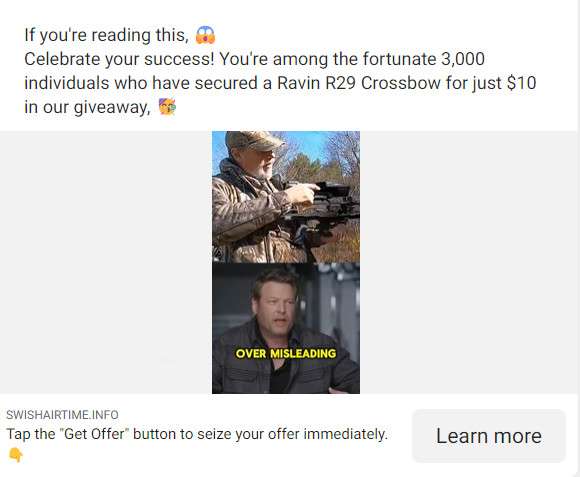
Scam Overview
This fraudulent scheme exploits Blake Shelton’s celebrity status and likeness to promote completely fabricated RAVIN R29 crossbow giveaways across social platforms. It ensnares victims by constructing an elaborate promotional facade before stealing their money through concealed subscription fees.
The scam heavily utilizes sponsored video ads and posts on sites like Facebook, Instagram, TikTok and YouTube. These ads utilize deepfake AI technology to accurately mimic Blake announcing exclusive deals gifting free RAVIN R29 crossbows worth over $2,000 to select supporters.
In the AI-generated footage, Blake cites various dubious reasons to justify gifting the pricey crossbows, like needing to clear excess inventory or products being mislabeled. The ads strongly compel viewers to click through to claim their free crossbow before it’s “too late.”
Some examples of the fictional video ad captions include:
- “Y’all, thanks to a supplier mix-up we’ve got too many RAVIN R29 crossbows! First 3000 fans to click below get one free!”
- “Hey y’all! We’re giving away 1000 RAVIN crossbows for FREE because of a labeling error! Click fast before they’re gone!”
- “We’ve partnered with RAVIN to gift crossbow sets from cancelled big retailer orders! Click below to claim this exclusive giveaway!”
The consistent scam narrative promotes urgency, exclusivity, and high perceived value of the fake promotion. But it’s completely bogus.
After luring victims via social media, the scam directs them through a sequence of sophisticated deceptions to eventually steal personal and financial data.
First, the social posts redirect to sham “news” articles published on fake domains impersonating authoritative outlets like Fox News, USA Today, and more. These fluent articles echo the false narrative about Blake’s crossbow gift partnership.
High-resolution product images make the free offer seem even more realistic. The articles use SEO keywords and natural writing to boost their search visibility, lending to their façade of authority.
After consuming the fake news reports, users reach mocked up RAVIN product listing pages showcasing the R29 crossbows offered for free or huge discounts.
These showcase sites utilize stolen RAVIN assets like the signature fonts and color schemes to appear legitimate. Users see the familiar RAVIN branding they associate with authenticity.
The only “fee” mentioned is a reasonable $4.99 – $9.96 shipping and handling cost. This is itself another ruse, as revealed later.
With defenses lowered by the perceived amazing deal, users are prompted to “confirm eligibility” by providing personal information and crucially, credit card details to cover shipping.
In reality, by submitting their card number, victims are auto-enrolled into costly monthly subscription plans without consent, often exceeding $79 per month. No free products are ever delivered.
This extremely devious scam relies on deepfake media, fake websites, and faulty celebrity associations to successfully dupe consumers. The bait of free crossbows from Blake Shelton himself drives engagement through its sequence of false promises.
Ultimately, it exploits Blake’s reputation and fame by forging his endorsement through AI. This allows the scammers behind the facade to steal user data and money before the deceit is uncovered.
This scam has been also investigated by Jordan Liles on his YouTube channel, where he offers a detailed video on the subject. We recommend watching his content for a comprehensive understanding of the scam.
Next, let’s break down exactly how scammers carry out this scam from start to finish.
How The Scam Works
Here is an in-depth look at how this Blake Shelton crossbow giveaway scam operates at each step to deceive and exploit targets:
Stage 1: Deceptive Social Media Ads
The scam starts with sponsored video and image ads on platforms like Facebook, Instagram and YouTube. These ads use deepfake AI to accurately mimic Blake announcing an exclusive RAVIN crossbow giveaway.
Reasons like overstock and order cancellations are cited to justify gifting free R29 crossbows worth over $2,000. Urgency and scarcity tactics encourage swift action.
Stage 2: Fake News Articles Add Credibility
Clicking the social ads leads to sham “news” articles on fraudulent domains posing as Fox News, USA Today, and other reputable sites.
These articles reinforce the fictional crossbow promotion, making it seem like Blake’s “limited-time” RAVIN partnership is highly exclusive. This builds up the scam’s legitimacy.
Stage 3: Phishing Forms Masquerading as RAVIN
Next, the scam guides users to forged RAVIN order pages. These mimic the real RAVIN website while touting the made-up Blake partnership.
Users are pushed to “claim” their free crossbow by providing personal info and crucially, credit card details – solely to cover a small $9.95 shipping fee.
In reality, these sites are not associated with RAVIN at all. The credit card data enables unwanted subscription fees.
Stage 4: Auto-Enrollment in Recurring Subscriptions
Although users believe they only paid shipping, their card details automatically sign them up for costly monthly subscriptions without consent.
These range from $79.99 to $99.99 per month for useless memberships providing vague perks unrelated to RAVIN.
Stage 5: No Free Crossbows Arrive
Despite moving through the entire scam expecting Blake’s promised free RAVIN R29, victims ultimately receive nothing.
The fictional gift was simply bait to harvest personal and financial data through the scam’s sequence of false fronts.
What To Do If You Are a Victim
If you unfortunately fell for the fake Blake Shelton RAVIN crossbow giveaway, here are some steps to take:
- Immediately notify your credit card company of the fraudulent charges so they can block payments and begin refunds. Cancel any active subscriptions.
- Closely monitor statements for additional suspicious charges and dispute them right away.
- Consider changing any account passwords you entered on the scam websites as a safety precaution.
- Place fraud alerts on your credit reports and renew them every 90 days.
- Report the scam to the FTC to join other complaints against the criminals.
- Leave comments on Blake’s official social media warning other fans. Also report the deceptive ads.
- Spread awareness about the scam to family and friends to help protect them.
- Seek credit counseling if the fraud causes financial hardship. Counselors can help manage debt and advocate on your behalf.
Stay persistent fighting the scam’s impact. With fast action and increased vigilance, you can minimize the damage and help bring these criminals to justice.
Frequently Asked Questions About The Blake Shelton Crossbow Giveaway Scam
1. How does the Blake Shelton crossbow giveaway scam work?
The scam starts by using AI-generated deepfake videos and images to portray Blake Shelton announcing an exclusive giveaway for free RAVIN R29 crossbows. Deceptive ads promote the falsified gift promotion and urge viewers to click through quickly before it expires.
Clicking the link leads victims through a funnel of fake news articles, phishing forms disguised as RAVIN pages, and requests for personal/payment information under the pretense of a small shipping fee. In reality, credit card details are used to auto-enroll victims in expensive recurring subscription plans without consent. No free crossbows are ever delivered.
2. What platforms does this scam advertise on?
The fraudulent Blake Shelton crossbow giveaway promotions typically appear as sponsored posts or video ads on Facebook, Instagram, YouTube, and other major social media sites. They leverage Blake’s celebrity status and these platforms’ wide reach to target many victims.
3. Do the scam ads use Blake Shelton’s real name and image?
Yes, the scam ads feature Blake’s actual name, image, and likeness. However, they are fabricated using AI deepfake technology without Blake’s real participation or consent. The convincing deepfakes portray Blake announcing the fictional crossbow deals. This faulty celebrity association tricks victims into believing the promotions are real.
4. Does Blake Shelton actually have a partnership with RAVIN crossbows?
No. Blake Shelton has no legitimate partnership or affiliation with RAVIN crossbows. The fabricated giveaway promotion is completely unauthorized and uses Blake’s identity illegally. RAVIN crossbows are also not involved with the scam.
5. How can I recognize these scam ads are fake?
Warning signs include unrealistically large discounts or free gifts that seem too good to be true, high-pressure tactics urging swift action, and suspicious links redirecting off social media rather than the official RAVIN site. Verify any celebrity endorsement claims directly with the brands before providing personal information.
6. What should I do if I fell victim to this crossbow scam?
Immediately contact your credit card company to cancel recurring subscription charges, then monitor statements closely and dispute any additional fraudulent fees. Change compromised account passwords, enable two-factor authentication, and place fraud alerts with credit bureaus. Report the scam to the FTC and social media sites used.
7. How can I help stop this Blake Shelton crossbow scam?
Spread awareness about the scam by reporting fake ads and leaving comments warning others on Blake’s official social media pages. Share your experience to educate family and friends to recognize similar celebrity-tied giveaway scams. The more light shed on these tactics, the less victims they can claim.
8. How can I protect myself from similar celebrity-based scams?
Be skeptical of any promotion featuring a celebrity endorsing expensive free gifts or major discounts. Verify endorsement claims on official brand websites. Avoid entering personal information on questionable domains. If an offer appears suspiciously too-good-to-be-true, it always is. Exercise caution sharing data online.
9. Who should I contact about fraudulent use of Blake Shelton’s identity?
You can report unauthorized use of Blake Shelton’s name/image to his official management team at Schmidt Relations. This helps warn Blake’s legitimate representatives about the scam’s misuse of his likeness against fans.
10. What legal recourse exists against celebrity endorsement scams?
Scammers using a celebrity’s image or proprietary assets without permission may face legal consequences for intellectual property theft and false advertising. Victims can pursue fraud charges and class action lawsuits. Reporting these scams helps build cases against the criminals.
The Bottom Line
This Blake Shelton crossbow giveaway scam reveals the alarming lengths fraudsters take to falsely connect celebrities with fake product promotions. It’s a cautionary tale for consumers.
The promise of free, expensive merchandise is incredibly enticing. But online users must stay skeptical of giveaways that look too good to be true or use deepfakes portraying celebrity endorsements.
Verify claims directly with official brand sources. Avoid providing personal data to questionable websites. If an offer seems suspicious, it certainly is.
We hope this guide can help protect more fans from predatory scams attempting to use celebrities like Blake Shelton as bait. Stay alert online and think twice when your favorite star offers you the chance to win extravagant prizes. It’s almost certainly a hoax orchestrated by scammers.

Join the discussion
0 commentsShare your experience or ask a question about this article.
Discussion
Start the conversation
Have a question or something useful to share? Add the first comment.