

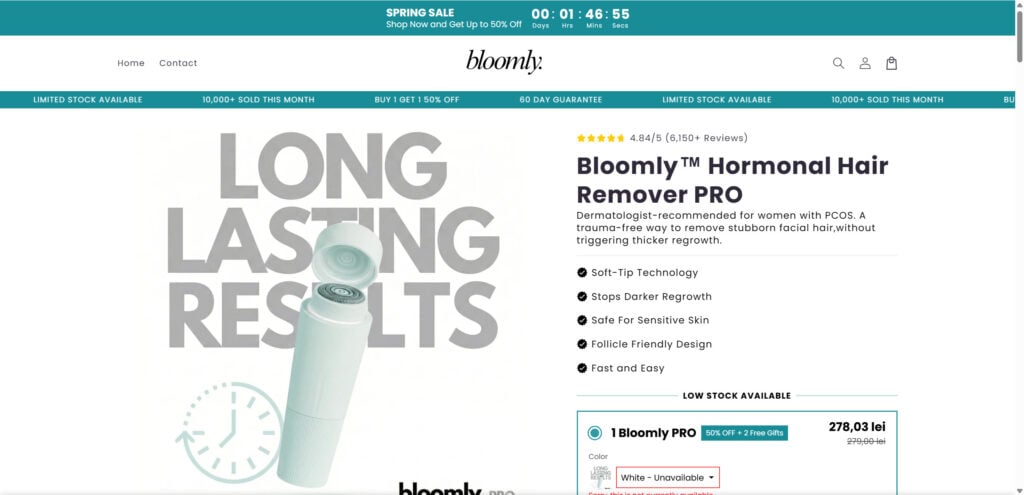
Bloomly Peach Fuzz Remover, also promoted as Bloomly Hormonal Hair Remover PRO, is being advertised online as a facial hair removal device designed for women with PCOS, menopause-related hair growth, chin hair, upper-lip hair, jawline hair and sensitive skin.
The product is marketed as a “trauma-free” solution that can remove stubborn facial hair without triggering thicker regrowth, irritation, ingrown hairs, bumps, redness or dark spots. It is also promoted as dermatologist-recommended, FDA-registered, CE certified and specifically engineered for hormonal facial hair.
That sounds impressive. But the sales page raises serious red flags.
Bloomly appears to follow the same pattern as many questionable beauty-product funnels previously covered on MalwareTips.com: exaggerated social media claims, AI-looking ads and images, fake or unverifiable doctor endorsements, emotional testimonials, inflated customer numbers, urgency tactics, cheap generic gadget risks, confusing refund terms and subscription/refill language buried in policy pages.
The device may ship. But that does not mean the marketing is trustworthy. The bigger issue is that Bloomly appears to take a common lipstick-style facial hair trimmer and promote it as a specialized solution for PCOS and hormonal hair, while charging a premium price and surrounding the product with questionable claims.
What Is Bloomly Peach Fuzz Remover?
Bloomly Peach Fuzz Remover is an electric facial hair remover shaped like a lipstick tube. The sales page calls it the “Bloomly Hormonal Hair Remover PRO” and presents it as a tool for women dealing with stubborn facial hair, especially hair linked to PCOS, menopause, thyroid changes or hormonal imbalance.
The website claims the device can help with:
- Chin hair
- Upper-lip hair
- Jawline hair
- Neck hair
- Peach fuzz
- Coarse hormonal facial hair
- Sensitive skin irritation
- Ingrown hairs
- Dark spots
- Makeup application
The product is listed at $59.99, with a crossed-out price of $119.99 and a “SAVE 50%” discount message. It is sold in colors such as white, pink and beige.
The basic concept is not new. Lipstick-shaped electric facial hair removers have been sold for years under many brands at much lower prices. What makes Bloomly different is not necessarily the device itself, but the aggressive marketing angle around PCOS, hormonal hair and emotional insecurity.
Why Bloomly Raises Scam Concerns
Bloomly raises concerns because the marketing appears to go far beyond what a small electric facial hair trimmer can realistically prove.
A facial hair remover can trim hair at the surface. It may help remove peach fuzz or short facial hair. It may be more convenient than tweezing or waxing for some users. But it does not treat PCOS, change hormones, prevent hair growth at the root, permanently stop hair from coming back or medically solve hirsutism.
The red flags include:
- Claims that it is made for PCOS and hormonal hair
- Claims that other methods trigger thicker or darker regrowth
- Claims that Bloomly stops darker regrowth
- Claims that it fades dark spots over time
- “Dermatologist-recommended” language without clear verification
- A doctor testimonial that is difficult to verify
- “FDA-registered facility” wording that can mislead buyers
- Huge customer-count claims such as 800,000+ customers
- “10,000+ sold this month” urgency language
- “Limited stock” and “sold out 12 times” pressure tactics
- Repeated testimonial blocks that look copy-pasted
- A refund policy that is much less simple than the product-page guarantee
- A terms page that appears to reference another brand entirely
- Subscription/refill policy language despite the product page claiming a one-time purchase
This is not how a transparent beauty device brand should sell a simple facial trimmer.
Fake or Exaggerated Social Media Claims
Bloomly is the type of product commonly promoted through social media ads that target insecurities around facial hair.
These ads may suggest that women with PCOS or menopause-related facial hair can finally stop plucking, stop waxing, stop hiding their chin, stop canceling plans, avoid laser and regain confidence in less than a minute.
That kind of emotional messaging can be very persuasive. But it is also risky when the product is essentially a surface-level hair trimmer.
A device like this does not remove hair from the root. It does not stop follicles from producing hair. It does not change androgen levels. It does not treat the underlying cause of PCOS-related facial hair. It simply cuts visible hair at the surface.
That distinction matters. A customer may buy Bloomly believing it is a specialized solution for hormonal hair, when it may perform similarly to many cheaper facial hair removers already sold online.
The “Hair Grows Back Thicker” Claim Is Misleading
One of Bloomly’s core claims is that plucking, waxing or harsh chemicals can traumatize the follicle and cause thicker, darker or coarser regrowth. The page then presents Bloomly as a safer option that cuts hair at the surface without triggering that response.
This framing is questionable.
Shaving or trimming hair at the surface does not change the hair’s thickness, color or growth rate. Hair can feel stubbly after being cut because it has a blunt tip, but the follicle itself has not been transformed by the act of shaving.
The Bloomly pitch uses a common fear: “If I remove facial hair the wrong way, it will come back worse.” That fear is especially powerful for women dealing with PCOS or menopause-related hair. But using that fear to sell a basic electric trimmer is a red flag.
A facial trimmer may be convenient. It should not be sold through exaggerated claims about follicle trauma and hormonal regrowth unless the seller has strong, product-specific evidence.
AI Videos and Fake-Looking Images
Many viral beauty-product funnels now use AI-generated videos, edited images and synthetic testimonials to make products look more credible than they are.
With Bloomly-type ads, AI can be used to create:
- Fake women discussing PCOS struggles
- Fake dermatologist-style explainers
- Fake before-and-after images
- Fake “doctor recommendation” clips
- Fake influencer reactions
- Fake user-generated content
- Fake emotional testimonials
- Synthetic voiceovers
This matters because facial hair is a sensitive issue. Ads can make people feel seen, understood and desperate for a solution. If those ads use fake visuals or AI-generated people, the customer is not making a decision based on real evidence.
A trustworthy company should not need questionable AI-style content or emotional manipulation to sell a facial hair device.
The Doctor Endorsement Is a Major Red Flag
The Bloomly page includes a testimonial-style quote attributed to “Dr. Jonathan White, MD,” presented as a dermatologist recommending the device.
This is a major credibility issue.
The page does not provide a medical license number, clinic profile, professional website, verifiable biography, board certification details, publication history or any way to confirm that this doctor actually exists or endorsed the product.
Fake doctor endorsements are extremely common in beauty, supplement and medical-device scams. A name, white-coat image and “MD” label can make a product feel legitimate, even when there is no independent proof behind it.
If a product relies on a doctor recommendation, the company should clearly disclose:
- The doctor’s full identity
- Medical license status
- Specialty and board certification
- Whether the doctor was paid
- Whether the doctor tested the product
- Whether the quote is real
- Whether the endorsement complies with advertising laws
Bloomly does not provide that level of transparency.
“FDA-Registered Facility” Does Not Mean FDA Approved
Bloomly uses the phrase “FDA-registered facility” in its marketing.
This wording can mislead consumers. FDA registration is not the same as FDA approval, FDA clearance or FDA authorization of a product’s effectiveness. A registered facility listing does not prove that the device works as advertised.
Many questionable products use FDA-related language because it sounds official. Customers may read “FDA-registered” and assume the product has been reviewed or approved by the government. That is not what the phrase means.
If Bloomly wants to imply medical-grade credibility, it should provide clear evidence of the product’s actual regulatory status, not just facility-related wording.
CE Certified and Dermatologist-Tested Claims Need Proof
Bloomly also uses terms like “CE certified” and “dermatologist-tested.”
These phrases can sound impressive, but they are often used loosely in e-commerce.
Important questions include:
- Which exact device was tested?
- What standard was used?
- Which laboratory performed the testing?
- Where is the certificate?
- Is the CE mark valid for this product category?
- Who conducted the dermatologist testing?
- How many users were included?
- Were results published?
- Were sensitive-skin claims independently verified?
Without documentation, these phrases are marketing claims, not proof.
A serious brand should make compliance documents, testing details and manufacturer information easy to verify.
Cheap Rebranded Gadget Concerns
One of the biggest red flags is that Bloomly appears similar to many low-cost lipstick-style facial hair removers sold on Amazon and other marketplaces.
These devices usually share the same general design:
- Lipstick-shaped body
- Small rotary head
- LED light
- Battery or USB charging
- Gold or metal-tone trimming head
- Claims of painless facial hair removal
- Use on upper lip, chin, cheek and peach fuzz
- Portable purse-friendly design
Many similar devices sell for a fraction of Bloomly’s price.
That creates the possibility that Bloomly is a generic or lightly rebranded facial trimmer being sold through a high-pressure marketing funnel. The product may not be a unique medical-grade PCOS device. It may simply be a common beauty gadget with a more emotional sales story.
This is a common dropshipping-style pattern: source a cheap beauty device, give it a polished brand name, build a landing page, add exaggerated claims, run social media ads, push urgency discounts and sell it at a premium.
The “Only Available Here” Claim Is Suspicious
Bloomly warns shoppers not to buy “fakes” on Amazon or eBay and says the product is only available through its site.
This is a common tactic used by questionable e-commerce brands. It discourages comparison shopping and makes customers afraid of cheaper alternatives.
The problem is that the same category of device is widely available elsewhere. Even if Bloomly has different branding or packaging, shoppers should compare it to similar facial hair removers before paying a premium.
A legitimate company can explain what makes its product different with clear specs, testing and manufacturing details. It should not rely mainly on fear of “fakes” to stop buyers from checking prices.
The Refund Policy Is Not as Simple as the Product Page Claims
The Bloomly product page says every device is backed by a 60-day guarantee and tells customers they can send it back for a full refund, no questions asked.
But the refund policy is more restrictive.
The policy says unopened and unused products have a 30-day return window. Opened products fall under the 60-day money-back guarantee, but customers must use the product consistently for at least 14 days, and they must either accept a 40% partial refund without returning it or pay return shipping for a full refund.
The policy also says the guarantee is only valid on the first order and limited to one refund per household. Free gifts, post-purchase offers and add-ons may not be eligible for refunds. Shipping fees are non-refundable. Sale items may not be accepted for returns.
That is very different from a simple “full refund, no questions asked” promise.
The guarantee may exist on paper, but the actual process creates friction, limits and possible deductions.
The Terms of Service Page Appears to Reference Another Brand
Another major red flag is the Terms of Service page.
Instead of clearly matching Bloomly, the terms page appears to welcome users to “GilmoreTote” and includes contact information for a GilmoreTote email address. It also states that all sales are final due to the handmade and limited-edition nature of the products.
That is not a small issue.
A mismatched terms page suggests the store may have copied boilerplate from another business, reused a template, or failed to properly configure its legal pages. For a beauty device promoted with medical-sounding claims, that kind of sloppy policy page damages trust.
If the terms do not clearly match the product, brand or refund promises, customers should be cautious.
Subscription and Refill Policy Risks
Bloomly’s product page says the device is a one-time purchase. But the cancellation policy contains “Subscriptions and Refills Policy” language.
It says that by purchasing a subscription product from Bloomly, customers agree to an automatic refill policy, recurring charges, billing every 30 days and cancellation requirements.
That is concerning.
A facial hair remover device does not obviously need monthly refills. The presence of subscription/refill language may be leftover template text, but it still creates a risk for customers. Some e-commerce funnels add optional subscriptions, replacement heads, refill programs, VIP memberships or post-purchase offers during checkout.
Anyone ordering from Bloomly should carefully inspect the cart and checkout page for:
- Monthly refill options
- Subscription boxes
- Replacement head plans
- VIP membership offers
- Auto-ship language
- Post-purchase add-ons
- Recurring billing terms
Do not assume the purchase is one-time unless the final checkout and confirmation email clearly say so.
Risk of Receiving More Units Than Ordered
Bloomly uses bundle-style promotional messaging such as “Buy 1 Get 1 50% Off.” The cart also includes an upsell-product area.
That creates a risk of customers adding extra items without realizing it or being pushed into post-purchase offers after entering payment details.
With questionable e-commerce funnels, buyers often report problems like:
- Ordering one unit but being charged for two
- Clicking an upsell by mistake
- Receiving bonus items that complicate refunds
- Finding post-purchase offers marked final sale
- Being told promotional items must be returned unused
- Getting only a partial refund because a “free” item was not returned
Bloomly’s own refund policy says free promotional items and post-purchase offers may not be eligible for refunds and that failure to return free items may reduce the refund amount.
That is exactly why buyers should screenshot the cart before paying.
Fake or Repeated Testimonials
Bloomly’s page contains many emotional testimonials from women discussing PCOS, chin hair, scabs, work anxiety, marriage, canceling plans and laser regrets.
The problem is that several testimonial-style blocks appear repeated multiple times on the page. Some use first names only, emotional storytelling and image files that are not independently verifiable.
This does not prove every review is fake. But it is a red flag.
Reliable reviews should come from independent platforms where negative reviews are visible, buyers can be verified and the seller cannot fully control the content. A product page filled with seller-controlled testimonials is not enough, especially when the claims are emotional and medical-adjacent.
PCOS and Hormonal Hair Claims Are Especially Problematic
Bloomly heavily targets women with PCOS and menopause-related facial hair.
That is sensitive territory.
PCOS-related facial hair can be linked to elevated androgens and may require medical evaluation, hormonal treatment, prescription options or professional hair removal guidance. A facial trimmer can help manage visible hair, but it does not treat the underlying cause.
A product should not make women feel that a gadget is a specialized PCOS solution unless there is solid clinical proof. Otherwise, it may exploit people dealing with a real medical condition.
If someone has sudden facial hair growth, irregular periods, acne, scalp hair thinning, voice changes or other hormonal symptoms, they should speak with a healthcare professional instead of relying on a viral beauty gadget.
Does Bloomly Actually Remove Hair?
Bloomly likely removes or trims visible facial hair at the surface, the same way many electric facial hair removers do.
That is not the same as stopping hair growth.
The device may help some users with:
- Light peach fuzz
- Quick touch-ups
- Temporary smoothness
- Makeup prep
- Avoiding tweezing pain
- Avoiding depilatory creams
- Reducing visible hair between grooming sessions
But it should not be expected to:
- Permanently remove hair
- Stop follicles from producing hair
- Treat PCOS
- Fix hormonal imbalance
- Reverse hirsutism
- Prevent all ingrown hairs
- Fade dark spots medically
- Replace laser hair removal
- Deliver unique “medical-grade” results without proof
The realistic expectation is surface trimming, not transformation.
Why Bloomly Looks Like Previous MalwareTips Scam Patterns
Bloomly fits a familiar pattern seen in many questionable beauty and wellness campaigns:
- A common product is repackaged as a special solution.
- Social media ads target a painful insecurity.
- The page uses emotional testimonials and urgency language.
- Medical-sounding claims are added to increase trust.
- A fake-looking doctor endorsement appears.
- The product is compared against cheaper alternatives.
- Customers are warned not to buy “fakes” elsewhere.
- Refund promises sound better than the actual policy.
- Upsells, post-purchase offers or subscription language appear.
- The same sales method can be reused under other product names.
This is the same general model used for questionable hair serums, lip serums, teeth-whitening kits, skin creams, anti-aging devices, posture gadgets and supplement offers.
Is Bloomly Legit or a Scam?
Bloomly should be treated as a high-risk beauty gadget offer.
It may ship a working electric facial hair remover. Some customers may find it useful for trimming facial hair. But the marketing appears exaggerated, emotionally manipulative and difficult to verify.
The main concerns are:
- It is promoted as a specialized hormonal hair device
- It targets PCOS and menopause-related hair growth
- The doctor endorsement is not clearly verifiable
- The FDA-related wording may mislead buyers
- Similar facial trimmers sell elsewhere for far less
- The refund terms are more complicated than the guarantee suggests
- The terms page appears mismatched with another brand
- The subscription/refill policy creates recurring-charge concerns
- The testimonials appear repetitive and seller-controlled
For these reasons, Bloomly is not a product we would recommend buying from social media ads.
What To Do If You Already Ordered Bloomly
If you already bought Bloomly, take these steps:
1. Check your order confirmation
Confirm the number of units, final price, shipping charge, billing name and whether any add-ons were included.
2. Look for subscription or refill wording
Search the confirmation email for words like subscription, refill, auto-ship, membership, recurring billing or replacement heads.
3. Screenshot the product page and refund policy
Save the 60-day guarantee, product claims, checkout total, refund policy and cancellation policy.
4. Contact support immediately
Use direct wording:
“I do not authorize any subscriptions, refills, replacement-head plans, memberships, recurring charges or additional products. Cancel any future billing and confirm in writing.”
5. Request a refund quickly
Because the refund process has conditions, do not wait. Ask for written return instructions and keep all emails.
6. Watch your bank statement
Look for duplicate charges, extra units, recurring charges or unfamiliar billing names.
7. Contact your bank if needed
If you were charged for more than expected, cannot cancel, cannot get a refund or see recurring billing, ask your card issuer about a chargeback.
8. Stop using the device if it irritates your skin
Stop using Bloomly if it causes burning, cuts, rash, swelling, dark marks, bumps, infection, worsening ingrown hairs or irritation.
9. Speak with a healthcare professional for hormonal hair growth
If facial hair is caused by PCOS, menopause, thyroid issues or another hormonal condition, a beauty gadget is not a medical solution.
How To Avoid Similar Peach Fuzz Remover Scams
Before buying a facial hair remover from a social media ad, check for these warning signs:
- Claims that it is made for PCOS or hormonal hair without clinical proof
- Fake-looking doctor endorsements
- AI-generated videos or testimonials
- Large customer-count claims with no verification
- “FDA-registered” wording used as a trust badge
- “Only available here” warnings against cheaper alternatives
- Heavy discounts from inflated original prices
- Repeated testimonial blocks
- Before-and-after images that cannot be verified
- Refund policies that contradict the sales page
- Post-purchase offers marked final sale
- Subscription/refill language in the policies
- No clear manufacturer information
- Similar devices available elsewhere for much less
A legitimate device brand should provide clear specs, verifiable testing, transparent policies and realistic claims.
Final Verdict
Bloomly Peach Fuzz Remover / Bloomly Hormonal Hair Remover PRO has too many red flags to recommend.
The product appears to be a lipstick-style electric facial hair remover promoted with exaggerated claims about PCOS, hormonal hair, follicle trauma, darker regrowth, dark spots and dermatologist-backed technology. The sales page uses urgency tactics, emotional testimonials, huge customer numbers and a doctor endorsement that is not clearly verifiable.
The refund policy is also more restrictive than the simple 60-day guarantee suggests. Customers may face partial-refund offers, customer-paid return shipping, non-refundable shipping fees, exclusions for promotional items and limits on first-order refunds. The terms page appearing to reference another brand is another serious trust issue.
Bloomly may remove surface hair. But it should not be treated as a proven medical-grade solution for PCOS, hormonal hair or permanent facial hair control.
For consumers, the main risks are overpaying for a cheap rebranded beauty gadget, believing exaggerated social media claims, receiving extra items, struggling with returns, and possibly encountering subscription or refill billing language.
Bloomly is best avoided unless the seller can provide verifiable doctor endorsements, real product-specific testing, transparent manufacturer details, clear regulatory documentation and a refund policy that matches the sales-page promise.








