

Renovia Hair Removal Serum, also promoted as Renovia Cyperus Rotundus Skin Serum or FolliCalm Cyperus Rotundus Serum, is being advertised online as a natural solution for unwanted hair growth. The product claims it can slow regrowth, weaken hair follicles, reduce chin hair, soften stubble, improve skin texture, help with PCOS-related facial hair, and deliver smoother skin without shaving, waxing, plucking, laser or IPL.
The pitch sounds appealing, especially for women dealing with chin hair, upper-lip hair, hormonal hair growth, menopause-related facial hair, ingrown hairs, dark shaving shadows or razor irritation.
But the way Renovia is marketed raises serious scam concerns.
The product appears to follow the same pattern as many questionable beauty and supplement-style funnels previously covered on MalwareTips.com: exaggerated social media claims, AI-looking videos and images, emotional testimonials, urgency timers, fake scarcity, vague “clinical research” references, inflated customer numbers, rebranded product risks, refund contradictions and possible order problems.
Renovia may ship a bottle of oil or serum. That does not make the marketing trustworthy. The bigger concern is that a cheap, generic Cyperus rotundus oil product is being promoted as if it can replace real hair removal treatments and permanently free users from unwanted hair.
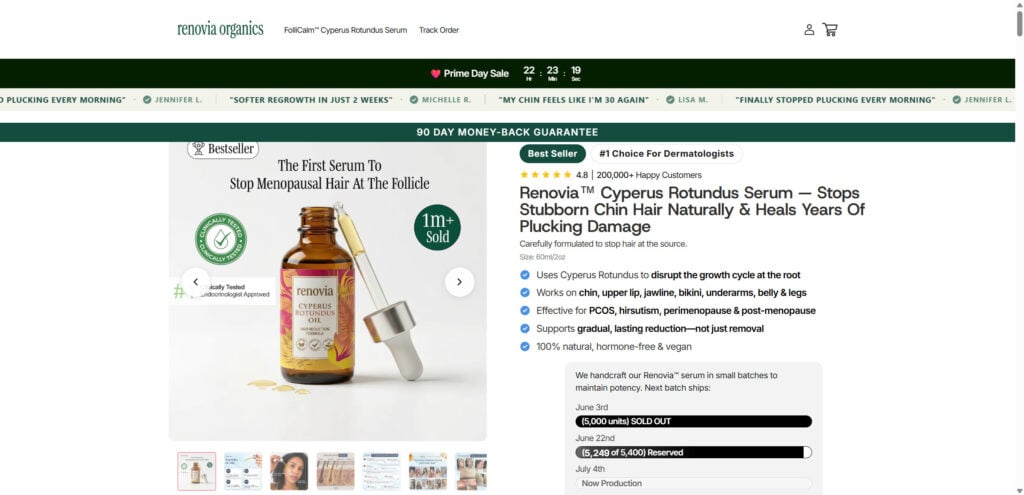
What Is Renovia Hair Removal Serum?
Renovia Hair Removal Serum is sold as a topical botanical serum made with Cyperus rotundus oil and other natural ingredients such as peppermint extract, citrus or lemon extract, olive oil and vitamin E.
The website says the product can be used on areas such as:
- Chin
- Upper lip
- Jawline
- Neck
- Underarms
- Bikini line
- Legs
- Arms
- Belly
The sales page claims the serum “stops stubborn chin hair naturally,” works at the root level, weakens follicles, slows regrowth, helps with hirsutism, and may be effective for PCOS, perimenopause and post-menopause-related unwanted hair.
These are strong claims for a cosmetic oil.
A topical oil may moisturize the skin or make hair feel softer. Some limited research has looked at Cyperus rotundus oil for slowing hair growth. But that is very different from proving that Renovia itself can stop hair growth, reverse years of plucking damage, replace laser treatments or produce dramatic results in a few weeks.
Why Renovia Raises Scam Concerns
Renovia raises scam concerns because its marketing relies heavily on emotional pressure and dramatic transformation claims.
The sales page targets women who feel embarrassed, anxious or frustrated by unwanted facial hair. It uses lines about finally stopping plucking, getting confidence back, forgetting about tweezers, feeling feminine again and no longer hiding from close-up moments.
That emotional angle is powerful, but it is also manipulative when paired with claims that are not clearly backed by strong product-specific evidence.
Major red flags include:
- Claims that it can “stop” unwanted hair growth naturally
- Claims that it weakens follicles at the root
- Claims that users see softer regrowth within 1–2 weeks
- Claims that visible thinning appears within 4–6 weeks
- Claims that hair becomes “barely there”
- Claims involving PCOS, hirsutism, perimenopause and post-menopause
- Claims that it works on all hair colors and skin tones
- Comparisons against laser and IPL
- “90-day” guarantee language that conflicts with a “send it back within 30 days” statement
- Large customer-count claims that are difficult to verify
- Before-and-after-style images and testimonial blocks
- Urgency timers and “sold out” scarcity messaging
- Multiple names, including Renovia and FolliCalm
- Similar low-cost Cyperus rotundus oils sold elsewhere
This is not how a transparent cosmetic brand should market a simple hair-growth-inhibiting oil.
Fake or Exaggerated Social Media Claims
Renovia is exactly the kind of product that spreads through viral social media ads.
These ads often suggest that women can stop shaving, stop plucking, avoid laser, and finally get rid of stubborn facial hair with a few drops of oil. Some ads may use AI-generated women, fake testimonial clips, synthetic voices, edited before-and-after images or doctor-style narration to make the product look more credible.
The issue is that social media ads often make stronger claims than the product can realistically support.
A real hair removal treatment does not work like magic. Shaving cuts hair. Waxing and plucking remove hair temporarily. Laser and IPL target hair follicles with light energy. Prescription options for facial hair work through specific medical mechanisms and should be discussed with a healthcare professional.
Renovia is a topical cosmetic oil. It should not be marketed as if it can permanently stop unwanted hair or replace professional treatment.
AI Videos and Fake-Looking Images
Beauty and wellness scammers increasingly use AI-generated videos and images because they are cheap, fast and persuasive.
With products like Renovia, AI can be used to create:
- Fake women claiming dramatic results
- Fake before-and-after images
- Fake doctor-style explanations
- Fake “older woman discovers ancient remedy” ads
- Fake influencer reactions
- Fake customer testimonials
- Fake close-up skin transformation videos
This matters because unwanted facial hair is a sensitive issue. Many buyers are emotionally vulnerable and may believe they are seeing real people who had real results.
But there is often no way to verify whether the women in the ads exist, whether they used Renovia, whether the images are edited, or whether the before-and-after examples show the same person under the same lighting.
If a product needs AI testimonials and emotional pain-point ads to sell, that is a major warning sign.
The Cyperus Rotundus Research Is Being Overstretched
Renovia’s marketing leans heavily on Cyperus rotundus oil, an ingredient that has received attention because of limited research suggesting it may reduce hair growth over time.
The problem is that sellers often stretch this research far beyond what it proves.
A small study on Cyperus rotundus oil is not the same as proof that every product containing Cyperus rotundus will work. It does not prove that Renovia’s formula is identical to the study material. It does not prove that results happen in two weeks. It does not prove permanent hair removal. It does not prove the product works for every body area, every hormone profile, every hair type or every skin type.
The sales page uses phrases like “rooted in science,” “professional-strength hair inhibition,” and “clinical research,” but shoppers should ask:
- Was Renovia itself tested?
- Was the exact formula clinically tested?
- Were the before-and-after images independently verified?
- Were the results published?
- Was the study large, blinded and controlled?
- Did users also wax, thread or sugar during the study?
- Are the results permanent after stopping the oil?
- Are the safety effects known after long-term use?
If the answer is unclear, the marketing should be treated with skepticism.
It Does Not Actually Remove Hair
One misleading part of this type of marketing is the phrase “hair removal serum.”
Renovia does not remove hair like a razor, wax strip, depilatory cream, laser or IPL device. Based on the product’s own usage instructions, users still need to remove hair first by shaving, waxing, epilating or another method. Then they apply the serum afterward.
That means the product is not really a hair remover. It is marketed as a hair-growth inhibitor or regrowth-slowing oil.
That distinction matters. Someone buying it may believe they can apply the serum and remove unwanted hair. In reality, the product is positioned as something to use after hair removal, not as a standalone hair removal method.
Cheap Rebranded Product Concerns
Another red flag is that Cyperus rotundus hair-reduction oils are widely sold online under many names.
Similar 60ml bottles appear on Amazon, eBay and marketplace-style sites at much lower prices. Some listings use nearly identical language around reducing body hair growth, moisturizing skin, soothing irritation and slowing regrowth. Some are sold under generic or obscure brand names.
This creates the possibility that Renovia is not a unique breakthrough formula, but part of a broader rebranded product trend.
A low-cost oil can be packaged, renamed, advertised through emotional social media campaigns and sold at a premium price. This is a common dropshipping-style pattern. The product may be cheap to source, while the customer pays for the ad funnel, not a proven innovation.
This does not prove every Renovia bottle comes from the same supplier. But it does show that the market is full of lookalike Cyperus rotundus oils, some priced far below what viral beauty funnels charge.
“Cheap Product From China” Red Flag
Many viral beauty products are sourced from low-cost overseas suppliers, then sold through polished Shopify-style websites as premium solutions.
This pattern is common with:
- Hair removal oils
- Lip plumpers
- Skin tightening creams
- Nail fungus pens
- Foot detox patches
- Teeth whitening kits
- Scar gels
- Anti-aging serums
The customer sees a premium brand. In reality, the item may be a low-cost private-label or generic product with a new label.
There are also consumer discussions around similar Cyperus rotundus oil products where buyers reported receiving China-manufactured lookalikes under different brand names. That does not prove Renovia’s official supply chain, but it reinforces the larger concern: this category is crowded with generic products, rebrands and copycats.
Before buying, shoppers should look for a real manufacturer, batch information, ingredient percentages, third-party testing, company address and transparent return details. Renovia’s sales page focuses far more on emotional claims than supply-chain transparency.
Refund Contradictions Are a Serious Red Flag
Renovia repeatedly promotes a 90-day money-back guarantee. The page says buyers are protected and can get a refund if they do not see results.
However, the same product page also says customers should “send it back within 30 days” for a complete refund.
That creates confusion.
Is the refund window 90 days or 30 days? Does the customer keep the bottle, or must they send it back? Does the product need to be unused? Who pays return shipping? Does the guarantee apply to opened bottles? Does it apply to sale items? What if the customer was told results take 8–12 weeks, but the return wording says 30 days?
This is a major problem because the product itself claims meaningful results may take weeks or months. If a customer needs to use it consistently before judging results, a short or confusing return window can make the guarantee less useful in practice.
A clear refund policy should not contradict itself.
Returns May Be Difficult in Practice
Even when a website advertises a guarantee, getting a refund can still be difficult.
With products like Renovia, customers may run into problems such as:
- Support not responding
- The seller asking for repeated information
- The return window being unclear
- The seller saying the guarantee does not apply
- The seller requiring the bottle to be returned
- Return shipping being expensive
- Opened products being refused
- Partial refunds instead of full refunds
- Delays until the customer gives up
- The original ad or landing page disappearing
This is why shoppers should never treat “money-back guarantee” language as proof that a purchase is risk-free.
The real question is whether the seller honors refunds quickly, clearly and without friction.
Risk of Receiving More Units Than Ordered
Another common issue with viral beauty funnels is receiving more units than expected.
These websites often use bundle offers, urgency timers and quantity discounts. A customer may think they are ordering one bottle, but the checkout process may push two, three or more bottles. Some funnels also use one-click upsells after payment information is entered.
That creates risk because once the order ships, the seller may claim the customer selected the larger bundle. If the return terms are unclear, the customer may struggle to get a full refund.
Before ordering any product like Renovia, shoppers should screenshot:
- The product page
- The cart page
- The selected quantity
- The final checkout total
- Any upsell pages
- The confirmation email
If the number of units or final charge differs from what was expected, contact the seller and the card issuer immediately.
Subscription and Refill Charge Risks
I did not see clear subscription language on the product page reviewed, but buyers should still be careful.
Many social media beauty-product funnels add subscription or refill offers at checkout, after checkout, through pop-ups or through follow-up emails. These may be presented as discounts, VIP memberships, “never run out” refill plans or limited-time add-ons.
Watch for phrases such as:
- Subscribe and save
- Auto-refill
- Monthly delivery
- VIP customer plan
- Replenishment program
- Membership discount
- Trial offer
- Future shipments
- Recurring billing
If you already ordered Renovia, check your confirmation email and bank statement. Make sure you were not enrolled in any recurring charge.
Fake or Unverifiable Testimonials
Renovia’s page includes many testimonial-style reviews. The reviews mention women who supposedly stopped plucking every morning, saw softer hair after a few weeks, improved confidence, reduced bikini-line irritation, avoided laser and felt free from the shaving cycle.
The issue is that these reviews are difficult to verify.
Common red flags include:
- First names only
- Perfectly positive results
- Emotional storytelling
- No independent review platform clearly shown
- No way to verify the photos
- No way to confirm the buyers are real
- No proof the results came from Renovia
- Repeated claims that match the sales pitch too closely
The page also uses large numbers, such as thousands of reviews and more than 100,000 or 150,000 happy customers. Without independent verification, these numbers should be treated as marketing claims, not proof.
PCOS and Hormonal Hair Claims Are Especially Concerning
Renovia’s page references PCOS, hirsutism, perimenopause and post-menopause.
That is a serious red flag.
Unwanted facial hair can sometimes be related to hormonal conditions. PCOS and hirsutism are medical issues that may require proper evaluation, lab testing and treatment guidance. A cosmetic oil should not be marketed in a way that makes people delay medical care.
If someone suddenly develops new facial hair, rapid hair growth, irregular periods, acne, hair thinning on the scalp, deepening voice or other hormonal symptoms, they should speak with a healthcare professional.
A social media serum is not a substitute for diagnosis or treatment.
Is Renovia FDA Approved?
No buyer should assume Renovia is FDA approved.
Cosmetic products and ingredients generally do not require FDA premarket approval before being sold, except for certain color additives. That means a cosmetic can appear online without the FDA reviewing whether it works as advertised.
If a product uses scientific language but is sold as a cosmetic, consumers should be careful. The company may be responsible for safety and labeling, but that does not mean the FDA has reviewed the product’s effectiveness.
Renovia’s claims about weakening follicles, hormone-related hair growth and long-term reduction make the marketing feel more medical than ordinary skincare. That is exactly why stronger proof should be expected.
Why Renovia Looks Like Previous MalwareTips Scam Patterns
Renovia fits a familiar pattern seen in questionable beauty and wellness campaigns:
- A viral social media ad targets a painful insecurity.
- The ad uses dramatic claims and emotional stories.
- The product is presented as a natural breakthrough.
- The landing page uses AI-looking images, testimonials and urgency.
- The claims compare the product to expensive professional treatments.
- The customer is pushed to buy quickly.
- Similar products are available elsewhere for less.
- Refund terms are confusing or difficult to use.
- Complaints may be hard to resolve.
- The same product concept appears under different names.
This model has been used repeatedly with supplements, weight loss products, skin serums, hair regrowth products, dental powders, posture devices and beauty gadgets.
Is Renovia Hair Removal Serum Legit or a Scam?
Renovia should be treated as a high-risk beauty-product offer.
It may be a real topical oil, and some users may notice softer skin or slower-feeling regrowth. But the marketing goes much further than that. The sales page implies root-level follicle weakening, dramatic reduction, confidence restoration, results within weeks, laser-like benefits and broad usefulness for hormone-related hair concerns.
Those claims are too aggressive for a cosmetic serum unless the company can provide strong product-specific evidence.
The biggest concern is not just the product. It is the sales operation: emotional ads, large unverified review numbers, urgency timers, refund contradictions, unclear guarantee terms and similar low-cost products available elsewhere.
What To Do If You Already Ordered Renovia
If you already bought Renovia Hair Removal Serum, take these steps:
1. Check your order confirmation
Verify the number of bottles, total price, shipping cost and billing name.
2. Look for subscriptions or refill wording
Search your email for terms like subscription, refill, membership, auto-ship or recurring billing.
3. Screenshot the sales page
Save the guarantee, product claims, checkout total and any ad that influenced your purchase.
4. Contact support in writing
Use direct language:
“I do not authorize any additional bottles, refills, subscriptions, memberships or recurring charges. Cancel any future billing and confirm in writing.”
5. Watch your bank statement
Look for duplicate charges, extra charges or future charges from unfamiliar billing names.
6. Request a refund quickly
Because the refund wording is confusing, do not wait. Contact the seller as soon as possible.
7. Contact your bank if the seller refuses to help
If you were charged for more than expected, cannot get a refund or see recurring charges, ask your card issuer about a chargeback.
8. Stop using it if you get irritation
Stop applying the product if you experience burning, rash, swelling, itching, clogged pores, darkening, worsening bumps or irritation.
9. Speak with a doctor for hormonal hair growth
If the unwanted hair may be related to PCOS, hirsutism, menopause or another hormonal issue, do not rely on a viral serum as your only solution.
How To Avoid Similar Hair Removal Serum Scams
Before buying any hair removal oil from a social media ad, check for these warning signs:
- Claims that a serum can “stop” hair growth
- Claims that it works better than laser
- Claims that it works for PCOS or hirsutism
- AI-looking testimonials or fake doctor videos
- Before-and-after images that cannot be verified
- “Ancient secret” or “natural breakthrough” language
- Huge customer numbers with no proof
- Countdown timers and fake scarcity
- Contradictory refund terms
- Similar products sold elsewhere for much less
- No clear manufacturer information
- No independent clinical testing of the exact product
- Checkout pages with bundles or upsells
A trustworthy product should make realistic claims, explain limitations clearly and provide transparent refund terms.
Final Verdict
Renovia Hair Removal Serum has too many red flags to recommend.
The product is promoted as a natural way to stop unwanted hair growth, weaken follicles and break the shaving or plucking cycle. But the claims appear exaggerated, the testimonials are hard to verify, the refund wording is confusing, and similar Cyperus rotundus oils are widely available under many names at lower prices.
Most importantly, Renovia is not a true hair remover. Users still need to shave, wax or remove hair first, then apply the oil afterward. At best, it may be a topical regrowth-slowing product with limited evidence behind the ingredient. It should not be treated as a proven replacement for laser, IPL, medical care or prescription options.
For consumers, the main risks are overpaying for a cheap rebranded oil, believing exaggerated social media claims, receiving more bottles than expected, struggling with refunds and possibly being exposed to refill or recurring billing offers.
Renovia Hair Removal Serum is best avoided unless the seller can provide clear product-specific clinical proof, transparent manufacturing information, verified independent reviews and a refund policy that does not contradict itself.








