

Derila Ergo is being promoted through advertorial-style pages as a special ergonomic pillow for people struggling with snoring, poor sleep, neck pain, and sleep apnea.
The pillow may be a real memory foam product, but the way it is marketed raises serious concerns. The sales funnel uses emotional medical scare stories, affiliate tracking, simulated social proof, dramatic sleep apnea claims, large discounts, review filtering, China-fulfillment disclosures, and return terms that may be much less simple than the sales page suggests.
What Is Derila Ergo?
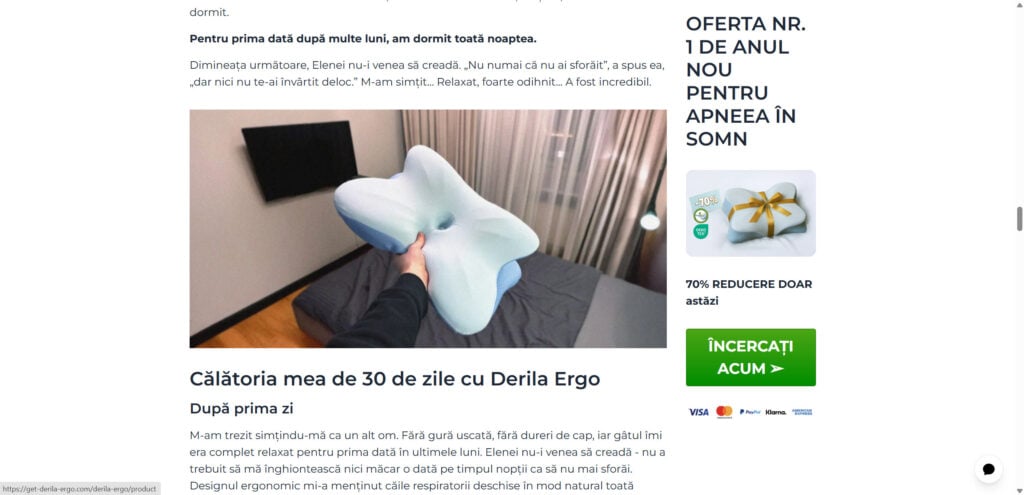
Derila Ergo is marketed as an ergonomic memory foam pillow with a butterfly-style shape, support wings, a shoulder arch, neck support zones, jaw alignment support, and cooling features.
The product is promoted as a pillow that may help with:
- snoring
- sleep quality
- neck pain
- shoulder tension
- poor posture
- airway alignment
- morning headaches
- restless sleep
- CPAP discomfort
- sleep apnea-related symptoms
Some Derila pages describe it more modestly as a neck support pillow. Other pages push much further and frame it as a “sleep apnea pillow” that can help keep airways open, reduce breathing interruptions, and restore normal sleep.
That difference matters.
An ergonomic pillow may help some people sleep more comfortably. It may support the neck better than a flat or worn-out pillow. It may reduce pressure or improve alignment for certain sleeping positions.
But a pillow is not a medical treatment for sleep apnea.
The Main Problem: The Sleep Apnea Angle Is Too Aggressive
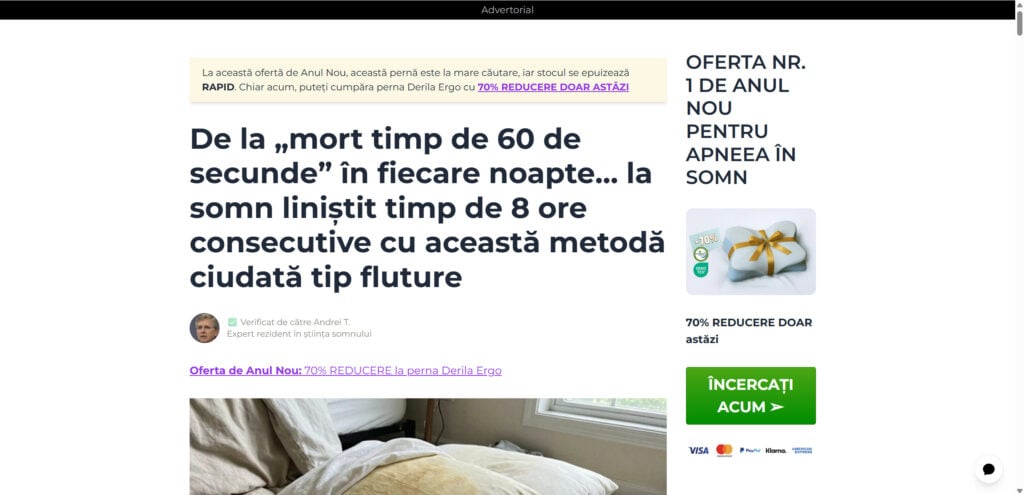
The Derila Ergo funnel you shared is not a normal product page. It is an advertorial.
It starts with a dramatic story about a man with sleep apnea, frightening nighttime breathing problems, a distressed spouse, and the fear of a serious health event. The page then presents Derila Ergo as the simple discovery that changed everything.
This is a powerful sales technique.
Instead of selling a pillow as a pillow, the funnel sells relief from fear. It speaks to people who may already be scared about snoring, poor breathing, CPAP discomfort, exhaustion, relationship strain, and untreated sleep apnea.
That is the issue.
Sleep apnea is not just bad sleep. It is a medical condition where breathing repeatedly stops and restarts during sleep. Untreated sleep apnea can increase the risk of serious health problems. People with suspected sleep apnea should speak with a healthcare provider and may need a sleep study, CPAP, oral appliance therapy, lifestyle changes, or other medical treatment.
A pillow may help sleep posture. It should not be positioned as a substitute for diagnosis or treatment.
Why Derila Ergo Raises Red Flags
1. The page is an advertorial, not a real news article
The page itself discloses that it is an advertisement and not an actual news article, blog, or consumer protection update.
That is important because the page is written like a personal story or health-style article. It uses emotional storytelling, expert-style language, medical anxiety, and dramatic results.
Readers may feel they are reading a discovery story or health recommendation. In reality, the page is a marketing page designed to send traffic to a checkout.
2. The URL shows affiliate tracking
The link contains tracking parameters such as vendor, affiliate ID, offer ID, source ID, Google Ads tracking, and campaign identifiers.
That suggests this is part of a paid affiliate or performance marketing funnel.
Affiliate funnels are not automatically scams. But they often rely on aggressive landing pages, fast checkout flows, upsells, and high-converting claims. The affiliate gets paid when a customer buys.
That means the page is built to convert, not to provide balanced medical information.
3. The page uses a medical scare story
The advertorial uses a frightening sleep apnea narrative involving breathing problems, fainting, panic, a spouse considering emergency help, and the fear of serious health consequences.
This kind of story is designed to make the reader think:
“That sounds like me.”
“I need to do something now.”
“Maybe this pillow is the simple fix I was missing.”
That is effective marketing, but it is risky when the topic is sleep apnea. Someone with real breathing interruptions should not delay medical care because an ad makes a pillow sound like a breakthrough solution.
4. Derila is compared against CPAP
The page talks about CPAP machines in a negative way, describing them as uncomfortable, awkward, and disruptive.
This is a common tactic in questionable sleep product marketing. The funnel first makes standard treatments feel unpleasant, then presents the product as easier, cheaper, and more natural.
But CPAP and other positive airway pressure devices are widely used sleep apnea treatments. They are prescribed and adjusted based on medical evaluation.
A pillow cannot be assumed to replace CPAP.
If someone has been diagnosed with sleep apnea, they should not stop CPAP or avoid treatment because of a pillow ad.
5. The page suggests dramatic health improvements
The advertorial describes changes after one day, one week, two weeks, and 30 days. It suggests improvements such as:
- no more snoring
- sleeping through the night
- better energy
- lower blood pressure
- improved mood
- fewer headaches
- restored relationship intimacy
- sleep apnea symptoms gone
- doctor impressed by progress
These are very strong claims for a pillow.
A pillow might improve comfort or neck positioning. But claims that sleep apnea symptoms disappeared, blood pressure normalized, or a doctor was amazed require real clinical evidence.
The page does not provide a transparent clinical trial on the exact product.
6. “Expert reviewed” language is weak
The advertorial says it was reviewed by “Daniel T.” and labels him as a sleep science expert. It does not provide clear credentials, a full name, medical license, sleep board certification, institutional affiliation, or independent profile.
That type of vague expert label is not enough.
Real medical content should clearly identify the reviewer and their qualifications. If a page uses medical claims but hides or abbreviates the reviewer identity, treat it cautiously.
7. Social media-style comments look simulated
The page includes Facebook-style comment blocks with names, likes, short replies, and timestamps such as “after two days,” “after eight hours,” or “after three minutes.”
These are designed to look like organic social proof.
But they are embedded in the sales page itself. They are not independently verifiable comments from a real social media platform.
This matters because fake-looking social comments can make the product seem more popular than it really is.
8. The terms say testimonials may use fictional names and images
The site’s terms state that testimonials and comments may contain fictional names and associative images. The terms also say the company usually does not publish negative reviews.
That is a major red flag for any page that relies heavily on testimonials.
If names and images may be fictional, and negative reviews are usually not published, the review section should not be treated as a balanced representation of real customer experience.
9. The page claims thousands of people switched
The advertorial claims that more than 10,000 people switched in the last month and transformed their sleep.
Claims like this sound impressive, but buyers should ask:
- Where is the verified sales data?
- Who counted those customers?
- Were they all verified buyers?
- Did they all use the product for sleep apnea?
- Were results medically confirmed?
- Were refunds included in the count?
- Is there an independent review platform?
Without those answers, the number is just marketing.
10. The “70% off only today” tactic creates urgency
The page repeatedly promotes a 70% discount and claims the offer is limited.
This is a classic direct-response tactic. It creates the feeling that the buyer must act immediately before the discount disappears.
But these “today only” offers often remain active for long periods across different landing pages, languages, and campaigns.
The urgency is designed to reduce comparison shopping.
11. Multiple corporate names appear across the ecosystem
Different pages connected to the Derila Ergo funnel show different business names, including UAB Domestica in the terms, Convenity, UAB on the about page, and Orbio World in the affiliate program environment.
This does not automatically prove wrongdoing. Large ecommerce networks can involve multiple entities.
But from a buyer’s perspective, it creates confusion:
- Who owns the product?
- Who operates the website?
- Who handles customer service?
- Who processes payments?
- Who handles returns?
- Who controls affiliates?
- Who is responsible if the ad is misleading?
The more entities involved, the harder it may be for customers to resolve problems.
12. The terms disclose China fulfillment
The terms say most products are made and may be delivered from China.
This is important because the advertorial frames Derila as a premium ergonomic sleep solution. Many buyers may not realize they are ordering a product that may be manufactured or shipped through China-based fulfillment.
A China-made product is not automatically bad. But when combined with aggressive medical claims and affiliate-style marketing, it looks like a familiar dropshipping or direct-response ecommerce model.
13. The return policy may be restrictive
The page promotes a 60-day return window. That sounds reassuring.
But the return terms include several conditions:
- the customer must contact support within the return window
- an RMA form or return authorization may be required
- returns must go to the address provided by customer support
- products must generally be unused, undamaged, and in original packaging
- return shipping is paid by the customer
- initial shipping may not be refundable after 14 days
- used products may be refused, partially refunded, or deducted for loss of value
- free promotional products may need to be returned too
This is not the same as a simple “try it for 60 nights and send it back if it does not work.”
For a pillow, this is especially important. A buyer cannot know whether it helps sleep without sleeping on it. But if the product is considered used, the seller may have grounds to reduce or deny the refund.
14. Order changes are limited after 24 hours
The terms say order modifications are generally allowed only within 24 hours. After that window, changes may not be allowed, and once the order is processed and ready to ship, cancellation may no longer be accepted.
This matters because these funnels often include bundles, add-ons, and one-click offers.
If a buyer accidentally orders extra pillows or selects a larger bundle, they may have a short window to fix it.
15. One-click payment language creates extra caution
The terms include one-click payment language allowing stored payment and shipping information to be used for future transactions after the user enables that feature.
This is not necessarily suspicious by itself, but buyers should be careful with any checkout that includes one-click purchases, post-purchase upsells, or saved payment options.
Always check the final order summary before clicking.
How The Derila Ergo Operation Appears To Work
Step 1: A paid ad targets sleep apnea fear
The funnel likely begins with a Google ad, social media ad, native ad, or sponsored placement.
The ad does not just sell comfort. It targets fear around sleep apnea, snoring, exhaustion, relationship strain, and poor health.
This is more powerful than a normal pillow ad because it touches a medical concern.
Step 2: The reader lands on an advertorial
Instead of going directly to a standard product page, the user lands on a long article-style page.
The page looks like a story. It uses emotional tension, a personal transformation narrative, a supposed expert review, and dramatic before-and-after results.
This format is designed to keep the reader engaged and lower resistance.
Step 3: Traditional treatments are made to seem unpleasant
The page talks about CPAP, chin straps, nasal strips, and normal pillows as frustrating or ineffective.
This builds the idea that common solutions are either uncomfortable or outdated.
Then Derila is positioned as the simple, natural alternative.
Step 4: The product is framed as the missing breakthrough
Derila is described with terms such as:
- support wings
- shoulder arch
- airway support
- jaw alignment
- advanced neck support
- ergonomic butterfly method
- cooling technology
- anti-allergen layer
- strategic support zones
This turns a pillow into something that sounds almost medical or scientific.
Step 5: Testimonials create emotional proof
The page includes customer-style stories about snoring, sleep apnea, headaches, neck pain, migraines, fatigue, arthritis, CPAP frustration, and relationship improvement.
These stories are not just about comfort. They suggest life-changing health and relationship benefits.
But because the terms say testimonials may use fictional names and associative images, these stories should be treated as marketing, not verified medical evidence.
Step 6: Urgency pushes the buyer to act
The advertorial repeatedly says the 70% discount is available today only, stock is running low, and the special price may disappear.
This pressures the reader to order before researching:
- sleep apnea treatment options
- real customer complaints
- return policy limits
- generic pillow alternatives
- supplier origin
- company identity
- medical claims
Step 7: The checkout may encourage bundles
Derila promotions often show multi-pillow pricing, such as one pillow, two pillows, three pillows, or four pillows.
Bundles can make the offer look cheaper per unit, but they increase buyer risk.
If the pillow does not work, if the buyer ordered too many, or if the return requires unused original packaging, extra units become harder to refund.
Step 8: Shipping and support happen through a wider ecommerce network
The terms describe international shipping, distribution centers, and possible China fulfillment. The footer also points to an affiliate program and multiple customer support phone numbers.
This suggests a large direct-response retail setup rather than a small independent sleep-health brand.
That matters because customers may deal with scripted support, return authorization requirements, and strict policy conditions.
Main Red Flags
- The page is an advertorial, not a real news article.
- The URL includes affiliate and tracking parameters.
- It targets sleep apnea, a medical condition.
- It uses a dramatic health scare story.
- It compares the pillow favorably against CPAP discomfort.
- It suggests major improvements in sleep apnea symptoms.
- It uses vague “expert reviewed” language.
- It includes simulated social media-style comments.
- The terms say testimonials may use fictional names and associative images.
- The terms say negative reviews are usually not published.
- It uses “70% off only today” urgency.
- It claims thousands of people switched recently.
- The company ecosystem includes multiple entities.
- The terms disclose that many products may be made and shipped from China.
- Returns require support approval and RMA steps.
- Unused/original packaging conditions may make testing the pillow risky.
- Return shipping is paid by the customer.
- Order changes may only be available within 24 hours.
- The terms state the products are not intended to diagnose, treat, cure, or prevent disease.
Is Derila Ergo A Scam?
Derila Ergo may ship a real pillow, so this does not appear to be a simple “pay and receive nothing” scam based on the pages reviewed.
The concern is the marketing operation.
A fair conclusion is this: Derila Ergo appears to be a high-risk affiliate-driven sleep pillow funnel because it uses aggressive sleep apnea messaging, medical-style storytelling, filtered testimonials, fictional-name disclosures, urgency discounts, China fulfillment language, and return conditions that may make refunds harder than the sales page suggests.
The pillow may help some people feel more comfortable. It may support the neck better than a poor pillow. It may reduce snoring for some users if posture was a contributing factor.
But buyers should not treat it as a proven sleep apnea treatment.
What Derila Ergo May Actually Do
Derila Ergo may help with:
- neck support
- side-sleeping comfort
- back-sleeping comfort
- pressure relief
- better pillow height for some users
- reduced neck stiffness for some people
- improved sleep comfort
- keeping the head and neck in a more comfortable position
Derila Ergo is unlikely to reliably:
- cure sleep apnea
- replace CPAP
- replace an oral appliance
- stop all snoring
- normalize blood pressure
- eliminate breathing interruptions
- fix daytime fatigue caused by untreated sleep apnea
- work for every sleep position
- deliver life-changing results in one night
- replace medical diagnosis or treatment
What To Do Before Buying
1. Do not buy it as a sleep apnea treatment
Treat it as an ergonomic pillow, not a medical device.
If you snore loudly, gasp during sleep, wake choking, feel exhausted during the day, or have been told you stop breathing during sleep, speak with a healthcare provider.
2. Ask your doctor before replacing CPAP
Do not stop using CPAP or any prescribed sleep apnea treatment because of a pillow ad.
If your CPAP is uncomfortable, ask your provider about mask fit, pressure settings, humidification, oral appliances, positional therapy, or other options.
3. Read the return policy before ordering
Check whether the pillow can be returned after use. If the policy requires unused original packaging, the guarantee may not be as useful as it sounds.
4. Avoid bundle pressure
Do not buy 2, 3, or 4 pillows before testing one.
Bundles may look cheaper, but they create refund risk.
5. Screenshot everything
Save screenshots of:
- sleep apnea claims
- 70% discount
- 60-day return claim
- checkout page
- selected quantity
- final price
- shipping terms
- refund policy
- company name
- order confirmation
6. Use a protected payment method
Use a credit card or PayPal if possible. Avoid payment methods that make disputes difficult.
What To Do If You Already Ordered
1. Check the order quantity
Look at your confirmation email immediately.
Confirm whether you ordered one pillow or a bundle. If you see extra units, contact support right away.
2. Try to cancel within 24 hours
The terms indicate that order changes may only be available within a short window.
Use clear wording:
“I am requesting immediate cancellation of my order. Please cancel the order before shipping and confirm that no additional units, upsells, or one-click purchases are attached to this order.”
3. Keep extra units sealed
If multiple pillows arrive, do not open every package. Keep extra units unused and in original packaging.
4. Save all packaging
Keep:
- shipping label
- box
- inserts
- product packaging
- invoice
- return instructions
- tracking details
5. Request an RMA if returning
The return policy may require a return authorization code and a specific address.
Do not ship the product back without written instructions from support.
6. State the problem clearly
Use wording like:
“The product was promoted as helping sleep apnea, but it does not match the advertised claims for me. I am requesting a refund under the 60-day return policy.”
7. Dispute if necessary
Contact your bank, credit card issuer, or PayPal if:
- you received more units than ordered
- you were charged more than expected
- the seller refuses the advertised refund
- the return process is unreasonable
- the product does not match the advertised claims
- support does not respond
- you cannot get an RMA in time
Use dispute wording such as:
- “item not as described”
- “misleading medical claims”
- “merchant refuses advertised refund”
- “unauthorized quantity charged”
- “refund policy contradicts sales page”
- “product sold as sleep apnea solution but is only a pillow”
FAQ
What is Derila Ergo?
Derila Ergo is an ergonomic memory foam pillow marketed for neck support, sleep comfort, cooling, posture, and, in some advertorials, sleep apnea-related concerns.
Is Derila Ergo a scam?
It may ship a real pillow. The red flags are mainly in the marketing, affiliate funnel, medical-style sleep apnea claims, filtered testimonials, and restrictive return conditions.
Can Derila Ergo cure sleep apnea?
No pillow should be treated as a cure for sleep apnea. Sleep apnea requires proper medical evaluation and treatment.
Can a pillow help snoring?
Sometimes sleep position and neck support can affect snoring. However, snoring can also be a sign of sleep apnea, so persistent loud snoring should be discussed with a healthcare provider.
Is Derila Ergo a medical device?
The terms state that the products are not designed to diagnose, treat, cure, or prevent disease and have not been tested by FDA or equivalent regulatory bodies.
Why is the advertorial risky?
It uses a frightening medical story and suggests dramatic improvements, which may cause readers to overestimate what a pillow can do.
Are the Derila reviews trustworthy?
Treat them cautiously. The terms say testimonials may use fictional names and associative images, and that negative reviews are usually not published.
Is Derila shipped from China?
The terms state that most products are made and may be delivered from China.
Are returns easy?
Not necessarily. Returns may require an RMA, customer-paid shipping, original packaging, and unused or resellable condition.
Should I buy Derila Ergo?
Only consider it as a pillow, not as a sleep apnea treatment. Buy one first, avoid bundles, read the return terms, and do not stop prescribed medical treatment.
The Bottom Line
Derila Ergo may be a real ergonomic memory foam pillow, but the sleep apnea advertorial raises major red flags.
The strongest concerns are the emotional medical scare story, affiliate tracking, vague expert review, simulated social proof, fictional-name testimonial disclosure, filtered negative reviews, 70% urgency discount, China fulfillment language, and return policy limits.
If you need a more supportive pillow, Derila Ergo may be one option among many. If you suspect sleep apnea, do not rely on a pillow ad. Speak with a healthcare provider and get proper diagnosis and treatment.









Extremely informative and helpful. I already used some of the tips, but now I have more and feel I have more control of my online activity. The in depth detail of why a decision has been made is what I liked most.
Thank you,
Thank you, Nigel – that is good to hear, and the part you valued is deliberate: knowing why something is a red flag is what lets you judge the next product on your own, rather than needing a review for every one.