

The caller sounds calm, official, and already knows enough about you to make the warning feel personal. Your identity has supposedly been compromised, a federal investigation is underway, and waiting could make the situation worse.
That frightening story recently led to an in-person cash handoff near Elmwood Avenue in Brighton, New York. Understanding how the pressure builds is the best way to stop it before a stranger takes control.
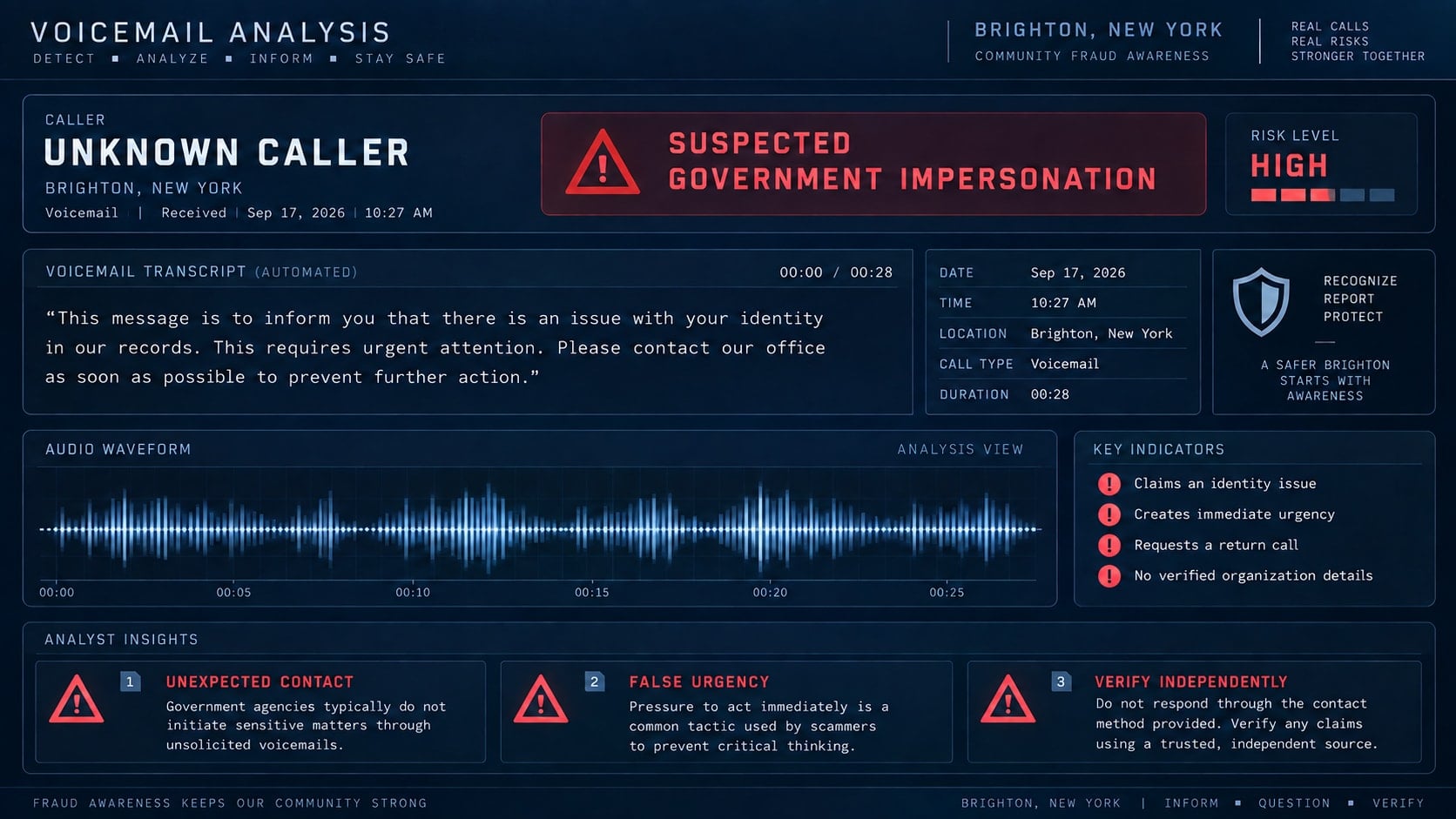
Overview
The reported incident involved a fake federal agent
Brighton Police described a September 17, 2026 fraud in which an unknown caller impersonated a federal law-enforcement agent. The caller told the victim to withdraw money after claiming there was a serious problem involving the victim’s identity or Social Security information.
The victim was then directed to meet a second unknown person near 2300 Elmwood Avenue in the Rochester area. That person collected the cash under the false claim that the payment was needed for a new Social Security number.
The story combines fear, secrecy, and an unusual payment
Government impersonation scams work because the first contact creates a crisis that feels both personal and official. A caller may mention identity theft, drug trafficking, money laundering, an arrest warrant, or bank accounts supposedly connected to a crime.
The criminal then presents a payment or money transfer as the only safe response. Cash withdrawals, courier pickups, gold, gift cards, cryptocurrency, and so-called protected accounts are warning signs, not legitimate government procedures.
A real agency does not sell replacement Social Security numbers
The Social Security Administration does not send unexpected callers to collect cash for a new number. A replacement Social Security card is free, and a completely new number is issued only in limited circumstances through an official application and identity-verification process.
No federal agent should ask you to meet a stranger in a parking area, conceal a withdrawal from bank staff, or hand over money to protect your identity. Those instructions identify the contact as a scam even when the caller knows personal details.
- An unexpected caller claims to be a federal agent or government investigator.
- You are told your Social Security number or identity is linked to a crime.
- The caller demands secrecy and discourages you from speaking with family or bank staff.
- You are instructed to withdraw cash, buy gold, send cryptocurrency, or purchase gift cards.
- A courier or second agent is supposed to collect money in person.
- Payment is described as necessary to obtain or secure a new Social Security number.
Why the Brighton Police Elmwood Avenue Scam Feels Convincing
The scheme does not begin with an obvious request for cash. It begins with a believable concern: someone may have stolen your identity. That possibility is common enough that many people listen before asking how the caller obtained their number.
The impersonator may use your name, address, age, or part of another record gathered from public databases, data breaches, social media, or commercial people-search services. Knowing a few facts does not prove access to a government file.
Caller ID is also weak evidence. Criminals can make a call display a local number, a Washington, D.C. area code, or the name of a government office. A callback may be answered with an official-sounding greeting, hold music, badge numbers, and transfers between fake departments.
The second person adds physical realism. Victims who might distrust an electronic payment can interpret an in-person meeting as proof that the case is genuine. In reality, the courier is simply another participant or money mule who separates the caller from the cash.
The Social Security explanation is especially effective because the number is tied to employment, taxes, credit, and benefits. The scammer turns that importance into leverage, claiming that money must be paid before the number can be replaced or cleared.
How the Brighton Government Impersonation Scam Works
Step 1: An unexpected caller announces an identity emergency
The contact may arrive by phone, voicemail, text, or email. The person claims to work for a federal law-enforcement agency, Social Security, a courthouse, or a special fraud unit investigating misuse of the victim’s identity.
The caller rarely gives the victim time to absorb the claim. A case number, employee ID, badge number, or reference to a real official may be offered quickly so the conversation feels procedural rather than suspicious.
Step 2: The story expands into a criminal investigation
The victim may be told that vehicles, bank accounts, packages, or telephone numbers connected to serious crimes were opened under their identity. The caller insists that ignoring the matter could lead to arrest, frozen accounts, or loss of benefits.
This is the emotional turning point. Instead of evaluating whether the caller is genuine, the victim begins trying to prove innocence. Questions about banks, balances, savings, and recent transactions are disguised as parts of the investigation.
Step 3: The fake agent orders a withdrawal to protect the money
The scammer says funds must be removed before criminals, banks, or investigators freeze them. The victim is instructed to visit a branch and make a large withdrawal, sometimes while keeping the caller connected throughout the trip.
If a teller asks questions, the caller may tell the victim to say the money is for a home purchase, family expense, or private investment. Any instruction to mislead financial staff is a clear sign that the caller fears fraud controls.
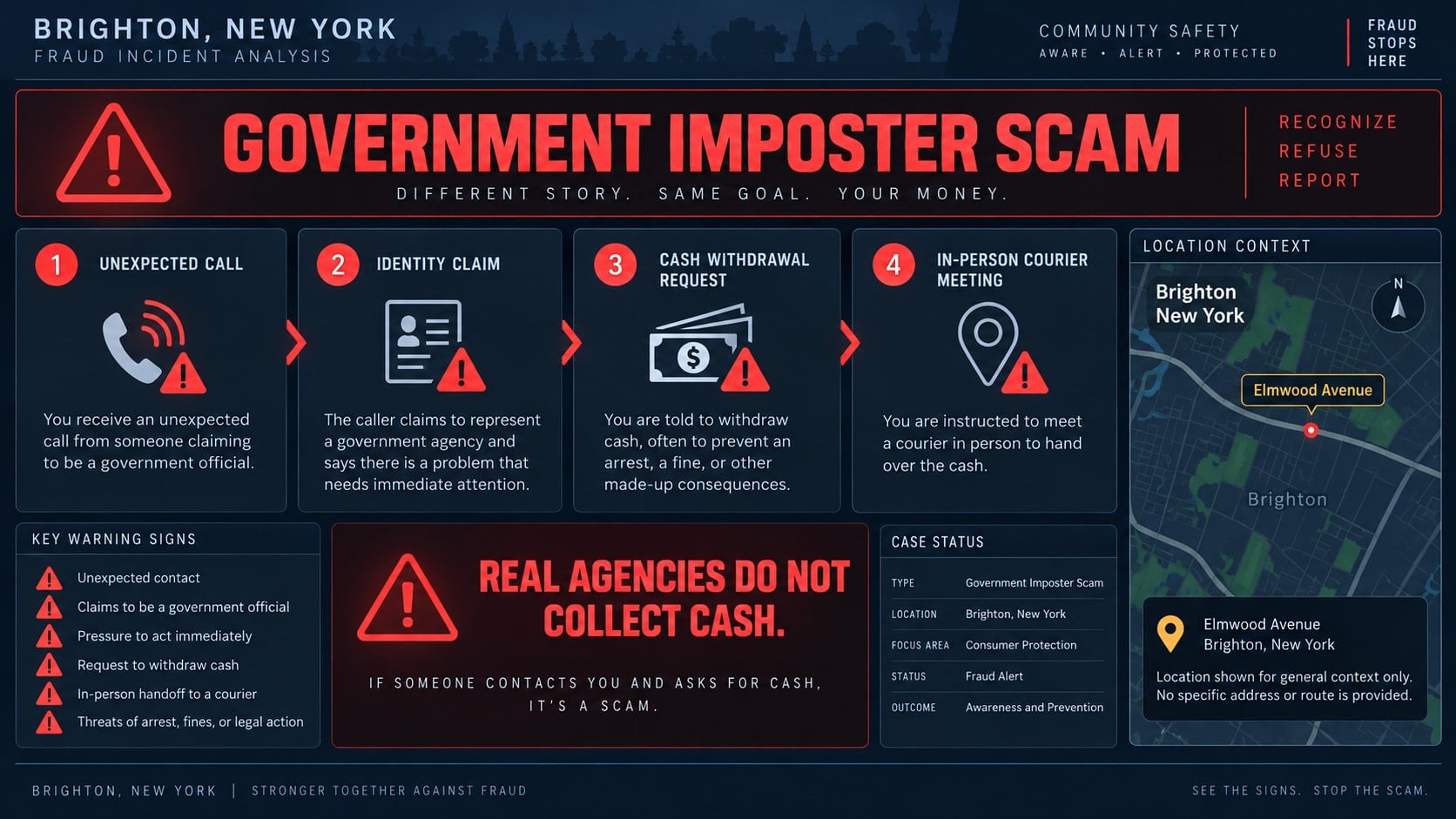
Step 4: A replacement Social Security number becomes the excuse
The criminal claims the current number is unsafe, suspended, or contaminated by illegal activity. A payment is supposedly required to issue a clean number or to move the victim into a protected identity program.
That procedure is invented. Social Security numbers are not purchased from agents, and the government does not use private couriers to collect fees. Legitimate applications require official forms and identity documents, not a secret cash transaction.
Step 5: A second suspect collects the cash in person
The victim receives a meeting point, description, or code word. The courier may be introduced as a federal employee, security officer, Treasury representative, or bonded driver who will place the money into government custody.
The Brighton incident reportedly directed the victim to meet someone near 2300 Elmwood Avenue. A public location does not make the exchange safer or official. It lets the collector leave quickly while the telephone operator remains distant.
Step 6: The scammers demand more or disappear
Once the first payment succeeds, the caller may invent another compromised account, processing fee, tax, or verification deposit. Victims are sometimes told that the original money will return after the investigation, encouraging a second handoff.
When the victim resists or contacts police, the numbers go silent and the courier vanishes. The stolen cash may already have been passed through several people, making immediate reporting especially important.
Identity, Contact, and Payment Checks
End the call and contact the agency independently
Do not use a number, link, transfer option, or extension supplied by the caller. Hang up, wait a moment, and obtain the agency’s contact information from a verified .gov website or USA.gov.
Explain what was claimed and ask whether the case or employee exists. A real official will not object to independent verification, while a scammer may insist that disconnecting will trigger arrest or cancel your protection.
Check whether the payment method matches real procedure
Federal agencies do not resolve identity cases through cash pickups, gold deliveries, gift cards, cryptocurrency kiosks, payment apps, or transfers to protected accounts. They also do not send couriers to collect your savings.
If the caller directs you to withdraw money or hide the reason from a teller, stop immediately. Tell the bank’s fraud team exactly what the caller said before moving any funds.
Verify Social Security claims through SSA
Open ssa.gov yourself or call the number published on the official website. Review your personal my Social Security account for unauthorized changes, but never sign in through a link sent by an unexpected caller.
SSA says it does not threaten to suspend Social Security numbers, demand immediate payment, or ask people to wire or mail cash. A new number is available only in rare cases after an official review.
Confirm local incidents with the police department
If someone arranges a pickup in Brighton or claims local officers are involved, call 911 when an exchange is imminent or use Brighton Police’s official contact information for a non-emergency report. Do not travel to the meeting place to investigate.
Save the caller ID, voicemail, messages, meeting instructions, vehicle description, and any photographs you already have. Do not put yourself in danger to collect more evidence.
What to Do if a Courier Meeting Has Already Been Arranged
Do not attend the meeting and do not send a friend in your place. A collector willing to participate in a cash handoff may react unpredictably when confronted or photographed.
Call local police before the scheduled time and follow their instructions. Provide the exact location, time, description, code word, telephone numbers, and whether the caller believes you are carrying cash.
Do not warn the scammer that police have been contacted. End communication unless an officer specifically asks you to preserve a channel. Block the numbers only after evidence has been saved.
If you are already at the location, remain inside a locked vehicle or move into a staffed business while calling 911. Do not approach a suspected courier or attempt to recover money yourself.
What to Do if You Have Fallen Victim to This Scam
- Contact police immediately. Report where and when the cash was collected, how the courier arrived, what the person looked like, and any vehicle information. Fast reporting may help investigators locate cameras or nearby witnesses.
- Notify your bank’s fraud department. Explain that a government impersonator pressured you into a withdrawal. Ask the bank to flag the account, review recent transfers, and stop any pending transaction connected to the scheme.
- Stop all contact with the impersonators. Do not pay a second fee or accept an offer to return the money. Save voicemails, call logs, messages, receipts, and meeting instructions before blocking the contact.
- Secure your Social Security record. Create or review your account at ssa.gov/myaccount, verify contact and direct-deposit details, and report the impersonation to the SSA Office of the Inspector General.
- Protect your credit. Visit IdentityTheft.gov for a recovery plan. Place a fraud alert or security freeze with Equifax, Experian, and TransUnion if Social Security, birth-date, or financial information was disclosed.
- Change exposed passwords. Start with email, banking, and mobile-carrier accounts. Use unique passwords, enable multi-factor authentication, and replace security questions whose answers were revealed.
- Check devices used during the call. If the scammer sent software or links, disconnect the device and run a full Malwarebytes scan. Remove remote-access applications you did not previously use and review browser extensions.
- Add protection against malicious links. AdGuard can block many known phishing and tracking domains, though it cannot verify a caller or stop every newly created page. Keep the browser and operating system updated.
- Report the fraud nationally. File at ReportFraud.ftc.gov and include the impersonated agency, payment method, courier details, and loss. Report Social Security-related contact through oig.ssa.gov/report.
- Prepare for recovery scams. Anyone promising guaranteed recovery for an upfront fee may be targeting you again. Share new contact with the original investigator instead of paying a private stranger.
How to Talk to a Family Member Who Is Still on the Phone
Do not begin by arguing that the person was careless. Government impersonators isolate victims by saying relatives will interfere with an investigation, so shame and confrontation can make the victim cling more tightly to the caller’s story.
Ask one concrete question: “What payment method did the agent request?” Cash, gold, gift cards, cryptocurrency, or a courier pickup gives you a simple fact that official government warnings directly contradict.
Encourage the person to pause without debating every detail. Offer to call the claimed agency together using the number on its official website. The goal is to interrupt the criminal’s control long enough for independent verification.
If money is being withdrawn or a courier meeting is imminent, call the bank and local police. Give responders the location and explain that the person may believe they are cooperating with federal law enforcement.
After the immediate danger passes, help preserve evidence and complete reports. A calm response improves the chance that the victim will disclose every payment and follow-up contact.
Frequently Asked Questions
Was there really a government impersonation scam near Elmwood Avenue?
Yes. Brighton Police reported a September 17, 2026 incident involving a caller impersonating a federal agent and a second suspect who collected money near 2300 Elmwood Avenue.
Can a federal agent ask me to withdraw cash during an investigation?
No legitimate agent will order you to withdraw cash, transfer savings to a protected account, or hand money to a courier. The FTC identifies those instructions as government impersonation scam tactics.
Do I have to pay for a new Social Security number?
No. Social Security cards are free, and completely new numbers are issued only in limited situations through an official SSA process. They are never sold through a telephone agent or cash collector.
What if the caller ID shows a real government number?
Caller ID can be spoofed. End the call and reach the agency through a telephone number you independently obtain from its official .gov website.
Should I attend the meeting to identify the courier?
No. Do not confront a suspected collector or conduct your own investigation. Give the time, place, and description to police and follow their safety instructions.
Can cash handed to a scam courier be recovered?
Recovery is difficult, but immediate reporting can help police identify cameras, vehicles, witnesses, and connected suspects. Never pay a recovery service that guarantees the money back.
The Bottom Line
The Brighton Police Elmwood Avenue scam used a fake federal investigation, a supposed Social Security problem, and an in-person cash collector to turn fear into a real financial loss.
A government official will not tell you to hide a withdrawal, buy a new identity, or meet a courier with cash. End the call, verify through an official source, and contact police before any planned handoff.

Join the discussion
0 commentsShare your experience or ask a question about this article.
Discussion
Start the conversation
Have a question or something useful to share? Add the first comment.