

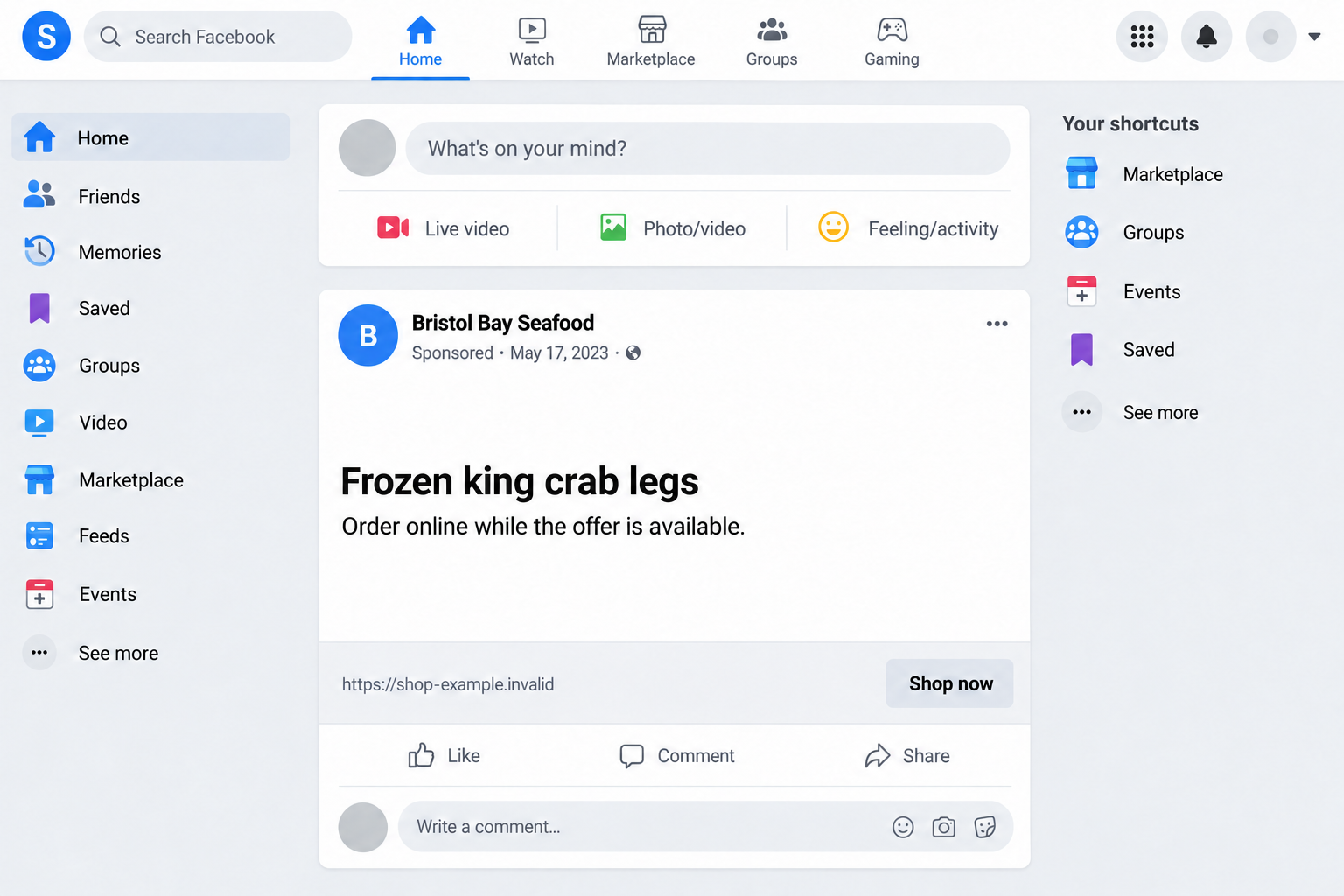
The seafood offer appears between ordinary Facebook posts. Frozen king crab legs, an inviting seller name, and a Shop Now button make dinner feel one click away.
The Bristol Bay Seafood scam is worth examining before that click becomes a purchase. The important clue is what happens between the ad and the store.
Overview
The documented case is a historical advertising deception
In May 2023, researchers documented Facebook seafood promotions using the Bristol Bay Seafood name that directed shoppers to a Keeprake clothing storefront.
That mismatch is the central finding. A seafood advertisement borrowed a convincing regional identity while the destination presented a different kind of shop.
The published research also recorded suspicious page history and repetitive activity. Those observations belong to the pages examined then.
This article does not claim that we intercepted a new 2026 campaign, tested today’s Keeprake checkout, or established the outcome of every historical order.
The deceptive promotion is the subject. Unrelated fisheries, legitimate seafood merchants, and businesses associated with the Bristol Bay region are not accused.
The seller must remain identifiable after the click
Advertising can take you to a separate website, but the relationship should be understandable. A new store name should not make the promised product disappear.
A broad retailer could sell multiple categories. That possibility does not explain a promotion whose advertised purchase cannot be traced through the destination.
Before paying, identify who sells the item, who receives the payment, and what product the order actually describes.
A polished checkout proves that a form exists. It does not establish seafood inventory, an honest offer, or a reliable refrigerated delivery arrangement.
A few checks can stop the purchase before money moves
Compare the offer with the destination rather than judging each screen separately. The break between them can be more useful than a copied trust badge.
- Does the store actually list the advertised seafood?
- Can you identify the business behind the checkout?
- Do contact and return details belong to that same merchant?
- Is the delivery method suitable for the promised goods?
- Can you verify the seller outside its own ad and comments?
The illustrations recreate the ad-to-store contrast using fictional addresses. They are not captures of the historical pages, authentic checkout terms, or evidence of a current price.
Why the Seafood Offer Gets Attention
A regional name does much of the selling
A name associated with seafood can make a seller feel close to the source. Shoppers may imagine fishing boats, warehouses, and direct shipping without seeing proof.
That mental picture can fill gaps in a sparse page. The buyer starts evaluating the deal as a local producer’s offer rather than an unknown merchant’s advertisement.
Ask what establishes that connection. A name alone is not a supplier contract, company record, stock confirmation, or shipping commitment.
Do not turn that caution into suspicion of every business in the region. Verification concerns the particular page, website, and transaction in front of you.
Visible enthusiasm can crowd out practical questions
Comments and shares can make an unfamiliar offer look settled. It is easy to assume that someone else already checked the merchant.
Repetitive comments deserve attention, but repetition alone does not identify a bot or prove that every commenter is part of the operation.
Look for independent, detailed experiences describing the same seller and product. A cheerleading comment underneath an ad supplies very little transaction evidence.
A newer page is not automatically fraudulent either. Its short history matters more when the offer implies an established operation that cannot otherwise be verified.
These clues should lead you to check the transaction, not to make unsupported accusations against individual commenters or page followers.
How the Bristol Bay Seafood Scam Works
Step 1: A seafood promotion creates a specific buying expectation
The ad leads with king crab legs and a familiar-sounding seller identity. A shopper approaches the button expecting to find the advertised seafood.
The historical research describes a coordinated-looking promotional presentation, but it does not prove that every similarly named page has the same operator.
Avoid treating a shared name as a complete map of the network. Save the exact page link and advertisement you encountered if you need to report it.
At this stage, no payment has to occur. You can stop with the offer itself if the seller’s identity or terms cannot be independently checked.
Step 2: The shopping link breaks the connection with the offer
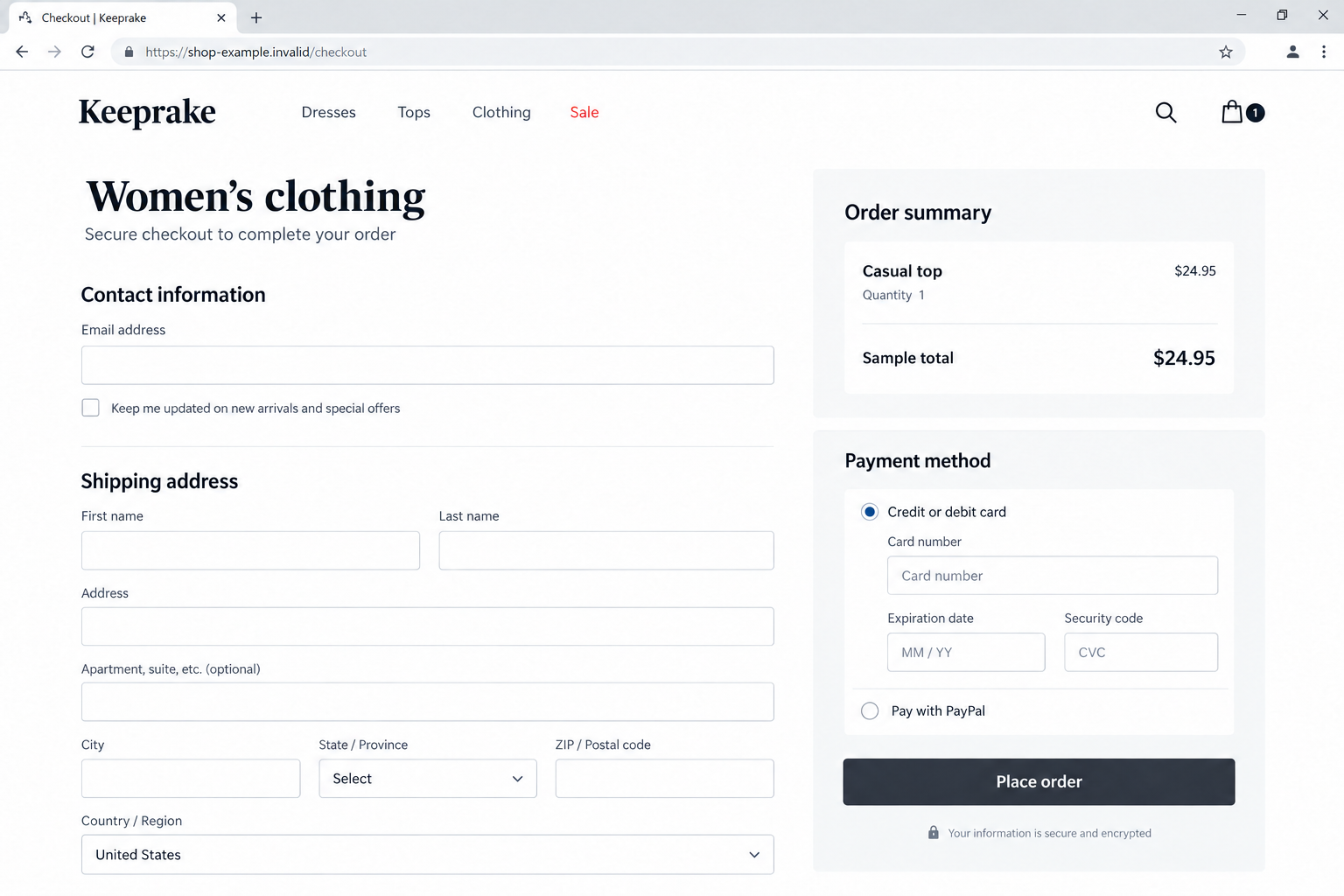
In the documented case, the destination was a clothing storefront rather than the seafood shop the promotion suggested. This changed the transaction the reader expected.
A redirect is not inherently malicious. The problem is the unexplained change in seller presentation, product category, and what the customer is supposed to buy.
Do not proceed simply because the page still looks professionally built. A functioning menu and shopping cart cannot repair a missing relationship with the advertised offer.
If you reach an unrelated catalog, close it and verify the seller independently. You do not need to place a test order to resolve the mismatch.
Step 3: Normal shopping controls invite the buyer to continue
A cart, address form, or payment button can restore a feeling of routine. The customer may start completing fields before asking why the seafood listing disappeared.
Some shoppers might search the new site for the original offer. Others may assume the wrong category is a temporary display problem.
That uncertainty should pause a purchase. If the store cannot clearly identify the product and merchant, do not supply personal information to find out more.
The second illustration uses a sample clothing item and $24.95 total. Those values are fictional and are not a verified price from Keeprake.
It shows the loss of continuity, not a claim that every historical buyer reached this particular payment screen or used the payment options pictured.
Step 4: A purchase can expose money and information
If a shopper pays an unverified merchant, the first risk is the transaction itself. The expected goods, seller, and delivery promise may not match the record.
Personal details entered during checkout create another exposure. A billing address, email, and phone number can make later fraudulent contact more convincing.
These are possible consequences, not evidence that every customer suffered identity theft or that every submitted card number was misused.
Respond according to what actually happened. A card payment, bank transfer, shared password, and abandoned cart each leave a different problem to investigate.
Step 5: An unclear seller makes resolution harder
When the ad and store present different identities, a buyer may not know where to ask about delivery or which merchant to identify in a dispute.
That is why the confirmation email and payment record matter. They document the transaction more precisely than a remembered page name.
A seller’s explanation should connect the advertisement, ordered item, payment recipient, and fulfillment promise. Vague references to a partner do not provide those records.
If answers remain inconsistent, preserve the evidence and involve the payment provider. Do not make another payment just to obtain a supposedly faster explanation.
Company, Address, Support, and Fulfillment Checks
The advertisement is not the legal merchant
Compare the business names in the ad, store terms, receipt, and card statement. An unexplained difference is a question to resolve before paying.
A payment processor’s name may appear legitimately, so a mismatch needs context. Ask who the contractual seller is and how the statement entry relates to your purchase.
This historical case does not establish a currently verified company behind every page using the same label. Do not invent an owner to fill that gap.
The useful requirement is traceability. You should be able to identify the party responsible for the item, charge, delivery, and complaint handling.
An address must fit the business it claims to support
A street address can belong to an office, mailbox, warehouse, or unrelated occupant. Its appearance on a website does not settle which function it performs.
For a seafood seller, ask where the goods are dispatched from. A return address for clothing would not explain the promised seafood fulfillment.
There is no independently verified current operating address asserted here. The absence of that verification should not become a fabricated claim about a particular building.
If a merchant supplies an address during a dispute, keep the original wording and check its relevance before sending goods or personal documents there.
Support needs records, not a reassuring name
Use contact information verified from the actual merchant relationship. Be wary of an account replying underneath an ad with a different payment or recovery link.
Ask a concise question about the order number, item, shipping commitment, and refund request. Written replies give you something concrete to compare.
We have not tested every historical support channel or confirmed that every buyer’s message went unanswered. Those outcomes should not be assumed.
What matters for your case is whether this seller can give a consistent, documented response. Save contradictory replies instead of arguing about the whole campaign.
Seafood fulfillment requires a credible shipping explanation
Ordering frozen seafood is not the same logistical transaction as buying a shirt. Packaging, dispatch timing, and delivery conditions need a clear explanation.
A generic free-shipping badge does not describe those arrangements. Ask how the merchant plans to deliver the actual product to your address.
This is a fulfillment check, not a claim that an unseen product is contaminated or unsafe. There is no tested shipment or laboratory result in this investigation.
A retailer should make its responsibilities understandable before purchase. If the ad promises seafood but the store describes clothing, that explanation is still missing.
What Your Records Can Establish
Separate the offer from the completed order
Save the advertisement and the order confirmation as separate evidence. One records the promise; the other records what the merchant actually agreed to supply.
Check the product description, quantity, total, currency, and delivery estimate. A screenshot showing only the store header may omit the most important differences.
If no order was placed, say so. Reporting a suspicious promotion does not require inventing a financial loss or claiming that goods failed to arrive.
Keep historical evidence in its proper time
The published captures establish what researchers saw in 2023. They do not prove that an old domain still hosts the same content today.
A changed or expired website also does not erase the records of a transaction. Keep receipts and messages without relying on the page remaining available.
If you encounter a current version, preserve its exact details. Do not assume a reused page name identifies the same person or operating company.
What to Do if You Have Fallen Victim to This Scam
-
Stop further purchases and payment requests. Do not pay an extra release, shipping, or refund fee through a new link sent after you complain.
Keep the original order separate from any later demand. A merchant should not need your banking login or a gift-card code to explain a purchase.
-
Build a clear purchase record. Save the ad, destination address, receipt, product description, payment confirmation, and delivery promise where available.
Write down what you expected and what the completed order said. That comparison gives a provider a more useful explanation than saying the whole website looked suspicious.
Do not post your full card details, address, or order-access link in a public complaint. Redact information that could create another exposure.
-
Request a resolution in writing when a verified merchant route exists. Identify the order and the specific mismatch, non-delivery, or unauthorized charge you are reporting.
Preserve the reply, including any cancellation or refund promise. Do not send identity documents or make additional payments merely to get a response.
If no trustworthy contact can be established, tell your payment provider. Do not spend days negotiating with a stranger who only contacted you through social comments.
-
Ask the payment provider about your options promptly. Explain whether you authorized the purchase, received the wrong item, received nothing, or found an unfamiliar charge.
Provide accurate dates and records. Dispute deadlines and protections differ, and an authorized purchase is not automatically the same as an unauthorized card transaction.
For general U.S. payment-response guidance, consult the FTC’s practical recovery steps. Your provider determines the options applicable to your payment.
-
Protect exposed payment and account information. If you entered card details into an untrusted page, ask the issuer about monitoring and protective action.
Change any password you reused at the store, especially if it also protects your email. Review alerts rather than relying only on today’s account balance.
Submitting a shipping address is different from submitting account credentials. Describe the actual information involved so the response remains proportionate.
-
Check the device only when the interaction warrants it. Suspicious downloads, notification permissions, or persistent redirects create a separate technical concern.
Malwarebytes can help examine a device after questionable software exposure. AdGuard can reduce malicious-ad encounters, but neither product reverses a purchase.
Seeing a seafood ad or receiving a receipt alone does not prove infection. Avoid installing a cleanup tool promoted by the seller or an unsolicited helper.
-
Report the exact promotion and storefront. Use the platform’s reporting controls and include the page and link you actually encountered.
Keep payment and authority-report references together. Reporting may help investigators connect cases, but it does not establish an immediate refund entitlement.
If another business is being impersonated, contact it through independently verified details rather than arguing with the deceptive page administrator.
-
Decline recovery guarantees. A person promising to retrieve your order money after an advance fee can exploit the same confusion about the seller.
Follow FTC recovery-scam advice and continue through the provider handling your payment. Do not transfer account control to a social-media refund specialist.
Frequently Asked Questions
Does this warning accuse every Bristol Bay seafood business?
No. It concerns a documented historical advertisement and destination mismatch. Legitimate regional businesses should be evaluated separately through their own verifiable identities and offers.
Was the Keeprake storefront captured recently?
The evidence discussed here comes from May 2023 research. This article does not present a new capture or claim to verify the domain’s current operation.
Can a store legitimately sell clothing and seafood?
A mixed catalog is possible. The seller must still explain the advertised item, contractual merchant, and fulfillment arrangement. An unexplained switch does not satisfy those checks.
Does a secure-looking checkout prove the offer is real?
No. Page design and encryption do not establish inventory, honest advertising, or delivery. Verify the merchant and purchase terms before submitting information.
What should I tell my bank if I authorized the order?
Explain that accurately, then describe the documented mismatch, missing goods, or other problem. The provider can assess applicable dispute options using the real transaction facts.
Are the images exact historical screenshots?
No. They are fictional interface reconstructions with sample values and addresses. They illustrate the stages without claiming to reproduce a real checkout or customer record.
The Bottom Line
The Bristol Bay Seafood scam shows why an advertisement and its destination must be checked together. The documented seafood-to-clothing switch broke the connection with the promised purchase.
Do not pay an unexplained merchant for an offer you cannot trace. If you already ordered, preserve the promise and transaction records, then pursue an accurate payment-provider review.








