

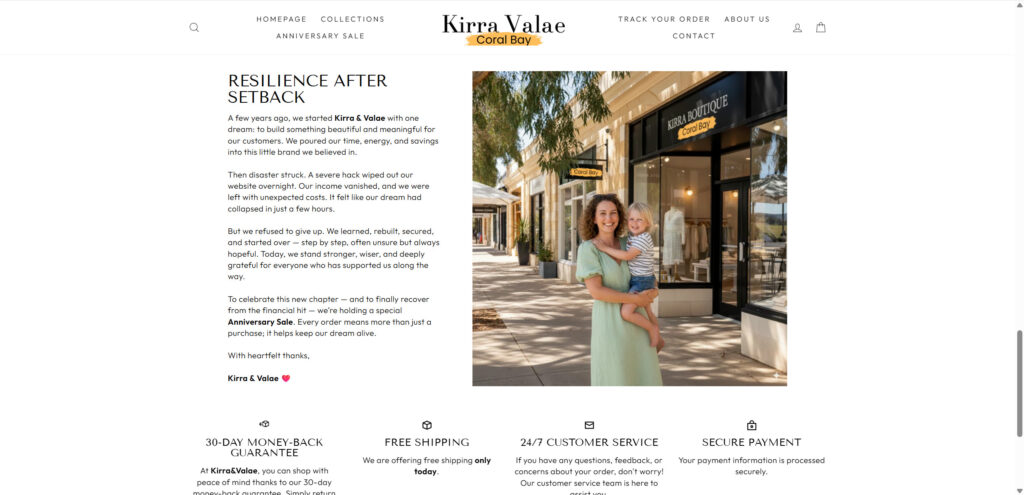
You’re scrolling through social media and see an ad that seems trustworthy: “Kirra Valae Coral Bay Anniversary Sale — Up to 80% Off!” The ad features a smiling woman outside a charming boutique, a heartfelt story of resilience, and a promise of unbeatable discounts on trendy dresses and accessories. It looks like a small Australian fashion brand giving back to loyal customers after a tough time.
But behind this polished image is another “anniversary sale” scam—a deceptive e-commerce operation designed to take your money and personal data without delivering the promised products.
This in-depth investigation exposes how kirravalae-coralbay.com operates, how it tricks thousands of shoppers, and what you should do if you’ve fallen victim.
Scam Overview
TThe Kirra Valae Coral Bay Anniversary Sale Scam is a carefully crafted deception that uses emotional marketing, professional web design, and fake storytelling to convince shoppers they are buying from a small, family-run Australian boutique. In reality, kirravalae-coralbay.com is a recently registered domain designed to collect payments without delivering quality products—or anything at all. This scam is part of a growing global trend of “anniversary sale” scams, which have exploded in late 2024 and 2025, targeting unsuspecting shoppers through Facebook, Instagram, Google Ads, and TikTok.
Unlike older scam sites that were often clumsy or poorly built, modern operations like Kirra Valae Coral Bay look convincingly legitimate. Their online stores mimic real fashion boutiques down to the smallest detail: professional photography, return policies, testimonials, free shipping promises, and secure payment badges. This level of sophistication makes the scam extremely effective and dangerous for shoppers who are used to trusting familiar online shopping formats.
The Fake Narrative
The website claims to represent a women-led Australian fashion brand named Kirra & Valae, based in Coral Bay. It tells a compelling backstory to build emotional trust:
- A few years ago, two women started a small online boutique with a dream to create meaningful fashion.
- A major cyberattack supposedly wiped out their business overnight.
- They worked hard to rebuild, and now, to celebrate their comeback, they’re hosting an “Anniversary Sale” to thank loyal customers.
This story isn’t unique to Kirra Valae Coral Bay — it’s almost identical to dozens of other fabricated origin stories used by scam networks. The goal is to make the company sound relatable and trustworthy, encouraging shoppers to “support” what they believe is a small, resilient business.
Why It’s So Convincing
- Polished branding: The site uses a modern design with elegant fonts, well-chosen images, and reassuring icons (like “30-day money-back guarantee,” “secure payments,” and “free shipping today”). These are all signals of legitimacy shoppers are trained to trust.
- Localized identity: Adding “Coral Bay” — a real location in Western Australia — tricks buyers into believing the store is locally operated. Using real place names like London, New York, Sydney, and Melbourne is a well-documented scam tactic used to inspire confidence.
- Anniversary sale hook: Many legitimate brands celebrate anniversaries with sales, making this tactic believable. Scammers exploit this by fabricating milestone events (like “10 years,” “20 years,” or “26 years”) to make the sale appear special and limited.
- Fake urgency: The site claims the sale is “only for today,” displaying countdown timers and messages like “only a few left in stock.” These psychological triggers push users to act fast without verifying legitimacy.
- Aggressive advertising: The scam is pushed heavily through Meta Ads (Facebook and Instagram), targeting fashion-conscious shoppers and older users who are more likely to trust branded-looking ads. Many victims report that they first encountered the scam through social media rather than organic search.
The Domain Tells the Real Story
Despite claims of years in business, kirravalae-coralbay.com was registered on September 25, 2025—just days before the ads started appearing. This is a key pattern in anniversary sale scams:
- Scammers register dozens of domains at once.
- They launch fast advertising campaigns to drive traffic.
- They disappear after collecting enough orders or once complaints pile up.
Legitimate fashion boutiques usually have years of online presence, Google reviews, social media history, and traceable company information. Kirra Valae Coral Bay has none of these, which is a major red flag.
Stolen and Reused Assets
The site’s product photos are not original. They are pulled from stock image libraries or copied from other legitimate fashion retailers. This allows scammers to build entire online stores without ever manufacturing or stocking products. In many cases, the same product photos appear on multiple scam sites with different fake brand names.
In addition to stolen images, the text on the site is almost identical to that found on other scam stores — with only minor name and location changes. This indicates that Kirra Valae Coral Bay is part of a larger network of fake online shops, likely operated by a single group or a small cluster of organized scam operators.
False Trust Signals
Scammers know exactly which trust signals make shoppers feel safe:
- “Free shipping on all orders” banners
- “30-day money-back guarantee” icons
- “Secure checkout” badges
- Fake testimonials that look like customer reviews
None of these guarantees are actually honored. Victims who attempt to claim refunds or contact support are usually met with silence or automated replies.
The Psychological Strategy
What makes scams like Kirra Valae Coral Bay so effective is that they don’t just sell a product—they sell a story. They tap into shoppers’ emotions and desire to support small businesses, especially in the wake of the COVID-19 pandemic, when many consumers became more inclined to “shop small” and support local or women-led companies.
The anniversary sale angle is particularly powerful because:
- It feels time-sensitive, encouraging impulse buys.
- It implies longevity and trustworthiness.
- It suggests a celebration, not a scam.
When combined with the aesthetic of a real online fashion boutique, these elements create a false sense of legitimacy strong enough to fool even experienced online shoppers.
What the Victims Experience
Most victims of Kirra Valae Coral Bay report similar outcomes:
- They place an order during the “anniversary sale” at a seemingly huge discount.
- They receive a confirmation email but no further updates.
- Some get a fake tracking number that shows no real shipment activity.
- Others receive a low-quality counterfeit item that looks nothing like the product image.
- Many never receive anything at all.
When customers try to get support, they find no working phone number, a dead or unresponsive email address, and vague refund policies. By the time they realize they’ve been scammed, the site may already be offline or operating under a new name.
A Coordinated Scam Network
The structure of Kirra Valae Coral Bay mirrors a coordinated global scam network that runs multiple fake boutique websites simultaneously. Once one site accumulates enough negative reviews or is reported, it’s quietly abandoned, and a new domain is launched with a different name but the same images, layout, and wording.
This explains why so many of these scams look eerily similar — they are likely being run by the same people or groups.
How the Scam Works
Understanding the step-by-step operation of Kirra Valae Coral Bay helps reveal why so many shoppers fall for similar schemes.
Step 1: Creating the Fake Brand
Scammers start by registering a domain — in this case, kirravalae-coralbay.com — just days before launching the campaign. They build a Shopify or similar storefront using pre-made templates.
Then they fabricate a brand identity: a friendly, community-driven Australian fashion boutique. They include a touching story of hardship and recovery to build emotional trust.
Step 2: Launching a Social Media Ad Campaign
The scam is advertised aggressively on platforms like Facebook and Instagram. The ads feature:
- Professional lifestyle photos.
- Messages like “Anniversary Sale — 80% Off, Last Day!”
- Fake reviews and engagement to create social proof.
- Direct links to the scam website.
These ads are micro-targeted to shoppers who have previously engaged with fashion content, increasing their success rate.
Step 3: Using Emotional Triggers and Urgency
Once shoppers land on the site, they’re met with strong psychological triggers designed to bypass skepticism:
- Countdown timers: Fake “today only” banners encourage instant purchases.
- Limited stock messages: “Only 2 left” signals scarcity.
- Emotional copywriting: Stories of resilience make people feel they’re supporting a struggling small business.
- Location branding: Using an Australian location builds trust for shoppers in the same or nearby regions.
Step 4: Processing Orders and Capturing Data
Buyers who proceed to checkout are required to enter full payment information. The site typically accepts credit cards or PayPal.
Shoppers receive:
- A confirmation email with an order number.
- Fake shipping estimates.
- Sometimes a fake tracking number.
Behind the scenes, the scammers have collected both payment and personal data.
Step 5: Non-Delivery or Wrong Item Delivery
Victims report several outcomes:
- The product never arrives.
- A cheap, low-quality substitute is delivered instead of the advertised item.
- An unrelated item (such as socks or accessories) is sent.
- The tracking number either leads nowhere or shows that the item is “in transit” indefinitely.
These tactics delay chargebacks and refunds, giving scammers more time to operate before shutting down.
Step 6: No Customer Support or Refunds
Attempts to reach customer service typically fail.
- Emails are ignored or met with generic auto-replies.
- There is no working phone number.
- The return policy is vague or unenforceable.
The scammers rely on this customer silence gap to keep collecting money before disappearing.
Step 7: Abandoning the Domain and Restarting Elsewhere
Once enough complaints pile up, the scammers either:
- Shut down the website entirely, or
- Clone it under a new domain name with the same structure, images, and copy.
This cycle allows them to scam thousands before detection.
What to Do If You’ve Been Scammed by Kirra Valae Coral Bay
If you placed an order through kirravalae-coralbay.com and suspect fraud, act immediately. Quick action significantly improves your chances of recovering your money.
1. Contact Your Bank or Card Issuer
- Report the transaction as fraudulent.
- Request a chargeback to reverse the payment.
- Cancel or block the card if necessary.
- Monitor your account for further suspicious activity.
2. File a PayPal Dispute (If Applicable)
- Go to the PayPal Resolution Center.
- Choose “Item Not Received” or “Significantly Not as Described.”
- Attach order confirmation, receipts, and screenshots.
- Escalate the claim if the scammer doesn’t respond.
3. Change Your Passwords and Protect Your Identity
- If you used the same email/password combo elsewhere, change it immediately.
- Enable two-factor authentication on your accounts.
- Be alert for phishing attempts posing as “refund support.”
4. Report the Scam to Authorities
Depending on your country:
- Australia: Scamwatch (scamwatch.gov.au)
- US: Federal Trade Commission (FTC)
- UK: Action Fraud
- EU: European Consumer Centre
Also report the ads to Facebook or Instagram to help block further exposure.
5. Warn Others
- Post your experience on scam reporting websites, Trustpilot, Reddit, and consumer forums.
- Share the website name to help others avoid it.
- Report the domain to scam databases.
6. Monitor for Identity Theft
If you entered personal details, consider:
- Monitoring your credit report.
- Using an identity protection service.
- Watching for suspicious account activity.
7. Document Everything
Keep all emails, receipts, order confirmations, and screenshots. This documentation helps in chargeback disputes and official reports.
Why Scams Like Kirra Valae Coral Bay Are So Effective
- Emotional branding makes shoppers let their guard down.
- Professional web design mimics real online boutiques.
- Urgency tactics encourage impulsive buying decisions.
- City/location names like “Coral Bay” create a false sense of authenticity.
- Social media advertising reaches massive audiences quickly.
- Scammers work fast, abandoning domains before being shut down.
This combination of trust-building and speed allows these scams to thrive.
How to Spot Fake “Anniversary Sale” Websites Like Kirra Valae Coral Bay
- Check the domain registration date. A store claiming years in business shouldn’t have a domain registered just weeks ago.
- Look for business registration numbers, physical addresses, and working phone numbers.
- Do a reverse image search on product photos to check for duplicates on other scam sites.
- Be skeptical of discounts over 70% across all items.
- Read refund and return policies carefully—if they’re vague or too good to be true, walk away.
- Search the store name + “scam” on Google to see if others have reported it.
- Check if WHOIS information is hidden. Legitimate businesses rarely hide ownership.
- Beware of emotional marketing stories tied to “anniversary” or “resilience” narratives.
Real Shopper Experiences and Reports
- “I ordered a dress during their ‘Anniversary Sale.’ I got a fake tracking number and never received anything.”
- “The dress that arrived looked nothing like the pictures. It was cheap fabric and poor stitching.”
- “They told me I couldn’t return the item even though they claim a 30-day guarantee.”
- “I checked the domain after ordering and realized it was only a few days old.”
These are classic signs of a coordinated scam operation—not a legitimate fashion boutique.
Frequently Asked Questions
What is the Kirra Valae Coral Bay Anniversary Sale Scam?
The Kirra Valae Coral Bay Anniversary Sale Scam is an online shopping scam that operates through the website kirravalae-coralbay.com. It presents itself as a legitimate Australian fashion brand hosting an “Anniversary Sale” with discounts of up to 80% off. The site uses emotional storytelling, polished web design, and fake trust signals to convince people it’s real. In reality, the domain was registered very recently, the company does not exist, and many customers never receive their orders. Those who do often get cheap knockoffs or unrelated items. The ultimate goal of this scam is to collect payment and personal information from unsuspecting shoppers.
How does the Kirra Valae Coral Bay scam work?
Scammers use a step-by-step strategy to lure and defraud buyers. First, they launch a professionally designed website with a fabricated backstory about a family-run boutique in Coral Bay, Australia. They claim to be “celebrating their anniversary” to make the business sound established and trustworthy. Then, they aggressively run ads on Facebook, Instagram, and other platforms to attract shoppers. Once people visit the website, they see high discounts, emotional language, and fake “last day” countdown timers, all designed to make them buy fast without verifying the store’s legitimacy. After payment is made, customers either receive nothing, get counterfeit products, or encounter fake tracking information. Refunds are nearly impossible to obtain.
Why do scammers use “Anniversary Sale” in their schemes?
The “Anniversary Sale” tactic works because it creates a sense of trust, urgency, and legitimacy. Real businesses often run anniversary promotions to thank loyal customers. Scammers exploit this familiarity. By pretending to celebrate an anniversary, they make it seem like the business has been around for years, even though the domain was often registered just days earlier. Phrases like “We’re celebrating 10 years” or “26-year anniversary sale” give shoppers a false sense of credibility. This strategy is commonly paired with emotional marketing stories—such as overcoming hardship, rebuilding after a hack, or being a small family business—to make the scam more convincing.
How can I identify if Kirra Valae Coral Bay is a scam?
There are several red flags to look out for. First, the domain kirravalae-coralbay.com was registered on September 25, 2025, which contradicts their claims of a long business history. Second, there is no real business registration, no phone number, and no physical address. Third, product images are identical to those found on other scam websites, often taken from real retailers. Fourth, the website offers unrealistic discounts of 70–80% across the entire store, which is rarely sustainable for real businesses. Fifth, WHOIS information is hidden, and the website relies on generic templates used by many other fraudulent fashion stores. If a store exhibits several of these signs, it’s likely a scam.
What happens after placing an order on kirravalae-coralbay.com?
Most victims report a similar sequence of events. Immediately after placing an order, they receive an automated confirmation email, which makes the transaction feel legitimate. Sometimes they receive a fake shipping notice or tracking number, which leads to nowhere or shows the order stuck “in transit” indefinitely. Weeks go by without the product arriving. If something is delivered, it is usually a poor-quality counterfeit that looks nothing like the advertised item. Attempts to contact customer service go unanswered, and refund requests are ignored. By the time many realize they’ve been scammed, the website may have already been taken down or rebranded under a new name.
Why do these scams look so professional?
Modern scam operators use advanced tools to create professional-looking online stores that mimic legitimate fashion boutiques. They use pre-built Shopify or WooCommerce templates, stock photos, and fabricated branding materials. Many even include fake return policies, 30-day guarantees, and “secure payment” badges to make the website appear trustworthy. These scammers understand that shoppers are more likely to trust a visually appealing and emotionally engaging website. That’s why relying solely on appearance is dangerous. Always verify domain history, contact information, and customer reviews before buying.
What should I do if I have fallen victim to the Kirra Valae Coral Bay scam?
Act quickly to limit the damage and increase your chances of recovering your money. Start by contacting your bank or credit card company to report the fraudulent transaction and request a chargeback. If you used PayPal, file a dispute through the Resolution Center. Change any passwords associated with the account you used, and monitor your bank statements for suspicious activity. Report the scam to relevant consumer protection agencies such as Scamwatch (Australia), the FTC (US), or Action Fraud (UK). Also, report the ads to Facebook or Instagram to help prevent others from being targeted. Keep all emails, receipts, and order confirmations as evidence.
Is Kirra Valae Coral Bay a real company in Australia?
No, there is no verified business by the name “Kirra Valae Coral Bay” registered in Australia or anywhere else. The name was fabricated to sound local and trustworthy. Using place names like Coral Bay is a known scam tactic designed to give the illusion of a small, established Australian business. Legitimate companies will typically have a verifiable ABN (Australian Business Number), a physical store address, or a clear contact trail. This site has none of those. Its entire identity is a marketing front created to run a short-lived scam campaign.
Are there other scams similar to Kirra Valae Coral Bay?
Yes, this scam is part of a larger pattern of fake boutique websites that use the same tactics. Dozens of fraudulent stores have used similar branding with names like “Clara Hart Minnesota,” “Arvella London,” and “Whitmore Oxford.” Each has an almost identical website layout, fake backstory, and anniversary sale structure. When one domain is flagged or receives too many complaints, scammers simply launch a new one with a different name. This makes these scams harder to track and shut down.
How can I protect myself from scams like this in the future?
The best defense against online shopping scams is skepticism and research. Always check the domain age using WHOIS tools. If a store claims to have been around for years but the domain was created recently, that’s a major red flag. Look for verified business registration numbers, read independent reviews, and search “[store name] scam” on Google. Be cautious of extreme discounts, vague refund policies, and emotional marketing stories. Never pay via direct bank transfer, and prefer payment methods that offer buyer protection, like credit cards or PayPal. If a deal seems too good to be true, it usually is.
Can I get my money back after being scammed by Kirra Valae Coral Bay?
Yes, in many cases you can recover your money if you act quickly. Credit card chargebacks and PayPal disputes are effective ways to reverse fraudulent transactions. Contact your payment provider immediately, explain the situation, and provide documentation such as order confirmations and screenshots. The faster you act, the more likely your claim will be successful. However, if too much time passes or if you paid via a method without buyer protection, recovery may be more difficult. Even if you can’t get a refund, reporting the scam helps prevent others from being targeted.
What should I do if I see ads for Kirra Valae Coral Bay?
Do not click on them. Instead, report the ad directly on Facebook, Instagram, or the platform where you saw it. This helps platforms identify and remove fraudulent advertisers. You can also warn others by sharing scam alerts on consumer forums, social media, and dedicated reporting platforms. Reporting scams contributes to a larger effort to disrupt scam networks that often operate multiple fake websites at once.
The Bottom Line
The Kirra Valae Coral Bay Anniversary Sale Scam is a textbook example of how scammers combine emotional branding, urgency marketing, and fake online stores to steal money and data from unsuspecting shoppers.
The site kirravalae-coralbay.com was only recently registered and has no proven track record. Despite its polished storefront and heartfelt story, it is not a legitimate fashion retailer.
If you have made a purchase, act quickly to recover your funds and protect your identity. If you haven’t, let this case serve as a warning: always verify before buying from unfamiliar online stores—especially when the deal seems too good to be true.








