

The Buffalo Trace 250th Anniversary Advent Calendar scam has spread rapidly across the internet, targeting bourbon lovers with what looks like an irresistible deal. With glossy ads, fake reviews, and promises of rare bottles at impossible prices, it has tricked thousands into parting with their money. At first glance, the offer seems genuine. Who wouldn’t want 24 days of premium bourbon from one of America’s most respected distilleries? But behind the professional photos and convincing sales pages lies a sophisticated scam operation.
In this article, we break down the full picture of the Buffalo Trace 250th Anniversary Advent Calendar scam. You will learn how it works, the red flags that give it away, and most importantly, what you should do if you’ve already fallen victim. By the end, you’ll understand why this scam is so dangerous and how to protect yourself from similar fraudulent schemes.
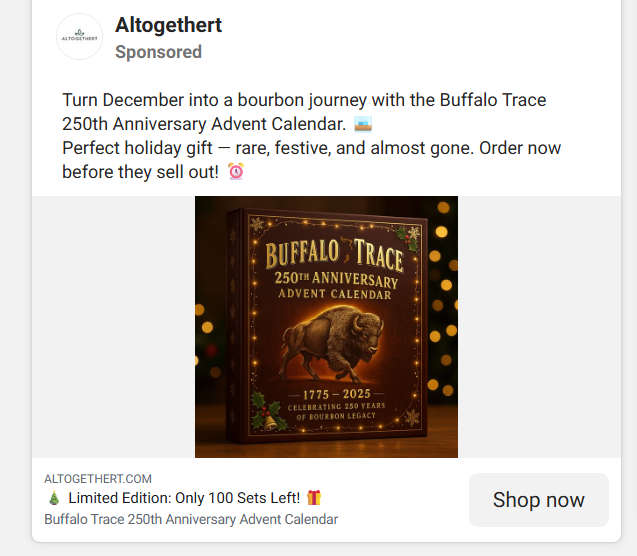
Scam Overview
The Buffalo Trace 250th Anniversary Advent Calendar scam is a fraudulent online shopping scheme that exploits trust in the Buffalo Trace brand. Buffalo Trace is a well-known American bourbon distillery with a loyal following. Scammers have piggybacked on its reputation to sell fake products online, particularly around the holiday season when advent calendars are in high demand.
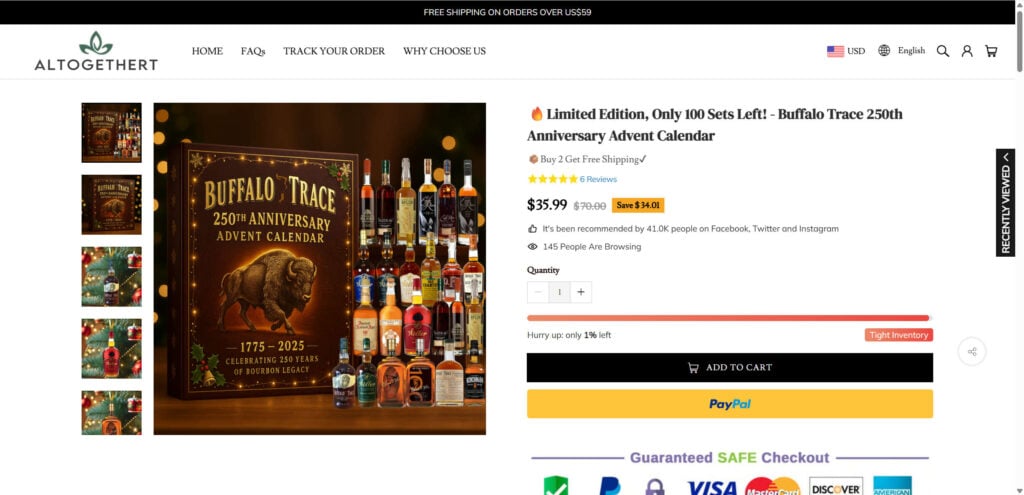
At first glance, the scam looks legitimate. The websites hosting the advent calendar feature slick graphics, glowing product descriptions, and pricing designed to create urgency. They often advertise the product for around $35.99, heavily discounted from a claimed retail price of $70 or more. Phrases like “limited edition,” “rare release,” and “only 100 sets left” are scattered across the page to pressure shoppers into making quick decisions.
The Appearance of Legitimacy
One of the most convincing aspects of this scam is how professional the websites appear. Fake stores such as altogethert.com, arosebrden.com, uniqueexquisites.com, blinging.shop, epickeeps.com, louxglow.com, vitestyle.com, hopelocalbrandus.com, degeshop.com, and hotflot.com all use the same formula:
- High-quality product images stolen from legitimate Buffalo Trace promotions or digital mockups.
- Discount banners claiming up to 90% off.
- Fake scarcity tactics like countdown timers and “1% left” inventory bars.
- Glowing customer reviews that look real but are fabricated.
- Payment options with recognizable logos (PayPal, Visa, Mastercard) to create trust, even though payments go directly to the scammers.
The sites also frequently run sponsored ads on Facebook, Instagram, and Google, where the scam gains credibility by appearing alongside legitimate brands. In these ads, the language is carefully crafted to resonate with bourbon fans:
“The Buffalo Trace 250th Anniversary Advent Calendar turns December into a journey through two and a half centuries of bourbon excellence. Discover 24 carefully selected whiskeys, each revealing the depth, craft, and character that Buffalo Trace has perfected over 250 years. A meaningful gift for bourbon lovers and collectors, combining festive joy with the legacy of America’s most enduring distillery.”
Red Flags of the Scam
Although the presentation looks polished, several warning signs reveal the truth:
- Recently created domains – The scam sites are all new, often registered just weeks before launching promotions.
- Opaque ownership – There is no legitimate company information, no verifiable physical address, and no responsive customer service phone number.
- Fake contact details – If an address or phone number is listed, it is usually fake or untraceable. The only contact option is an unresponsive email address.
- Unbelievable discounts – Offering up to 90% off a rare, limited-edition bourbon product is unrealistic. Genuine Buffalo Trace releases often sell for much more than retail, not less.
- Template designs – The sites use cookie-cutter e-commerce templates with recycled layouts and plagiarized content.
- No social media presence – Despite claiming to be highly recommended by thousands, these sites have no verifiable social media accounts or brand engagement.
- Shipping from China – Victims who do receive something report cheap knock-offs shipped from China, not authentic Buffalo Trace products.
- Refunds are impossible – Once payment is made, customers cannot get their money back.
Common Outcomes for Victims
Customers who fall for the scam usually end up with one of three outcomes:
- Nothing at all – Payments are processed, but no product ever arrives.
- Knock-off products – Some victims receive low-quality substitutes that look nothing like what was advertised.
- Completely wrong items – In some cases, customers receive unrelated products like generic clothing or household trinkets.
These tactics serve one purpose: to prevent customers from filing successful chargebacks. If a scammer can prove that something was shipped, it complicates the dispute process with banks or PayPal.
In short, the Buffalo Trace 250th Anniversary Advent Calendar scam is designed to look legitimate while leaving shoppers with empty wallets, no product, and no recourse.
This scam has been also investigated by Jordan Liles on his YouTube channel, where he offers a detailed video on the subject. We recommend watching his content for a comprehensive understanding of the scam.
Next, let’s break down exactly how scammers carry out this scam from start to finish.
How the Scam Works
Understanding how this scam unfolds step by step is critical to recognizing and avoiding it in the future. Below is a detailed breakdown of how scammers execute the Buffalo Trace 250th Anniversary Advent Calendar fraud.
Step 1: Creating the Fake Website
Scammers begin by registering a new domain name. These domains often sound vaguely related to lifestyle, shopping, or fashion but do not tie back to any real business. Examples include altogethert.com and arosebrden.com.
Once the domain is live, the scammers install a generic e-commerce template. They populate it with stolen images of Buffalo Trace bottles and professional-looking product descriptions. Many of these templates are reused across multiple scam sites, with only minor variations in logos and color schemes.
Step 2: Crafting the Fake Product
The centerpiece of the scam is the Buffalo Trace 250th Anniversary Advent Calendar. Scammers position it as a once-in-a-lifetime collectible, leveraging the authentic reputation of Buffalo Trace. They claim the calendar includes 24 miniature bottles of rare bourbon varieties.
Key selling points include:
- 250 years of bourbon legacy (1775–2025)
- Limited release and exclusive availability
- Celebration of Buffalo Trace’s history
- Perfect holiday gift for bourbon lovers
None of this is real. Buffalo Trace has made no such product, and the images are fabricated.
Step 3: Launching the Ads
Once the website is live, scammers purchase paid ads on Facebook, Instagram, and Google. These ads are targeted at bourbon fans, holiday shoppers, and gift buyers.
The ads use enticing language like:
- “Rare festive gift”
- “Only 100 sets left”
- “Turn December into a bourbon journey”
- “Save $34 today”
By combining urgency, scarcity, and the prestige of Buffalo Trace, scammers generate impulse purchases.
Step 4: Collecting Payments
Victims who click through the ads arrive at the fake store. The checkout process looks legitimate, complete with credit card logos and PayPal options.
However, payments go directly to the scammers. Even if PayPal is offered, victims often find themselves unable to file disputes successfully because scammers provide fake shipping information.
Step 5: Cutting Off Communication
After payment is complete, victims quickly realize they have no way to contact the seller. The listed phone numbers are fake, addresses lead to random locations, and emails go unanswered.
In some cases, customers receive a tracking number that never updates or points to an unrelated package shipped from China. This gives scammers just enough cover to argue that they delivered something, blocking refunds.
Step 6: Moving On to the Next Domain
As complaints pile up, scam sites are eventually flagged or shut down. But the operation continues seamlessly by launching new domains. The same product images, descriptions, and ads are recycled across a fresh site.
This cycle allows scammers to continuously target new victims while avoiding accountability.
What to Do if You Have Fallen Victim to This Scam
If you purchased the Buffalo Trace 250th Anniversary Advent Calendar from one of these fraudulent sites, take immediate action. Here are the steps you should follow:
1. Stop All Communication
Do not respond to emails or messages from the scam site. Any communication may expose you to further fraud attempts, including phishing or identity theft.
2. Contact Your Bank or Payment Provider
- Credit or debit card payments – Call your bank immediately and request a chargeback. Explain that you were defrauded by a fake online store.
- PayPal payments – Open a dispute as soon as possible. Provide documentation, including screenshots of the website and order confirmation.
- Other payment apps – Contact the app’s support team and report the transaction as fraudulent.
3. Monitor Your Accounts
Scammers sometimes attempt multiple charges after the first successful payment. Monitor your accounts daily for any suspicious activity. Report unauthorized charges immediately.
4. Report the Scam
File a report with:
- The Federal Trade Commission (FTC) in the U.S.
- Internet Crime Complaint Center (IC3)
- Better Business Bureau (BBB) for record-keeping.
- Local consumer protection agencies if outside the U.S.
Reporting helps authorities track and shut down fraudulent sites.
5. Strengthen Your Security
- Change your online banking and shopping passwords.
- Enable two-factor authentication wherever possible.
- Be alert for phishing emails pretending to be from your bank or PayPal.
6. Learn for the Future
Educate yourself and others about the warning signs of scam websites:
- Prices that are too good to be true.
- Lack of company transparency.
- Recently created domains.
- Limited or fake contact options.
Spreading awareness reduces the chances of others falling victim.
The Bottom Line
The Buffalo Trace 250th Anniversary Advent Calendar scam is a well-crafted but fraudulent scheme designed to trick bourbon lovers into paying for a product that does not exist. By using professional-looking websites, fake scarcity tactics, and the trusted Buffalo Trace name, scammers lure in unsuspecting shoppers during the holiday season.
Victims are left with nothing, cheap knock-offs, or completely unrelated products, with no possibility of refunds. The scam continues to spread across multiple domains, making vigilance essential.
If you have already fallen for this scam, act quickly to secure your finances and report the fraud. For everyone else, remember: if a deal looks too good to be true, it almost always is.
Frequently Asked Questions About the Buffalo Trace 250th Anniversary Advent Calendar Scam
Is the Buffalo Trace 250th Anniversary Advent Calendar real?
No. The Buffalo Trace 250th Anniversary Advent Calendar is not a real product offered by Buffalo Trace Distillery. The calendar being promoted on sites like altogethert.com, uniqueexquisites.com, blinging.shop, arosebrden.com, and others is entirely fake. Scammers are using stolen images, fabricated product descriptions, and misleading ads to trick shoppers into making purchases for a product that does not exist.
How do I know if a website selling the Buffalo Trace Advent Calendar is fake?
There are several red flags that reveal the site is fraudulent:
- Recently registered domain – Scam websites are often new and disappear within months.
- Unbelievable discounts – The calendar is listed at 70–90% off, which is not realistic for a rare collectible.
- No real contact information – Only an email address is offered, and if a phone number or address is listed, they are fake.
- No official ties to Buffalo Trace – The real Buffalo Trace Distillery has not announced or endorsed any such product.
- Generic design – The site looks like a template with stock images and plagiarized descriptions.
If you see these warning signs, do not make a purchase.
What happens if I buy the Buffalo Trace Advent Calendar from one of these scam websites?
Victims typically face one of three outcomes:
- No delivery at all – The order is accepted, but nothing is ever shipped.
- Cheap knock-offs – Some customers receive low-quality items from China that have nothing to do with Buffalo Trace.
- Completely wrong products – In some cases, random items like clothing or trinkets arrive, making refunds difficult to claim.
In every case, customers lose their money, and refunds are nearly impossible to secure directly from the scam site.
Which websites are promoting this scam?
Scammers frequently change domains to avoid being shut down, but known fraudulent sites include:
- altogethert.com
- uniqueexquisites.com
- arosebrden.com
- blinging.shop
- epickeeps.com
- louxglow.com
- vitestyle.com
- hopelocalbrandus.com
- degeshop.com
- hotflot.com
There are many others. If you come across a new site selling the Buffalo Trace 250th Anniversary Advent Calendar, assume it is fake unless verified directly by Buffalo Trace Distillery.
Can I get my money back if I ordered from one of these scam sites?
It depends on how you paid:
- Credit card – Contact your bank immediately and request a chargeback. Provide proof that the site is fraudulent.
- PayPal – Open a dispute as soon as possible. Include screenshots of the order, website, and advertisements.
- Debit card or direct transfer – Refunds are much harder. Contact your bank, but chances are slim if the payment has already cleared.
Acting quickly increases your chances of recovering the money.
Why are these scam websites so convincing?
The scammers use several tactics to appear legitimate:
- High-quality images stolen from real Buffalo Trace promotions.
- Professional-looking ads on Facebook, Instagram, and Google.
- Fake scarcity tactics like “Only 100 sets left” or “1% inventory remaining.”
- Well-written but plagiarized product descriptions.
- Recognizable payment logos (Visa, Mastercard, PayPal) to build trust.
These tricks make shoppers believe they are buying from a trustworthy retailer when in reality, the entire store is fake.
What should I do if I already gave my personal or payment information to these scammers?
If you entered payment or personal details on one of these scam sites, take the following steps immediately:
- Call your bank or card issuer and freeze your card if necessary.
- Change your online shopping and banking passwords.
- Enable two-factor authentication on your accounts for extra protection.
- Watch for suspicious charges on your bank or PayPal account.
- Report the scam to the FTC (U.S.), IC3, or your local consumer protection agency.
Acting quickly can help you limit the damage and protect your identity.
Why do scammers target popular brands like Buffalo Trace?
Scammers rely on the trust consumers already have in established brands. Buffalo Trace is a respected bourbon distillery with a strong reputation. By attaching a fake anniversary product to its name, scammers make the deal sound credible and desirable, especially during the holiday season. Consumers let their guard down because they assume such a reputable brand must be behind the product.
How can I avoid falling for similar scams in the future?
Here are practical tips to avoid fake shopping sites:
- Research the product on the official brand’s website. If Buffalo Trace doesn’t mention an advent calendar, it doesn’t exist.
- Check the domain age. Scam websites are often brand new.
- Look for customer reviews outside the site. Fake stores only display positive, fabricated reviews.
- Be skeptical of deep discounts. If it looks too good to be true, it usually is.
- Verify contact details. A legitimate business will have a real physical address, working phone number, and active social media profiles.
Has Buffalo Trace Distillery confirmed this advent calendar is fake?
Yes. Buffalo Trace has not released or endorsed a 250th Anniversary Advent Calendar. The official distillery website makes no mention of this product. Any site claiming to sell such a calendar is fraudulent. Always verify directly with the brand before purchasing limited edition products.
Is it safe to click on ads promoting the Buffalo Trace Advent Calendar?
No. Even clicking these ads can be risky. While many simply redirect you to scam websites, some could potentially lead to phishing attempts or malware downloads. It is safer to avoid interacting with any sponsored ads for the Buffalo Trace Advent Calendar.

Join the discussion
0 commentsShare your experience or ask a question about this article.
Discussion
Start the conversation
Have a question or something useful to share? Add the first comment.