

The “Buried Tesla Blueprint Generator” pitch is back, again.
It shows up in social media ads claiming Nikola Tesla left behind a simple, cheap device that can slash your power bill, sometimes even promising you will “never pay for electricity again.” The story usually adds a villain, like J.P. Morgan, government agents, or a shadowy coverup, then pushes you into a long sales video and a checkout page.
This article explains what this scam is, how it works, why the claims fall apart, what people actually receive after paying, and what to do if you already bought in.
Scam Overview
The “Buried Tesla Blueprint Generator” scam is a classic “free energy” con dressed up in modern marketing.
It does not matter if the page calls it a “generator,” a “Tesla-inspired system,” an “energy revolution,” or a “forbidden blueprint.” The core promise is the same: a simple DIY build that supposedly produces huge amounts of usable electricity for a home, with minimal cost, minimal skill, and big monthly savings.
That combination is the giveaway.
The headline claims you will see over and over
These funnels rotate wording, but the message stays consistent. Common claims include:
- Tesla created a device that produces “unlimited free electricity”
- The blueprint was “buried,” confiscated, or suppressed for decades
- A cheap build, sometimes framed as a $200 device, is all you need
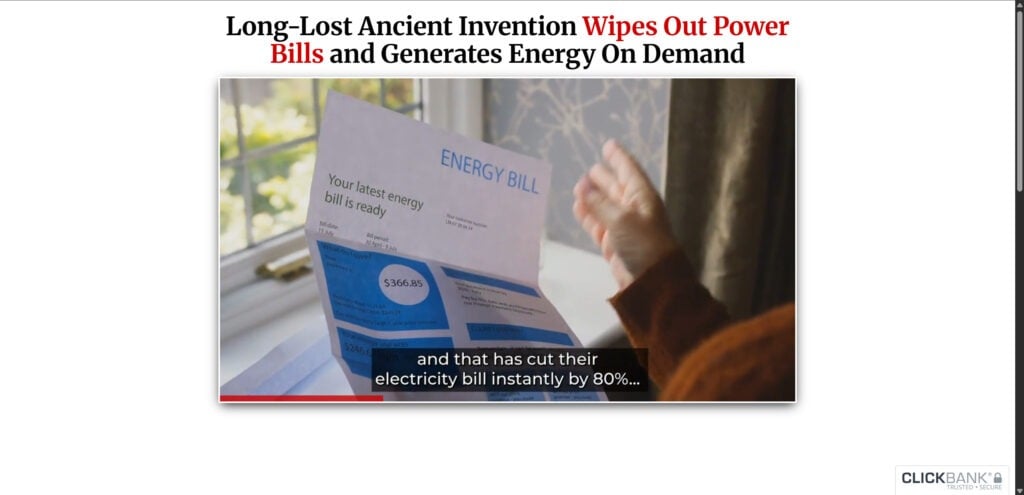
- You can cut your electric bill by up to 80%
- You can reach “complete energy independence”
- You do not need solar panels, complex installations, or technical expertise
- Tens of thousands, sometimes “100,000+ families,” are already using it
These claims are designed to hit hard emotional triggers:
- frustration with monthly bills
- fear about rising energy costs
- anger at “big companies” and utilities
- hope that there is a shortcut
- the thrill of discovering something “forbidden”
Then the funnel turns that emotion into a purchase.
The Tesla name is the bait
Tesla was a real inventor, and scammers lean on that reputation because it reduces resistance instantly.
Most people do not know the details of Tesla’s work. They just know the name carries weight. That makes it perfect for a marketing story that sounds scientific, legendary, and just plausible enough to keep someone watching.
But using Tesla’s name does not prove anything.
A claim is not true because it is wrapped in a Tesla storyline. It is true only if it holds up under basic reality: measurable output, clear inputs, independent testing, and a design that works safely and consistently in the real world.
These funnels avoid that level of proof.
The “suppressed blueprint” story is a manipulation tool
The coverup narrative is not there because it is historically accurate.
It is there because it does three powerful things at once:
- It explains why you have never heard of the device before.
- It turns skepticism into a flaw, like you are “asleep” or “programmed.”
- It reframes buying as rebellion, like you are taking power back from a corrupt system.
That is exactly why you often see lines like:
- “They buried Tesla’s blueprint… twice.”
- “Agents confiscated his files.”
- “Suppressed for 80 years… until now.”
- “You’re about to see the truth they hid.”
A real product does not need a villain to sell itself. It needs evidence.
The promise fails a simple test: where does the energy come from?
A generator is not magic. It converts energy from one form into electricity.
That means you always need an input source, like:
- sunlight (solar panels)
- wind (turbine)
- water flow (hydro)
- fuel (gas, diesel, propane)
- stored chemical energy (batteries)
- mechanical input (hand crank, engine, spinning mass)
If a page implies a small DIY build can power a home without a clear input source, you are looking at fantasy marketing.
A common trick is to blur the “input” discussion with vague phrases like:
- “harnessing natural energy”
- “electromagnetic induction”
- “capturing and recycling wasted energy”
- “advanced capacitors store power”
- “Tesla coil principles”
Those phrases can sound technical, but they do not answer the central question.
Capacitors store energy. They do not create it.
Coils can transform voltage and current characteristics. They do not create energy from nothing.
Induction transfers energy between circuits. It does not eliminate the need for an energy source.
If the pitch does not clearly explain the energy input and show measured output, it is not a home power solution.
The pseudo-science is meant to impress, not to be checked
These scams are built to sound smart without being testable.
They often mention real concepts, like electromagnetic induction, Tesla coils, bifilar pancake coils, resonance, or “efficiency,” then attach impossible outcomes, like near-free household electricity.
This is a classic persuasion move: mix real words with unrealistic results, so the viewer assumes the speaker must know what they are talking about.
A legitimate energy product does the opposite. It makes verification easy.
It provides:
- rated power output in watts or kilowatts
- clear input source and expected conversion efficiency
- safe connection method (off-grid only, grid-tied with certified inverter, transfer switch, etc.)
- parts list with certification details
- documented tests, ideally from independent reviewers
- predictable performance limits and real-world examples that can be checked
These funnels avoid specifics because specifics would expose the gap between the story and the results.
The pages often reveal themselves through sloppy template reuse
One of the strongest signals that you are dealing with a recycled scam funnel is when the content stops matching the product.
For example, some versions of these Tesla “energy” pages drift into unrelated claims about:
- generating purified drinking water from humidity in the air
- filtration that removes fluoride, lead, chlorine, and contaminants
- “no plumbing required”
- a named water product inserted into the copy
That kind of mismatch is not a small typo. It suggests the page was assembled from reused sections taken from other pitches, then patched together quickly.
If a sales page cannot keep the product description consistent, it is not a trustworthy source for claims about powering your home.
The “reviews” and “families are using it” claims are easy to fake
Many versions include testimonials that follow the same pattern:
- a friendly first name and initial
- a state or city label
- a stock-looking profile photo
- a glowing paragraph claiming dramatic results
That is not proof of anything.
This scam style relies on the fact that most people do not verify testimonials. They read them, feel reassured, and move on.
Real proof for a power-producing system looks like:
- independent measurements with photos and hardware details
- repeatable builds with consistent outputs
- documented installs reviewed by qualified electricians or engineers
- credible third-party reviews that show the device running real loads
A paragraph on a sales page does not power a refrigerator.
Why the “cut your bill by 80%” promise is especially misleading
“Up to 80%” is one of the most abused phrases in scam marketing.
It sounds specific, but it is actually slippery. It allows the seller to imply big results while leaving the outcome undefined.
To cut a household bill by 80% using a real solution, you would need something like:
- a properly sized solar setup with storage or grid-tie
- major energy efficiency upgrades (HVAC, insulation, windows, appliances)
- a combination of demand reduction plus a verified alternative energy source
None of that is a beginner DIY coil project.
If the pitch suggests a small device you build with basic parts can reliably reduce household costs by 80% without solar or fuel, it is not a realistic claim.
What people usually receive after paying
This scam is almost always a digital product.
Most buyers end up with some combination of:
- PDFs framed as “blueprints” or “step-by-step guides”
- basic diagrams and generic parts lists
- vague explanations of coil concepts
- “bonus” reports that pad the perceived value
- upsells that try to extract more money right after purchase
Even if the PDFs contain real electrical terms, the core promise is still the issue.
The marketing implies a breakthrough generator that changes your monthly bills. The delivery is usually information, not a verified device.
That mismatch is where people feel tricked.
The safety risk people do not think about
When a funnel encourages viewers to build electrical devices and connect them to household power, the risk is not just financial.
Unsafe electrical projects can cause:
- shock hazards
- damaged appliances
- fires
- violations of local electrical codes
- serious injury
A PDF does not protect you from poor design. It does not protect you from incorrect wiring. It does not protect you from a bad idea.
If a sales page tells beginners they can tie something into home power “without technical expertise,” that should set off alarms immediately.
Why the name keeps changing
Scammers rebrand because the template works.
Once a name gets too many complaints, bad reviews, chargebacks, or reports, they switch:
- new domain
- new branding
- same script
- same claims
- same structure
- same delivery
This is why it is better to write about the scam category, not just one product name.
“Buried Tesla Blueprint Generator” is a reusable story. The label changes, but the playbook stays.
How The Scam Works
This is how the Buried Tesla Blueprint Generator scam typically pulls people in, step by step.
Step 1: Social media ads bait the click with outrage and hope
The ad usually leads with a punchy claim:
- “Tesla’s hidden blueprint finally revealed”
- “They never wanted you to know this”
- “Never pay for electricity again”
- “Cut your electric bill by 80%”
- “Build this simple device at home”
It is designed to trigger a reaction before you have time to think.
The audience is often people who:
- search for “lower electricity bill”
- follow off-grid and prepper content
- watch DIY and home improvement videos
- are struggling with utility bills
The ad does not give you real details. It gives you a reason to click.
Step 2: You get redirected through multiple domains
Many of these operations use multiple websites for the same offer.
This achieves a few things:
- makes it harder for complaints to stick to one domain
- helps them test different page designs and scripts
- lets affiliates promote slightly different links
- keeps the funnel alive if one site gets flagged
So you might click one link and end up on another domain with the same branding, the same claims, and the same checkout path.
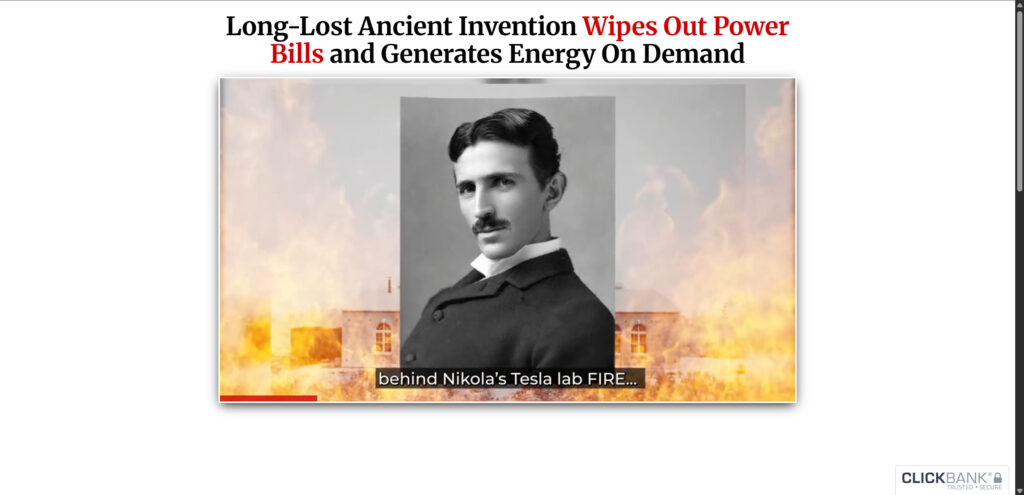
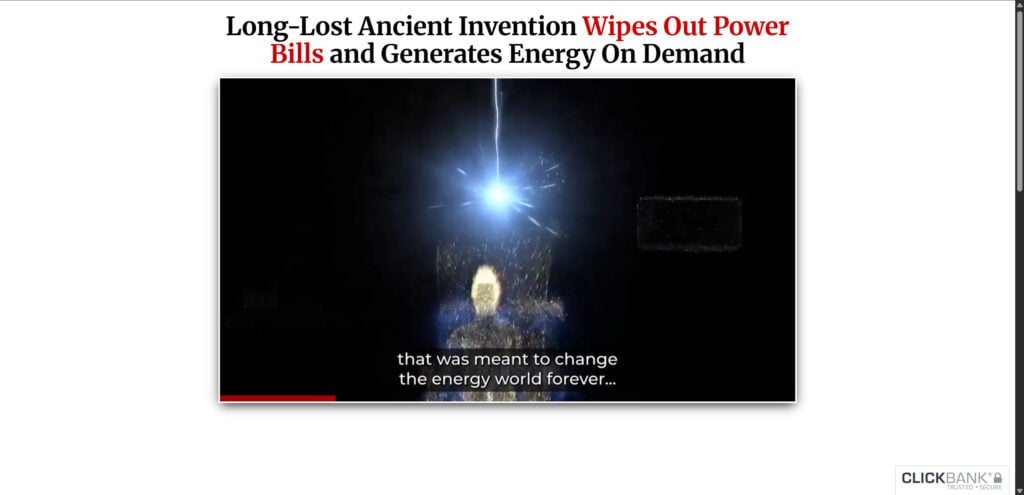
Step 3: The landing page pushes the long video first
The page is built around a long-form sales video, often called a VSL (video sales letter).
This matters because a VSL is not a normal product explanation.
Its job is to:
- build emotion
- tell a story
- create villains and heroes
- keep you watching
- wear down skepticism
- push you into a purchase
Most of the “proof” is delivered through narration and visuals, not through verifiable measurements.
Step 4: The script uses Tesla mythology to build instant authority
The story often includes variations of:
- Tesla perfected a device
- financiers or powerful figures shut it down
- files were confiscated
- the method vanished
- now it has resurfaced through a researcher, engineer, or “inventor”
The details change, but the theme stays: you are being invited into a secret.
It feels exciting. That is the point.
Step 5: Technical-sounding language fills the gaps
Once you accept the story, the funnel gives a sprinkling of science words to make it feel real:
- induction
- coils
- electromagnetism
- resonance
- capacitors
- efficiency
- sensors and monitoring
Notice what is missing: hard numbers.
No clear watts. No test reports. No consistent output data. No grid-tie details. No certification.
That is not an accident. It is how the funnel stays alive.
Step 6: Big claims are repeated until they feel normal
A common VSL tactic is repetition.
The script repeats the same promises in slightly different forms:
- “huge savings”
- “no more dependency”
- “easy build”
- “anyone can do it”
- “family security”
- “utilities hate this”
The repetition is designed to make the claim feel familiar, and familiar feels true to the brain.
Step 7: Social proof seals the emotional case
Then come the “families are using it” numbers and testimonial blocks.
This is where you see:
- “over 102,000 families”
- “tens of thousands of households”
- reviews that read like ads
The goal is not accuracy. The goal is momentum.
If you feel like everyone else is already doing it, your brain wants to avoid missing out.
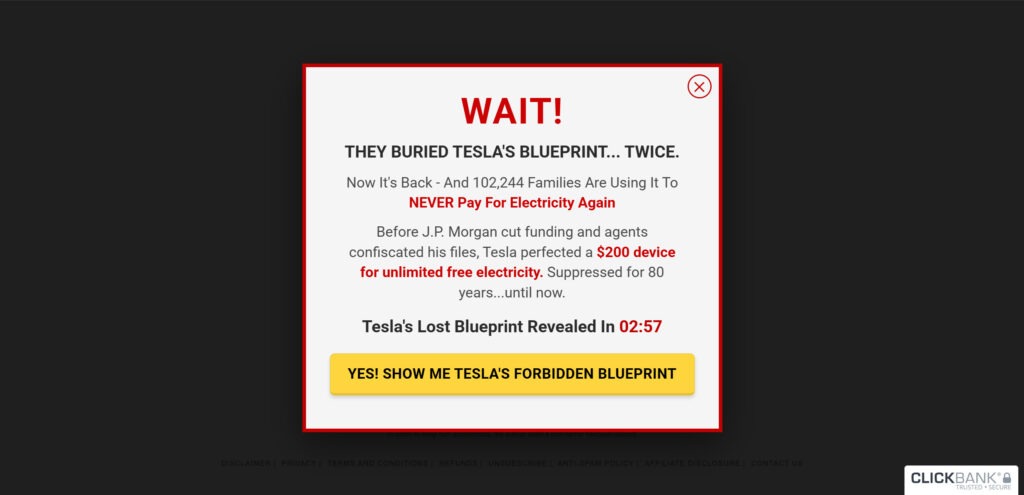
Step 8: Urgency popups hit when you try to leave
A common feature of these funnels is the exit popup.
You move your cursor toward closing the page, and suddenly:
- “WAIT!”
- “Tesla’s forbidden blueprint”
- a countdown timer
- a bright button telling you to continue
This is a pressure tactic. It is designed to interrupt your escape and keep you inside the story.
Legitimate products do not need to trap you. They can survive a calm decision.
Step 9: Checkout is streamlined and often routed through affiliate platforms
Many of these offers are sold as digital downloads through affiliate marketplaces or payment processors that handle large volumes of direct response products.
That model makes it easy to scale fast:
- affiliates run ads
- traffic hits the VSL
- purchases flow through a standardized checkout
- the funnel keeps running as long as the ads keep converting
The buyer often thinks they are purchasing a real “system,” but the delivery is typically a download library.
Step 10: Upsells and add-ons appear immediately after purchase
After you pay, many funnels show additional offers like:
- expanded “premium” guides
- extra “blueprints”
- private community access
- printed hard copy versions
- “fast-track” video training
This is not unusual in scam-style funnels. The first sale is only step one. The real goal is extracting additional payments while the buyer is still emotionally invested.
Step 11: The product arrives, and the reality feels smaller than the promise
This is the moment many buyers describe as the gut punch.
The marketing implied:
- a device that changes your energy bills
- a breakthrough blueprint
- a practical path to independence
The reality is usually:
- generic PDFs
- vague diagrams
- recycled explanations
- no verified performance results
Even if the guide is presented nicely, it rarely matches the scale of the promise.
Step 12: Refund friction and support runarounds wear people down
Many of these funnels advertise refund policies, but experiences vary.
Common patterns people report with this style of product include:
- slow support replies
- unclear instructions
- being passed between vendor and platform support
- delays that push the buyer toward giving up
Even when refunds are available, the process can be annoying enough that a percentage of people simply stop trying.
Step 13: The name changes and the funnel repeats
When complaints pile up, the operation often rebrands.
New name. New domain. Same story.
This is why you will see near-identical pitches under different titles, including “lost generator,” “secret blueprint,” “energy freedom,” and other Tesla-themed variants.
What To Do If You Have Fallen Victim to This Scam
If you bought a Buried Tesla Blueprint Generator offer and feel misled, focus on a clean plan that protects your money and reduces risk.
1) Gather your proof immediately
Save:
- screenshots of the main claims (especially “never pay again” and “up to 80%”)
- the domain names you were routed through
- the checkout page
- your email receipt and transaction ID
- the refund policy page, if it exists
- any upsell pages you were shown
Also download what you received, even if it is junk. It helps show what was delivered.
2) Request a refund in writing
Keep your message simple:
- you want a refund
- the marketing claims do not match what you received
- include your order ID and purchase email
- ask for confirmation and a timeline
Short and firm usually works better than a long argument.
3) Watch your statements for extra charges
Some funnels stack add-ons, upgrades, or memberships.
Check for:
- additional charges from the same merchant
- charges a few days later
- recurring billing you did not expect
If you see anything suspicious, contact your card issuer right away.
4) If support stalls, contact your card issuer or payment service
If the refund request goes nowhere, consider a dispute.
Use clear language like:
- “digital product not as described”
- misleading advertising
- claims did not match delivery
Attach your screenshots and receipt.
5) Do not wire anything into your home electrical system
If the guide suggests tying a DIY device into your electrical panel, do not do it.
Home electrical panels are not beginner territory.
If you are genuinely interested in DIY energy, start with safer, proven paths:
- learning basics with low-voltage projects
- certified inverters and properly rated components
- advice from licensed electricians
- reputable off-grid resources that show real measurements
Your safety matters more than any PDF.
6) Avoid installing random software or browser extensions
Some shady funnels push “members area tools” or downloads that are not just PDFs.
If anything looks like an executable file, an installer, or a browser add-on, skip it.
Stick to viewing files in a safe environment and scan downloads if you are unsure.
7) Report the ads and domains
Report the social media ads for misleading claims.
If you want to go further, you can report the domains to:
- the ad platform
- the hosting provider (if you can identify it)
- consumer complaint channels in your country
Every report helps reduce how many people get pulled in.
8) Warn others with specific details
If friends or family are considering buying, do not just say “it’s a scam.”
Point to the exact tells:
- “never pay for electricity again”
- “Tesla’s buried blueprint”
- huge savings with no real specs
- rotating domains and pressure popups
- download-based delivery
Specific warnings stop purchases more effectively than labels.
The Bottom Line
The Buried Tesla Blueprint Generator scam is a recycled “free energy” pitch built for clicks, not truth.
It uses Tesla’s name, a coverup storyline, big savings promises like 80%, and urgency tactics to push people into buying digital “blueprints.” The offer changes names and domains constantly, but the structure stays the same: dramatic story, vague science, social proof, pressure, and a download that rarely matches the promise.
If you want to lower your energy costs, there are real options. They are not mysterious, and they are not hidden. They involve measurable upgrades, proven equipment, and clear limits.
If a page claims Tesla’s “forbidden blueprint” will let you stop paying for electricity with a simple DIY device, treat it as what it is: a polished sales story built to take your money.
FAQ
What is the Buried Tesla Blueprint Generator scam?
It’s a “free energy” style pitch that claims Nikola Tesla left behind a hidden or “buried” blueprint for a simple DIY generator that can slash your power bill, sometimes promising you will “never pay for electricity again.” In most cases, it is sold as a digital download through a long sales video and pressure tactics, not as a real, tested energy product.
Is the Buried Tesla Blueprint Generator legit?
No. The core claim is the giveaway. A small DIY device cannot power a home or cut bills dramatically without a real, clearly stated energy input source and verified output. These funnels rely on storytelling, not proof.
What do you actually get after you pay?
Usually downloadable content, often PDFs marketed as “blueprints,” plus “bonus” guides. Many versions add upsells right after checkout, including upgraded guides, additional “plans,” or a printed copy. Buyers typically do not receive a real generator or certified hardware.
Can a Tesla coil or “bifilar pancake coil” generate free electricity?
No. Coils and inductive components can transfer or transform energy, and capacitors can store energy, but none of that creates energy from nothing. If the pitch suggests “unlimited” or near-free household power from a coil-based DIY device, it is misleading.
Why do these pages claim the blueprint was “suppressed” or “forbidden”?
That story is used to explain why the device is not widely known and to make the offer feel urgent and exclusive. It also frames skepticism as ignorance, which keeps viewers emotionally locked into the pitch.
Why do scammers keep changing the product name and domain?
Rebranding helps them dodge complaints, bad reviews, ad platform enforcement, and chargeback history. The name changes, the domain changes, the script stays the same.
I saw multiple websites like theenergyrevolution.net and energyrevoloutionsystem.com. Is that normal?
For this type of funnel, yes. Multiple domains and redirects are commonly used to track ads, rotate traffic, and keep the operation running if one domain gets flagged.
Do these offers ever provide real proof, like test results?
Rarely. Legitimate energy solutions show measurable output (watts or kilowatts), clear input sources, safety certifications, and independent testing. These funnels usually offer testimonials and dramatic claims instead of data.
Is it safe to try building what they describe?
Be careful. Anything that suggests connecting a DIY device to your home electrical panel can be dangerous and may violate electrical code. Bad wiring can cause shock hazards, fires, and appliance damage. Do not attempt panel connections without a qualified electrician.
What should I do if I already bought it?
- Save screenshots of the claims, checkout page, and receipt
- Request a refund in writing using your order ID
- Watch for extra charges or add-ons
- If they stall, dispute the charge as “not as described” and provide documentation
How can I spot the next version of this scam?
Look for:
- “Tesla blueprint” or “lost invention” themes
- huge savings claims like “up to 80%”
- long sales videos that delay basic facts
- countdown timers and exit popups
- vague technical buzzwords with no clear specs
- rotating domains and constant rebranding








