


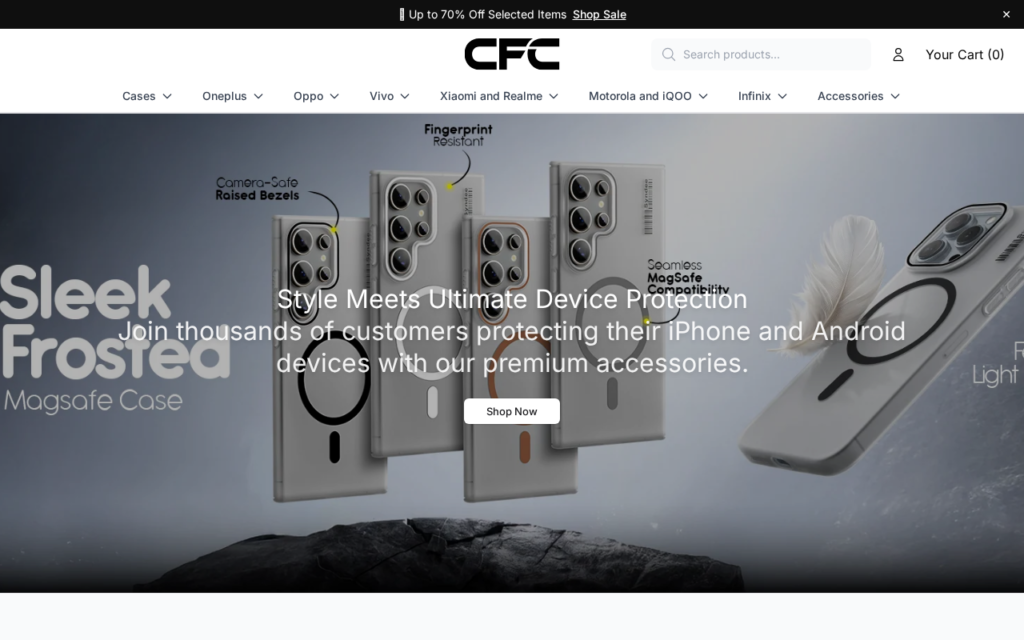
If you’ve come across Buycforcover.shop, you’ve seen what looks like an established brand’s store: crisp product shots, careful descriptions and prices that seem too good to skip.
Before your cart has anything in it, get clear on who’s really behind this site and what usually happens to the money once it’s paid.
Overview
The products are familiar, the address isn’t
None of the real brands and stores whose catalog, photos and branding appear on Buycforcover.shop actually runs it. Those genuine sellers trade from their own websites instead.
On mobile, that’s easy to miss. Everything on the page looks right, the products look familiar and the checkout button does its job.
The network running copycat stores like this one has a clear cycle. Ads go out in force, orders roll in, and once complaints build, it moves on to new domains.
How the deep discounts are built
It’s the markdowns that get people clicking. Something that normally costs $180 appears at $39, often with a “closing sale” banner or a countdown timer right beside it.
That number isn’t a markdown on leftover stock. It’s there to keep you moving straight through checkout, before you notice the store isn’t who it claims to be.
Legitimate brands put things on sale through their own websites and the retailers they name. An untraceable store marking its entire catalog down 70% isn’t doing that.
What people really get when they order
Buyers at fake stores like Buycforcover.shop usually run into one of the following:
- The package never comes. Its tracking number stays frozen, or it turns out to track a stranger’s parcel.
- You get a knockoff. It’s cheap, the size and finish are wrong, the materials are off, and it isn’t genuine.
- A random cheap item arrives. It isn’t what you ordered. It exists only so there’s a record showing something was delivered.
- Strange payments follow. The same card you typed in at checkout begins listing charges that aren’t yours.
A copied catalog is all Buycforcover.shop has. It’s a fake store, so do not buy from it and do not enter your card details at its checkout.
What We Found on Buycforcover.shop
Here’s what stands out about Buycforcover.shop:
- Buycforcover.shop was registered on June 19, 2026, about 5 months ago.
- The MalwareTips URL scanner gives Buycforcover.shop a Safety Score of 28/100, rated High Risk (full report).
- On VirusTotal, 7 of 93 security vendors flag Buycforcover.shop as malicious or suspicious.
How the Buycforcover.shop Scam Works
The good news is that the script repeats. It runs across hundreds of copycat stores, so knowing its steps helps you spot the next one before you pay.
Step 1: A social ad with lifted photos
The first thing you see is a sponsored post on Facebook, Instagram or TikTok. Its photos and videos come straight from real brands and stores, so it looks perfectly normal.
Then comes the caption, and it’s always urgent. Think anniversary sale, warehouse clearance or “we’re closing our stores.” Below it, comments may be disabled or crowded with brief, gushing praise.
The link opens Buycforcover.shop, a page designed to pass as an established shop.
Step 2: The store is copied, piece by piece
The page is assembled from real shops, from product photos and descriptions to the branding. Even the menus, guides and “free returns” badges can look the same.
A real company can’t be copied, and that’s where these stores fall short. The business name, address and customer service are usually absent or lead nowhere useful.
Start with the footer, then the legal pages. Those are usually the weakest parts of the copy: a generic company name, a missing address, a free email address.
Step 3: Pressure tactics that rush your payment
Countdown timers, “only 3 left” badges and “12 people are viewing this” pop-ups are there to keep you clicking. Slow down, and the holes start showing.
The upselling is deliberate. Free-shipping thresholds and “buy 2, get 1 free” bundles push your basket up, maximizing what the store collects from each card that gets to checkout.
Step 4: Confirmation in your inbox, then no word
The first thing you see after checkout is an order confirmation. It’s meant to look routine, because a routine email delays your doubts and hands the store extra time.
A week later you may get a tracking number. It often goes nowhere: frozen on “label created,” never updating, or marked delivered in a city you’ve never lived in.
That stretch of waiting costs you. Each day pushes you nearer the end of your card’s dispute window, which is why the delay is built into the plan.
Step 5: Counterfeit goods or no delivery at all
If anything is delivered, it’s usually a cheap copy sent from overseas. It doesn’t match the product photos, and it isn’t what you paid for.
A “delivered” status can be staged, too. Some stores mail a token item, a cheap accessory for example, to a real address and later cite the tracking against your refund.
Step 6: Promised refunds that never land
Your emails get silence or the same scripted line: wait “a few more days.” If a refund ever comes up, it’s tied to conditions no one could meet.
The store may offer 20% back to keep the item, or tell you to ship it to China at your own cost. Both leave it with most of your money.
Red Flags at Buycforcover.shop
You won’t prove a store is fake with one odd detail. Stores like Buycforcover.shop stack several together, and you can confirm each one yourself in under a minute.
The site’s address doesn’t match the brand
A genuine brand sells through its own domain or through retailers named on its official site. Buycforcover.shop is neither.
Look up the brand on your own and visit its official website. Compare that address to the one in your browser. Don’t match? You’re not in the brand’s store.
Just a logo, no company
There’s rarely a registered company, tax number or real address you can check behind stores like this. When an order goes wrong, there’s simply no one to hold responsible.
Before you pay, find out who’s actually selling to you. A real brand’s site usually names that company in the footer, the terms of service or an imprint page.
Ways to reach the store that go nowhere
On stores like this, help usually means a contact form or a generic email address. There’s no phone number, no live chat and no local return address.
The genuine brand usually gives you phone support, store locations and a returns center. A fake store, on the other hand, has every reason to stay hard to find.
Store policies pasted in from another shop
Look at the refund, shipping and privacy pages. On copycat stores they often read like another shop’s paperwork, sometimes still mentioning the wrong store, country or currency.
A returns headline can sound generous while the real rule sits further down. On copycat stores, that rule is often something like returns to China at your cost.
Sales that don’t match the real brand
Established brands rarely take 70% or more off their entire catalog. When every single item gets cut that deeply, the sale isn’t real.
Those “original” prices printed beside the deals are often made up as well. They’re there only to make a fake discount seem bigger.
Ratings you can’t trace to real shoppers
The five-star reviews look convincing, but on stores like this they rarely lead back to real customers. Matching reviews on other sites are usually missing.
Search the store’s address with “reviews” added. Copycat stores usually return no results at all, or a string of complaints about orders people are still waiting for.
How to Spot These Scam Websites
Fake brand stores have become harder to spot. Many of them now use AI-generated ads, polished product videos and copied checkout pages that look identical to the real thing.
The good news is that the same few checks still catch almost all of them:
- Check the address, not the logo. Open the brand’s official site yourself and compare addresses. One extra word or an odd ending is enough.
- Scan the site before you pay. Paste the address into the MalwareTips Website Scanner. It shows the domain’s age, security results and known warning signs in seconds.
- Look up who owns the domain. A Whois.com lookup shows when it was registered. A brand’s official shop doesn’t sit on a newly registered domain.
- Find the company behind the store. A real brand names its legal company, address and tax details. A copycat store leaves them out or invents them.
- Be suspicious of “closing down” sales. Store-closure, anniversary and warehouse-clearance stories are the most common hooks in fake brand ads.
- Search for outside reviews. Look the store up on Trustpilot and in search results. No history at all is as telling as a wall of complaints.
- Watch the payment options. A checkout that pushes bank transfers, crypto or a payment page on another domain is a reason to stop.
A browser extension can help. Malwarebytes Browser Guard blocks many known scam and phishing sites, and Malwarebytes ScamGuard checks suspicious links and messages before you click.
How to Buy the Real Thing Safely
If Buycforcover.shop had something you wanted, you can usually buy the genuine version and skip the risk:
- Buy from the brand directly. Search for it on your own and use its official website, not a link someone dropped in an ad or comment.
- Confirm the store is an authorized seller. Many brands say exactly who those sellers are. Can’t find the store on the list? Then it isn’t one.
- Cross-check the discount. Visit the brand’s website and verified social accounts. A real clearance appears there, not only in sponsored ads.
- Try a marketplace that backs its buyers. When the brand sells there through an official storefront, you have a clear way to get your money back.
- Pay with protection on your side. That means a credit card or PayPal, and never a bank transfer, a gift card or crypto.
Spending more than Buycforcover.shop asks may be part of buying the real product. So is dealing with a seller that honors refunds.
What To Do If You Already Fell For the Scam
If you paid a fake store, move quickly. The sooner you act, the better your chances of getting the money back and stopping further charges.
- Call your bank or card issuer. Say you paid a fake store and ask for a chargeback. Disputes have time limits, often around 120 days, so don’t wait.
- Open a PayPal dispute if you paid that way. Choose “item not received” or “significantly not as described.” PayPal generally accepts claims within 180 days of payment.
- Block or replace your card. If you typed your card details into the site, ask for a new card and turn on transaction alerts.
- Save your evidence. Keep the order email, the tracking number, screenshots of the product page and any messages from the store.
- Watch for follow-up scams. Fake delivery texts asking for a “customs fee” or “address update” often follow these orders. Don’t pay them or click their links.
- Change reused passwords. If you created an account on the store with a password you use elsewhere, change it on those other sites.
- Protect your data. Your name, address and phone number are now in the wrong hands. Malwarebytes Personal Data Remover finds where your details are exposed and helps remove them.
- Cut off the ads. These stores find people through ads. AdGuard blocks many malicious ads and pop-ups in your browser, so fewer of them reach you.
- Report the store. Report the ad on the platform where you saw it. In the US, file a report at ReportFraud.ftc.gov. For cross-border purchases, use econsumer.gov.
If you downloaded anything from the store, such as an “order tracking” app or a file attached to an email, scan your device with Malwarebytes Free.
Frequently Asked Questions
Is Buycforcover.shop a legitimate store?
No. Buycforcover.shop only looks like a store. It’s a fake one, built from a copied catalog of real brands’ photos and descriptions, and those brands don’t run it.
Why does Buycforcover.shop look so convincing?
Because almost nothing on it is original. Product photos, descriptions, menus and guides were copied from real brands and stores. What it lacks is a real business behind them.
Will I receive my order from Buycforcover.shop?
Maybe, but probably not the product you paid for. Often, buyers of stores like this get nothing, or a cheap copy that looks nothing like what’s pictured.
I already paid. Can I get my money back?
Often, yes. Move quickly and contact your card issuer or PayPal to dispute the charge, picking “item not received” or “not as described.”
Hang on to the order email and tracking number, and take screenshots of the product page. Waiting for the store to reply first is a mistake.
Should I replace my card?
Yes, if Buycforcover.shop got your card details at checkout. Request a replacement card from your bank and watch your statements closely for small test charges.
Where can I report Buycforcover.shop?
Flag the ad on the site or app where it showed up, contact the brand whose photos it copies, and send a complaint to your country’s consumer protection authority.
The Bottom Line
The catalog on Buycforcover.shop is borrowed from real brands, photos and all. Its low prices are bait, and the items you pay for will probably never arrive.
Keep your money away from Buycforcover.shop and do not buy there. If the product appeals to you, get it from the brand’s official website or a retailer the brand lists.
Ordered already? Contact your bank or start a PayPal dispute today. Hold on to every email and screenshot, and get a new card if you entered your card details.

Reviews & discussion
0 commentsShare a firsthand experience, or ask a question.
Community reviews
buycforcover.shop
Moderated reader experiences, not an editorial verdict.
Start the conversation
Have a question or something useful to share? Add the first comment.