

You’ve compared dates, moved the trip by a day, and finally found a Tokyo fare that makes the budget work. The confirmation feels like progress.
Then someone calls about the booking. A cheap Tokyo flight scam often becomes easier to recognize at that moment than on the page advertising the price.
Overview
The bargain can be the opening, not the price you receive
Fraudulent booking sites and phony travel-support contacts can advertise an appealing fare, collect information or payment, then introduce an unexpected charge before providing a usable ticket.
The Better Business Bureau’s airfare warning documents reports involving sudden price increases, invented restrictions, and false cancellation claims.
Those are documented booking tactics, not proof that every low Tokyo fare or third-party agency is fraudulent. The destination and a discount do not decide the case.
This guide concerns the deceptive booking-and-extra-payment journey. It does not identify a particular Tokyo seller or establish a new wave of attacks against Japan-bound travelers.
A booking reference is not the whole answer
A neat email can make the purchase feel complete. What you need to establish is whether the airline recognizes the trip and whether travel has actually been ticketed.
Ask the airline through its genuine support route. Give it the reservation information you received and ask what it can confirm for each passenger.
If something cannot be found immediately, check spelling, the operating airline, and the reference required before concluding there is fraud. Booking systems and agency references can differ.
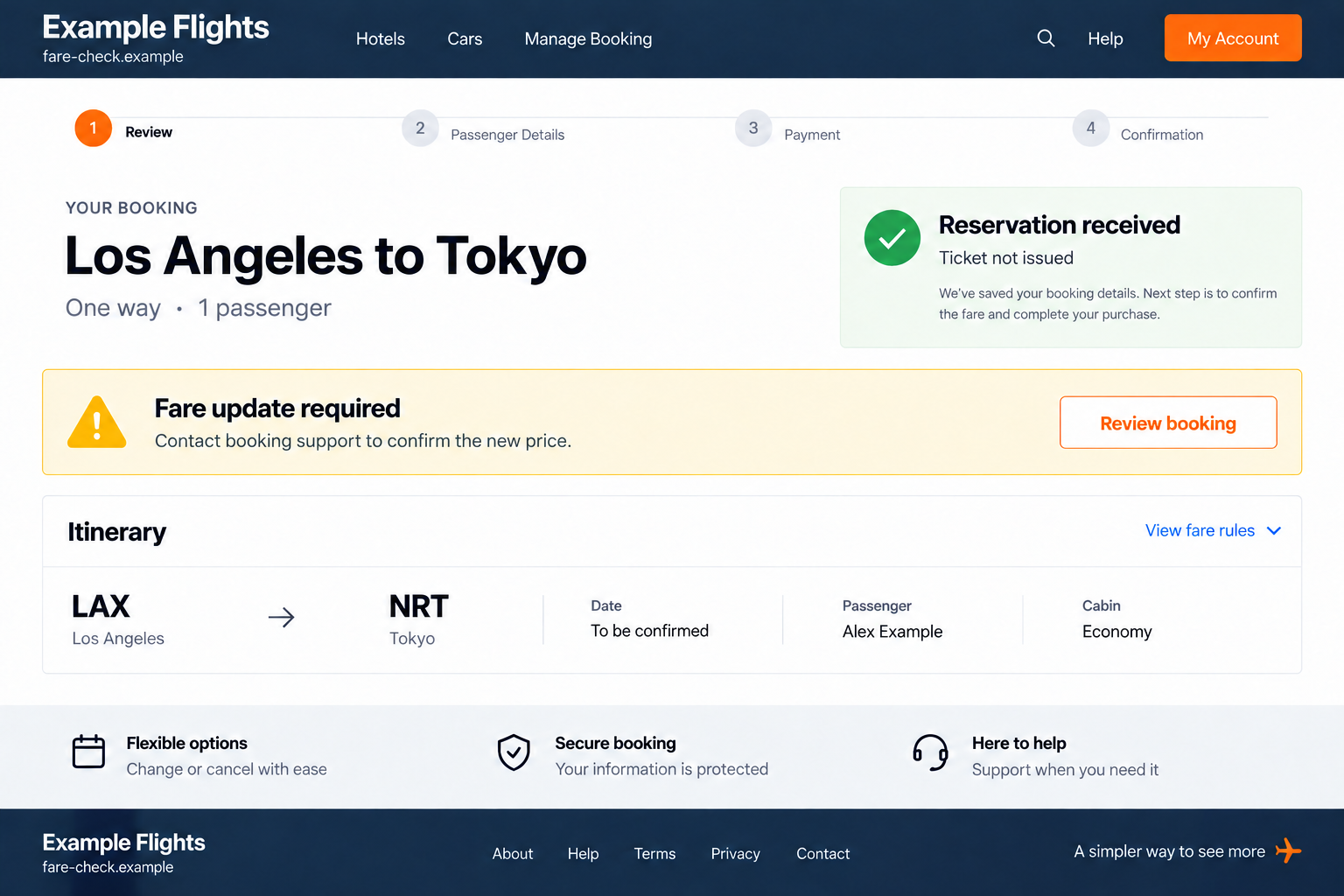
The image uses an invented business, passenger, and example domain. It illustrates the gap between a reservation message and ticket issuance, not a real disputed purchase.
The critical check comes before another payment
Stop treating the follow-up call as an automatic continuation of a legitimate purchase. Verify the seller, booking status, and reason for the proposed change first.
Keep these separate questions in view:
- Which business accepted the order and payment?
- Does the airline recognize the passenger and itinerary?
- Was a ticket issued, or is the request still pending?
- Where were the original fare conditions disclosed?
- What exactly would the extra payment buy?
If the caller won’t let you pause and check, end the call. You need answers, not another rushed authorization.
Why a Tokyo Flight Deal Can Be So Persuasive
Once the rest of the trip is taking shape, walking away feels costly
You may already be discussing hotels, time off, and airport transfers. A ticket problem threatens more than a single purchase; it threatens the plan around it.
That makes an additional charge easier to justify. You start comparing it with losing the trip rather than asking whether the seller delivered the original agreement.
Pause that comparison. Existing plans do not authenticate a new payment request, and paying again does not resolve uncertainty about the first transaction.
Real fare differences give invented restrictions somewhere to hide
Airfares genuinely vary with route, dates, cabin, baggage, and other conditions. A cheaper option can have fewer included services without being a scam.
The problem is a misleading sale or invented condition used to obtain more money after you committed. Compare the new claim with the conditions actually presented.
Ask for the explanation in writing. A hurried call about an unfamiliar restriction should not replace the terms you can examine for yourself.
Do not assume every fare change is criminal either. Establish whether the original quote was confirmed, what was purchased, and which business is proposing a change.
Finding a support number is not the same as finding airline support
A search result can lead to a third party or an impersonator. A familiar airline name in the result does not necessarily identify who answers.
Start with the airline’s known website or app. If you booked through an agency, separately establish its identity rather than accepting whatever number appears most prominently.
A person knowing your route may simply have received it from your booking request. That knowledge does not independently prove an airline connection.
How the Cheap Tokyo Flight Scam Works
Step 1: A low fare gets you into an unfamiliar booking process
You arrive through a search, advertisement, comparison result, or link. The offer appears to solve the hardest part of the trip: finding an affordable flight.
A recognizable destination, route, and cabin make the listing feel concrete. But useful travel information can appear on a page whose operator you have not checked.
Before submitting details, identify the seller and read what the displayed price includes. Do not let a countdown become your reason to skip that step.
If the seller says everything will be explained after payment, leave. You need the material conditions while you can still decide whether to buy.
Step 2: A confirmation creates confidence before the ticket is clear
The page or email may display a reference and thank you for the reservation. That can look like the end of the process even when fulfillment remains uncertain.
Save the message and check what its status actually says. An order acknowledgement, reservation request, and issued travel document should not be treated as interchangeable descriptions.
You do not have to become a ticketing expert. Ask the real airline what it can verify and what information it needs to check the booking.
Keep each passenger in mind. A reassuring answer about an itinerary does not replace confirming the people and travel you intended to purchase.
Step 3: A call introduces a price or restriction you did not expect
The supposed agent says the fare is unavailable, a restriction prevents travel, or another charge is necessary. Suddenly the advertised bargain is no longer the complete offer.
The caller may make refusal sound like abandoning the whole trip. That framing shifts attention away from whether the original seller has met its promises.
Request the exact change, total, and contractual explanation in writing. Do not approve an amount you cannot connect to a genuine service or disclosed condition.
BBB has recorded this kind of after-booking price pressure. Its warning concerns the deceptive pattern, not a rule that every legitimate optional upgrade is fraudulent.
If baggage is the explanation, ask the airline about the actual fare conditions. Do not let an unverified caller invent what the airline supposedly forbids.
Step 4: A supposed emergency narrows your time to think
A false cancellation or urgent ticketing problem can make another payment seem necessary right away. The seller’s deadline becomes the center of the conversation.
End the call long enough to check independently. A caller-controlled transfer to another department does not provide an independent confirmation.
If a genuine flight change exists, handle it through the verified airline or booking provider. Do not dismiss real travel updates merely because scam cancellations also exist.
Keep the original itinerary and any new version. Comparing concrete details is more useful than debating the caller’s confidence or friendliness.
Step 5: More charges can leave the original problem unresolved
Another payment may produce another explanation rather than a clear ticket. Do not assume the process is becoming genuine because you have already invested time and money.
Stop approving additional charges until the booking and seller are established. Keep transaction records and distinguish completed payments from pending authorizations.
If the airline cannot confirm travel after checking the correct details, preserve that response. Take it to the seller and payment provider through verified channels.
Do not wait until departure day to investigate. You need time to address the disputed purchase and make any necessary travel decision without the caller’s pressure.
Who’s Selling the Ticket and Taking Your Payment?
The booking site should identify the actual seller
A travel-style name on the page is not enough. Look for the business responsible for the order and check that name against the receipt and terms.
If different names appear, ask how they relate before paying. A payment processor or service provider is not automatically the same company as the booking agency.
Ask which company sold the ticket and which one will handle a refund. Keep that explanation with the receipt so you know whom to contact.
A contact form is not proof of working airline support
Find the agency’s published contact route and the airline’s independently. Keep their roles separate when asking who can issue, change, or refund the ticket.
A form existing on a website does not show how support handles a real problem. Keep your written question, response, and case reference.
Do not make another purchase merely to test whether the agency is genuine. Verify the order already in question.
The payment record should help identify the transaction
Check the amount and merchant description in your payment account. Compare them with the receipt and what you authorized, including any later charge.
An unfamiliar descriptor needs investigation, but it is not automatically a second scam. Your issuer can help identify the actual transaction and available response.
Keep the original advertised total as well. A screenshot of the offer can explain why a later demand did not match your understanding.
Confirm who issued the ticket and controls changes
An agency and airline can have different responsibilities. Ask who issued the travel document and which verified party should handle the particular issue.
Do not assume a legitimate operating airline endorses every website selling seats on its flights. A real route is not an authorization for an unrelated seller.
Get the answer before accepting a new fee described as mandatory. The person demanding payment should not be your only source for what is required.
What to Do if You Have Fallen Victim to This Scam
-
Stop additional payments and preserve the offer. Save the booking page, price, conditions, receipt, messages, and callback details. Do not return to a suspicious page to re-enter payment information.
Write a short timeline separating the initial order from later demands. Include what was promised at each stage and which amounts you actually authorized.
A precise record helps more than calling every charge identical. The original purchase and the follow-up payment may need different explanations.
-
Ask the genuine airline to check the travel. Use its official website or app to obtain support. Provide the references and passenger details through that verified route.
Ask whether travel has been ticketed and whether the claimed cancellation or restriction is real. Correct reference or spelling problems before drawing conclusions.
Keep the airline’s response and any case number. Do not treat a stranger’s offer to transfer you as a substitute for this independent check.
-
Contact the seller in writing through a verified channel. State the promised fare, what you received, and the explanation or remedy you need.
If the booking cannot be supplied as agreed, ask about cancellation or reimbursement. Keep the answer rather than accepting a vague promise of an update.
Do not disclose another full card number to release a refund. Discuss unexpected payment instructions with your issuer first.
-
Tell the payment provider about the transaction and exposed details. Use the number on your card or the provider’s genuine app, not the travel caller’s referral.
Describe the purchase accurately and ask about the applicable dispute process, deadlines, and protective measures. A misleading purchase is not always the same as an unauthorized payment.
The FTC’s recovery guide lists payment-specific options. A report or dispute request does not guarantee that money will be returned.
-
Secure accounts if a password or code was shared. Change the exposed credential through the genuine service and replace reused passwords where relevant.
Inspect unfamiliar sign-ins and recovery details. If a travel account connects to your email, protect the mailbox as well as the booking account.
A passenger name or route alone does not prove an account takeover. Explain the actual disclosure when asking the provider for help.
-
Deal with software only if it became part of the interaction. If a supposed agent asked you to install a tool, stop and obtain trusted assistance.
Malwarebytes may help investigate a risky download. AdGuard can reduce exposure to some malicious ads and destinations, but neither verifies a ticket or reverses a charge.
If remote access was allowed, address that permission and any visible accounts separately. Do not rely on closing the booking tab to remove it.
-
Report the misleading booking through appropriate channels. U.S. readers can use ReportFraud.ftc.gov and BBB Scam Tracker for a fraud report.
Give the actual seller address, communication, payment method, and booking outcome. Avoid posting private passenger documents or complete card details publicly.
Keep reporting separate from resolving travel and requesting reimbursement. Continue those conversations with the airline, seller, and payment provider as appropriate.
-
Make any replacement travel decision independently. Establish the status of the first booking before paying for another ticket, so you understand possible duplicate costs.
Compare a replacement’s full conditions and seller identity without using the original caller’s deadline. Keep confirmation of whatever you decide.
Ignore recovery offers asking for an advance fee to retrieve the airfare. Work through the case references and genuine providers you already contacted.
Frequently Asked Questions
Are cheap flights to Tokyo always scams?
No. Genuine fares vary. The warning concerns deceptive sellers, unverified tickets, and unexplained extra-payment pressure, not the destination or price alone.
Does a reservation number prove I can fly?
Do not rely on it alone. Ask the airline to confirm the booking and ticket status for each passenger using the correct reference details.
Is every third-party booking agency fraudulent?
No. Verify the actual business, transaction, conditions, and support route. A legitimate agency is different from a site impersonating one.
What if the airline cannot find my reference?
Check passenger spelling, the reference type, and the relevant airline. If travel still cannot be confirmed, preserve that answer and contact the seller and issuer.
Should I pay another fee to keep the booking alive?
Not before independently confirming the booking, reason, and amount. Do not let an unverified caller’s urgency replace written conditions and genuine airline information.
Can a security scan recover the airfare?
No. Software checks address device risks. A ticket problem or financial loss needs action through the airline, booking seller, and payment provider.
The Bottom Line
Do not send more money through an unverified cheap Tokyo flight offer to solve a suddenly changed fare. Confirm the ticket and proposed charge independently first.
If you already paid, preserve the booking record, contact the genuine airline, and discuss the transaction with your payment provider. A convincing confirmation should withstand those checks.

Join the discussion
0 commentsShare your experience or ask a question about this article.
Discussion
Start the conversation
Have a question or something useful to share? Add the first comment.