


A stock commentator publishes a sharp call, and the price moves before you’ve finished reading it. The movement makes the call look more convincing.
The Andrew Left case is a reason to pause at that moment. The price can react to the publication before readers know anything new about the underlying company.
Overview
What the jury found in the Citron Research case
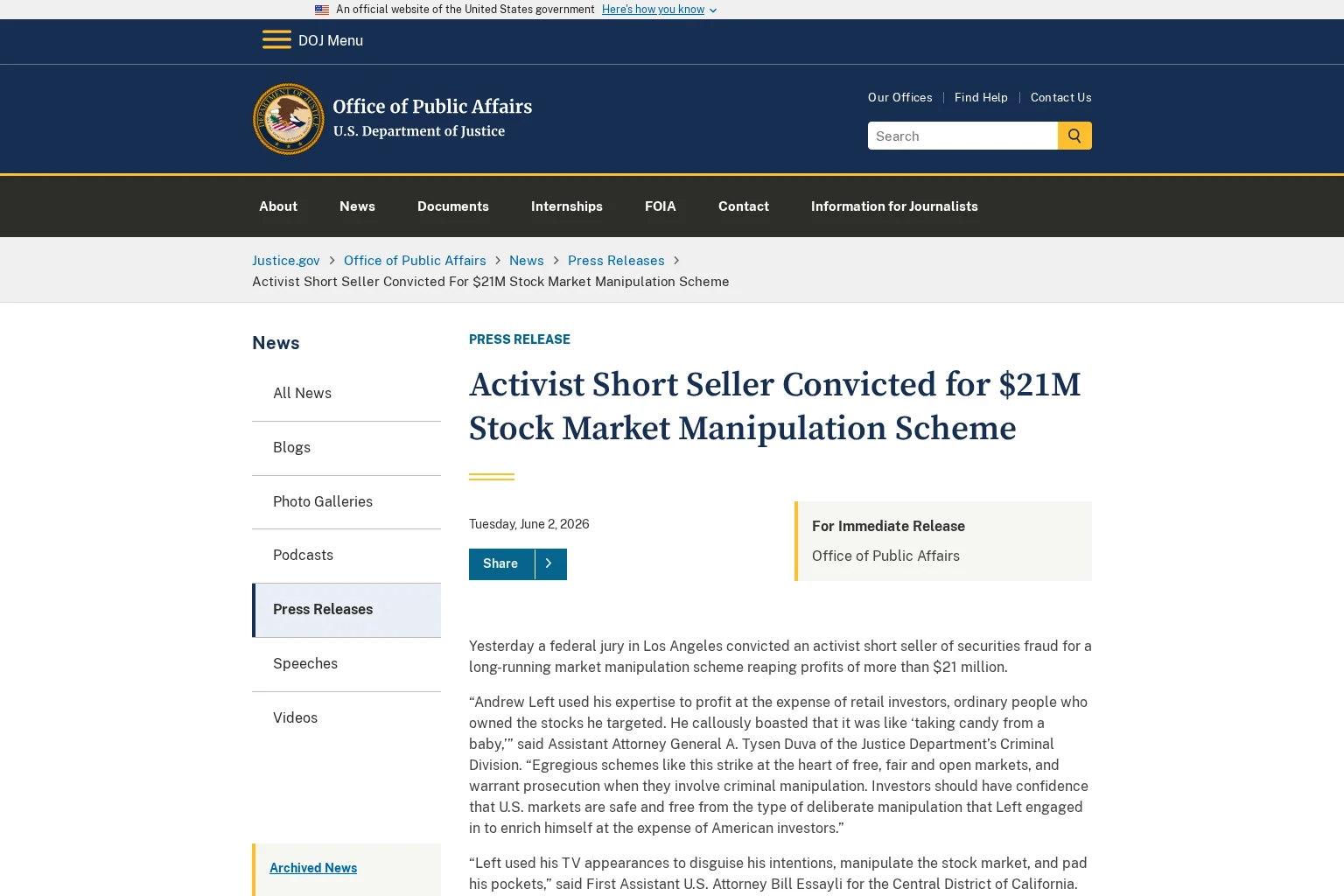
A Los Angeles federal jury found Andrew Left guilty in June 2026. The Justice Department announcement identifies a securities fraud scheme count and 12 substantive securities fraud counts.
Left published market commentary through Citron Research. Prosecutors said he used misleading public statements and the price reactions they could provoke to profit from his own positions.
The Justice Department put profits from the scheme at more than $21 million. That is the government’s figure for the scheme’s proceeds, not a verified loss for any particular reader.
The Guardian’s account reported the verdict and a Citron Research statement disputing it. The article here concerns the verdict and the practice proved at trial, not every Citron report.
A real trade can still be influenced by fraud
You can trade a listed security through your normal brokerage and still be reacting to misleading information. A fake exchange or a request for a deposit is not required.
Prosecutors described public calls in both directions. What mattered was the gap between the impression the commentary gave to readers and the promoter’s plans for trading around it.
That does not mean bearish research is illegitimate. Critical analysts can uncover useful facts, and traders may legitimately hold positions that benefit when a stock falls.
A trader who changes their mind has not automatically committed a crime. The jury evaluated the specific statements and evidence presented in this federal prosecution.
The records that answer different questions
A clip might show a strong recommendation but leave out qualifications. A brokerage statement shows what you did, not what the person who published the recommendation did.
- The original recommendation and its date show what readers could see when they decided to trade.
- A position or conflict disclosure can clarify what the publisher stood to gain, without proving how long that position was held.
- The issuer’s filings can verify concrete business claims independently of the opinion and the trading activity it attracted.
- A broker’s execution confirmation documents your actual fill price, order details, and fees, rather than the price shown in a post.
- A dated official case update can clarify the criminal proceeding. It cannot decide by itself whether your own trades are covered.
How the Citron Research Securities Fraud Worked
Step 1: A market commentator built a following people listened to
Citron Research had a recognizable name, and Left appeared in financial media. Readers did not have to be members of a private group to encounter his opinions.
That public reputation helped the commentary draw attention. Popularity, however, does not show whether a recommendation rests on a reliable finding or what the commentator stands to gain.
The same principle applies when a tip comes from someone whose earlier calls seemed right. An earlier outcome is not independent evidence for the next claim.
Step 2: The public call told readers how to interpret the stock
A call can make the argument sound simple. The stock is supposedly too high or too low, and the reader is invited to act before the wider market catches on.
According to prosecutors, Left used false and misleading social posts and reports about publicly traded businesses. The deception was not just that some forecasts could turn out to be wrong.
Read the words that explain why a stock should move. A checkable statement about an issuer and an opinion about valuation are different things and need different evidence.
If the actionable conclusion is easier to find than the factual basis, wait. A call that must be acted on before it can be read is not useful research.
Step 3: The publisher’s interests and the public message diverged
The Justice Department described positions Left established before releasing commentary. It said he was prepared to exit them quickly after the market reacted, despite the public impression his calls created.
Your time horizon can differ from the publisher’s. You may still be holding the stock based on a long-term argument after its author has sold.
You don’t need access to the publisher’s account. You can decide whether any reason to trade survives once you remove claims that only the promoter can support.
A vague statement that the author might own shares does not explain the author’s incentives. Look for the actual disclosure and note anything it leaves unclear.
Step 4: The first price move could reinforce the impression
A quick reaction can feel like an independent verdict from the market. It may simply show that many people read and acted on the same post.
A chart cannot show why individual orders were placed. Use price movement to put events in order, not to prove a commentator’s claim about a business.
If you screenshot a recommendation, save its timestamp and the original link. The trading session, timezone, and subsequent edits can matter when you compare it with an account statement.
The conviction concerned what the evidence showed about this specific conduct. Price swings, short interest, or an unpopular opinion are not enough to label someone else a manipulator.
How to Check a Stock Tip Before Trading
Verify the ticker, date, and claim before entering the order
Start with the exact ticker and issuer named in the message. A screenshot of a gain from one company is not evidence about a different security with a similar symbol.
Open the SEC’s company filing search yourself. Enter the company name or ticker, match the issuer, and open the dated filing that should contain the claim.
A quarterly report may explain reported results. An announcement referenced in a tip might instead appear in a current report or on the issuer’s verified investor relations page.
Read the applicable passage and compare periods, units, and timestamps. If the claim changes from revenue to profit or from company results to one subsidiary, treat the difference as material.
If no filing supports the claim, don’t fill the gap with more posts from the same account. Wait for a source independent of the original recommendation.
Check a person’s claimed role separately
If someone claims to be a registered broker or securities professional, open FINRA BrokerCheck yourself and search the person’s name or registration number.
Confirm the firm and current details rather than just the name. Use the firm’s separately verified contact if you need to establish that a message or service came from it.
Not everyone who publishes commentary needs the same registration. A missing listing does not settle that issue, and a matching listing does not validate someone’s trade thesis.
Decide what a shortfall in evidence means
Ask what you would do if the recommendation disappeared. If all you have left is a price move and other people’s reactions, leave the order alone.
Check whether you’ve already queued an order because the post felt urgent. In your brokerage, open the open-order list and check the actual status before assuming you can cancel it.
To cancel an open order, use the brokerage’s order control and wait for confirmation. If it already filled or the status is unclear, contact the broker.
If you only saw the recommendation through a repost, look for a dated original before acting. A screenshot may omit later corrections or the disclosure underneath.
When an issuer’s own announcement appears close to the post, keep both timestamps with their timezones. The order in which readers received the information can matter more than the chart.
What to Do If You Traded on a Misleading Stock Tip
Save the recommendation before its wording changes
Keep the original URL, date, displayed timezone, author, and any statements about a position or price target. If the post disappeared, retain any copy you already have.
Preserve the surrounding context separately from your notes. Don’t edit the screenshot to add facts that weren’t visible to you at the time.
If somebody sent you a screenshot rather than a link, record where you got it. Make clear that you cannot establish whether it matched the original post.
Pull the order and execution records from your broker
Open the broker’s genuine app or site and locate your order history. Save the confirmation for each trade, including order time, execution time, price, and ticker.
Compare the confirmation with your statement and identify partial fills or later orders. A chart price and a fill price can differ for ordinary reasons.
If a transaction appears that you did not authorize, flag that to the broker immediately. An unauthorized trade needs a separate response from one you chose to make.
Put the chronology in a form a reviewer can use
Write a short timeline showing when you saw the recommendation, what it claimed, what you traded, and when you found the discrepancy.
Keep published statements separate from your interpretation of them. Attach a source for each claim you can independently confirm, without stating facts about someone else’s account.
Do not forward an entire account history when a narrower, securely submitted record will do. Ask the recipient if it needs more before sending further documents.
Submit a suspected securities manipulation tip to the SEC
Use the SEC’s official tip instructions and open the submission form from there. Choose the issue that best matches your facts.
Identify the person or business and the investment involved. Add dates and your description, provide contact details as appropriate, and upload relevant supporting records.
Review the completed entry, submit it, and save any confirmation number. If you cannot find it afterward, use the SEC’s official tip contact guidance before resubmitting.
A tip helps regulators assess conduct; it does not automatically create a private claim or entitle the sender to a refund.
Use the correct route for an existing criminal case
Open the Justice Department’s Andrew Left case page, match the defendant, and check the update relevant to your question.
Ask the listed Victim Witness Unit whether your situation falls within the case and which information it requests. Do not assume buying any stock Left discussed makes you eligible.
Preserve any response and its date. An old hearing calendar, a headline about profits, or a stranger’s promise does not establish a payment process.
Don’t buy a promised recovery from an unsolicited caller
Do not send a tax, processing fee, or brokerage login to someone promising compensation for a manipulated stock. Verify any claim through the named agency directly.
If you already sent money or shared broker access, contact the financial provider through its normal customer route. Report that separate event and keep both cases in your timeline.
Frequently Asked Questions
Was every stock mentioned by Citron Research part of the conviction?
The verdict concerned particular securities fraud counts and an overall scheme. It cannot establish that every published Citron opinion or every stock reference was fraudulent.
If you think a trade relates to the case, preserve the exact report and the order record. Ask the official case contact rather than guessing from the name.
Is short selling the same thing as securities fraud?
Short selling is a form of trading. The case concerned a deceptive course of conduct connected to public statements and the trader’s own positions.
An analyst can be bearish without lying. Evaluate the supporting facts, interests, and disclosures rather than assuming a negative view proves manipulation.
Does a price drop prove a short report is accurate?
A drop establishes the price movement, not the truth of a specific statement. Traders may react because others are reacting to the same report.
Find the issuer’s filings and use them to test factual claims. Separate what happened to the price from what happened at the business.
Can my broker reverse an order I placed myself?
Don’t assume an executed trade will be reversed because you saw a misleading tip. Ask your broker about your actual execution and the policies that apply.
If the order has not executed, check whether your brokerage lets you cancel it. Confirm the final status before making any second order.
Does the $21 million figure mean investors can claim that amount?
The figure is the Justice Department’s estimate of profits from the scheme. It isn’t a confirmed collection balance or a promise of payment for each trader.
Use the official case page for any process that applies to you. Do not pay anyone offering to convert the headline number into an individual refund.
Should I report a suspicious tip without knowing the poster’s trades?
You can tell a regulator what you actually observed. Keep the distinction between a misleading statement you can document and a trading motive you cannot see.
Include dates, links, and records when you can. Let investigators determine what other evidence is needed rather than making a public accusation.
The Bottom Line
Don’t enter a stock order because a commentator’s post moved the price. Verify the company’s facts independently and make sure the trade makes sense without the post.
If you already traded, keep the original call and the broker’s execution record. If you suspect manipulation, use the SEC tip route and verify case claims with the Justice Department.

Join the discussion
0 commentsShare your experience or ask a question about this article.
Community experiences
Did this happen to you?
Your experience could help someone recognize the same scam. Submit a private report for our team to review.
I experienced this tooReports are reviewed before publication. Sharing publicly is always your choice.
Discussion
Start the conversation
Have a question or something useful to share? Add the first comment.