

A stainless steel grill for the cost of lunch is the sort of offer that makes people pause. The email looks familiar, the reward feels plausible, and the requested payment seems too small to justify a long investigation.
That small fee is exactly what makes this campaign dangerous. The Costco gas grill giveaway scam is not really about delivering an expensive grill. It is a carefully staged path from a fake loyalty survey to recurring charges hidden where most shoppers will never look.
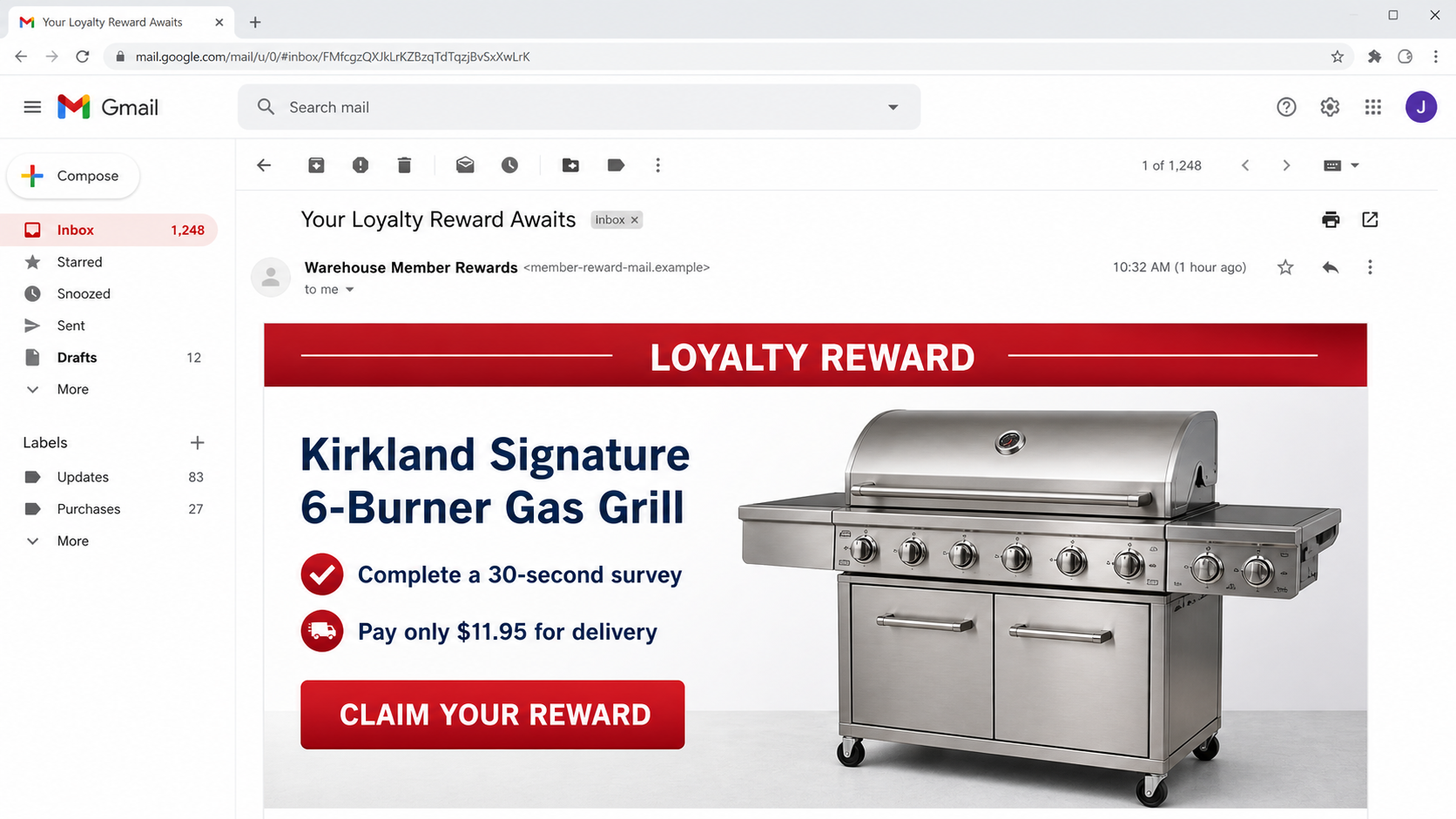
The message is designed to resemble a warehouse membership reward. It presents a Kirkland Signature six-burner gas grill, asks the recipient to complete a short survey, and says the only cost is $11.95 for delivery.
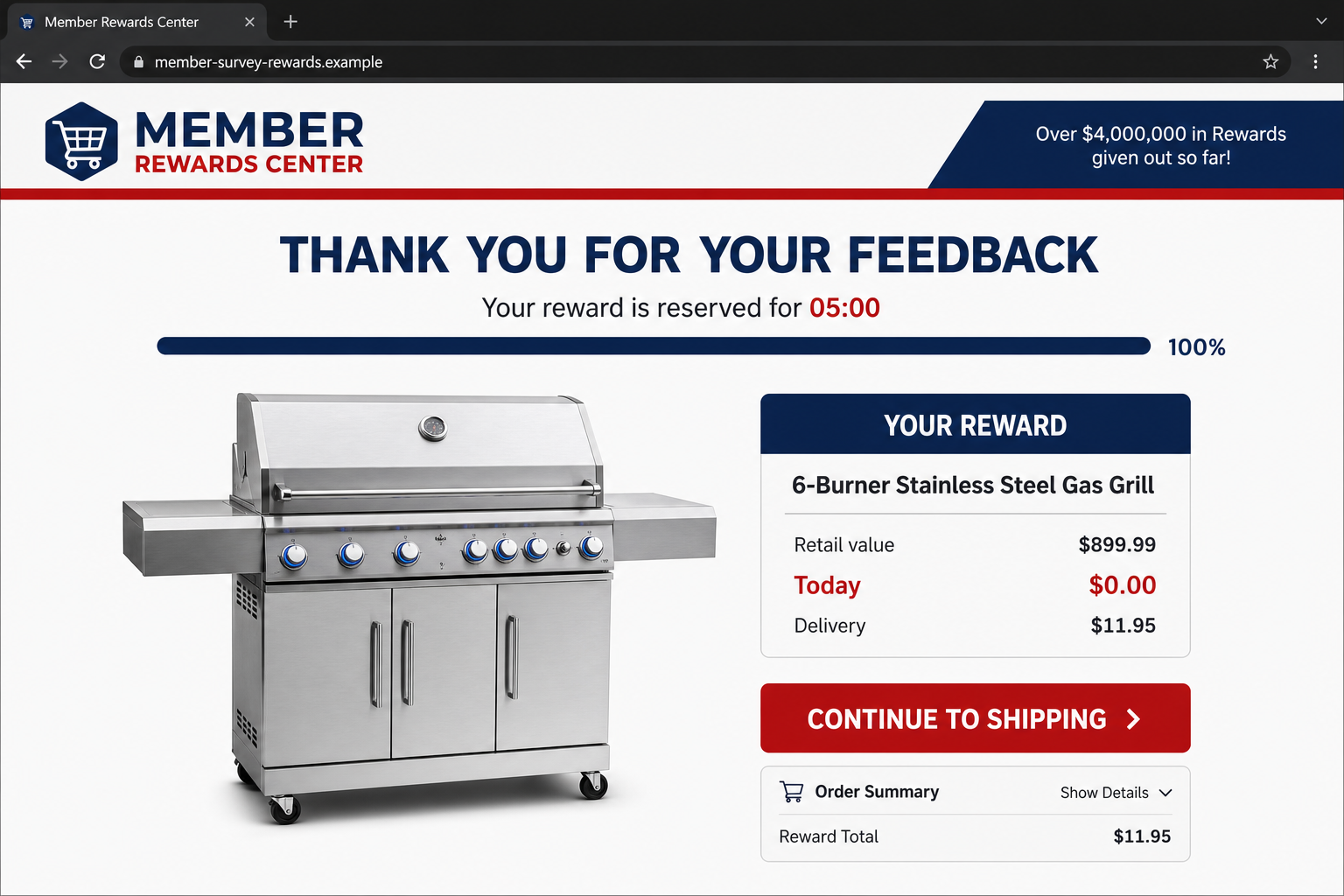
After the survey, the visitor sees a congratulatory page with a countdown and a dramatic retail-value comparison. The grill appears to cost $0, while the delivery fee remains small enough to feel harmless. The timer discourages the careful reading that would expose the real offer.
The images above illustrate the reported campaign because the disposable email and checkout pages no longer remain reliably available. They reproduce the sales path without copying a live inbox, account information, or a scammer-controlled payment form.
Overview
The email is not an official Costco promotion
Costco warns that fraudulent emails, surveys, websites, social posts, and advertisements frequently misuse its name. Official guidance tells shoppers not to visit links in suspicious offers and notes that ordinary Costco email comes from a costco.com domain, with a limited exception for digital Shop Cards.
The grill campaign moved recipients through unrelated domains, including appointment.de.com, axletreepleasingness.shop, and fastmarketzonefresh.com. None is an official Costco shopping domain. A familiar product photo cannot turn an unrelated web address into an authorized promotion.
The $11.95 charge is only the visible part
The reward page emphasizes an $11.95 delivery payment. Buried terms reportedly authorize two separate monthly charges of $73.54 and $76.33. Together, they total $149.87 every month until canceled.
That is not a minor difference in presentation. A shopper who thinks they approved a one-time shipping fee may instead expose a card to nearly $150 in monthly billing. The expensive grill works as bait while the recurring programs create the revenue.
The real grill does not make the giveaway real
Costco has sold a genuine Kirkland Signature stainless steel six-burner gas grill with 63,000 BTUs and 737 square inches of cooking space. Scammers often choose a real, desirable product because shoppers can find authentic photos and listings elsewhere.
The existence of that product proves only that the picture was easy to borrow. It does not connect Costco to a survey hosted on disposable domains, and it does not explain why an outside site would give away a large grill for $11.95.
- The email and survey are not hosted on official Costco domains.
- The promised reward is a real Costco product used without authorization.
- The visible payment is presented as an $11.95 delivery fee.
- Hidden terms reportedly add charges of $73.54 and $76.33 each month.
- The two recurring charges total $149.87 per month.
- A five-minute countdown pushes visitors toward an impulsive checkout.
- The funnel uses rotating domains that can disappear after complaints begin.
- Receiving a cheap item would not make the subscription disclosure acceptable.
Why the Free Grill Story Feels Believable
Membership retailers do send surveys, seasonal promotions, and account messages. That background gives the email just enough plausibility. A recipient may remember a recent warehouse visit and assume the reward is connected to their membership history.
The campaign also selects a product people recognize but do not buy casually. A large stainless steel grill feels like a meaningful loyalty prize. Its high retail value makes the $11.95 payment look like a negligible delivery requirement rather than a purchase decision.
The survey creates a sense of participation. Answering a few harmless questions about shopping preferences makes the reward feel earned. Each click is a small commitment, and by the time the card form appears, leaving can feel like wasting the effort already invested.
A countdown adds manufactured scarcity. It implies that the grill has been reserved for only five minutes, even though the page can restart the timer for every new visitor. The pressure is psychological, not logistical.
The final deception is hidden in the contrast between large and small text. The words free, reward, and $11.95 dominate the page. Recurring prices, billing frequency, cancellation details, and the identities of the membership programs are placed in terms that few people open.
A legitimate negative-option subscription must be clearly disclosed. The FTC describes problems that arise when businesses keep billing consumers without making the ongoing obligation clear or make cancellation difficult. A disclosure should not require detective work after the card has already been entered.
What Our Costco Grill Scam Investigation Found
The reported email claimed that the recipient had been selected to receive a Kirkland Signature six-burner gas grill after completing a short questionnaire. Costco did not send the message and did not authorize the outside domains used in the funnel.
Clicks were redirected through appointment.de.com before reaching axletreepleasingness.shop and fastmarketzonefresh.com. A chain of unrelated domains can help affiliates track traffic, replace dead pages, and distance the original email from the final billing operator.
The survey used simple questions and a reward-game presentation. These steps collect engagement rather than meaningful eligibility information. Every visitor is led toward the same paid outcome, which is a strong sign that the survey is theater.
The checkout framed $11.95 as the amount due. The buried conditions reportedly authorized $73.54 and $76.33 monthly charges, creating a combined recurring cost of $149.87. Those amounts are the central fact a reasonable shopper would need before paying.
The campaign displayed 888-681-3576 in connection with support or card-statement billing. A toll-free number does not establish who operates the offer, where the company is registered, or whether a trained agent will cancel both programs.
No stable legal company, headquarters, fulfillment address, or responsible merchant was clearly tied to the public-facing promotion. The changing domains and fragmented billing labels make it harder for victims to identify the correct party after a charge appears.
The real Costco product listing shows why the bargain is implausible. A heavy full-size grill requires costly inventory, freight, and delivery. A stranger on an unrelated domain cannot economically send it nationwide for $11.95 while giving every survey participant the same result.
It is possible for low-cost trial funnels to send a small item or unrelated merchandise. Delivery does not prove the original representation was honest. The key questions are what the shopper knowingly authorized, what arrived, and whether recurring billing was presented prominently before payment.
How the Costco Gas Grill Giveaway Scam Works
Step 1: A fake Costco reward email reaches the inbox
The subject promises an exclusive loyalty reward, customer appreciation gift, or survey opportunity. Familiar colors and a recognizable grill photo encourage the recipient to react to the brand before checking the sender.
The sender address is not an ordinary costco.com address. Buttons may hide a completely different destination when the pointer hovers over them. On a phone, that mismatch is easier to miss because the full link is rarely visible.
Step 2: Redirects hide the real destination
The button passes through tracking and appointment-style domains before reaching the reward page. This lets the operator count clicks and replace the final destination without resending the email.
Each redirect also complicates reporting. A victim may remember the brand name but not the exact domains, while the operator can abandon one address and continue the same campaign on another.
Step 3: A survey makes the reward feel earned
The page asks a handful of questions about shopping frequency, product satisfaction, or household preferences. The answers do not determine eligibility. Their purpose is to keep the visitor clicking and make the offer feel personalized.
A box-selection game or congratulatory animation follows. The visitor wins because the funnel needs every qualified cardholder to continue. A genuine limited drawing would not award the same expensive item to essentially everyone.
Step 4: The page creates urgency with a reservation timer
A five-minute countdown says the grill will be released to another member. Stock messages and recent-winner notices may appear nearby, creating the impression that other shoppers are claiming the remaining units.
Reloading or revisiting these pages often restarts the urgency. Even when the timer behaves differently, there is no evidence that an actual grill has been assigned to the visitor or removed from real inventory.
Step 5: The checkout asks for only $11.95
The card form emphasizes shipping rather than purchase. Because $11.95 is small, the visitor may decide the risk is limited and may not examine the merchant name or expandable terms.
The form also collects the victim’s name, address, phone number, email, and payment details. That information can support billing, further marketing, or later impersonation attempts even if no meaningful reward arrives.
Step 6: Hidden terms authorize two monthly programs
The reported conditions attach charges of $73.54 and $76.33 to the transaction. These are not taxes or freight for the grill. They function as recurring membership or service fees that continue until cancellation.
Two billing streams create additional friction. Canceling one may not stop the other, and the names shown on a card statement may bear little resemblance to Costco, the grill, or the domain where the card was entered.
Step 7: Cancellation becomes a maze
Victims must identify both descriptors, find working contact information, reach support, request cancellation, and argue for refunds. The original reward site may already be offline by the time the first larger charge appears.
If support stalls, offers only a partial refund, or says the terms were accepted, the victim may have to document the entire funnel for a card dispute. That is why screenshots taken before payment are so valuable.
Company, Address, and Fulfillment Checks
The identity trail is deliberately weak
The promotion borrows Costco’s reputation but does not present Costco as the actual merchant at checkout. The rotating domains do not provide a clear legal entity that can be checked against a state business registry or matched to a card descriptor.
A legitimate promotion should identify who accepts payment, who supplies the reward, and who operates each subscription. If those answers appear only after a charge, the consumer never received a fair opportunity to evaluate the deal.
The web addresses are disposable, not business locations
Domains such as axletreepleasingness.shop and fastmarketzonefresh.com do not correspond to a recognized retailer or an obvious reward administrator. They look designed for short campaigns rather than long-term customer service.
A domain registration or shared hosting address is not a headquarters. Scammers can place many unrelated sites behind the same infrastructure, abandon them quickly, and leave victims without a stable place to send complaints.
A toll-free number does not prove support exists
The number 888-681-3576 has appeared in the reported billing path, but a toll-free line can route to an outsourced call center anywhere. It does not prove that the caller reached Costco or even the company responsible for both charges.
Ask the agent to state the legal company name, both recurring plan names, cancellation confirmation numbers, refund amounts, and the date billing ends. Follow up in writing. If the line does not answer, go directly to the card issuer.
The fulfillment promise does not survive basic scrutiny
A full-size grill requires a warehouse, freight carrier, delivery appointment, and a seller willing to absorb $100s in product and shipping costs. The funnel identifies none of that operational chain.
A fulfillment center can mail a token item without being the retailer, manufacturer, or subscription operator. If anything arrives, preserve the label. It may reveal a returns warehouse, but it still may not identify the company that charged the card.
The Difference Between a Giveaway and a Subscription Trap
A genuine giveaway explains who is sponsoring it, who can enter, whether a purchase is necessary, how winners are selected, how many prizes exist, and when the promotion ends. It does not quietly turn a nominal delivery payment into two continuing memberships.
The grill campaign reverses that logic. The prize receives the largest text, while the bill receives the smallest. The survey produces no real contest rules, and the countdown pressures the visitor to pay before asking who is responsible.
The combined monthly total is especially important. A victim who notices one $73.54 charge might cancel it and believe the problem is resolved, only to see the separate $76.33 charge continue. Review at least several statements after cancellation.
Do not assume a bank will automatically recognize the merchant as fraudulent. A billing company may submit a transaction under a neutral descriptor and point to an acceptance box. Strong evidence shows that the dominant page promised an $11.95 delivery fee while recurring costs were obscured.
The safest verification method never begins with the email link. Open a new browser tab, type Costco’s official address yourself, sign in if needed, and check the retailer’s known-scam page or contact customer service through a verified number.
If an offer is real, leaving the email and approaching the retailer independently will not destroy it. If the offer exists only behind a tracking link, a countdown, and an unrelated checkout domain, walking away is the correct decision.
Warning Signs to Watch For
- An unsolicited email promises a high-value grill for a tiny fee.
- The sender and button links do not use costco.com.
- Several unrelated domains appear during one short checkout.
- Every visitor wins after answering generic survey questions.
- A countdown claims the reward will expire within minutes.
- The page emphasizes $11.95 while recurring terms are difficult to find.
- Two separate monthly prices appear in the fine print.
- The legal merchant and subscription operators are unclear.
- A toll-free support number is not tied to a transparent company.
- There are no credible official rules for the supposed giveaway.
An $11.95 shipping payment is not low risk when it opens the door to $149.87 in monthly charges. The less the page says about the company and the more it says about an expiring free grill, the faster you should close it.
What to Do if You Have Fallen Victim to This Scam
- Lock or replace the payment card. Call the card issuer immediately, explain that the card was entered into a deceptive reward funnel, and ask whether the number should be locked or replaced. Do not wait for the first large charge if the checkout has just occurred.
- Dispute every unauthorized charge separately. Identify the $11.95 transaction and any $73.54 or $76.33 charges. Explain what you knowingly approved and provide the email, survey, checkout screenshots, terms, and confirmation. Each descriptor may require its own dispute.
- Cancel both recurring programs in writing. Contact any support channel shown on the receipt or statement and ask whether two plans are active. Request cancellation of both, refund decisions, and confirmation numbers by email. Do not rely on a verbal promise alone.
- Save the full evidence trail. Preserve the sender address, email headers, every redirect domain, screenshots, receipt, card statement, support messages, and any package label. Write down dates, agent names, and what each person promised.
- Protect the personal information you submitted. Expect follow-up spam or impersonation attempts if you provided a phone number, address, or email. Change any reused password, enable multifactor authentication, and watch for messages that reference the supposed reward.
- Report the campaign. Forward the phishing email to Costco through its official contact route and report the transaction to the FTC. Report the sender to the email provider and include the redirect domains so they can be investigated or blocked.
- Run Malwarebytes if the pages behaved suspiciously. If the link produced pop-ups, notification prompts, downloads, or unfamiliar extensions, run a complete Malwarebytes scan. Remove detections and revoke browser notification permissions from every unknown site.
- Use AdGuard to reduce repeat lures. AdGuard can block many malicious ad networks, tracking links, pop-ups, and cloned reward pages. It cannot reverse a card charge, but it can reduce exposure to the next version of the same campaign.
Frequently Asked Questions
Is Costco giving away a six-burner gas grill for $11.95?
No evidence connects this email funnel to an authorized Costco promotion. The links use unrelated domains, and Costco warns that fake surveys and rewards commonly misuse its name.
Why does the ad use a real Kirkland Signature grill?
A real product makes the bait easier to recognize and research. Scammers can copy authentic photos and specifications without owning the merchandise or having any relationship with the retailer.
How much can the Costco grill scam charge?
The reported checkout shows $11.95 prominently while hidden terms authorize monthly charges of $73.54 and $76.33. The recurring total is $149.87 per month.
Will I actually receive a grill?
A full-size grill is economically implausible at that price, and the funnel does not show a credible fulfillment chain. Some trial schemes mail a cheap item, but delivery would not validate hidden subscription billing.
How can I tell whether a Costco email is real?
Check the complete sender and hover over links. Open Costco independently rather than clicking. Ordinary official mail should use Costco-controlled domains, and suspicious promotions can be checked against Costco’s known-scam guidance.
Can my bank stop the monthly charges?
Contact the issuer promptly. Ask it to block future charges, replace the card if appropriate, and dispute transactions you did not knowingly authorize. Provide proof that the page emphasized a one-time $11.95 fee.
The Bottom Line
The Costco gas grill giveaway scam works because the reward is vivid and the initial payment is small. Behind that simple story is a chain of unofficial domains and reported terms that can convert $11.95 into $149.87 of recurring charges every month.
Costco’s name, a genuine Kirkland product photo, and a polished survey do not establish authorization. Verify every promotion by visiting the retailer directly, and never let a countdown decide whether an unknown company receives your card details.
If you already paid, act before the next billing cycle. Cancel both possible programs, contact the issuer, preserve the evidence, and monitor the replacement card and future statements closely.








